
From Baeyer Strain Theory to the Golden Section
From Baeyer Strain Theory to the Golden Section Adolph von Baeyer (1835 - 1917)
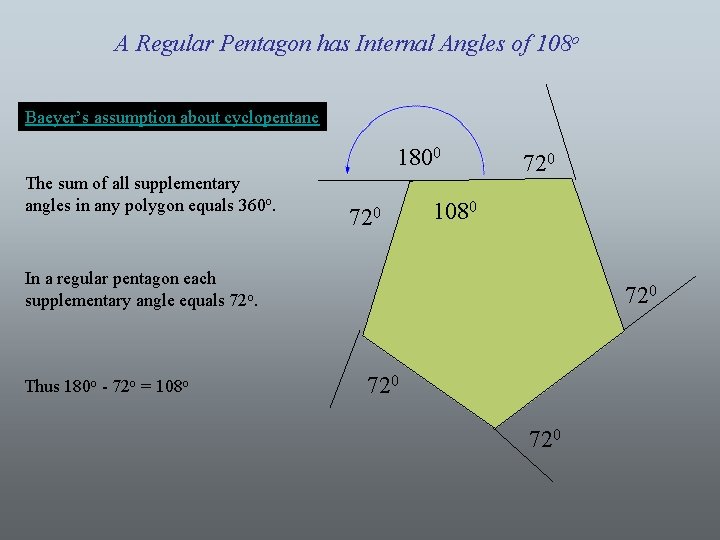
A Regular Pentagon has Internal Angles of 108 o Baeyer’s assumption about cyclopentane 1800 The sum of all supplementary angles in any polygon equals 360 o. 720 1080 In a regular pentagon each supplementary angle equals 72 o. Thus 180 o - 72 o = 108 o 720 720
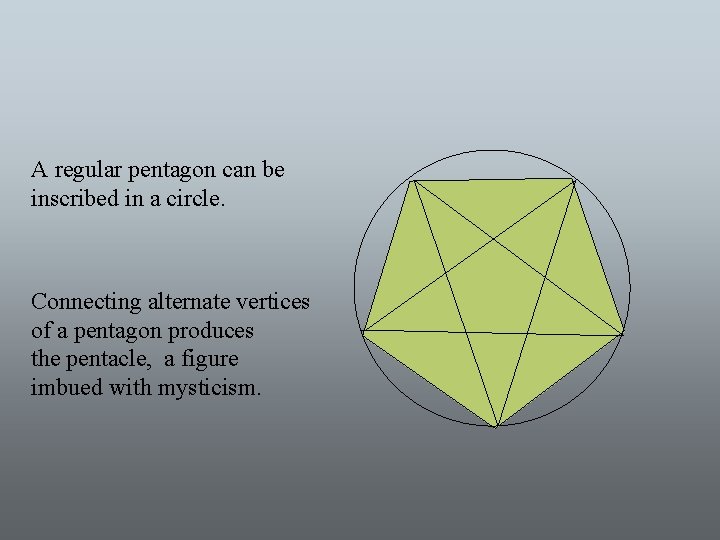
A regular pentagon can be inscribed in a circle. Connecting alternate vertices of a pentagon produces the pentacle, a figure imbued with mysticism.
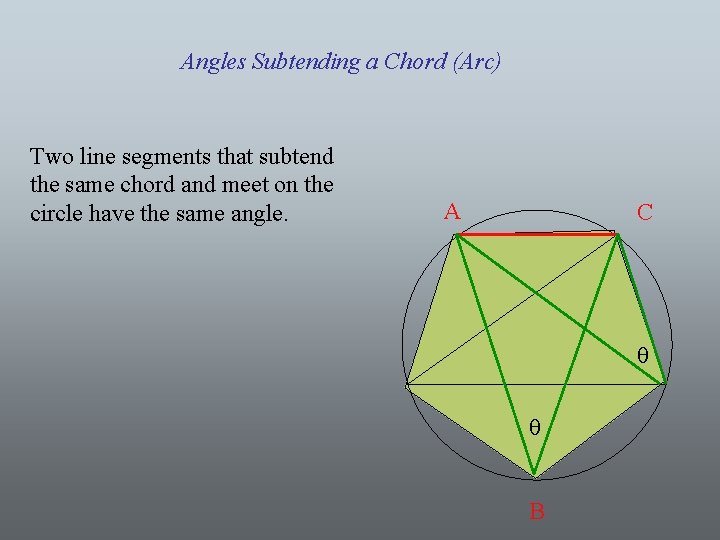
Angles Subtending a Chord (Arc) Two line segments that subtend the same chord and meet on the circle have the same angle. A C q q B
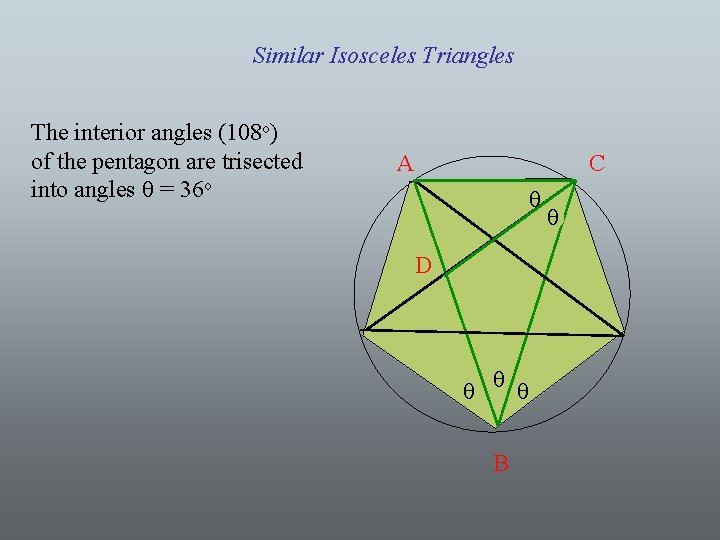
Similar Isosceles Triangles The interior angles (108 o) of the pentagon are trisected into angles q = 36 o A C q D q q B q q
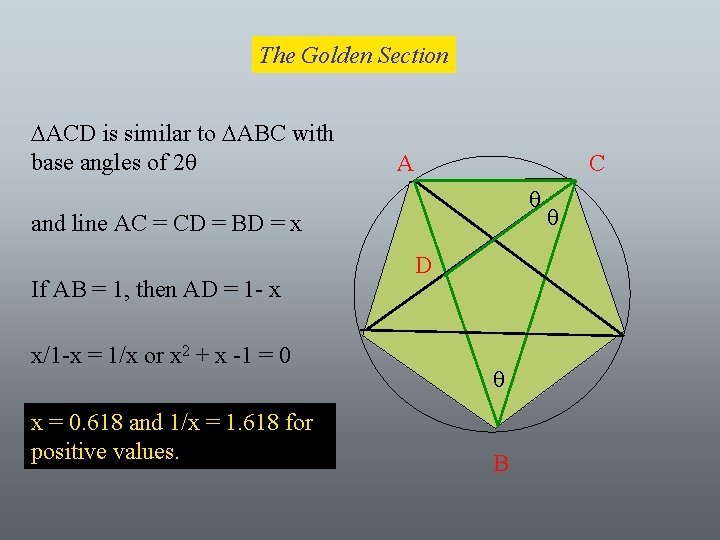
The Golden Section DACD is similar to DABC with base angles of 2 q A C q and line AC = CD = BD = x If AB = 1, then AD = 1 - x x/1 -x = 1/x or x 2 + x -1 = 0 x = 0. 618 and 1/x = 1. 618 for positive values. D q B q
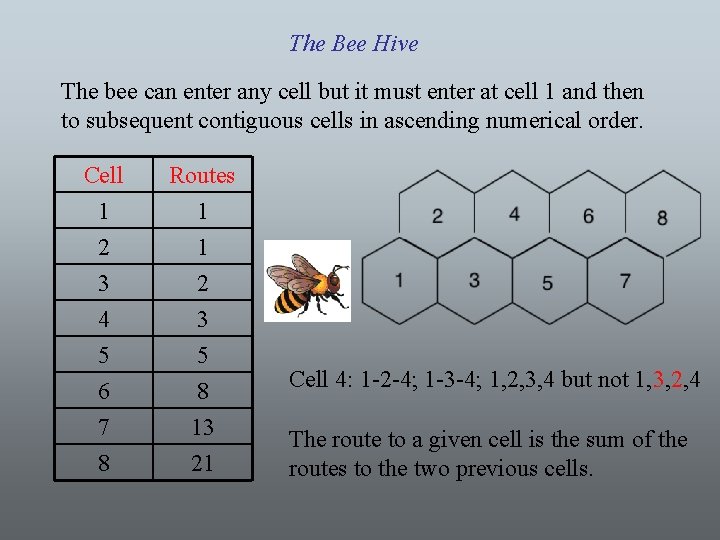
The Bee Hive The bee can enter any cell but it must enter at cell 1 and then to subsequent contiguous cells in ascending numerical order. Cell 1 2 3 Routes 1 1 2 4 5 6 7 8 3 5 8 13 21 Cell 4: 1 -2 -4; 1 -3 -4; 1, 2, 3, 4 but not 1, 3, 2, 4 The route to a given cell is the sum of the routes to the two previous cells.
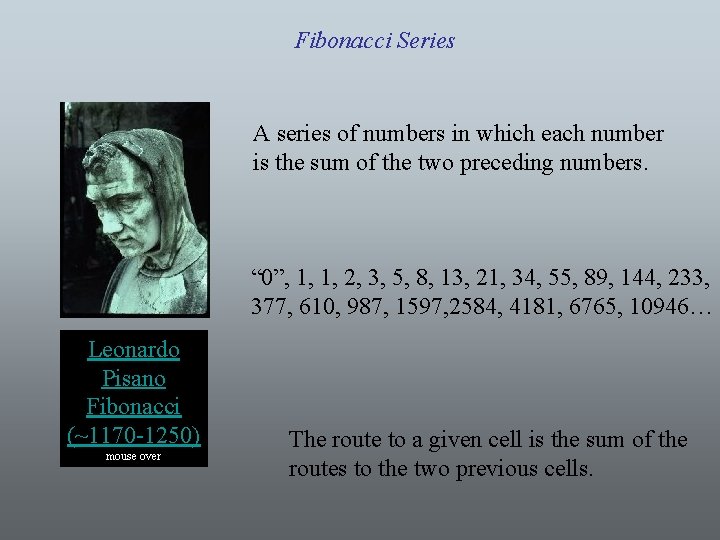
Fibonacci Series A series of numbers in which each number is the sum of the two preceding numbers. “ 0”, 1, 1, 2, 3, 5, 8, 13, 21, 34, 55, 89, 144, 233, 377, 610, 987, 1597, 2584, 4181, 6765, 10946… Leonardo Pisano Fibonacci (~1170 -1250) mouse over The route to a given cell is the sum of the routes to the two previous cells.
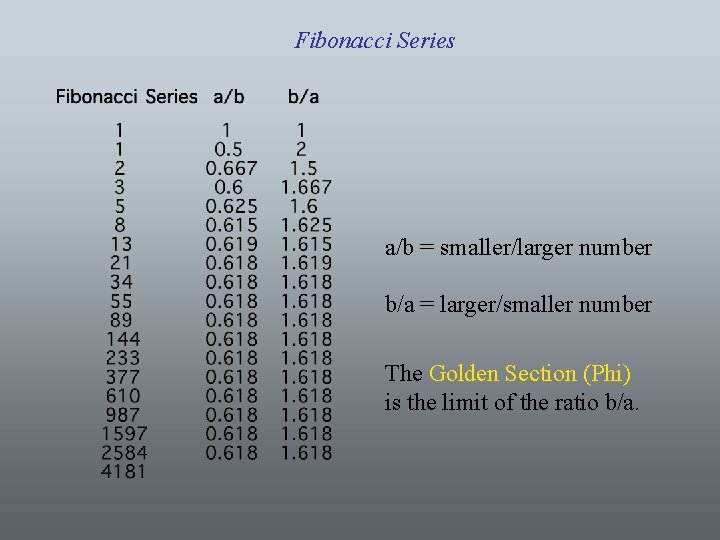
Fibonacci Series a/b = smaller/larger number b/a = larger/smaller number The Golden Section (Phi) is the limit of the ratio b/a.
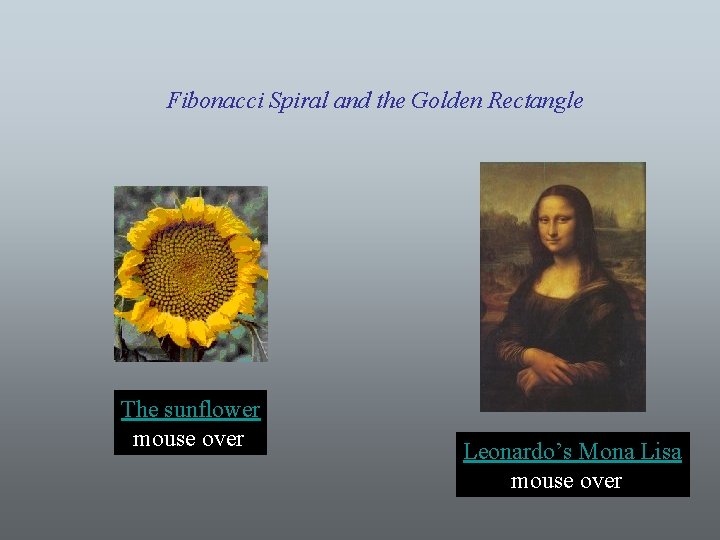
Fibonacci Spiral and the Golden Rectangle The sunflower mouse over Leonardo’s Mona Lisa mouse over
- Slides: 11