
From Allesandro Lenci Linguistic Ontologies Mikrokosmos Nirenburg Mahesh
From Allesandro Lenci
Linguistic Ontologies • Mikrokosmos (Nirenburg, Mahesh et al. ) • Generalized Upper Model (Bateman et al. ) • Word. Net (Miller, Fellbaum et al. ) – Euro. Word. Net (Vossen et al. ) • Sensus (Hovy, Knight, et al. ) • SIMPLE (Calzolari, Lenci et al. )
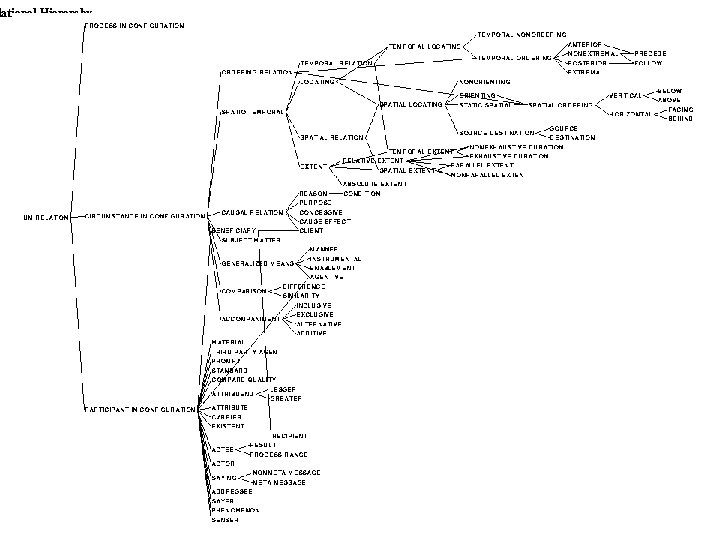
lational Hierarchy • The Relational Hierarchy •
Linguistic Ontologies design issues • Network based – hierarchy (taxonomy) • Word. Net – heterarchy • SIMPLE • Frame based – Mikrokosmos – Generative Lexicon
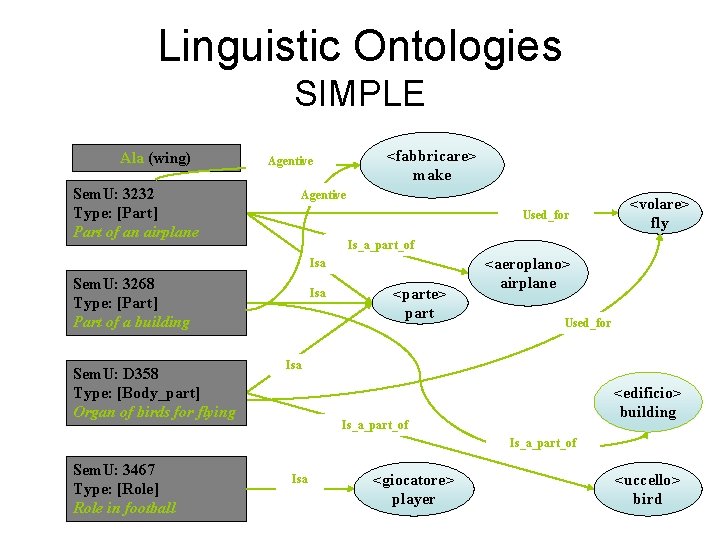
Linguistic Ontologies SIMPLE Ala (wing) Sem. U: 3232 Type: [Part] Part of an airplane <fabbricare> make Agentive Used_for Is_a_part_of Isa Sem. U: 3268 Type: [Part] Part of a building Sem. U: D 358 Type: [Body_part] Organ of birds for flying <volare> fly Isa <parte> part <aeroplano> airplane Used_for Isa <edificio> building Is_a_part_of Sem. U: 3467 Type: [Role] Role in football Isa <giocatore> player <uccello> bird
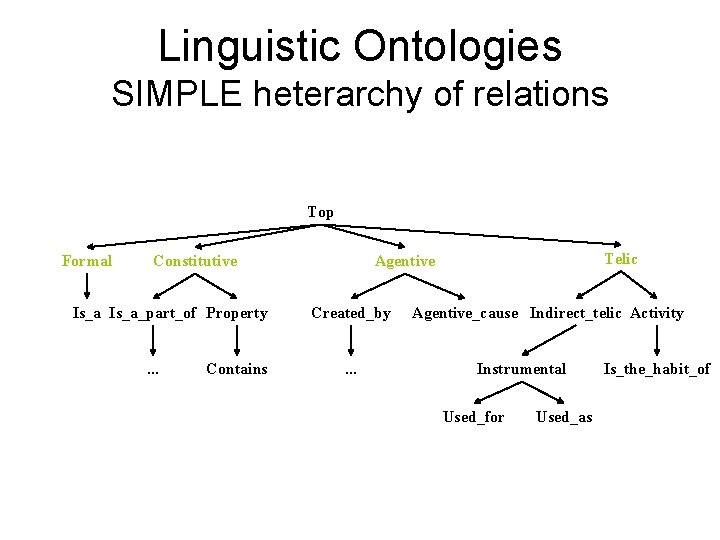
Linguistic Ontologies SIMPLE heterarchy of relations Top Formal Constitutive Is_a_part_of Property. . . Contains Telic Agentive Created_by. . . Agentive_cause Indirect_telic Activity Instrumental Used_for Used_as Is_the_habit_of
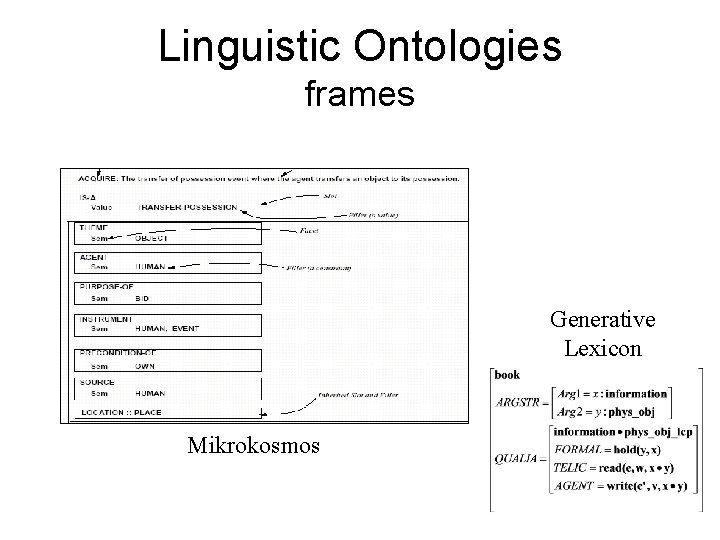
Linguistic Ontologies frames Generative Lexicon Mikrokosmos
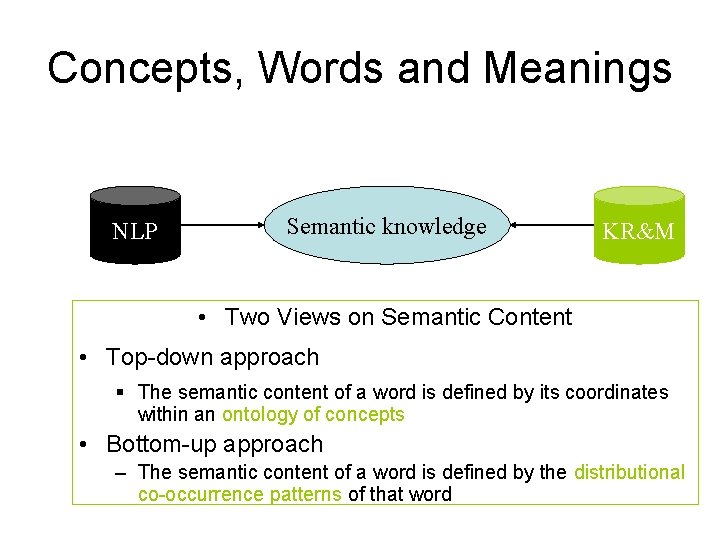
Concepts, Words and Meanings NLP Semantic knowledge KR&M • Two Views on Semantic Content • Top-down approach § The semantic content of a word is defined by its coordinates within an ontology of concepts • Bottom-up approach – The semantic content of a word is defined by the distributional co-occurrence patterns of that word
Concepts, Words and Meanings • Top-down view – Words express meanings corresponding to semantic types – Semantic types are defined by a symbolic system (ontology) of conceptual categories independent of (and yet linked to) the concrete uses of words in context – The actual instantiation of a meaning in context is a token of a given semantic type
The Top-Down View • Semantic type systems (ontologies) provide explicit, directly processable representations of word content – Discrete and symbolic view of lexical meaning – Support inferential mechanisms • Language independent representation (e. g. multilinguality, etc. ) • Complex concepts are explained by symbol syntactic combinations • Respond quite nicely to the language engineering demands for reusable semantic resources in machine readable form
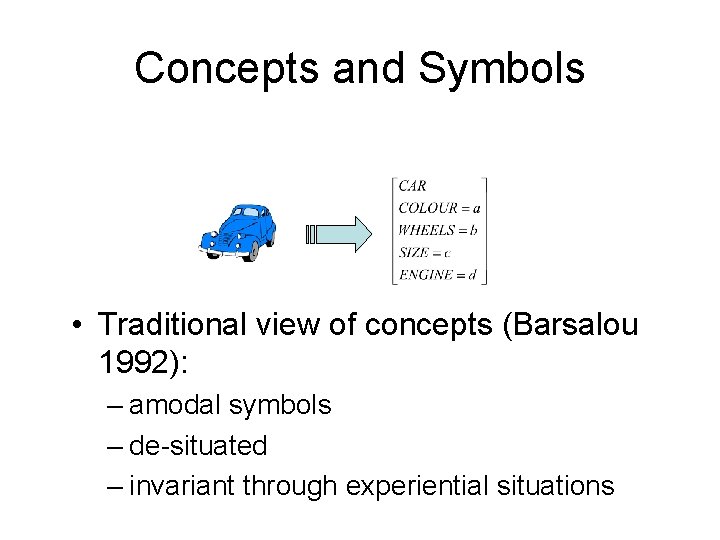
Concepts and Symbols • Traditional view of concepts (Barsalou 1992): – amodal symbols – de-situated – invariant through experiential situations
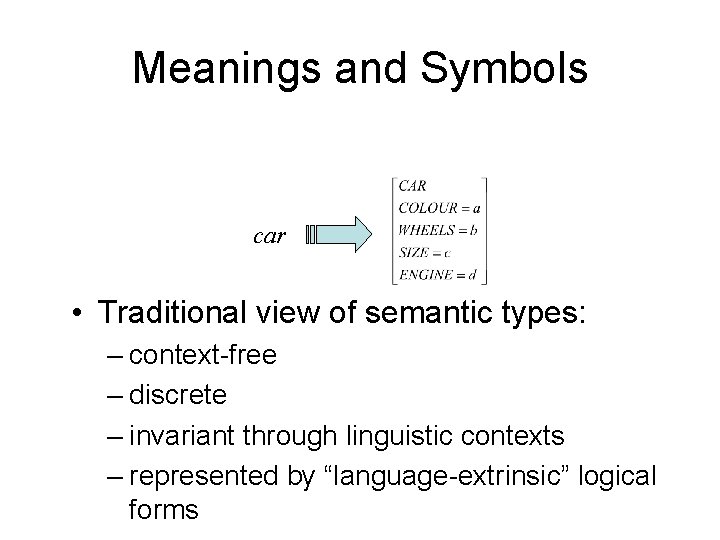
Meanings and Symbols car • Traditional view of semantic types: – context-free – discrete – invariant through linguistic contexts – represented by “language-extrinsic” logical forms
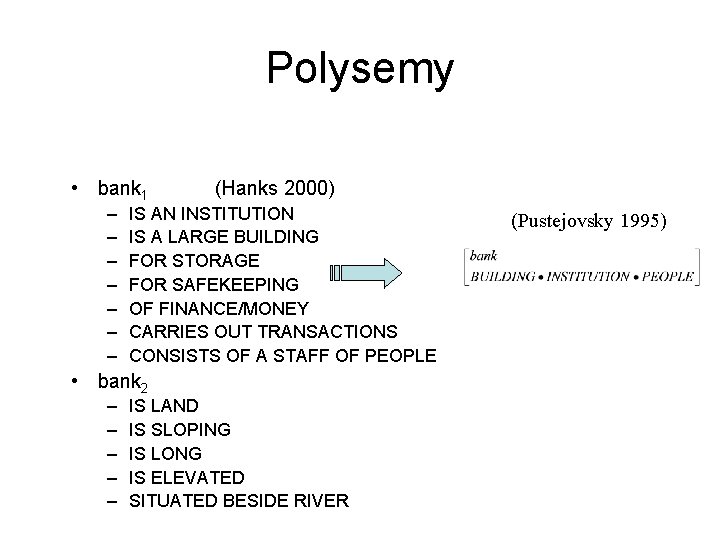
Polysemy • bank 1 – – – – (Hanks 2000) IS AN INSTITUTION IS A LARGE BUILDING FOR STORAGE FOR SAFEKEEPING OF FINANCE/MONEY CARRIES OUT TRANSACTIONS CONSISTS OF A STAFF OF PEOPLE • bank 2 – – – IS LAND IS SLOPING IS LONG IS ELEVATED SITUATED BESIDE RIVER (Pustejovsky 1995)
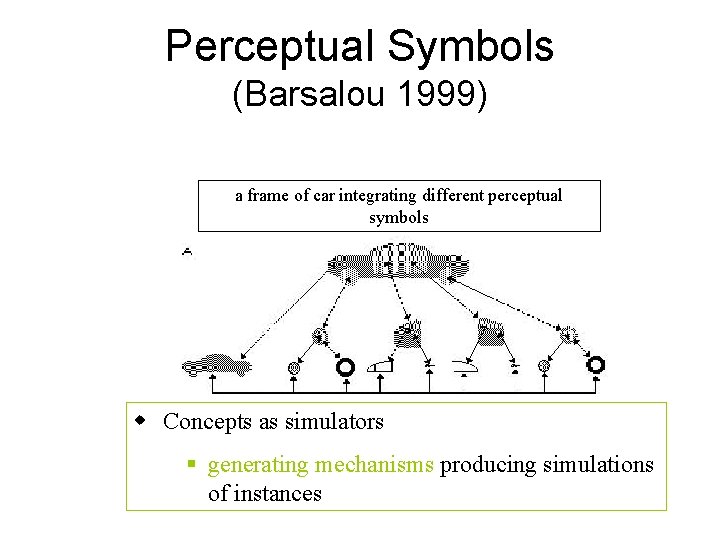
Perceptual Symbols (Barsalou 1999) a frame of car integrating different perceptual symbols w Concepts as simulators § generating mechanisms producing simulations of instances
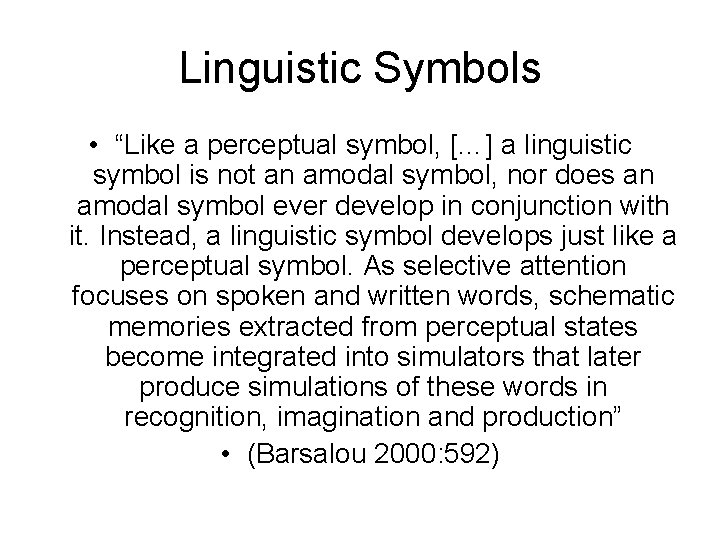
Linguistic Symbols • “Like a perceptual symbol, […] a linguistic symbol is not an amodal symbol, nor does an amodal symbol ever develop in conjunction with it. Instead, a linguistic symbol develops just like a perceptual symbol. As selective attention focuses on spoken and written words, schematic memories extracted from perceptual states become integrated into simulators that later produce simulations of these words in recognition, imagination and production” • (Barsalou 2000: 592)
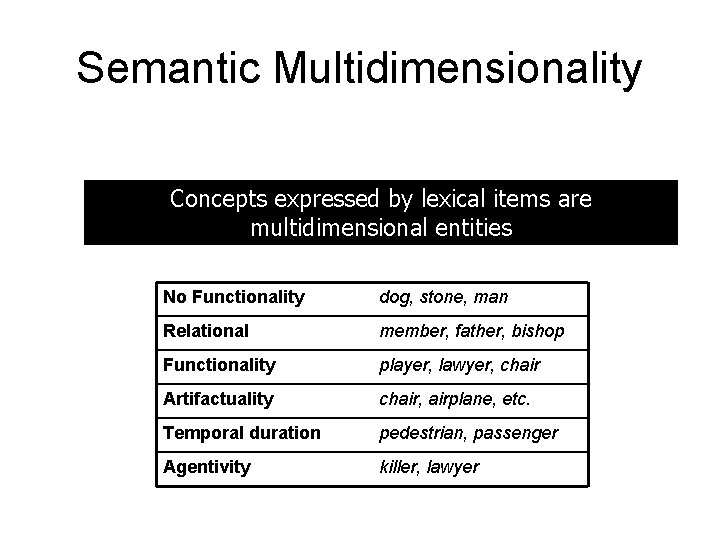
Semantic Multidimensionality Concepts expressed by lexical items are multidimensional entities No Functionality dog, stone, man Relational member, father, bishop Functionality player, lawyer, chair Artifactuality chair, airplane, etc. Temporal duration pedestrian, passenger Agentivity killer, lawyer
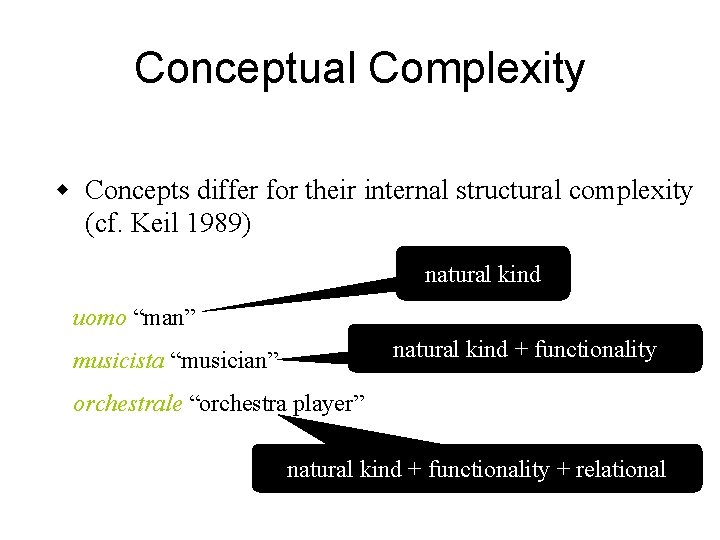
Conceptual Complexity w Concepts differ for their internal structural complexity (cf. Keil 1989) natural kind uomo “man” natural kind + functionality musicista “musician” orchestrale “orchestra player” natural kind + functionality + relational
Dimensions of Meaning • Concepts are systems of dimensions – words lexicalize the concept, its dimensions, the possible values of these dimensions • Ontology are system of concepts • Ontology Learning vs. Concept Learning
- Slides: 18