
Fritz Redl William W Wattenberg BY CINDY CASTRO

Fritz Redl & William W. Wattenberg BY CINDY CASTRO

Wilitz Team �Their first theory is group dynamics or “group life in the classroom”. Educators need to understand that an individual behavior affects group behavior, and vice versa. Within a group, they found that individuals assume roles, including leader, clown or entertainer, fall guy or blame taker, and instigator.

Wilitz Team � These two also identified that the members in the groups behavior is contagious such as making fun of the weak member. Another example would be reactions to strangers, which usually cause tensions throughout the group; teasing the teacher’s pet or showing a negative reaction to a student.

Wilitz Team �One other theory is reality appraisal. They maintained that students need to appraise reality in an effort to understand whether their actions are guided by intelligence and conscience or by fear or prejudice.
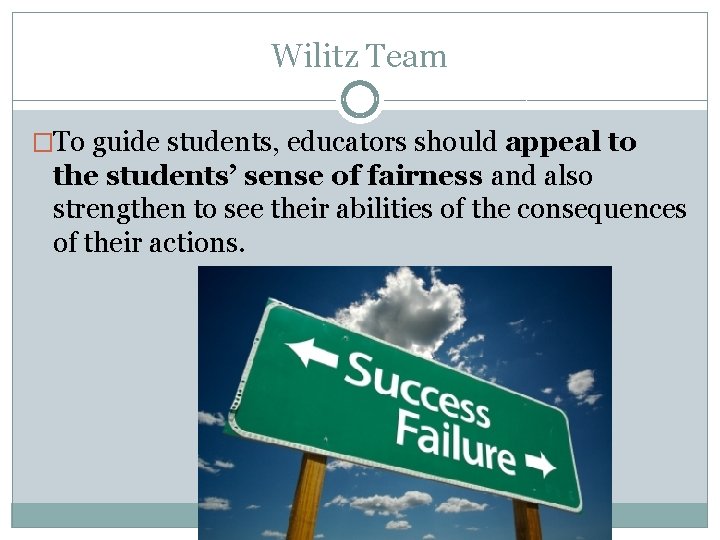
Wilitz Team �To guide students, educators should appeal to the students’ sense of fairness and also strengthen to see their abilities of the consequences of their actions.

Wilitz Team �They theorized that students want to behave but they lose control sometimes because sometimes they forget or feel strange about the rules, are bored, or are tired of sitting.

Wilitz Team �An influence technique of supporting self- control is and based on the belief that individuals control their own conduct and that much misbehavior results from a temporary lapse of an individual’s control system rather than from a motivation to be disagreeable.
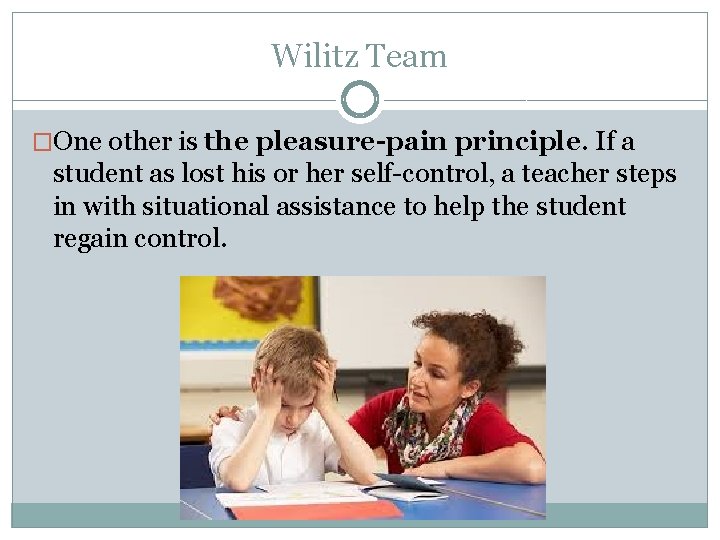
Wilitz Team �One other is the pleasure-pain principle. If a student as lost his or her self-control, a teacher steps in with situational assistance to help the student regain control.

Wilitz Team �When using the principle, the teacher deliberately provides experiences to produce pleasant to unpleasant feelings in hopes that the child will choose the pleasant feeling always.
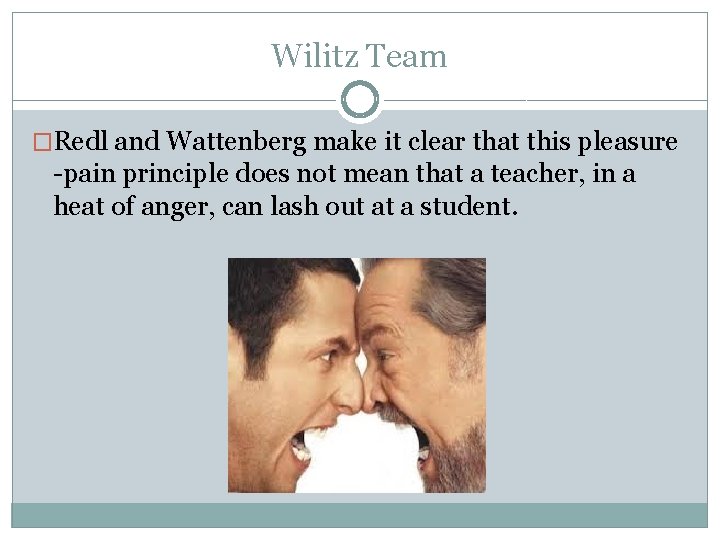
Wilitz Team �Redl and Wattenberg make it clear that this pleasure -pain principle does not mean that a teacher, in a heat of anger, can lash out at a student.
Wilitz Team �Redl and Wattenberg contributed to our understanding of the ways students function in as a member of groups within a classroom and the effect that group expectations have on individual group members. �Teachers should observe the groups within the classroom, as well as within the total classroom groups, in order to maintain functioning between the groups.

References �Manning, M. Lee. , and Katherine Toth Bucher. "Applications of Redl's and Wattenberg's Theories. " Classroom Management: Models, Applications, and Cases. 2 nd ed. Upper Saddle River, NJ: Merrill, 2003. N. pag. Print.
- Slides: 12