
FritoLay The Backhaul Decision NJIT 1 Background 27

Frito-Lay: The Backhaul Decision NJIT 1
Background 27, 000 employees and sales of $2. 053 billion in 1982 Frito-Lay has 35 plants – 1/3 full mix: entire product line – 1/3 core-mix: core product line – 1/3 no-mix: typically specialty products 2 Regional warehouse 24 traffic centers NJIT 2
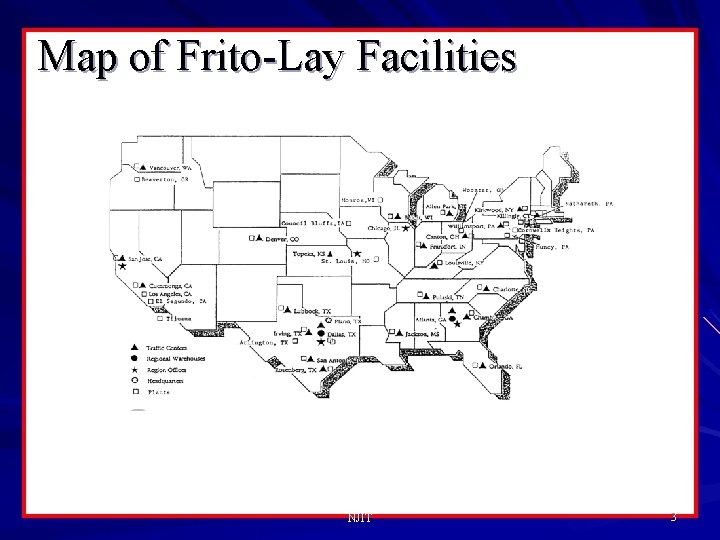
Map of Frito-Lay Facilities NJIT 3
Logistics: Background Prior to 1981, distribution activities were the responsibility of the manufacturing organization From 1978 to 1981, delivery cost per standard case had risen from 36 cents to 41 cents 4. 17% increase (historical range: 3. 5~4. 0%) The rise in stock keeping unit (SKU) and the decrease in slack capacity made operation more complex NJIT 4
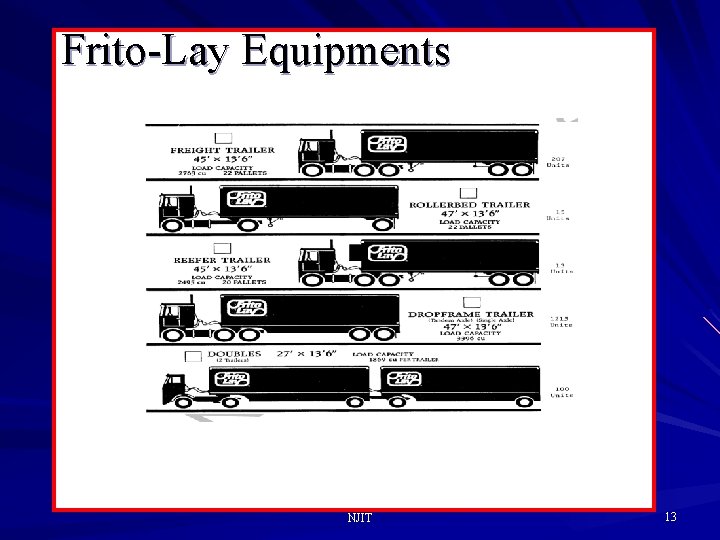
Logistics: Operation Own private fleet and third-party carriers – Third party carriers used on less service-sensitive shipments (e. g. , interplant and plant-to-regional warehouse deliveries) – Private fleet used for critical service (e. g. , to distribution centers and bins) Private fleet: – 69 million miles per year – 678 tractors & 1, 550 trailers operated by 900 drivers – 85% of trailers are: high-volume drop-frame and remainders are straight-frame & roller-bed trailers NJIT 5
Logistics: Operation (cont’d) The typical movement of truck was along a route from a plant or regional warehouse to a number of distribution centers and bins An average day, 600, 000 standard cases were hauled to 1, 800 distribution centers and bins Route had anywhere from 1 to 20 stops At each location, the driver would drop off that portion of the load destined for that particular location The driver also pick up empty cartons (called ‘KD’) for return to the plant NJIT 6
Logistics: Operation (cont’d) On average, a KD occupies 15% of the volume of a filled carton. Up to 25% of driver’s trailer might be filled on the return leg of a trip The majority of routes took less than one day to complete – In some metropolitan areas, a driver could cover as many as four routes in one day – Routes take more than 1 day Drivers lay over for a night (2/3) Driver team (1/3) NJIT 7
Logistics: Operation (cont’d) Routes were assigned to drivers through bidding system based on seniority Drivers: highly trained and highly skilled Driver turnover: less than 3% NJIT 8
Logistics: Traffic Center Private fleet operated out of 24 traffic centers and managed by a plant distribution manager (PDM) Each traffic center was responsible for routing its fleet and scheduling the transportation needs NJIT 9
The Backhaul Proposal Use empty trucks to carry goods for other companies for additional revenue Total of 69 MM run per year with 35 MM empty return miles, Kugler estimated that 20 MM will be available to fill on the backhaul truck. (Exclude route less than 100 miles) Two developments: The deregulation of the trucking industry and mandate from Frito-Lay management to halt the increasing delivery cost. NJIT 10
Implementation Plan The backhaul proposal would be gained operating authority from the ICC and state agencies. The traffic center’s PDM is responsible for marketing the backhaul services, their jobs include: – Optimize the existing outbound routes, – Determine which routes were available for backhaul – Rank backhaul routes by the number of miles, available (e. g. frequency x distance), – Make pricing decision for each route, – Identify suitable customers, – Sell the backhaul services to those customers NJIT 11
Objections to the Backhaul Proposal Sales – Salespeople worry that the backhaul program would interface with the removal of KDs from these facilities. Manufacture – The plants were concerned that backhaul would reduce both the number of trailers available and the length of time that each was available. Quality Control – The backhaul cargo might lead to contamination of company equipment. Legal Department – Company liability for carriage of high-value and hazardous cargos. FOG – Hard to help create the marketing brochures and tracking systems necessary to implement backhaul. PDM – Many of them are not willing to learn and become a salesperson. Drivers – They have additional responsibilities and have more chance to work overnight in distant cities away from home NJIT 12
Frito-Lay Equipments NJIT 13
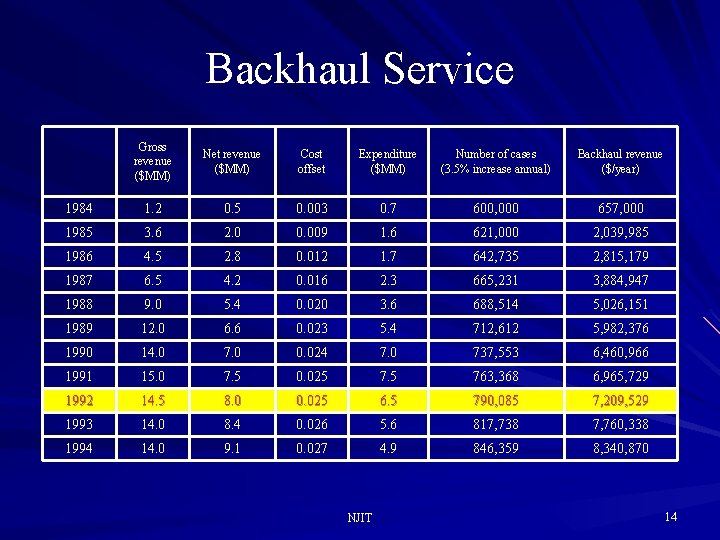
Backhaul Service Gross revenue ($MM) Net revenue ($MM) Cost offset Expenditure ($MM) Number of cases (3. 5% increase annual) Backhaul revenue ($/year) 1984 1. 2 0. 5 0. 003 0. 7 600, 000 657, 000 1985 3. 6 2. 0 0. 009 1. 6 621, 000 2, 039, 985 1986 4. 5 2. 8 0. 012 1. 7 642, 735 2, 815, 179 1987 6. 5 4. 2 0. 016 2. 3 665, 231 3, 884, 947 1988 9. 0 5. 4 0. 020 3. 6 688, 514 5, 026, 151 1989 12. 0 6. 6 0. 023 5. 4 712, 612 5, 982, 376 1990 14. 0 7. 0 0. 024 7. 0 737, 553 6, 460, 966 1991 15. 0 7. 5 0. 025 7. 5 763, 368 6, 965, 729 1992 14. 5 8. 0 0. 025 6. 5 790, 085 7, 209, 529 1993 14. 0 8. 4 0. 026 5. 6 817, 738 7, 760, 338 1994 14. 0 9. 1 0. 027 4. 9 846, 359 8, 340, 870 NJIT 14
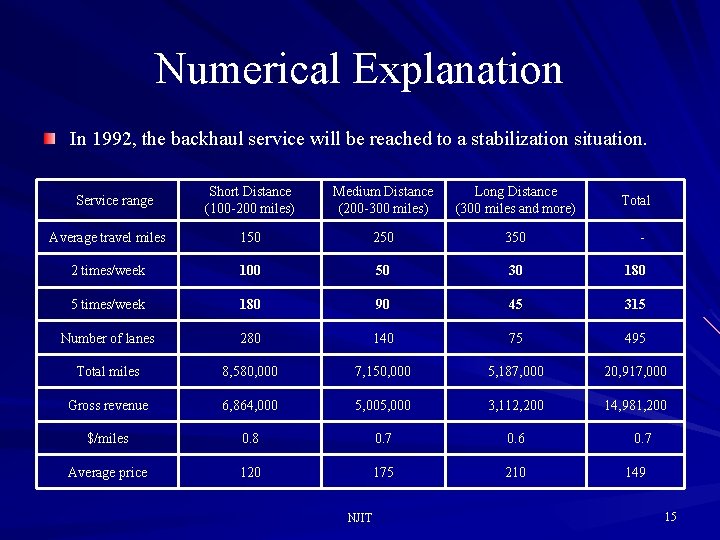
Numerical Explanation In 1992, the backhaul service will be reached to a stabilization situation. Short Distance (100 -200 miles) Medium Distance (200 -300 miles) Long Distance (300 miles and more) Average travel miles 150 250 350 - 2 times/week 100 50 30 180 5 times/week 180 90 45 315 Number of lanes 280 140 75 495 Total miles 8, 580, 000 7, 150, 000 5, 187, 000 20, 917, 000 Gross revenue 6, 864, 000 5, 000 3, 112, 200 14, 981, 200 $/miles 0. 8 0. 7 0. 6 Average price 120 175 210 Service range NJIT Total 0. 7 149 15
- Slides: 15