
FRISC II Trial Fragmin and Fast Revascularization during
- Slides: 8
FRISC II Trial Fragmin and Fast Revascularization during Instability in Coronary Artery Disease (FRISC II): Five-Year Follow-up of the FRISC-II Invasive Study Presented at The European Society of Cardiology Scientific Congress 2006 Presented by Dr. Bo Lagerqvist
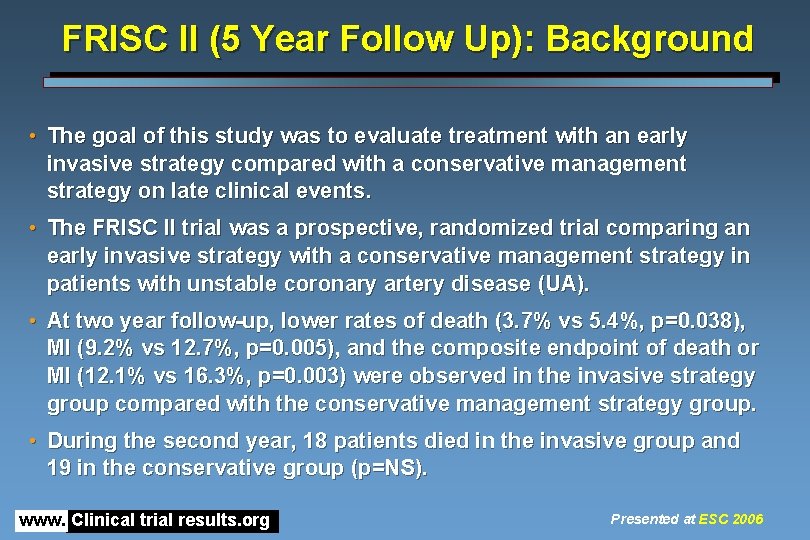
FRISC II (5 Year Follow Up): Background • The goal of this study was to evaluate treatment with an early invasive strategy compared with a conservative management strategy on late clinical events. • The FRISC II trial was a prospective, randomized trial comparing an early invasive strategy with a conservative management strategy in patients with unstable coronary artery disease (UA). • At two year follow-up, lower rates of death (3. 7% vs 5. 4%, p=0. 038), MI (9. 2% vs 12. 7%, p=0. 005), and the composite endpoint of death or MI (12. 1% vs 16. 3%, p=0. 003) were observed in the invasive strategy group compared with the conservative management strategy group. • During the second year, 18 patients died in the invasive group and 19 in the conservative group (p=NS). www. Clinical trial results. org Presented at ESC 2006
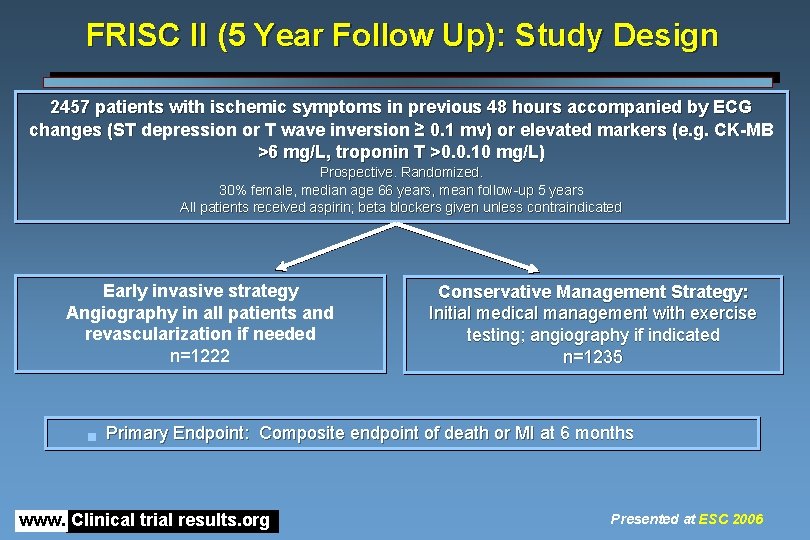
FRISC II (5 Year Follow Up): Study Design 2457 patients with ischemic symptoms in previous 48 hours accompanied by ECG changes (ST depression or T wave inversion ≥ 0. 1 mv) or elevated markers (e. g. CK-MB >6 mg/L, troponin T >0. 0. 10 mg/L) Prospective. Randomized. 30% female, median age 66 years, mean follow-up 5 years All patients received aspirin; beta blockers given unless contraindicated Early invasive strategy Angiography in all patients and revascularization if needed n=1222 g Conservative Management Strategy: Initial medical management with exercise testing; angiography if indicated n=1235 Primary Endpoint: Composite endpoint of death or MI at 6 months www. Clinical trial results. org Presented at ESC 2006
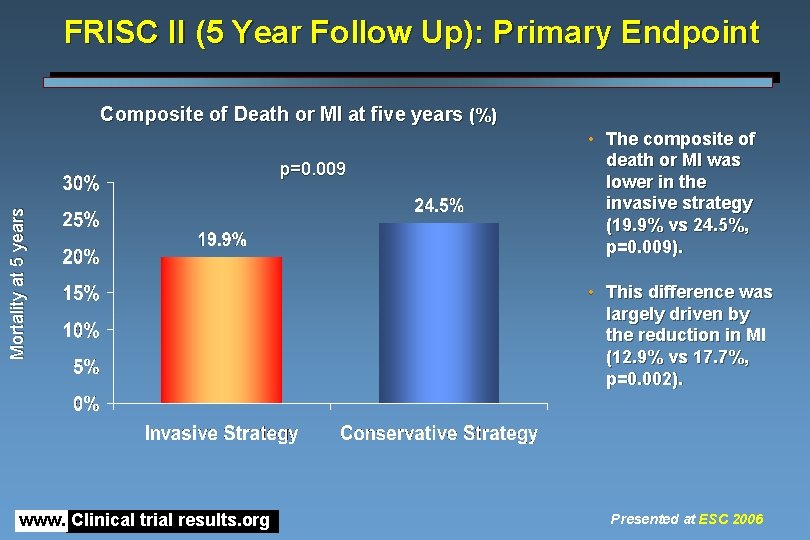
FRISC II (5 Year Follow Up): Primary Endpoint Composite of Death or MI at five years (%) Mortality at 5 years p=0. 009 www. Clinical trial results. org • The composite of death or MI was lower in the invasive strategy (19. 9% vs 24. 5%, p=0. 009). • This difference was largely driven by the reduction in MI (12. 9% vs 17. 7%, p=0. 002). Presented at ESC 2006
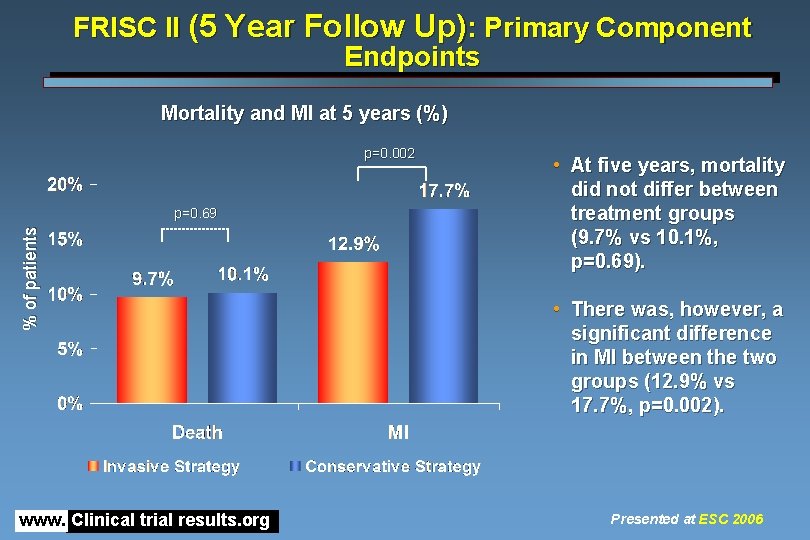
FRISC II (5 Year Follow Up): Primary Component Endpoints Mortality and MI at 5 years (%) p=0. 002 % of patients p=0. 69 www. Clinical trial results. org • At five years, mortality did not differ between treatment groups (9. 7% vs 10. 1%, p=0. 69). • There was, however, a significant difference in MI between the two groups (12. 9% vs 17. 7%, p=0. 002). Presented at ESC 2006
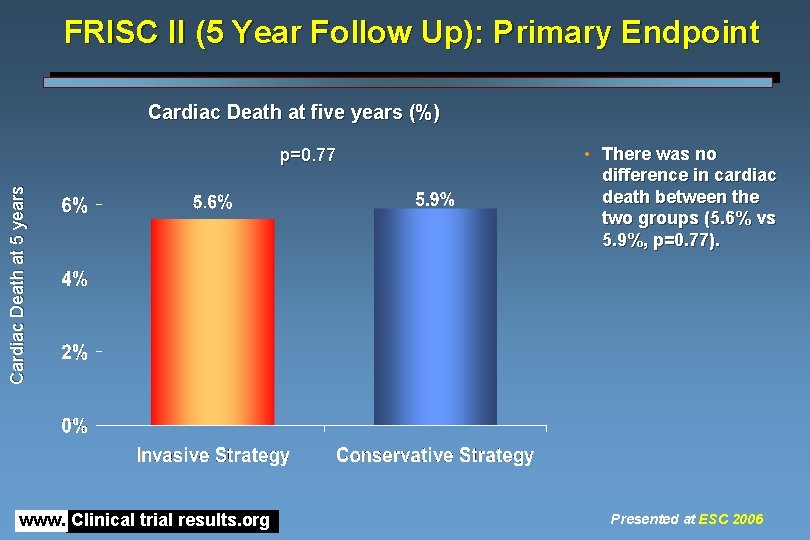
FRISC II (5 Year Follow Up): Primary Endpoint Cardiac Death at five years (%) Cardiac Death at 5 years p=0. 77 www. Clinical trial results. org • There was no difference in cardiac death between the two groups (5. 6% vs 5. 9%, p=0. 77). Presented at ESC 2006
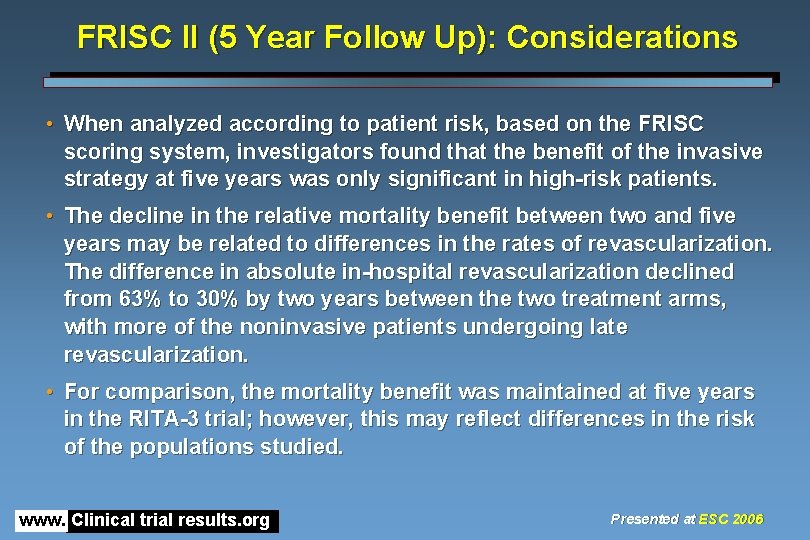
FRISC II (5 Year Follow Up): Considerations • When analyzed according to patient risk, based on the FRISC scoring system, investigators found that the benefit of the invasive strategy at five years was only significant in high-risk patients. • The decline in the relative mortality benefit between two and five years may be related to differences in the rates of revascularization. The difference in absolute in-hospital revascularization declined from 63% to 30% by two years between the two treatment arms, with more of the noninvasive patients undergoing late revascularization. • For comparison, the mortality benefit was maintained at five years in the RITA-3 trial; however, this may reflect differences in the risk of the populations studied. www. Clinical trial results. org Presented at ESC 2006
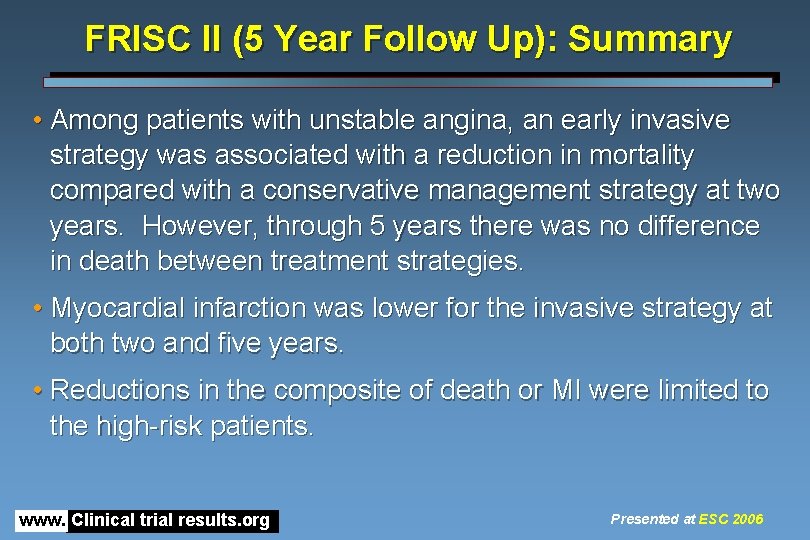
FRISC II (5 Year Follow Up): Summary • Among patients with unstable angina, an early invasive strategy was associated with a reduction in mortality compared with a conservative management strategy at two years. However, through 5 years there was no difference in death between treatment strategies. • Myocardial infarction was lower for the invasive strategy at both two and five years. • Reductions in the composite of death or MI were limited to the high-risk patients. www. Clinical trial results. org Presented at ESC 2006