
Friday WarmUp minimum 5 sentences 1 If you

- Slides: 49
Friday Warm-Up (minimum 5 sentences) 1. If you could get your DNA sequenced (read) in a lab, would you want to know or NOT want to know about any diseases that you might develop later in life? Why or why not? 2. What about even though scientists might not be able to cure it yet? Explain your reasoning. Fill out the last two boxes and turn in your warm-up
What is DNA? 2 facts 2
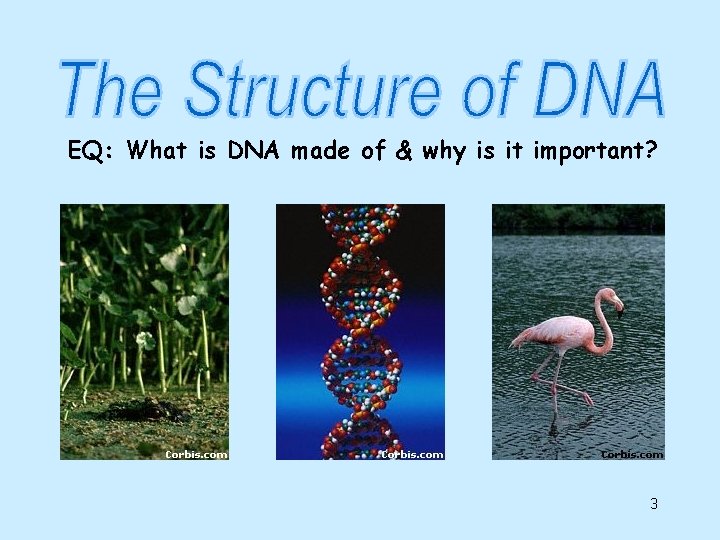
EQ: What is DNA made of & why is it important? 3
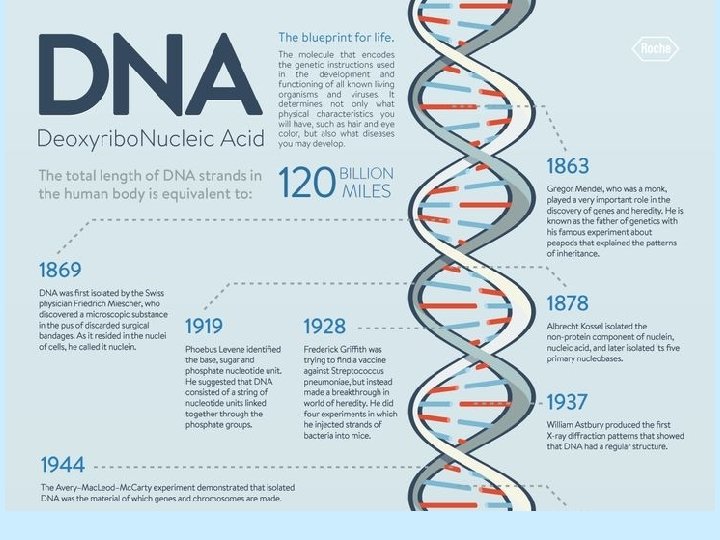
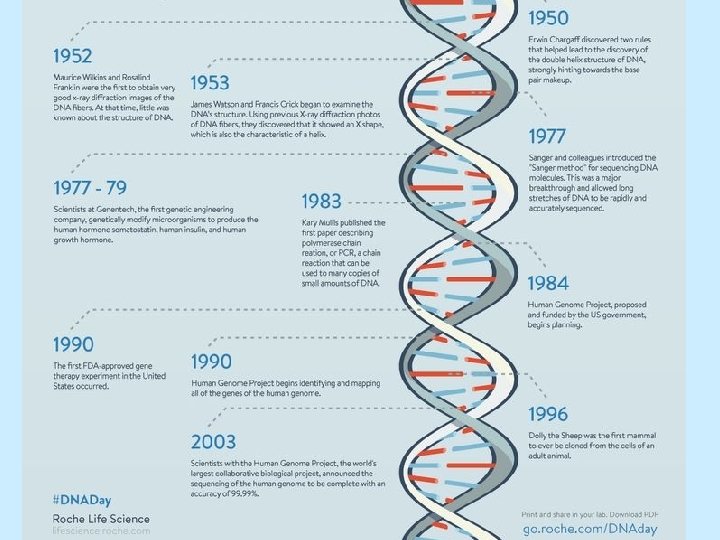
What year do you think DNA was first discovered? 4
5
6
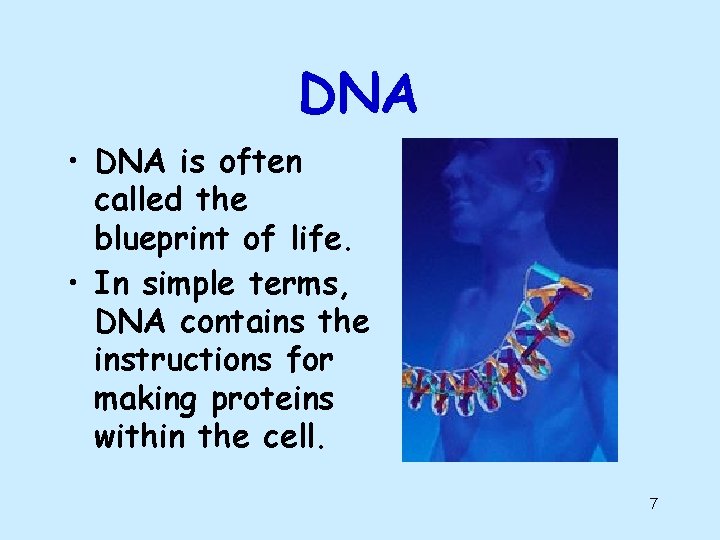
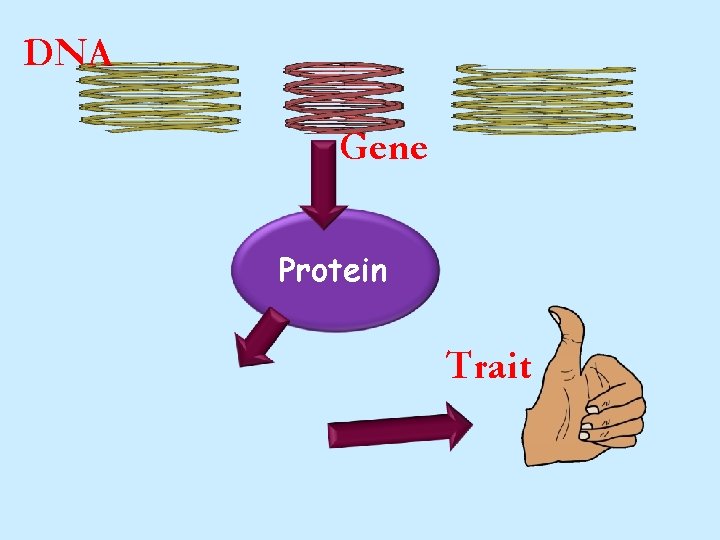
DNA • DNA is often called the blueprint of life. • In simple terms, DNA contains the instructions for making proteins within the cell. 7
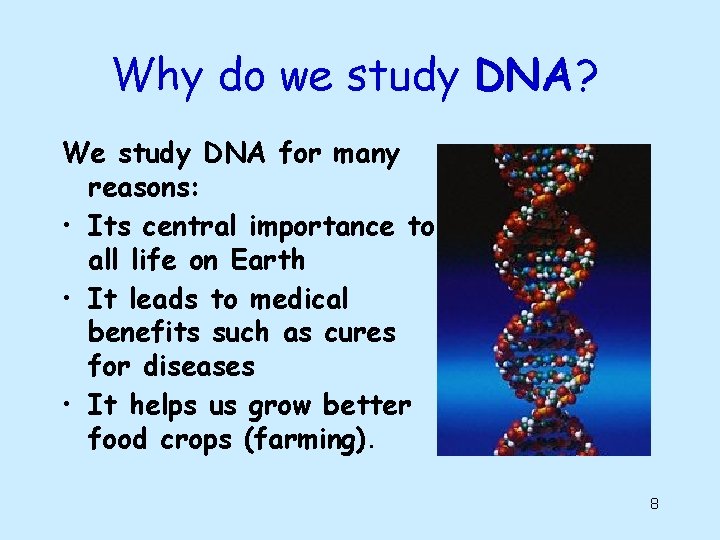
Why do we study DNA? We study DNA for many reasons: • Its central importance to all life on Earth • It leads to medical benefits such as cures for diseases • It helps us grow better food crops (farming). 8
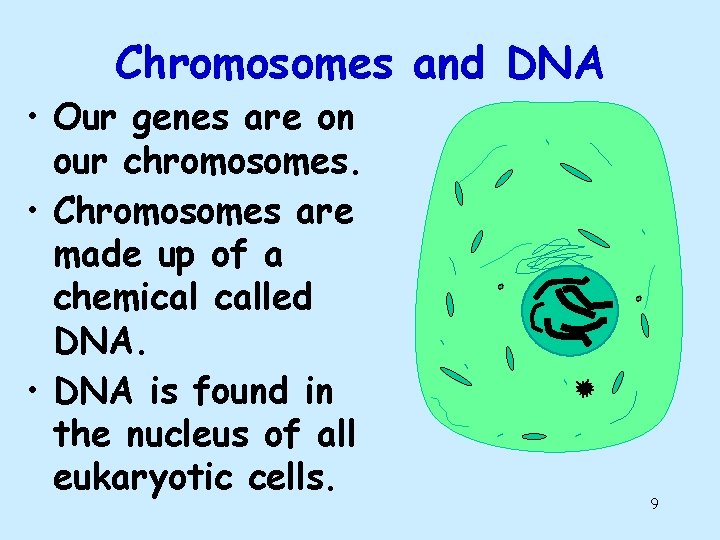
Chromosomes and DNA • Our genes are on our chromosomes. • Chromosomes are made up of a chemical called DNA. • DNA is found in the nucleus of all eukaryotic cells. 9
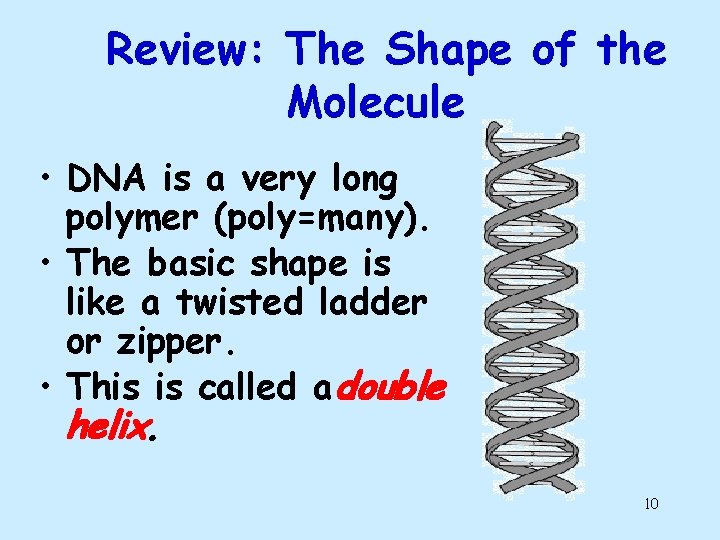
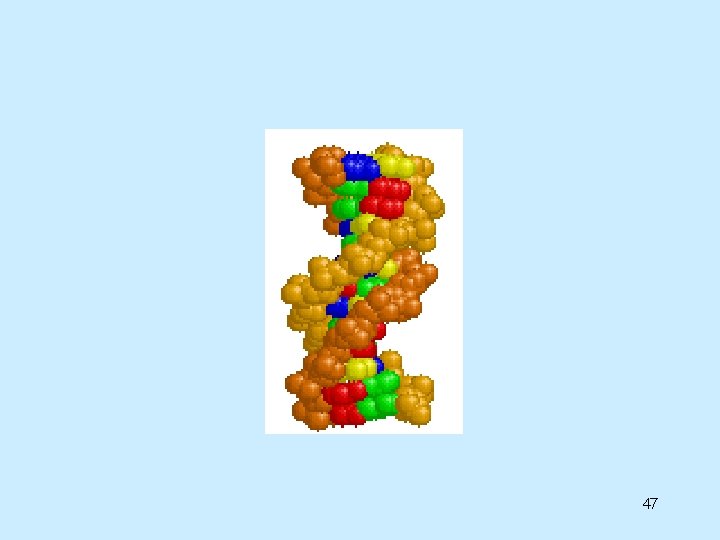
Review: The Shape of the Molecule • DNA is a very long polymer (poly=many). • The basic shape is like a twisted ladder or zipper. • This is called a double helix. 10
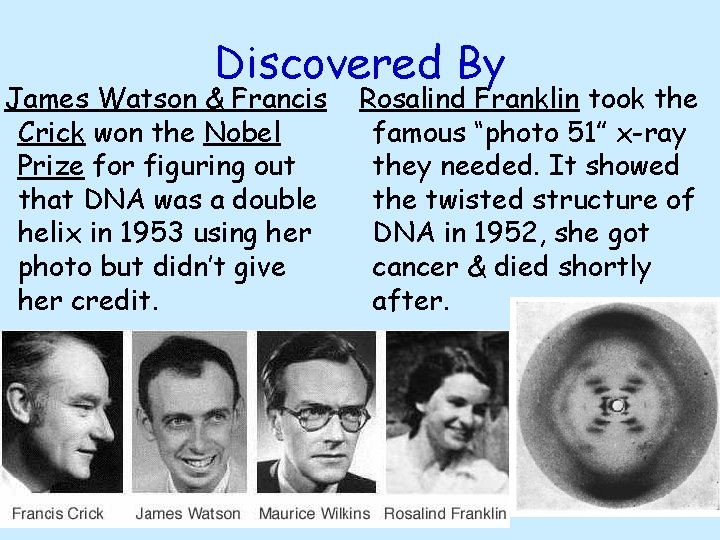
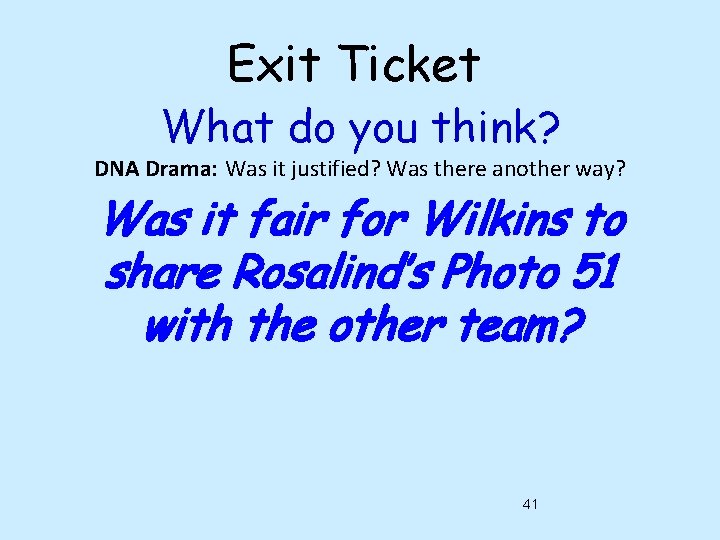
Discovered By James Watson & Francis Crick won the Nobel Prize for figuring out that DNA was a double helix in 1953 using her photo but didn’t give her credit. Rosalind Franklin took the famous “photo 51” x-ray they needed. It showed the twisted structure of DNA in 1952, she got cancer & died shortly after. 11
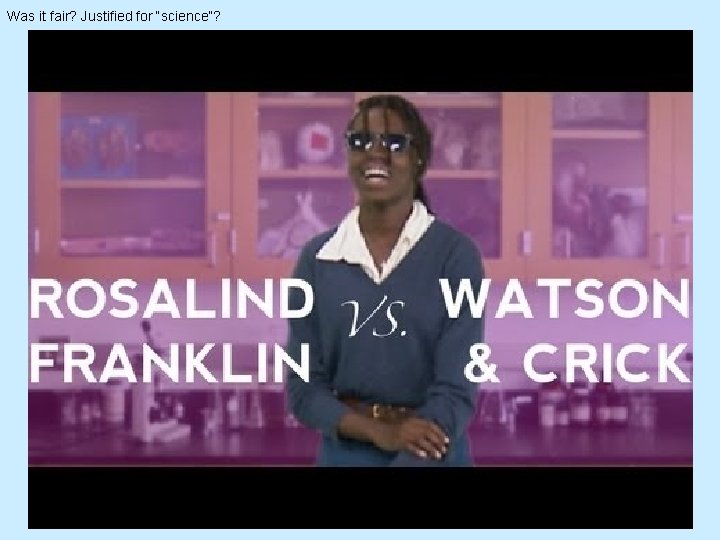
Was it fair? Justified for “science”? 12
Think-Pair-Share In your pairs, if you’re on the left: Give 2 reasons why it was justified or at least benefits science that Watson and Crick took Rosalind’s photo. In your pairs, if you’re on the right : Give 2 reasons why it was wrong that they took Rosalind’s photo and what they could have done better. 13
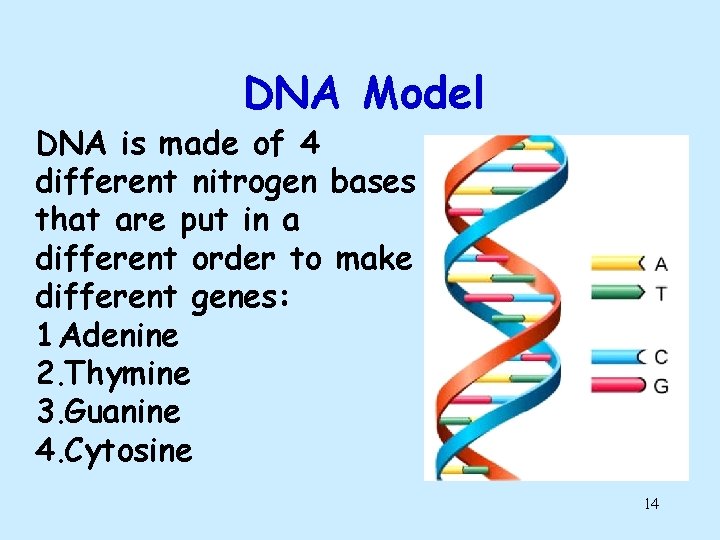
DNA Model DNA is made of 4 different nitrogen bases that are put in a different order to make different genes: 1. Adenine 2. Thymine 3. Guanine 4. Cytosine 14
Let’s Practice! Call out the answers! 15
What does G stand for? Guanine! 16
What does A stand for? Adenine! 17
What does T stand for? Thymine! 18
What does C stand for? Cytosine! 19
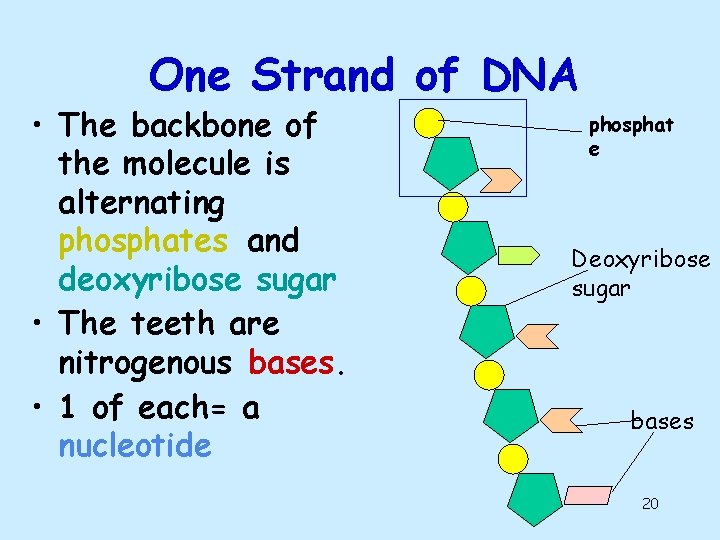
One Strand of DNA • The backbone of the molecule is alternating phosphates and deoxyribose sugar • The teeth are nitrogenous bases. • 1 of each= a nucleotide phosphat e Deoxyribose sugar bases 20
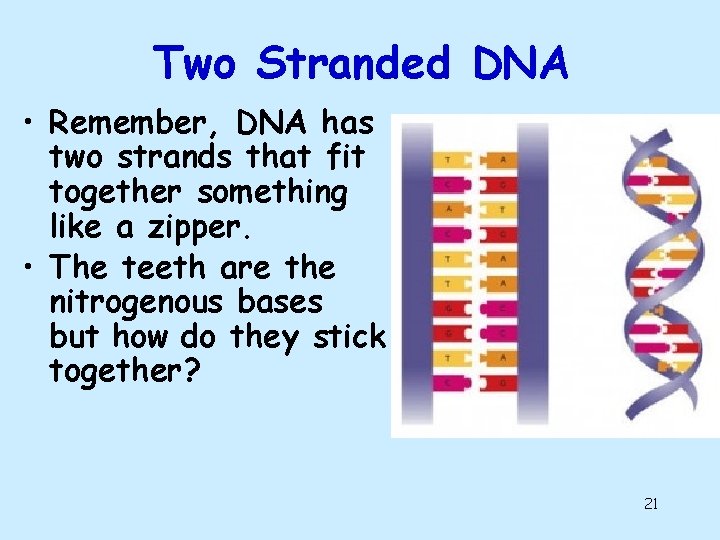
Two Stranded DNA • Remember, DNA has two strands that fit together something like a zipper. • The teeth are the nitrogenous bases but how do they stick together? 21
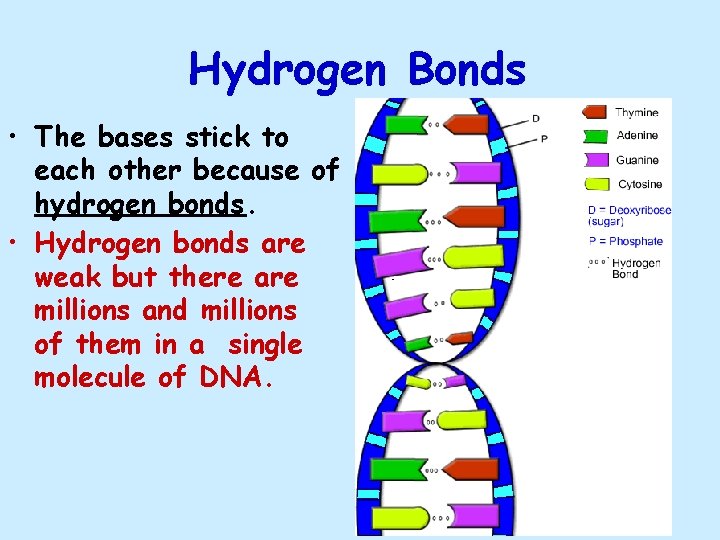
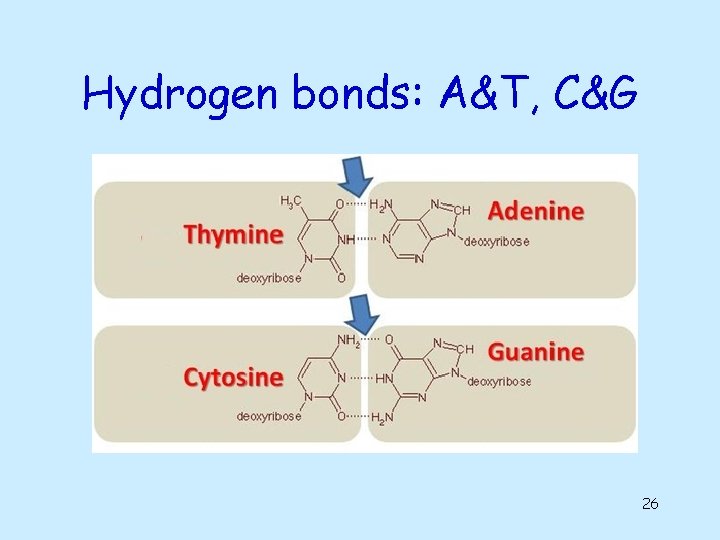
Hydrogen Bonds • The bases stick to each other because of hydrogen bonds. • Hydrogen bonds are weak but there are millions and millions of them in a single molecule of DNA. 22
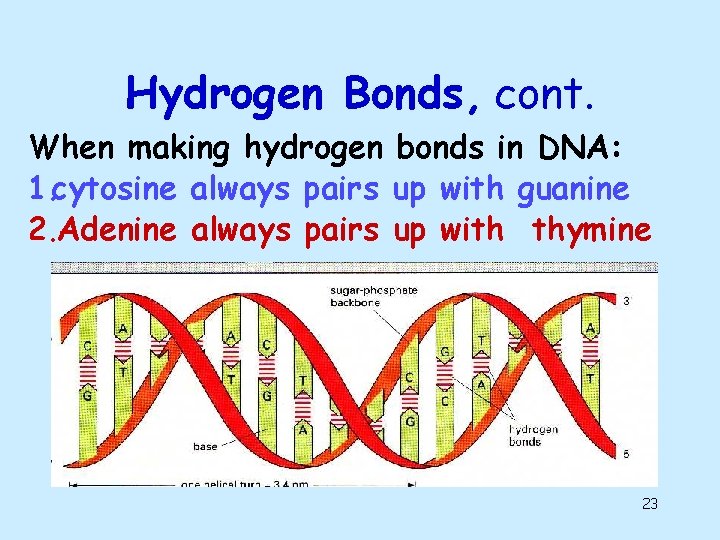
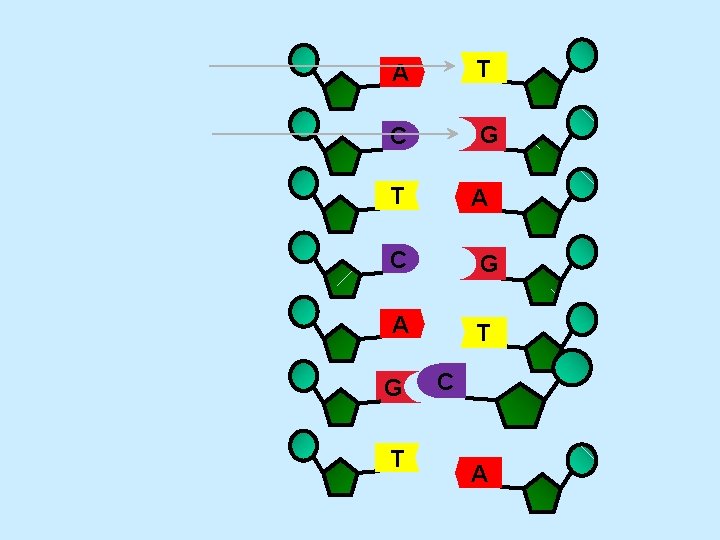
Hydrogen Bonds, cont. When making hydrogen bonds in DNA: 1. cytosine always pairs up with guanine 2. Adenine always pairs up with thymine 23
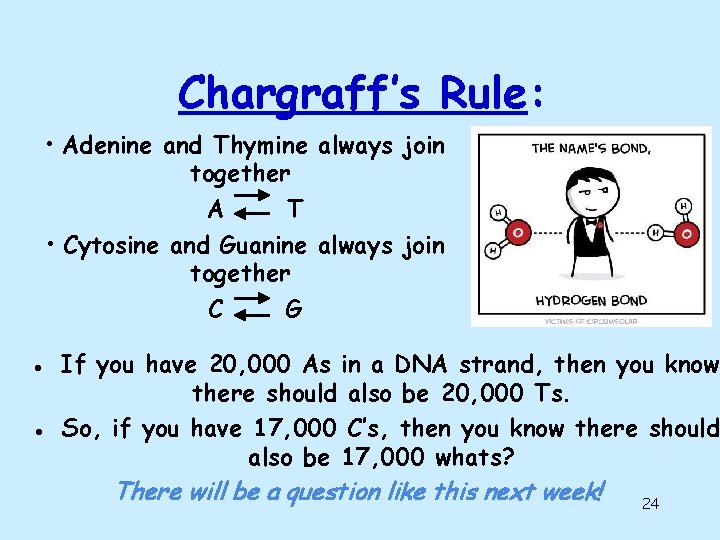
Chargraff’s Rule: • Adenine and Thymine always join together A T • Cytosine and Guanine always join together C G ● If you have 20, 000 As in a DNA strand, then you know there should also be 20, 000 Ts. ● So, if you have 17, 000 C’s, then you know there should also be 17, 000 whats? There will be a question like this next week! 24
A T C G T A C G A T G T C A
Hydrogen bonds: A&T, C&G 26
Base Pairs: Let’s Practice! 27
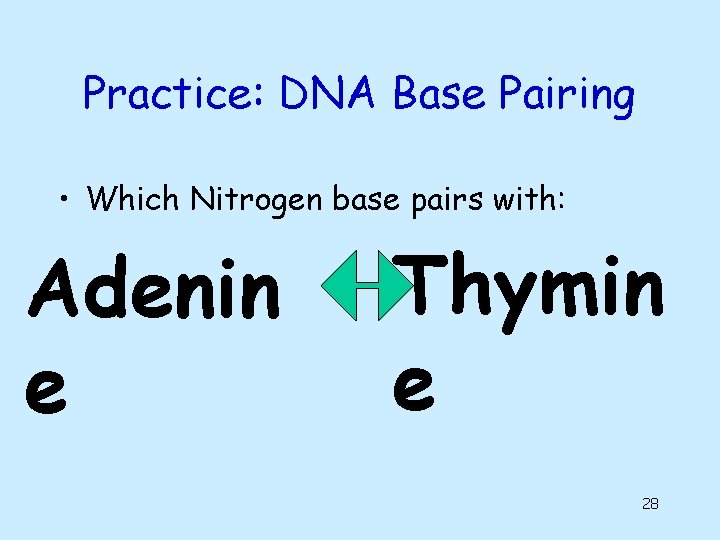
Practice: DNA Base Pairing • Which Nitrogen base pairs with: Adenin e Thymin e 28
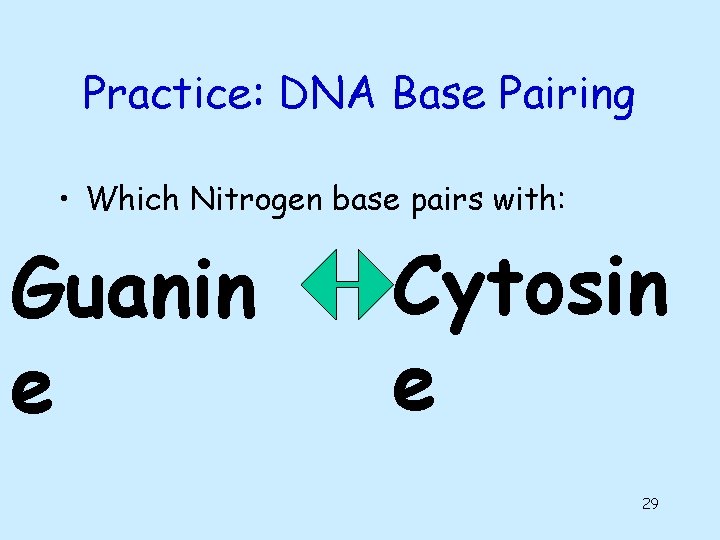
Practice: DNA Base Pairing • Which Nitrogen base pairs with: Guanin e Cytosin e 29
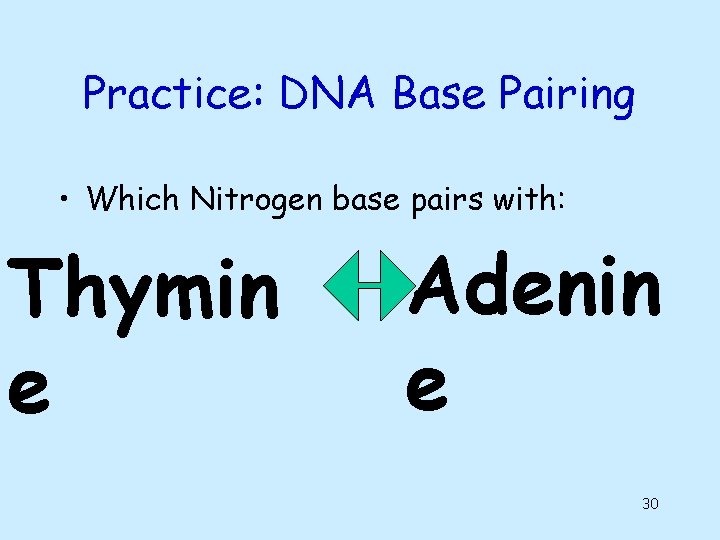
Practice: DNA Base Pairing • Which Nitrogen base pairs with: Thymin e Adenin e 30
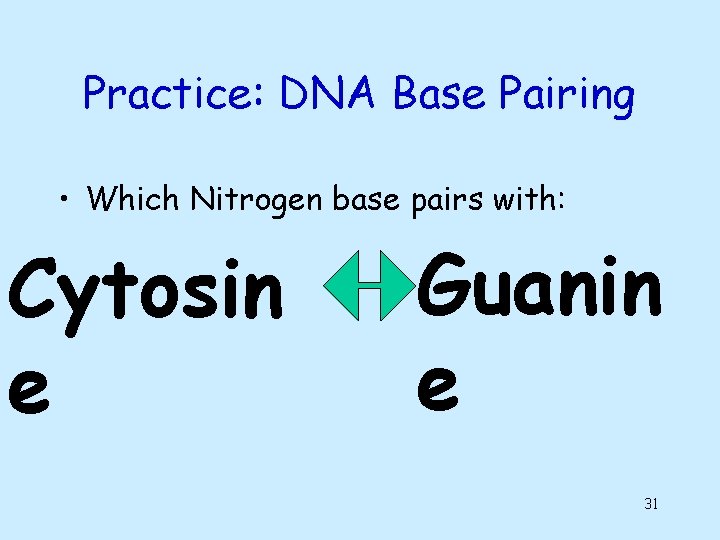
Practice: DNA Base Pairing • Which Nitrogen base pairs with: Cytosin e Guanin e 31
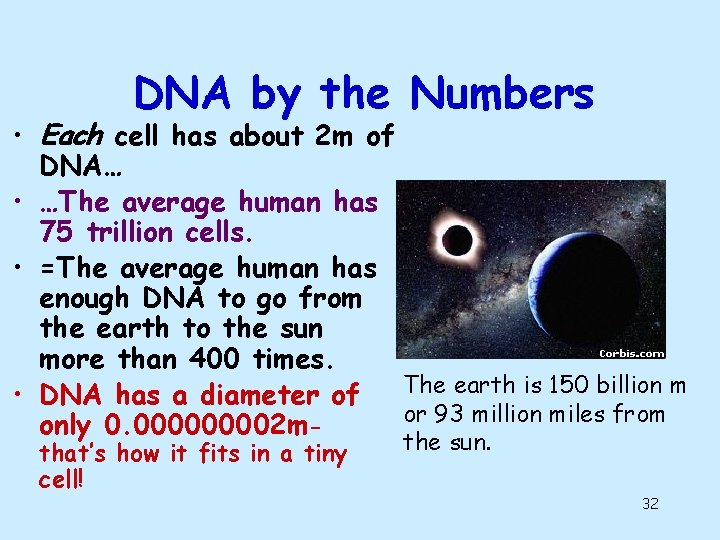
DNA by the Numbers • Each cell has about 2 m of DNA… • …The average human has 75 trillion cells. • =The average human has enough DNA to go from the earth to the sun more than 400 times. The earth is 150 billion m • DNA has a diameter of or 93 million miles from only 0. 00002 mthat’s how it fits in a tiny cell! the sun. 32
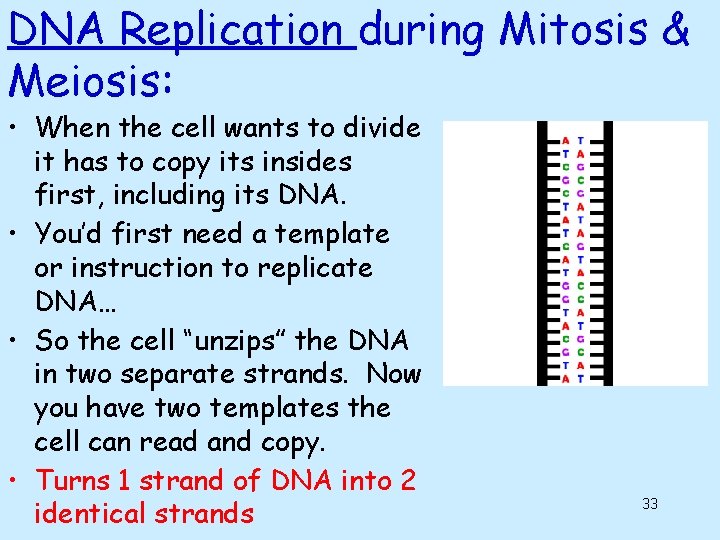
DNA Replication during Mitosis & Meiosis: • When the cell wants to divide it has to copy its insides first, including its DNA. • You’d first need a template or instruction to replicate DNA… • So the cell “unzips” the DNA in two separate strands. Now you have two templates the cell can read and copy. • Turns 1 strand of DNA into 2 identical strands 33
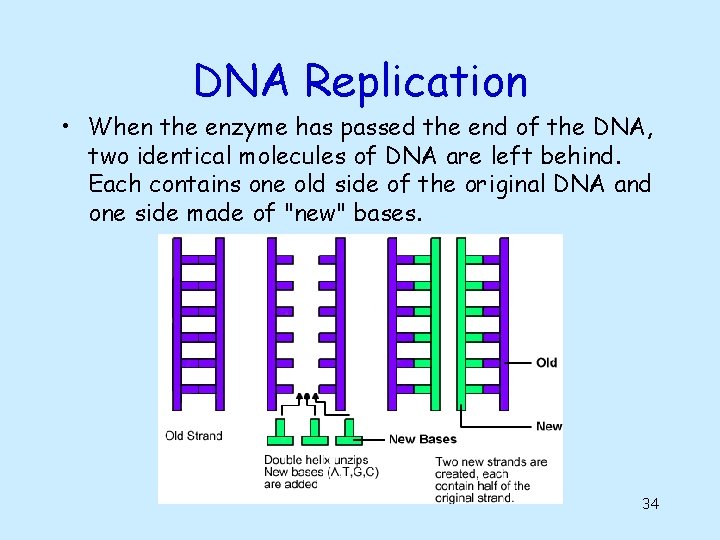
DNA Replication • When the enzyme has passed the end of the DNA, two identical molecules of DNA are left behind. Each contains one old side of the original DNA and one side made of "new" bases. 34
Errors “Mutations” occur during replication • It is possible that mistakes were made along the way -- in other words, that a base pair in one DNA molecule doesn't match the corresponding pair in the other molecule. On average, one mistake may exist in every billion base pairs. – That's the same as typing out the entire Encyclopedia Britannica five times and typing in a wrong letter only once! 35
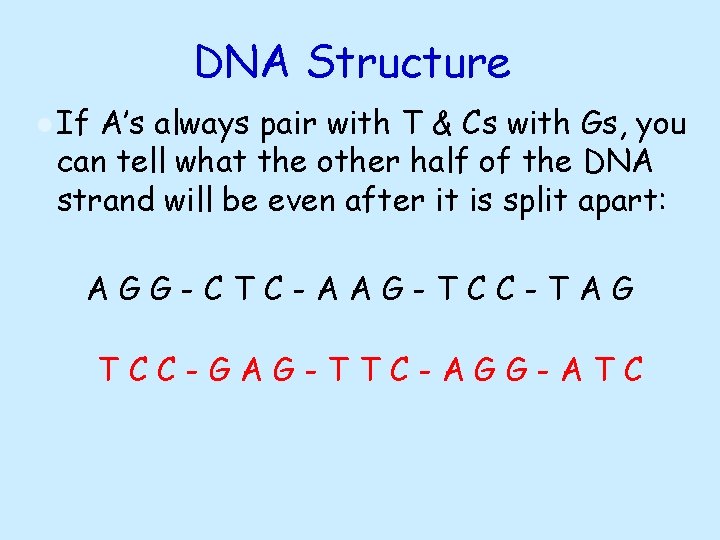
DNA Structure ● If A’s always pair with T & Cs with Gs, you can tell what the other half of the DNA strand will be even after it is split apart: AGG-CTC-AAG-TCC-TAG TCC-GAG-TTC-AGG-ATC
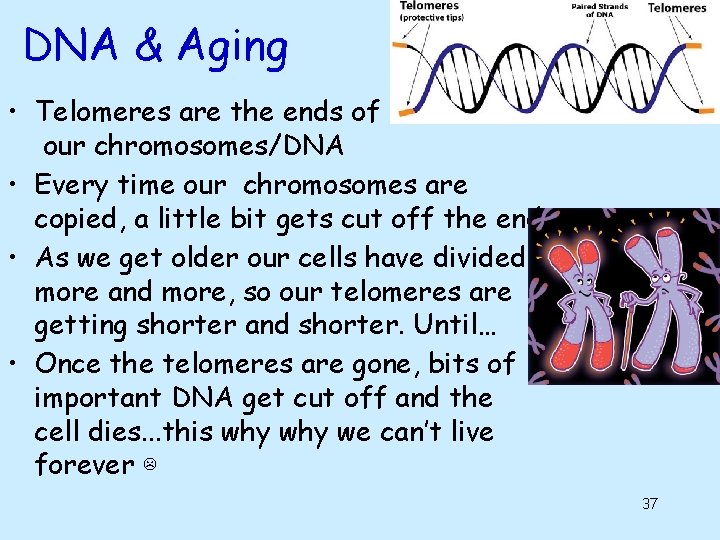
DNA & Aging • Telomeres are the ends of our chromosomes/DNA • Every time our chromosomes are copied, a little bit gets cut off the end. • As we get older our cells have divided more and more, so our telomeres are getting shorter and shorter. Until… • Once the telomeres are gone, bits of important DNA get cut off and the cell dies. . . this why we can’t live forever ☹ 37
DNA Structure ● A gene is a section of DNA that codes for a protein. ● Each unique gene has a unique sequence of bases. ● This unique sequence of bases will code for the production of a unique protein. ● It is these proteins and combination of proteins that give us a unique phenotype.
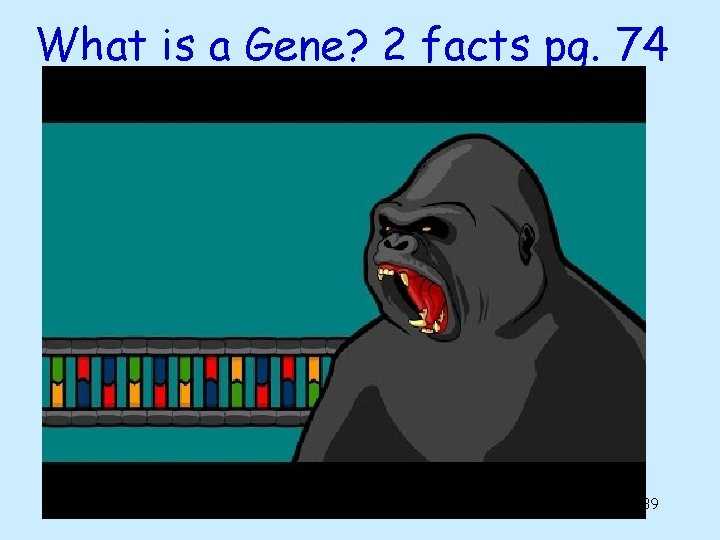
What is a Gene? 2 facts pg. 74 39
Honors Video: Amoeba Sisters 40
Exit Ticket What do you think? DNA Drama: Was it justified? Was there another way? Was it fair for Wilkins to share Rosalind’s Photo 51 with the other team? 41
DNA Replication Practice WS pg. 75 half-sheet 42
43
Tuesday 44
DNA Gene Protein Trait
• Shorter telomeres have been associated with increased incidence of diseases and poor survival. • The rate of telomere shortening can be either increased or decreased by specific lifestyle factors. 46
47
DNA-RNA-protein Video 48
Have your DNA and eat it, too! Lab • Make a DNA model 49