
FRIDAY PLENARY SESSION DAY 2 of Team STEPPS
- Slides: 72
FRIDAY PLENARY SESSION
DAY 2 of Team. STEPPS National Conference 2012
Team. STEPPS How This Conference Fits n What is needed for successful Team. STEPPS implementations? n Passion for safety and quality care n Understanding of teamwork tools & how to equip people to use them n Support to overcome challenges and make rapid progress n Resources to support implementation efforts and knowledge about how to use them most efficiently n How AHRQ is addressing each of these needs Mod 1 05. 2 Page 3 TEAMSTEPPS 05. 2
Team. STEPPS Passion n National Meeting: n n n Mod 1 05. 2 Page 4 Next year: same general time, probable location: San Antonio Meeting sponsors Larger venue Call for papers/panels to share your Team. STEPPS successes Adjustments made based on feedback from this year TEAMSTEPPS 05. 2
Team. STEPPS Understanding n Team. STEPPS trainings n n Expanded number of seats in trainings and locations they’re offered Planning some advance topic trainings Large backlog of interested participants Addressing by: n Reallocating resources to offer more trainings n Opening up new set of trainings to enroll in by late summer n Increased efforts to ensure participants can succeed n Coordinate with hospitals, systems, HENS, etc. to pair groups wanting trainings with strong training teams Mod 1 05. 2 Page 5 TEAMSTEPPS 05. 2
Team. STEPPS Support n User Support Network Webinars n List. Serv/Discussion forum n Library of resources n http: //teamsteppsportal. com/ n Resources: n Team. STEPPS materials: http: //www. ahrq. gov/teamsteppstools/ n Team. STEPPS mailbox: AHRQTeam. STEPPS@aha. org n Mod 1 05. 2 Page 6 TEAMSTEPPS 05. 2
Team. STEPPS Resources Mod 1 05. 2 Page 7 TEAMSTEPPS 05. 2
Team. STEPPS Acknowledgments Mod 1 05. 2 Page 8 TEAMSTEPPS 05. 2
Team. STEPPS Our Organizations Mod 1 05. 2 Page 9 TEAMSTEPPS 05. 2
Team. STEPPS National Training Centers Mod 1 05. 2 Page 10 TEAMSTEPPS 05. 2
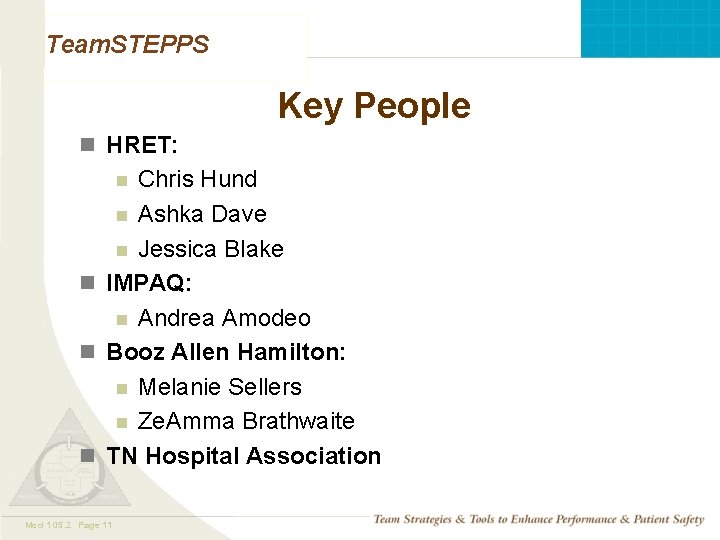
Team. STEPPS Key People n HRET: Chris Hund n Ashka Dave n Jessica Blake n IMPAQ: n Andrea Amodeo n Booz Allen Hamilton: n Melanie Sellers n Ze. Amma Brathwaite n TN Hospital Association n Mod 1 05. 2 Page 11 TEAMSTEPPS 05. 2
The State of Team. STEPPS: New Modules and Other Available Team. STEPPS Resources
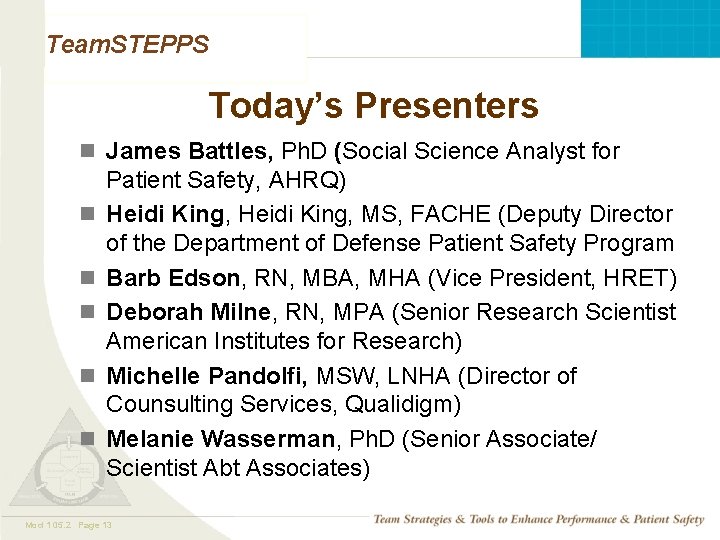
Team. STEPPS Today’s Presenters n James Battles, Ph. D (Social Science Analyst for n n n Patient Safety, AHRQ) Heidi King, MS, FACHE (Deputy Director of the Department of Defense Patient Safety Program Barb Edson, RN, MBA, MHA (Vice President, HRET) Deborah Milne, RN, MPA (Senior Research Scientist American Institutes for Research) Michelle Pandolfi, MSW, LNHA (Director of Counsulting Services, Qualidigm) Melanie Wasserman, Ph. D (Senior Associate/ Scientist Abt Associates) Mod 1 05. 2 Page 13 TEAMSTEPPS 05. 2
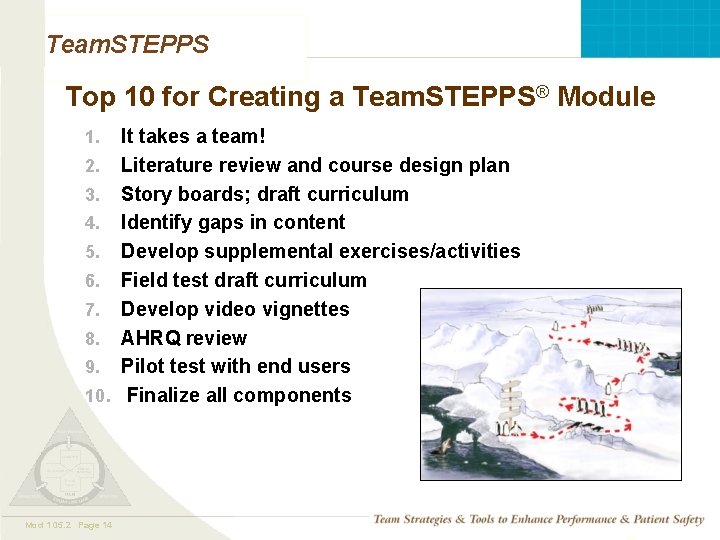
Team. STEPPS Top 10 for Creating a Team. STEPPS® Module It takes a team! 2. Literature review and course design plan 3. Story boards; draft curriculum 4. Identify gaps in content 5. Develop supplemental exercises/activities 6. Field test draft curriculum 7. Develop video vignettes 8. AHRQ review 9. Pilot test with end users 10. Finalize all components 1. Mod 1 05. 2 Page 14 TEAMSTEPPS 05. 2
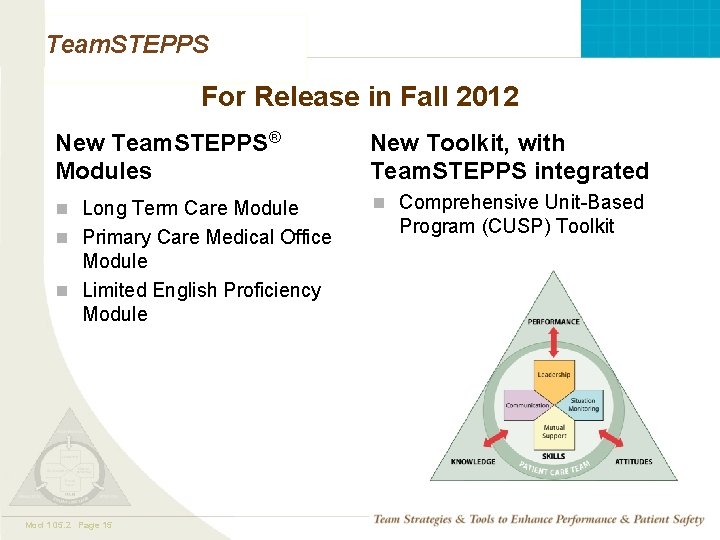
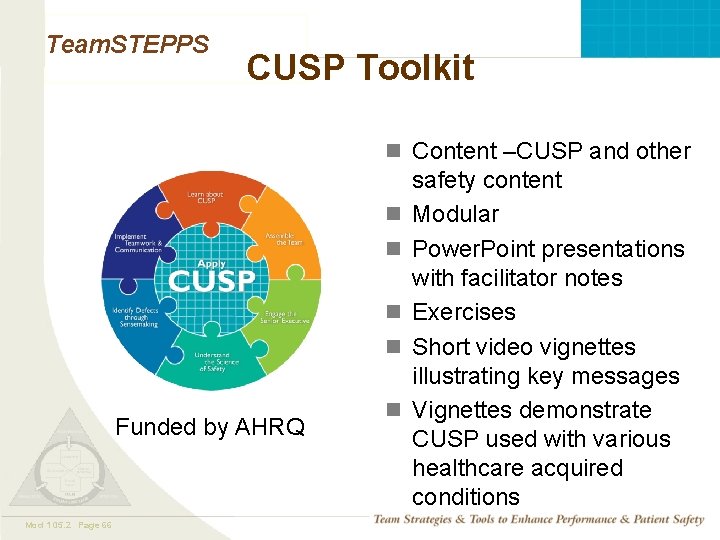
Team. STEPPS For Release in Fall 2012 New Team. STEPPS® Modules New Toolkit, with Team. STEPPS integrated n Long Term Care Module n Comprehensive Unit-Based n Primary Care Medical Office Module n Limited English Proficiency Module Mod 1 05. 2 Page 15 TEAMSTEPPS 05. 2 Program (CUSP) Toolkit
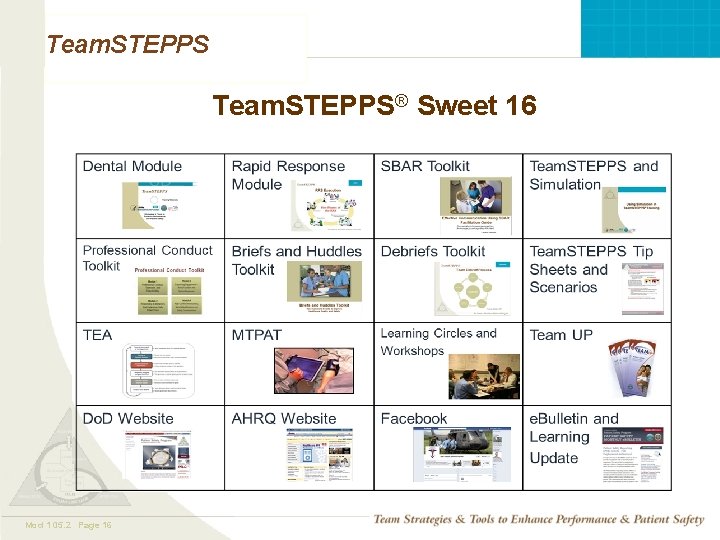
Team. STEPPS® Sweet 16 Mod 1 05. 2 Page 16 TEAMSTEPPS 05. 2
Team. STEPPS Contact Information Heidi King Heidi. King@tma. osd. mil Jim Battles James. Battles@ahrq. hhs. gov http: //teamstepps. ahrq. gov/ Mod 1 05. 2 Page 17 http: //health. mil/dodpatientsafety/ TEAMSTEPPS 05. 2
LEP module
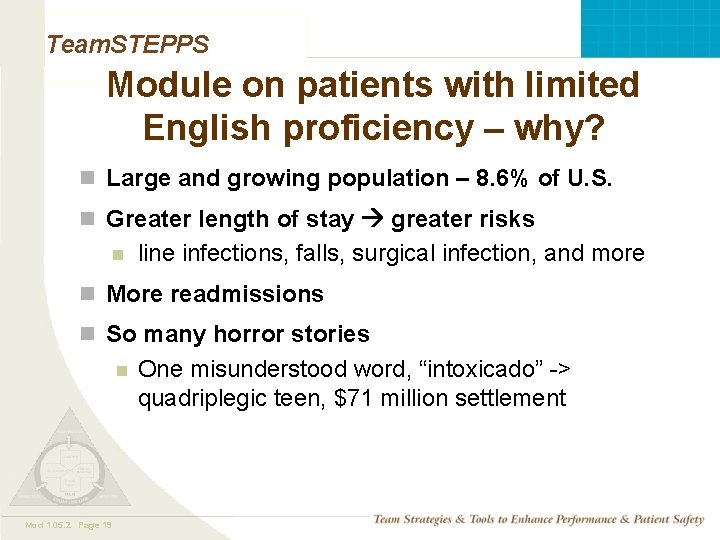
Team. STEPPS Module on patients with limited English proficiency – why? n Large and growing population – 8. 6% of U. S. n Greater length of stay greater risks n line infections, falls, surgical infection, and more n More readmissions n So many horror stories n Mod 1 05. 2 Page 19 One misunderstood word, “intoxicado” -> quadriplegic teen, $71 million settlement TEAMSTEPPS 05. 2
Team. STEPPS The evidence § Patient safety events more severe and more often due to communication errors for LEP patients (Divi et al. 2006, Flores 2005) § Ad hoc interpreters (family members, house staff) make serious medical interpretation errors (Flores et al. 2003) § LEP patient safety events cost hospitals millions (Price. Wise 2008; Quan 2010; Carbone et al. 2003) Mod 1 05. 2 Page 20 TEAMSTEPPS 05. 2
Team. STEPPS More evidence § Professional interpreters reduce length of stay and readmissions for LEP (Linholm et al. 2012) § Despite evidence that LEP patients are safer with professional interpreters, health care providers often try to “get by” without (Diamond et al. 2009; Ring et al. 2010) § Even when interpreters are present, they often can’t speak up when they see a patient safety risk (Betancourt et al. 2012) Mod 1 05. 2 Page 21 TEAMSTEPPS 05. 2
Team. STEPPS Other reasons for LEP focus § Joint Commission patient-centered communication standards come into effect July 1, 2012 n n Mod 1 05. 2 Page 22 Identify the patient’s oral and written communication needs; and Meet those needs n Including the need for qualified interpreters TEAMSTEPPS 05. 2
Team. STEPPS How the LEP module can help n 1 -hour staff training module and 4 -hour train-the- trainer program so unit staff and interpreters can: n Understand the risks to LEP patients n Assemble the right team (call an interpreter!) n Identify and raise patient communication issues n Also includes a guide for hospital leaders n Mod 1 05. 2 Page 23 To identify/ implement needed system changes ahead of training TEAMSTEPPS 05. 2
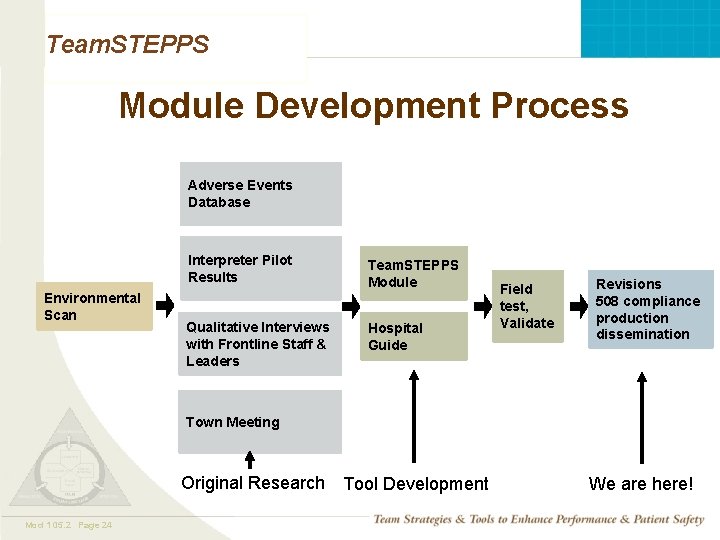
Team. STEPPS Module Development Process Adverse Events Database Environmental Scan Interpreter Pilot Results Team. STEPPS Module Qualitative Interviews with Frontline Staff & Leaders Hospital Guide Field test, Validate Revisions 508 compliance production dissemination Town Meeting Original Research Mod 1 05. 2 Page 24 Tool Development TEAMSTEPPS 05. 2 We are here!
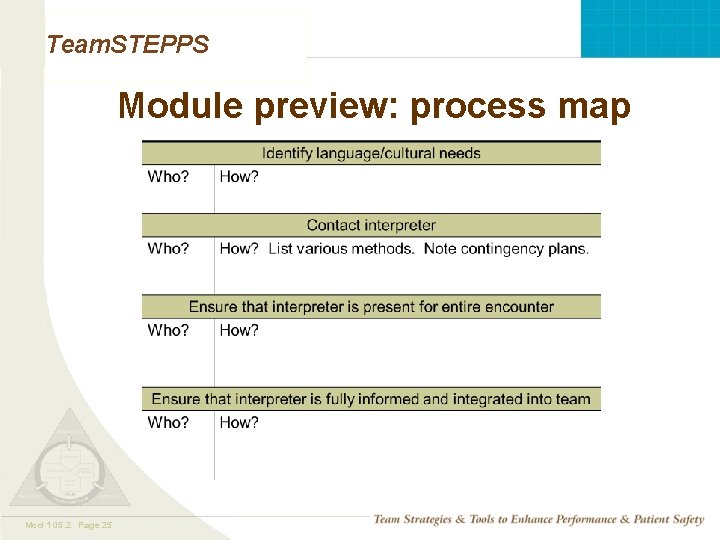
Team. STEPPS Module preview: process map Mod 1 05. 2 Page 25 TEAMSTEPPS 05. 2
Team. STEPPS Field-test results n Module can be implemented various ways in various settings n Team. STEPPS/non-Team. STEPPS hospital (MO, DE, NC) n Stand-alone or part of overall Team. STEPPS n Hospital units (ED, L&D, OB), or primary care n Catalyst for institutional changes Mod 1 05. 2 Page 26 TEAMSTEPPS 05. 2
Team. STEPPS Evaluation n Module includes an evaluation guide n n Mod 1 05. 2 Page 27 Satisfaction scores high Knowledge scores significantly increased Qualitative results: n Clinicians more aware of need for interpreter n Interpreters more empowered to raise/address communication issues Problems with language data challenges evaluating provider behavior and patient outcomes TEAMSTEPPS 05. 2
Team. STEPPS Next steps n Module available late summer/early fall n Mod 1 05. 2 Page 28 Want a copy? Sign up with me today! TEAMSTEPPS 05. 2
Team. STEPPS Outline n Why LTC version n What changes were made and why n Video creation n TEP recommendations n Field testing n Findings – potential future work n Availability Mod 1 05. 2 Page 30 TEAMSTEPPS 05. 2
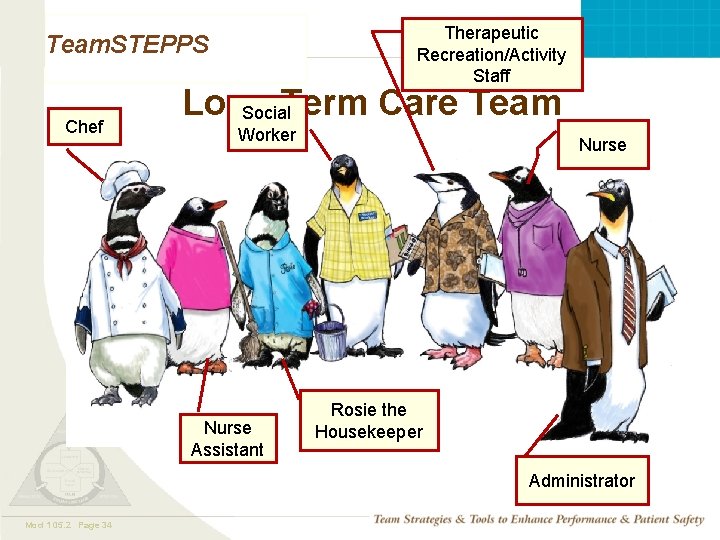
Team. STEPPS Why Long-Term Care? n Long-term care environment is unique n Long-term/chronic and short term/sub-acute n Patients are called “residents” n Multi-disciplinary teams, including non-clinical staff n Long-term care: custodial care through IV therapy n Approximately 16, 000 nursing homes and 1. 6 M nursing home residents across the country Mod 1 05. 2 Page 31 TEAMSTEPPS 05. 2
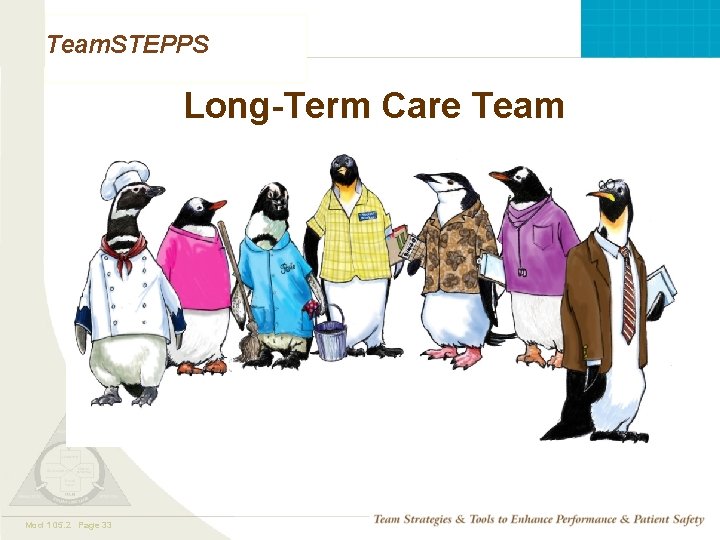
Team. STEPPS Changes Targeted n The work of this project was to modify the text and associated training materials to be relevant to the long-term care environment n Changed language throughout to be meaningful to long-term care n Exercises, scenarios, tests and videos were changed and centered around chronic medical or rehabilitation circumstances n Graphics and pictures were changed to reflect nursing home staff, care and environment Mod 1 05. 2 Page 32 TEAMSTEPPS 05. 2
Team. STEPPS Long-Term Care Team Mod 1 05. 2 Page 33 TEAMSTEPPS 05. 2
Therapeutic Recreation/Activity Staff Team. STEPPS Chef Long Term Care Team Social Worker Nurse Assistant Nurse Rosie the Housekeeper Administrator Mod 1 05. 2 Page 34 TEAMSTEPPS 05. 2
Team. STEPPS Videos n Two videos created Long-term care – subtle decline in a resident over a 24 hour period n Sub-acute care –possible MI/PE in a resident receiving physical therapy n 14 of 15 Team. STEPPS skills were highlighted n Time-Out is not a skill deemed necessary for most nursing homes n Mod 1 05. 2 Page 35 TEAMSTEPPS 05. 2
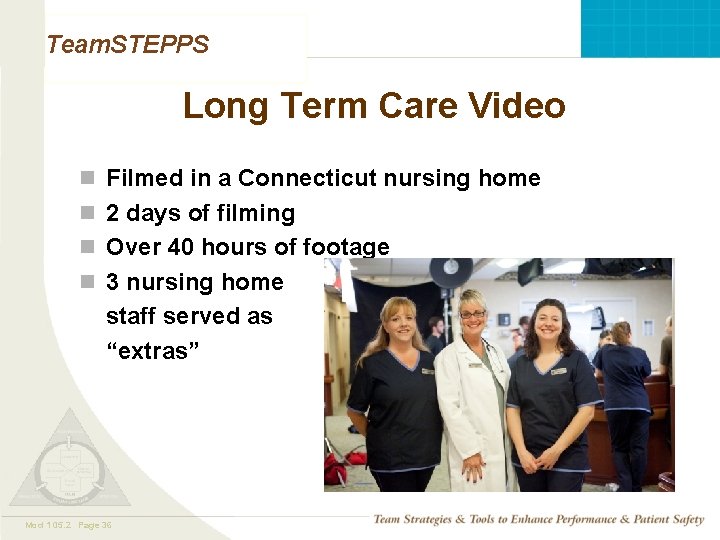
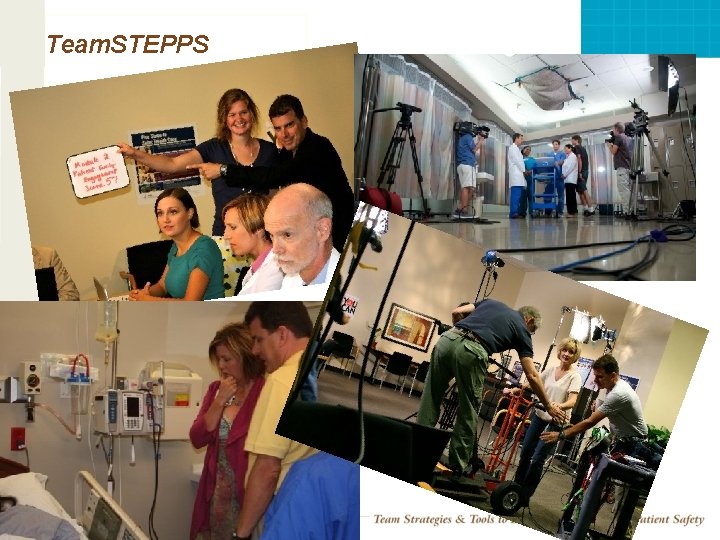
Team. STEPPS Long Term Care Video n Filmed in a Connecticut nursing home n 2 days of filming n Over 40 hours of footage n 3 nursing home staff served as “extras” Mod 1 05. 2 Page 36 TEAMSTEPPS 05. 2
Team. STEPPS Sub-Acute Video n Filmed in a Massachusetts nursing home’s rehabilitation gym n 1 day of filming n 15 hours of footage Mod 1 05. 2 Page 37 TEAMSTEPPS 05. 2
Team. STEPPS Technical Expert Panel n National Experts in: Long-term care n Team. STEPPS (Master Trainers) n Nursing Workforce Development n Culture Change n Quality of Care/Life Outcomes n Individual calls with each TEP Member were conducted n Materials were sent prior to each call: description, agenda, questions n Mod 1 05. 2 Page 38 TEAMSTEPPS 05. 2
Team. STEPPS TEP Recommendations n Joint Commission Accreditation of nursing homes is very low nationally n Language/terms not commonly used in nursing homes n Culture Change and Patient Safety n Clear language on the two “concepts” n Sample Exercise n Illustrate benefit of including all members of the healthcare team in care planning n Mod 1 05. 2 Page 39 TEAMSTEPPS 05. 2
Team. STEPPS TEP Recommendations 2 n Other n n n Mod 1 05. 2 Page 40 Content should be delivered at literacy levels appropriate for the audience Deliver training in interactive sessions: role play and “teach back” Advanced skills introduced after basic concepts mastered TEAMSTEPPS 05. 2
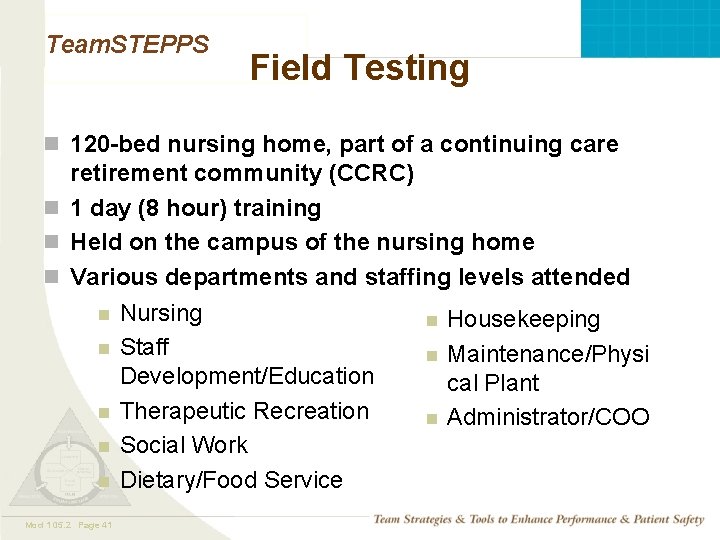
Team. STEPPS Field Testing n 120 -bed nursing home, part of a continuing care retirement community (CCRC) n 1 day (8 hour) training n Held on the campus of the nursing home n Various departments and staffing levels attended n n n Mod 1 05. 2 Page 41 Nursing Staff Development/Education Therapeutic Recreation Social Work Dietary/Food Service TEAMSTEPPS 05. 2 n n n Housekeeping Maintenance/Physi cal Plant Administrator/COO
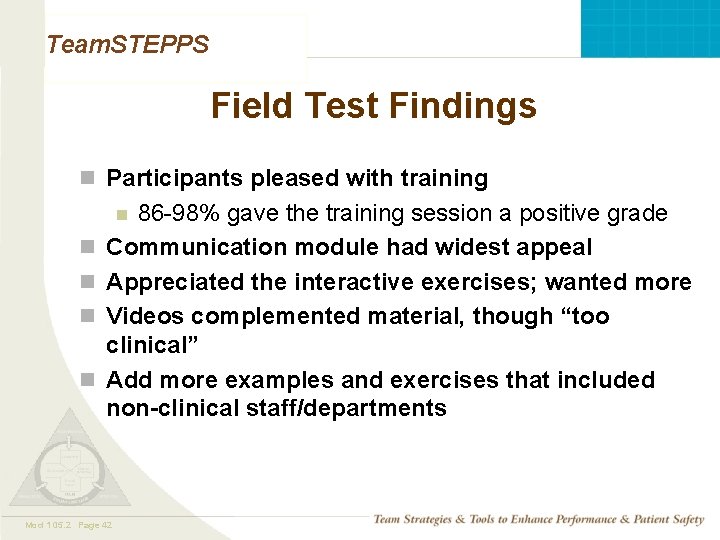
Team. STEPPS Field Test Findings n Participants pleased with training 86 -98% gave the training session a positive grade Communication module had widest appeal Appreciated the interactive exercises; wanted more Videos complemented material, though “too clinical” Add more examples and exercises that included non-clinical staff/departments n n n Mod 1 05. 2 Page 42 TEAMSTEPPS 05. 2
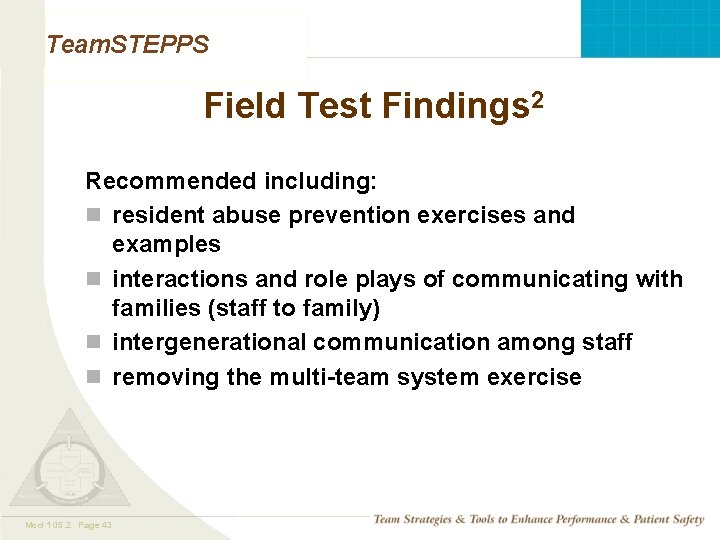
Team. STEPPS Field Test Findings 2 Recommended including: n resident abuse prevention exercises and examples n interactions and role plays of communicating with families (staff to family) n intergenerational communication among staff n removing the multi-team system exercise Mod 1 05. 2 Page 43 TEAMSTEPPS 05. 2
Team. STEPPS for Long Term Care n Available: ? ? ? Mod 1 05. 2 Page 44 TEAMSTEPPS 05. 2
Team. STEPPS Contact Information n Abt Associates: Donna Hurd donna_hurd@abtassoc. com n Qualidigm: n Michelle Pandolfi mpandolfi@qualidigm. org n Ann Spenard aspenard@qualidigm. org n Team. STEPPS® Primary Care Medical Office Module n Deborah A. Milne, RN MPA American Institutes for Research June 22, 2012 Mod 1 05. 2 Page 45 TEAMSTEPPS 05. 2
Team. STEPPS® Primary Care Medical Office Module Deborah A. Milne, RN MPA American Institutes for Research June 22, 2012
Team. STEPPS First Step n Convened Technical Expert Panel (TEP) December 2010 n n n Mod 1 05. 2 Page 47 Representatives from AHRQ and Do. D Experts in primary care and quality improvement Interprofessional primary health care providers TEAMSTEPPS 05. 2
Team. STEPPS Laying the Groundwork Mod 1 05. 2 Page 48 n Defined the “team” n Identified the “system” n Evaluated the challenges n Decided areas of focus TEAMSTEPPS 05. 2
Team. STEPPS Primary Care Office (PCO) Team n TEP defined the scope of “team” for purpose of this project n Focus of the project was intended to be on optimizing teamwork within the medical office n Caveat - it was noted that external care coordination is of extreme importance for future work Mod 1 05. 2 Page 49 TEAMSTEPPS 05. 2
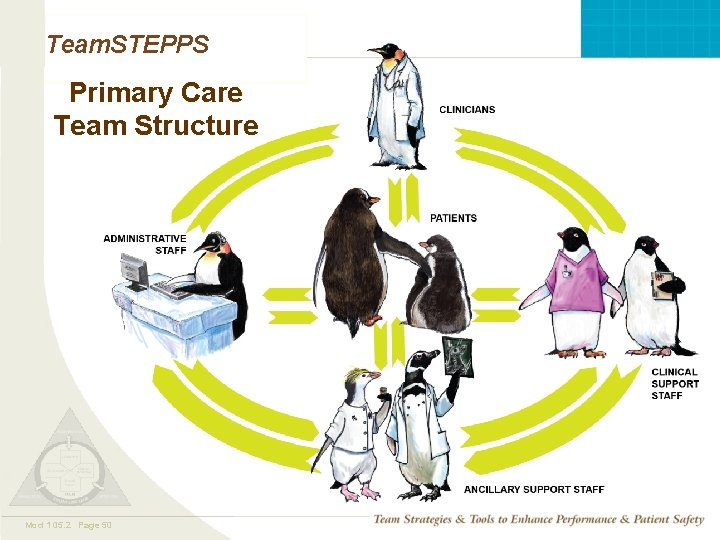
Team. STEPPS Primary Care Team Structure Mod 1 05. 2 Page 50 TEAMSTEPPS 05. 2
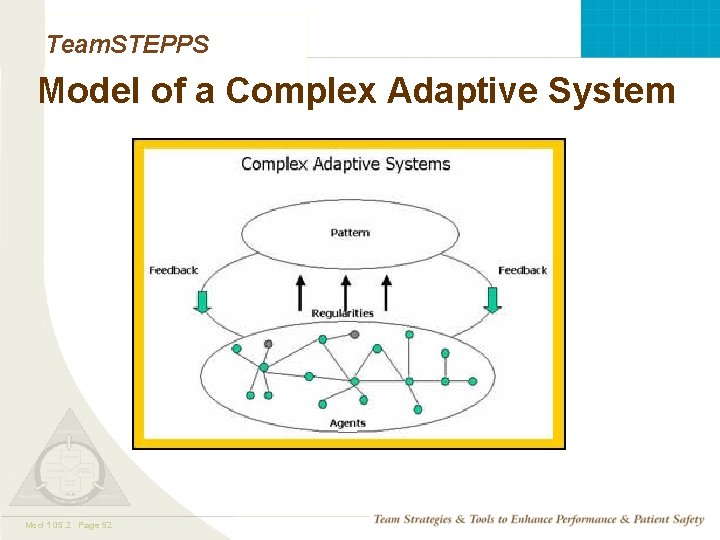
Team. STEPPS How is the PCO Different? n Complex Adaptive System n Non – linear, non – episodic n The agents in the system are all the components of that system n Agents interact and connect with each other in unpredictable and unplanned ways n Interactions cause regularities to emerge n Start to form a pattern which feeds back on the system and informs the interactions of the agents Mod 1 05. 2 Page 51 TEAMSTEPPS 05. 2
Team. STEPPS Model of a Complex Adaptive System Mod 1 05. 2 Page 52 TEAMSTEPPS 05. 2
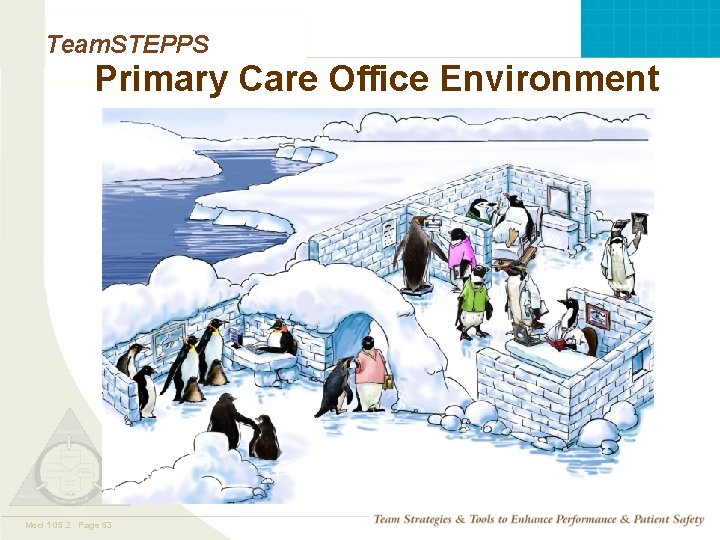
Team. STEPPS Primary Care Office Environment Mod 1 05. 2 Page 53 TEAMSTEPPS 05. 2
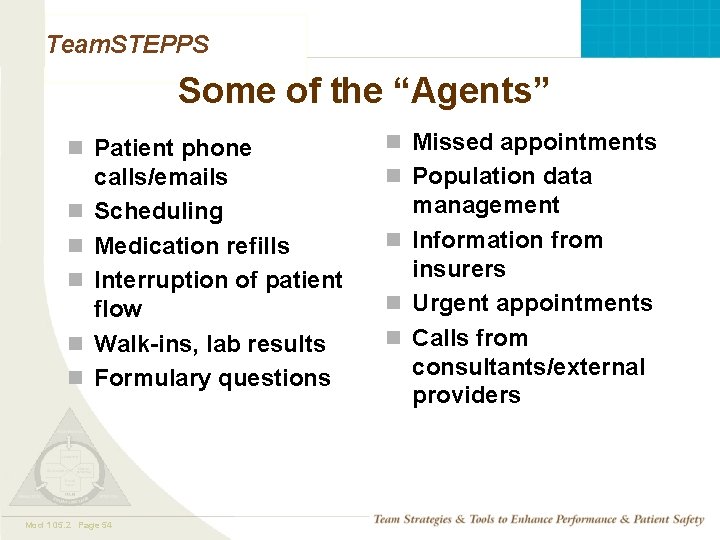
Team. STEPPS Some of the “Agents” n Missed appointments n Patient phone n n n calls/emails Scheduling Medication refills Interruption of patient flow Walk-ins, lab results Formulary questions Mod 1 05. 2 Page 54 n Population data management n Information from insurers n Urgent appointments n Calls from consultants/external providers TEAMSTEPPS 05. 2
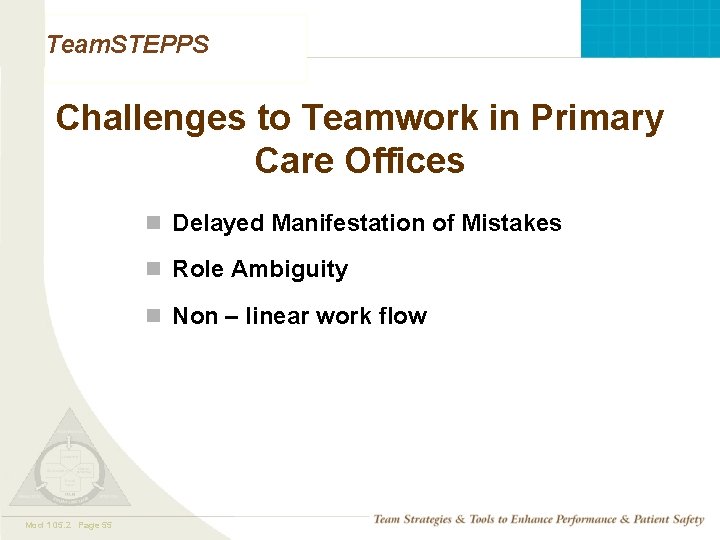
Team. STEPPS Challenges to Teamwork in Primary Care Offices n Delayed Manifestation of Mistakes n Role Ambiguity n Non – linear work flow Mod 1 05. 2 Page 55 TEAMSTEPPS 05. 2
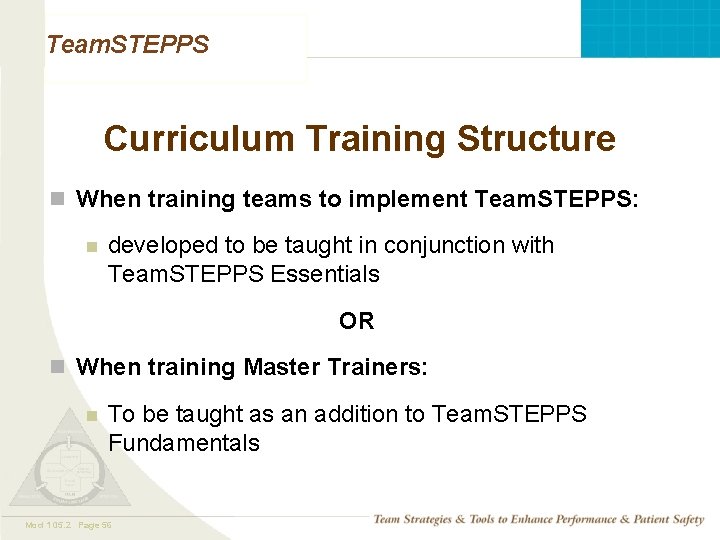
Team. STEPPS Curriculum Training Structure n When training teams to implement Team. STEPPS: n developed to be taught in conjunction with Team. STEPPS Essentials OR n When training Master Trainers: n To be taught as an addition to Team. STEPPS Fundamentals Mod 1 05. 2 Page 56 TEAMSTEPPS 05. 2
Team. STEPPS Next Steps n Literature review n Curriculum design guide development n Developed draft curriculum slides and instructor guide n Begin preliminary scripts for video vignettes n Mod 1 05. 2 Page 57 We asked all TEP members to send us brief “stories” that represented actual scenarios they had experienced TEAMSTEPPS 05. 2
Team. STEPPS Field Testing n Two sites n Team. STEPPS essentials followed by Primary Care Office Module n Data collection Mod 1 05. 2 Page 58 TEAMSTEPPS 05. 2
Team. STEPPS Highlights of Field Testing Focus Groups n “What parts of the module are most relevant to primary care? ” n Patient advocacy and communication n Conflict resolution n Situation monitoring n Debriefing Mod 1 05. 2 Page 59 TEAMSTEPPS 05. 2
Team. STEPPS Highlights of Field Testing Focus Groups n “What improvements could be made to the module? ” n More emphasis on roles of non-clinical staff in the care team n More case-based scenarios, especially across team roles Non clinical staff felt that they often had important information to communicate but no process to do so Quote: “Little bits that you don’t automatically put into the records as a formal thing are so important. ” n Resulting module change: n Included 4 scenarios in module that emphasize non-clinical staff Mod 1 05. 2 Page 60 TEAMSTEPPS 05. 2
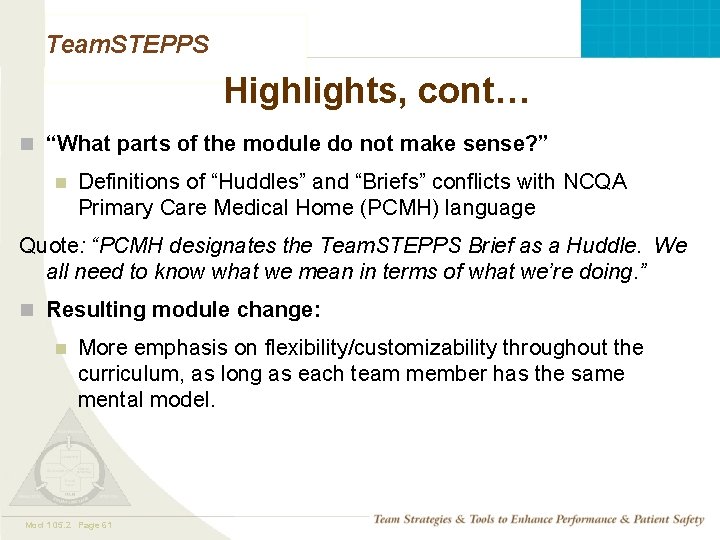
Team. STEPPS Highlights, cont… n “What parts of the module do not make sense? ” n Definitions of “Huddles” and “Briefs” conflicts with NCQA Primary Care Medical Home (PCMH) language Quote: “PCMH designates the Team. STEPPS Brief as a Huddle. We all need to know what we mean in terms of what we’re doing. ” n Resulting module change: n More emphasis on flexibility/customizability throughout the curriculum, as long as each team member has the same mental model. Mod 1 05. 2 Page 61 TEAMSTEPPS 05. 2
Team. STEPPS Video Production n Scenario video production – 4 paired scenarios (right way and wrong way) n Script changes influenced by field testing results n Each based on an actual event n Leadership, Communication, Mutual Support, Situation Monitoring Mod 1 05. 2 Page 62 TEAMSTEPPS 05. 2
Comprehensive Unit-based Safety Program Barbara Edson, RN, MBA, MHA VP, Clinical Quality Health Research and Educational Trust American Hospital Association
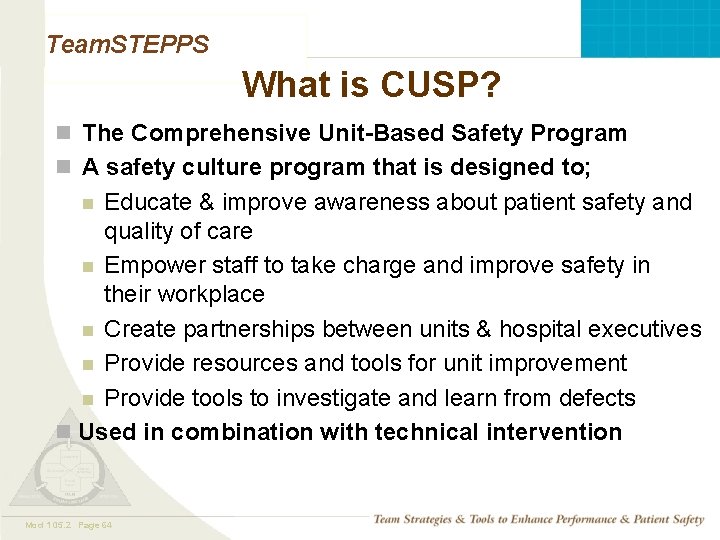
Team. STEPPS What is CUSP? n The Comprehensive Unit-Based Safety Program n A safety culture program that is designed to; Educate & improve awareness about patient safety and quality of care n Empower staff to take charge and improve safety in their workplace n Create partnerships between units & hospital executives n Provide resources and tools for unit improvement n Provide tools to investigate and learn from defects n Used in combination with technical intervention n Mod 1 05. 2 Page 64 TEAMSTEPPS 05. 2
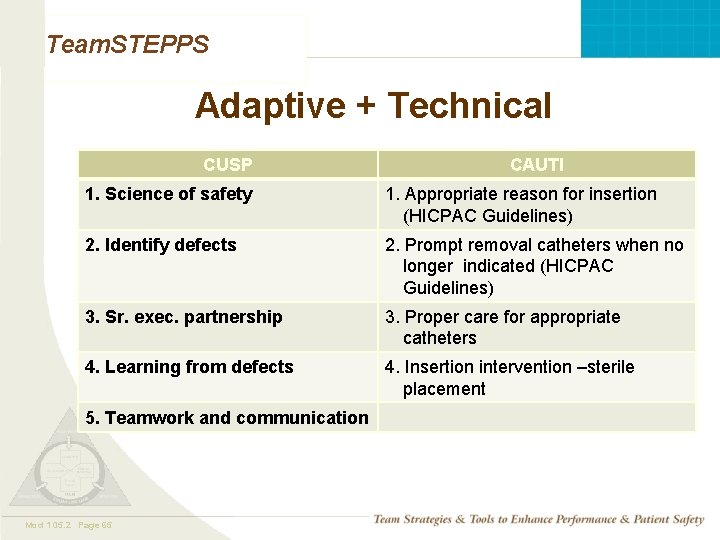
Team. STEPPS Adaptive + Technical CUSP CAUTI 1. Science of safety 1. Appropriate reason for insertion (HICPAC Guidelines) 2. Identify defects 2. Prompt removal catheters when no longer indicated (HICPAC Guidelines) 3. Sr. exec. partnership 3. Proper care for appropriate catheters 4. Learning from defects 4. Insertion intervention –sterile placement 5. Teamwork and communication Mod 1 05. 2 Page 65 TEAMSTEPPS 05. 2
Team. STEPPS CUSP Toolkit n Content –CUSP and other n n Funded by AHRQ Mod 1 05. 2 Page 66 n TEAMSTEPPS 05. 2 safety content Modular Power. Point presentations with facilitator notes Exercises Short video vignettes illustrating key messages Vignettes demonstrate CUSP used with various healthcare acquired conditions
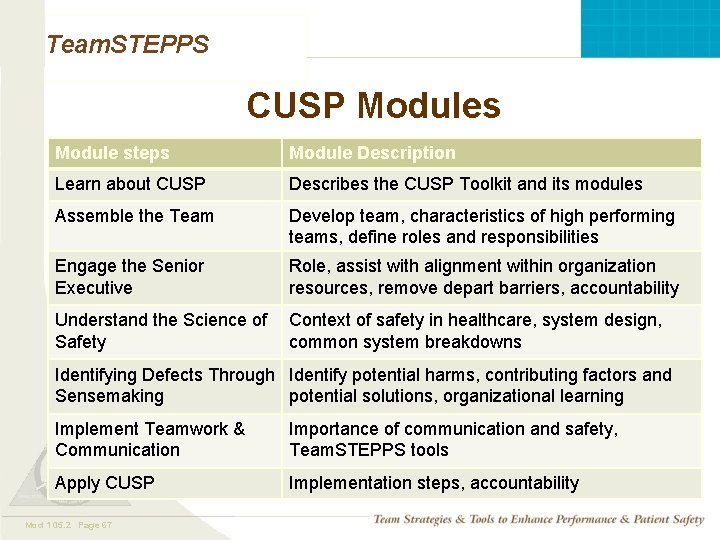
Team. STEPPS CUSP Modules Module steps Module Description Learn about CUSP Describes the CUSP Toolkit and its modules Assemble the Team Develop team, characteristics of high performing teams, define roles and responsibilities Engage the Senior Executive Role, assist with alignment within organization resources, remove depart barriers, accountability Understand the Science of Safety Context of safety in healthcare, system design, common system breakdowns Identifying Defects Through Identify potential harms, contributing factors and Sensemaking potential solutions, organizational learning Implement Teamwork & Communication Importance of communication and safety, Team. STEPPS tools Apply CUSP Implementation steps, accountability Mod 1 05. 2 Page 67 TEAMSTEPPS 05. 2
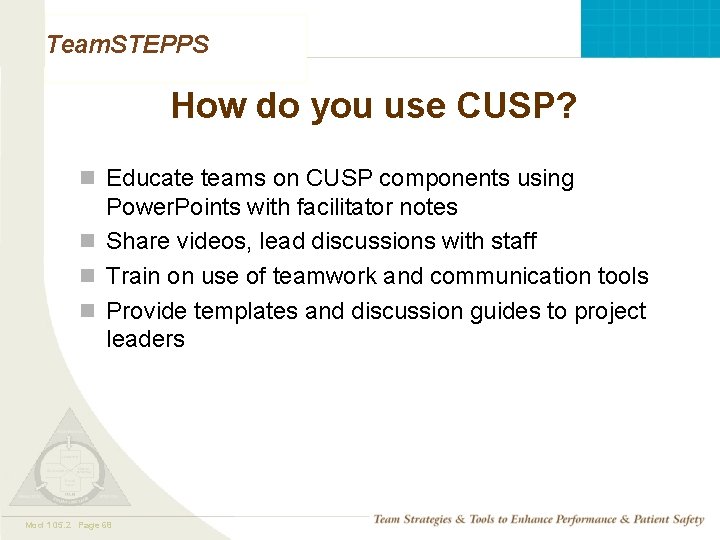
Team. STEPPS How do you use CUSP? n Educate teams on CUSP components using Power. Points with facilitator notes n Share videos, lead discussions with staff n Train on use of teamwork and communication tools n Provide templates and discussion guides to project leaders Mod 1 05. 2 Page 68 TEAMSTEPPS 05. 2
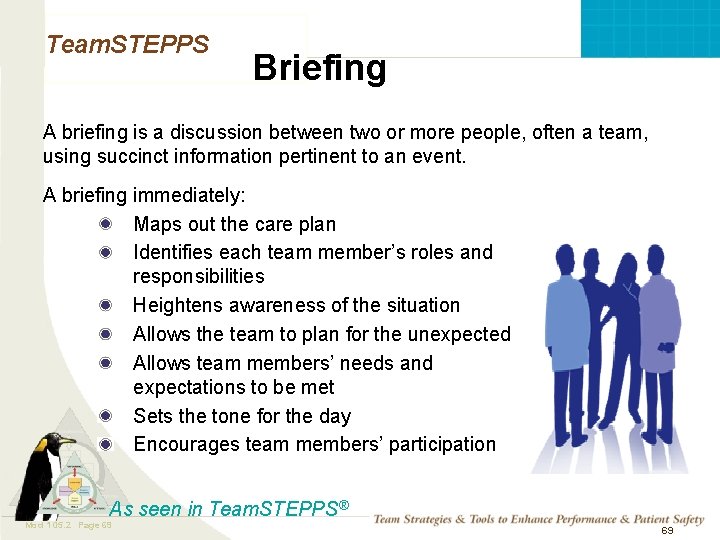
Team. STEPPS Briefing A briefing is a discussion between two or more people, often a team, using succinct information pertinent to an event. A briefing immediately: Maps out the care plan Identifies each team member’s roles and responsibilities Heightens awareness of the situation Allows the team to plan for the unexpected Allows team members’ needs and expectations to be met Sets the tone for the day Encourages team members’ participation As seen in Team. STEPPS® Mod 1 05. 2 Page 69 TEAMSTEPPS 05. 2 69
Team. STEPPS Mod 1 05. 2 Page 70 TEAMSTEPPS 05. 2
Team. STEPPS Mod 1 05. 2 Page 71 TEAMSTEPPS 05. 2
Team. STEPPS DISCUSSION AND Q&A Mod 1 05. 2 Page 72 TEAMSTEPPS 05. 2