
Friday 12 th February 2021 LO to use
Friday 12 th February 2021 LO: to use adjectives to create clarity.
Success Criteria • I know the features of a play script. • include a cast list of characters? • give a short description of each scene’s setting? • use a narrator to briefly set the scene for the audience? • write the speaker’s name on the left? • use a colon after the speaker’s name? • write dialogue (speech) without inverted commas? • put stage directions in brackets? • use the present tense? What is our continuous success criteria? • Using capital letters. • Using punctuations (. - , ‘ !) • Use simile and metaphor • Varied sentence structures • Use tier 1 and 2 vocabulary
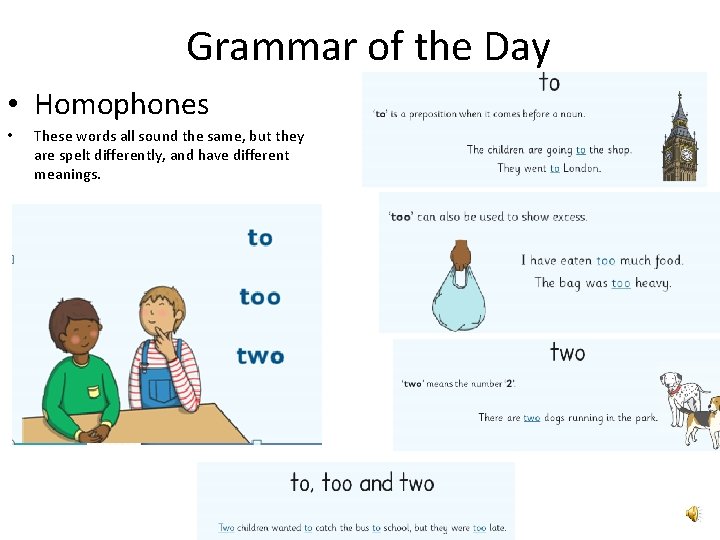
Grammar of the Day • Homophones • These words all sound the same, but they are spelt differently, and have different meanings.
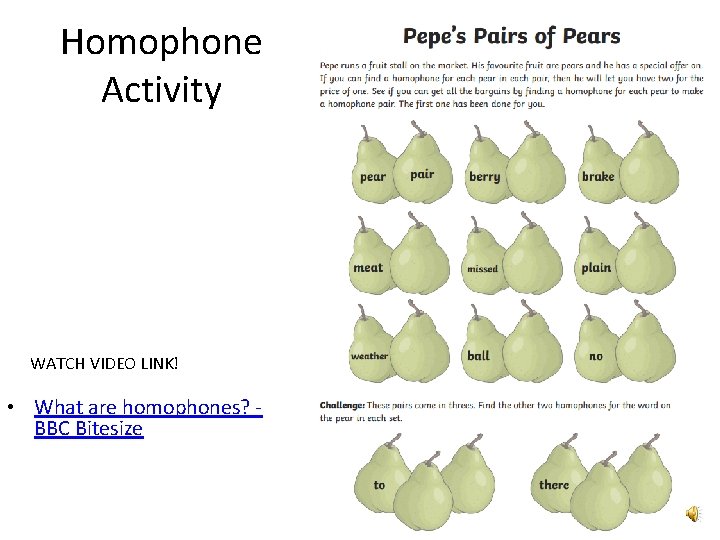
Homophone Activity WATCH VIDEO LINK! • What are homophones? BBC Bitesize
Let’s start our lesson!

Read the following extract from the Little Red Riding Hood Collection play script. You will need four characters: Big Rabbit, Little Rabbit, Mother and Red. Writing a Play Script
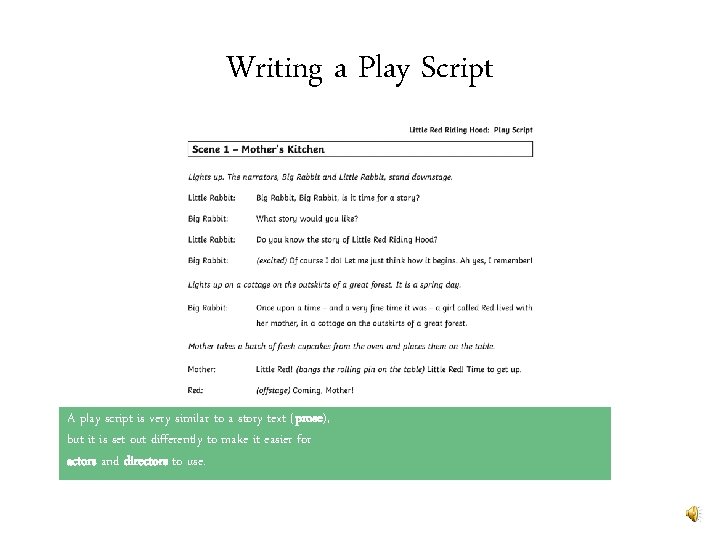
Writing a Play Script A play script is very similar to a story text (prose), but it is set out differently to make it easier for actors and directors to use.
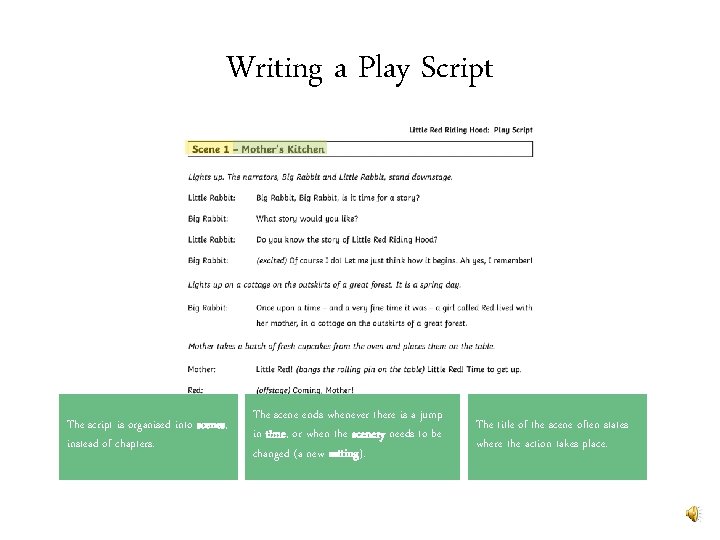
Writing a Play Script The script is organised into scenes, instead of chapters. The scene ends whenever there is a jump in time, or when the scenery needs to be changed (a new setting). The title of the scene often states where the action takes place.
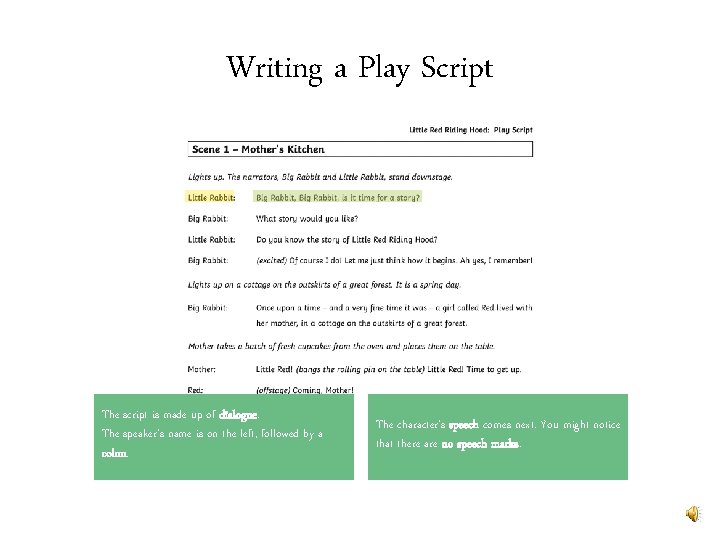
Writing a Play Script The script is made up of dialogue. The speaker’s name is on the left, followed by a colon. The character’s speech comes next. You might notice that there are no speech marks.
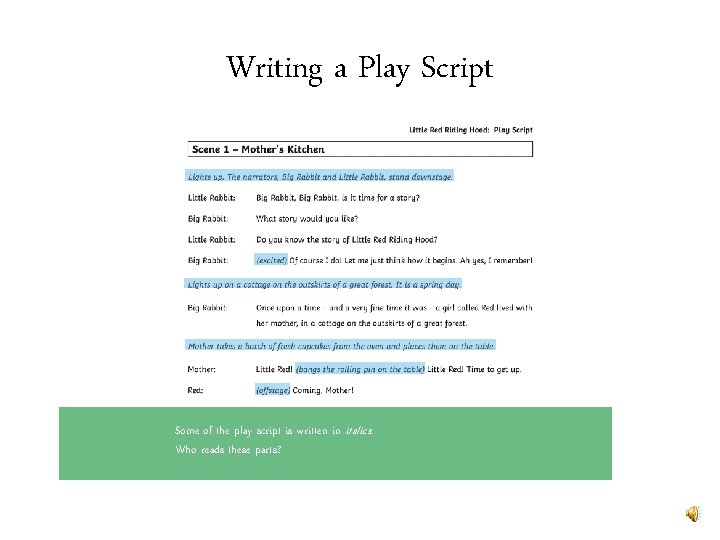
Writing a Play Script Some of the play script is written in italics. Who reads these parts?
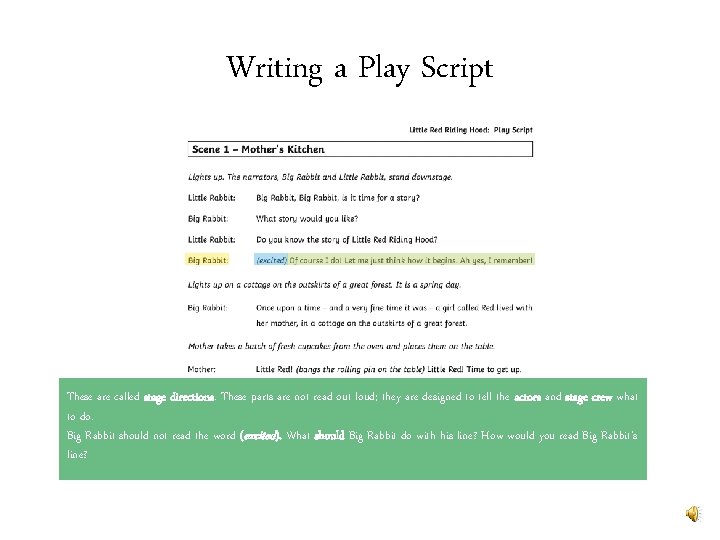
Writing a Play Script These are called stage directions. These parts are not read out loud; they are designed to tell the actors and stage crew what to do. Big Rabbit should not read the word (excited). What should Big Rabbit do with his line? How would you read Big Rabbit’s line?
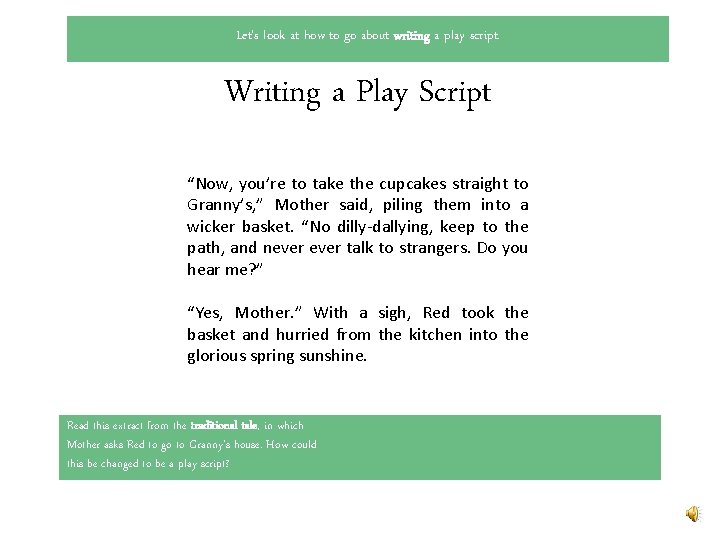
Let’s look at how to go about writing a play script. Writing a Play Script “Now, you’re to take the cupcakes straight to Granny’s, ” Mother said, piling them into a wicker basket. “No dilly-dallying, keep to the path, and never talk to strangers. Do you hear me? ” “Yes, Mother. ” With a sigh, Red took the basket and hurried from the kitchen into the glorious spring sunshine. Read this extract from the traditional tale, in which Mother asks Red to go to Granny’s house. How could this be changed to be a play script?
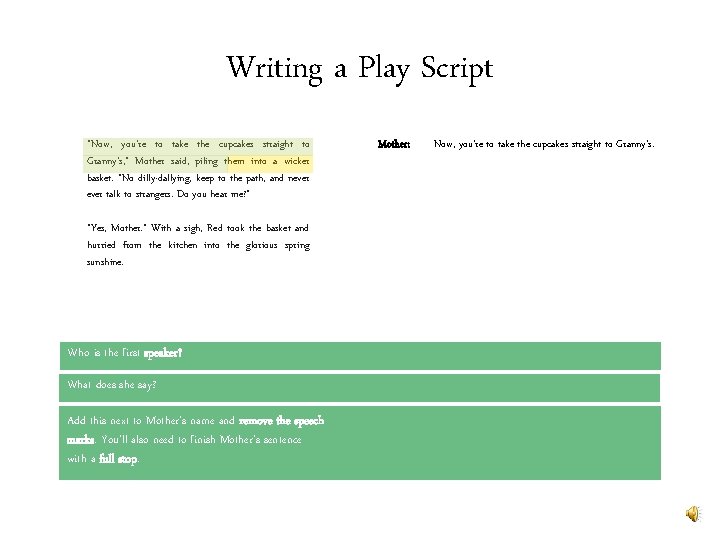
Writing a Play Script “Now, you’re to take the cupcakes straight to Granny’s, ” Mother said, piling them into a wicker basket. “No dilly-dallying, keep to the path, and never talk to strangers. Do you hear me? ” “Yes, Mother. ” With a sigh, Red took the basket and hurried from the kitchen into the glorious spring sunshine. Who is the first speaker? What does she say? Add this next to Mother’s name and remove the speech marks. You’ll also need to finish Mother’s sentence with a full stop. Mother: Now, you’re to take the cupcakes straight to Granny’s.
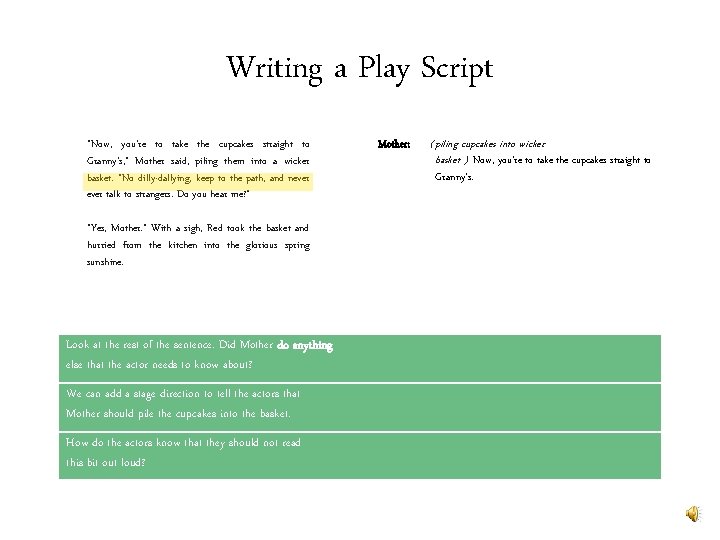
Writing a Play Script “Now, you’re to take the cupcakes straight to Granny’s, ” Mother said, piling them into a wicker basket. “No dilly-dallying, keep to the path, and never talk to strangers. Do you hear me? ” “Yes, Mother. ” With a sigh, Red took the basket and hurried from the kitchen into the glorious spring sunshine. Look at the rest of the sentence. Did Mother do anything else that the actor needs to know about? We can add a stage direction to tell the actors that Mother should pile the cupcakes into the basket. How do the actors know that they should not read this bit out loud? Mother: ( piling cupcakes into wicker basket ) Now, you’re to take the cupcakes straight to Granny’s.
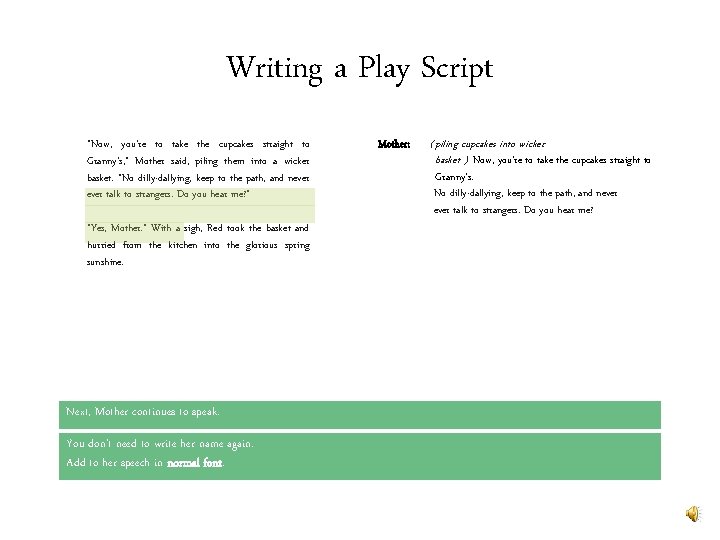
Writing a Play Script “Now, you’re to take the cupcakes straight to Granny’s, ” Mother said, piling them into a wicker basket. “No dilly-dallying, keep to the path, and never talk to strangers. Do you hear me? ” “Yes, Mother. ” With a sigh, Red took the basket and hurried from the kitchen into the glorious spring sunshine. Next, Mother continues to speak. You don’t need to write her name again. Add to her speech in normal font. Mother: ( piling cupcakes into wicker basket ) Now, you’re to take the cupcakes straight to Granny’s. No dilly-dallying, keep to the path, and never talk to strangers. Do you hear me?
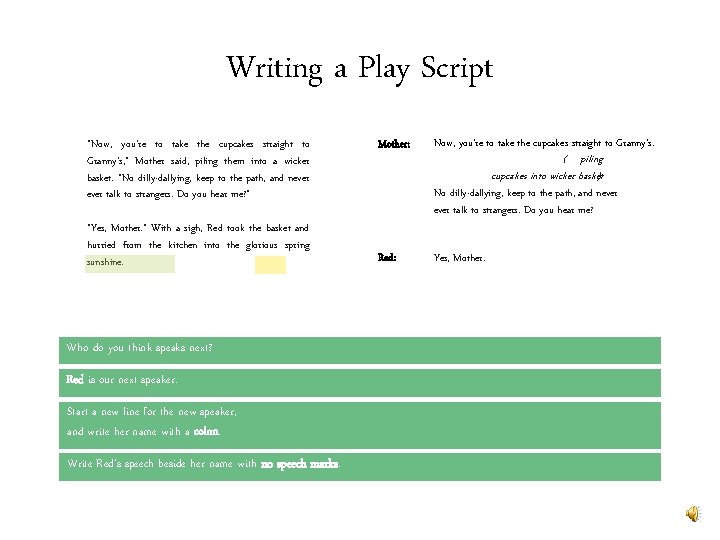
Writing a Play Script “Now, you’re to take the cupcakes straight to Granny’s, ” Mother said, piling them into a wicker basket. “No dilly-dallying, keep to the path, and never talk to strangers. Do you hear me? ” “Yes, Mother. ” With a sigh, Red took the basket and hurried from the kitchen into the glorious spring sunshine. Who do you think speaks next? Red is our next speaker. Start a new line for the new speaker, and write her name with a colon. Write Red’s speech beside her name with no speech marks. Mother: Now, you’re to take the cupcakes straight to Granny’s. ( piling cupcakes into wicker basket) No dilly-dallying, keep to the path, and never talk to strangers. Do you hear me? Red: Yes, Mother.
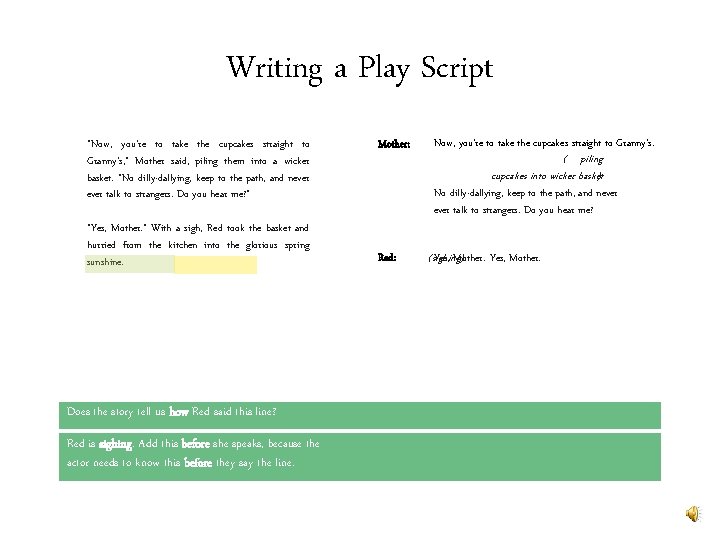
Writing a Play Script “Now, you’re to take the cupcakes straight to Granny’s, ” Mother said, piling them into a wicker basket. “No dilly-dallying, keep to the path, and never talk to strangers. Do you hear me? ” “Yes, Mother. ” With a sigh, Red took the basket and hurried from the kitchen into the glorious spring sunshine. Does the story tell us how Red said this line? Red is sighing. Add this before she speaks, because the actor needs to know this before they say the line. Mother: Now, you’re to take the cupcakes straight to Granny’s. ( piling cupcakes into wicker basket) No dilly-dallying, keep to the path, and never talk to strangers. Do you hear me? Red: (sighing) Yes, Mother.
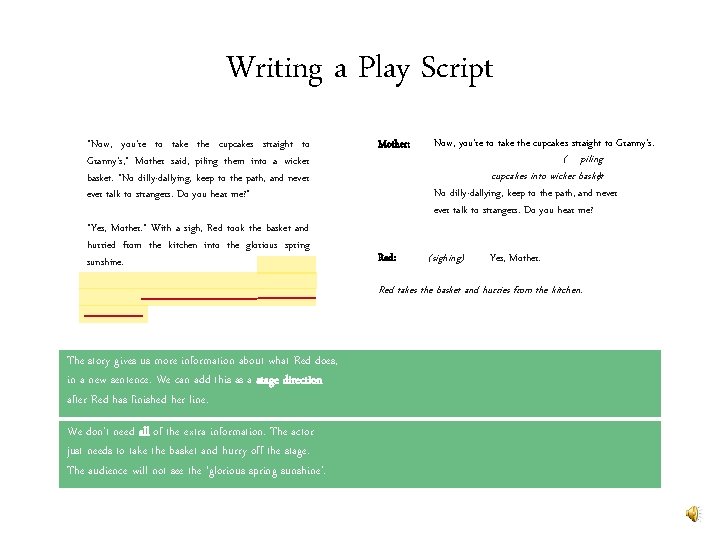
Writing a Play Script “Now, you’re to take the cupcakes straight to Granny’s, ” Mother said, piling them into a wicker basket. “No dilly-dallying, keep to the path, and never talk to strangers. Do you hear me? ” “Yes, Mother. ” With a sigh, Red took the basket and hurried from the kitchen into the glorious spring sunshine. Mother: Now, you’re to take the cupcakes straight to Granny’s. ( piling cupcakes into wicker basket) No dilly-dallying, keep to the path, and never talk to strangers. Do you hear me? Red: (sighing) Yes, Mother. Red takes the basket and hurries from the kitchen. The story gives us more information about what Red does, in a new sentence. We can add this as a stage direction after Red has finished her line. We don’t need all of the extra information. The actor just needs to take the basket and hurry off the stage. The audience will not see the ‘glorious spring sunshine’.
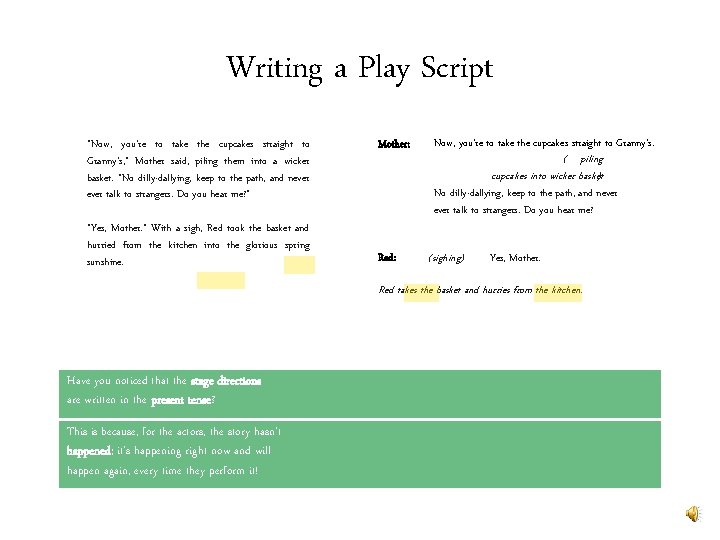
Writing a Play Script “Now, you’re to take the cupcakes straight to Granny’s, ” Mother said, piling them into a wicker basket. “No dilly-dallying, keep to the path, and never talk to strangers. Do you hear me? ” “Yes, Mother. ” With a sigh, Red took the basket and hurried from the kitchen into the glorious spring sunshine. Mother: Now, you’re to take the cupcakes straight to Granny’s. ( piling cupcakes into wicker basket) No dilly-dallying, keep to the path, and never talk to strangers. Do you hear me? Red: (sighing) Yes, Mother. Red takes the basket and hurries from the kitchen. Have you noticed that the stage directions are written in the present tense? This is because, for the actors, the story hasn’t happened; it’s happening right now and will happen again, every time they perform it!
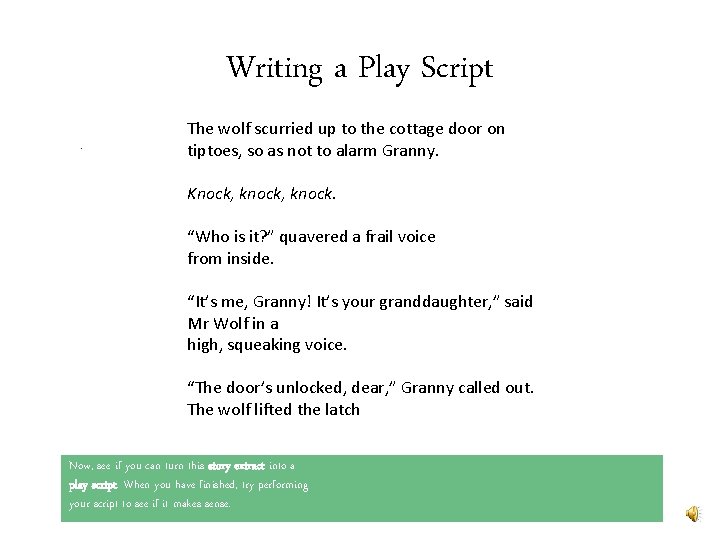
Writing a Play Script. The wolf scurried up to the cottage door on tiptoes, so as not to alarm Granny. Knock, knock. “Who is it? ” quavered a frail voice from inside. “It’s me, Granny! It’s your granddaughter, ” said Mr Wolf in a high, squeaking voice. “The door’s unlocked, dear, ” Granny called out. The wolf lifted the latch Now, see if you can turn this story extract into a play script. When you have finished, try performing your script to see if it makes sense.
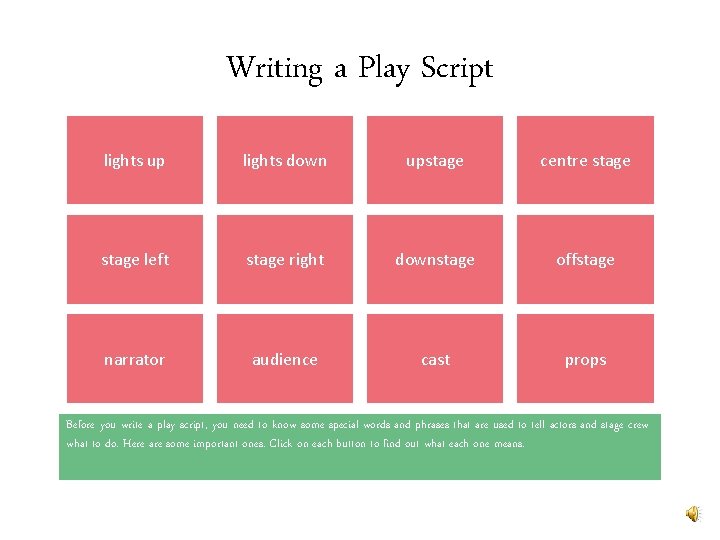
Writing a Play Script lights up lights down upstage centre stage left stage right downstage offstage narrator audience cast props Before you write a play script, you need to know some special words and phrases that are used to tell actors and stage crew what to do. Here are some important ones. Click on each button to find out what each one means.
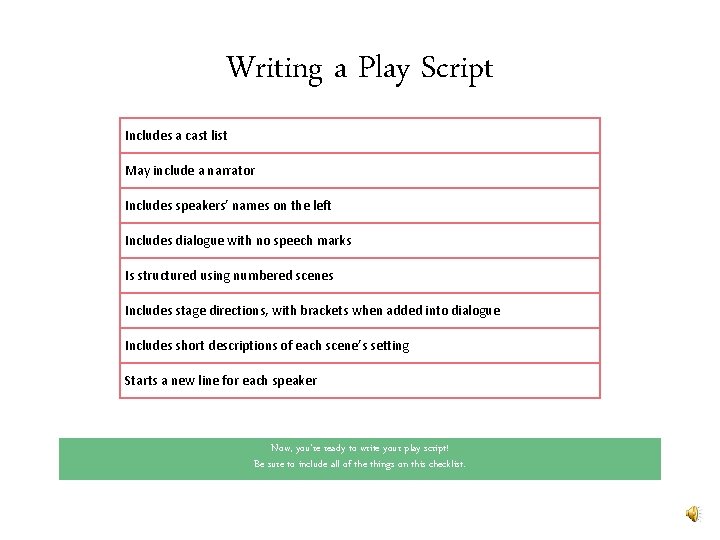
Writing a Play Script Includes a cast list May include a narrator Includes speakers’ names on the left Includes dialogue with no speech marks Is structured using numbered scenes Includes stage directions, with brackets when added into dialogue Includes short descriptions of each scene’s setting Starts a new line for each speaker Now, you’re ready to write your play script! Be sure to include all of the things on this checklist.
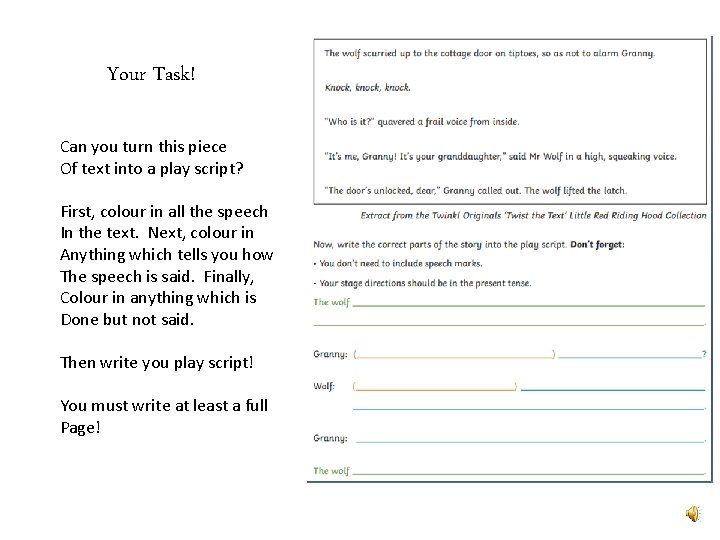
Your Task! Can you turn this piece Of text into a play script? First, colour in all the speech In the text. Next, colour in Anything which tells you how The speech is said. Finally, Colour in anything which is Done but not said. Then write you play script! You must write at least a full Page!
- Slides: 23