
Friday 0214 Happy Valentines Day 1 5 move
- Slides: 10
Friday 02/14 Happy Valentine's Day!! 1 -5: move to phylogenic tree 7 -8: cladograms lab/ ws
Advisory • Work make up day! • Everyone needs to be working on something! You only have until Tuesday to turn in any makeup/missing work from this quarter or it stays a zero!!
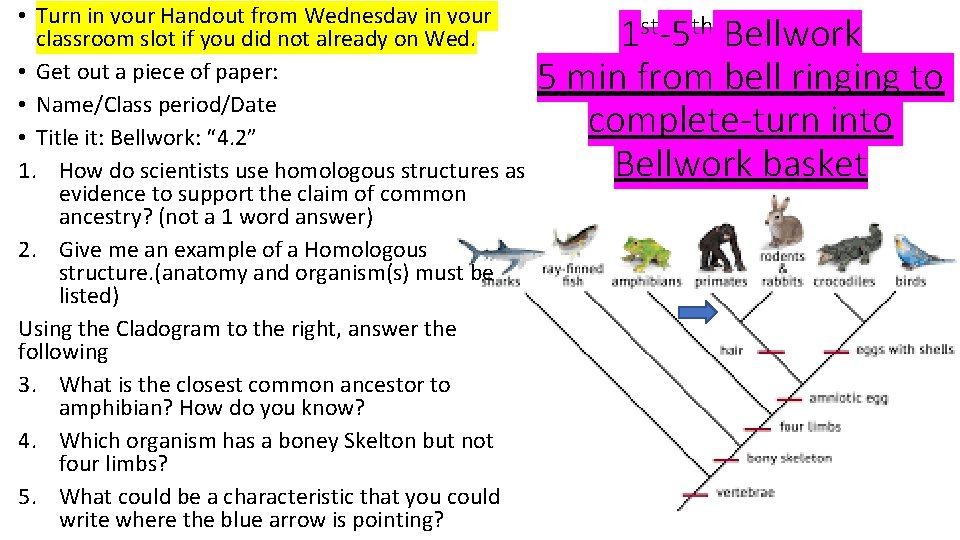
• Turn in your Handout from Wednesday in your classroom slot if you did not already on Wed. • Get out a piece of paper: • Name/Class period/Date • Title it: Bellwork: “ 4. 2” 1. How do scientists use homologous structures as evidence to support the claim of common ancestry? (not a 1 word answer) 2. Give me an example of a Homologous structure. (anatomy and organism(s) must be listed) Using the Cladogram to the right, answer the following 3. What is the closest common ancestor to amphibian? How do you know? 4. Which organism has a boney Skelton but not four limbs? 5. What could be a characteristic that you could write where the blue arrow is pointing? 1 st-5 th Bellwork 5 min from bell ringing to complete-turn into Bellwork basket
1 st -5 th period- you choose the order you work on the handouts…. ALL Due Tuesday!! Phylogenetic Tree handout 1. Go to Ms. sweet’s Website 2. Click on lesson plan links 3. Click on the “Part one” link under todays lesson and following along with the powerpoint. 4. Then click on “ part two” link and use the website to complete your phylogenic tree handout. 5. Turn in once complete Comparative Embryology handout 1. Got to lesson plan links and click on the interactive website link 2. Go through the steps and guess the Embryos 3. Then complete page 1 of the handout. 4. Once you have completed that you can pick up handout 2 from Ms. Sweet and use your 1 st handout to complete the second. 5. Staple and turn in once complete.
Bellwork 7 th & 8 th-5 min from bell to complete If you did not turn in your handout and/or textbook work turn that in now to your classroom slot. Make sure you name is on it! On a sheet of notebook paper write your name/class pd/date Title it : “Bellwork homologous structures” Answer the following- Answers only! 1. What does the word “Homologous” mean? 2. Name at least 1 type of anatomy that you witnessed was apparent in multiple organisms from yesterdays handout. 3. What can we infer from these anatomical similarities in a very different species? 4. List 1 observation made by Darwin during the beagle Voyage. 5. What would be an example of artificial selection- be specific(not a 1 word answer) 6. Turn into basket at Ms. Sweet’s Desk!!
Evolution Theories and DNA • The change & development of a species over the course of many generations is called EVOLUTION • These theory’s have been developed over time by scientist using data and fossils from the past as well as current species to support theory. • Lets review how traits are passed down from generation to generation. (from last year) • These traits can also be called characteristics of an organism. • https: //www. youtube. com/watch? v=Mehz 7 t. Cxj. SE&vl=en
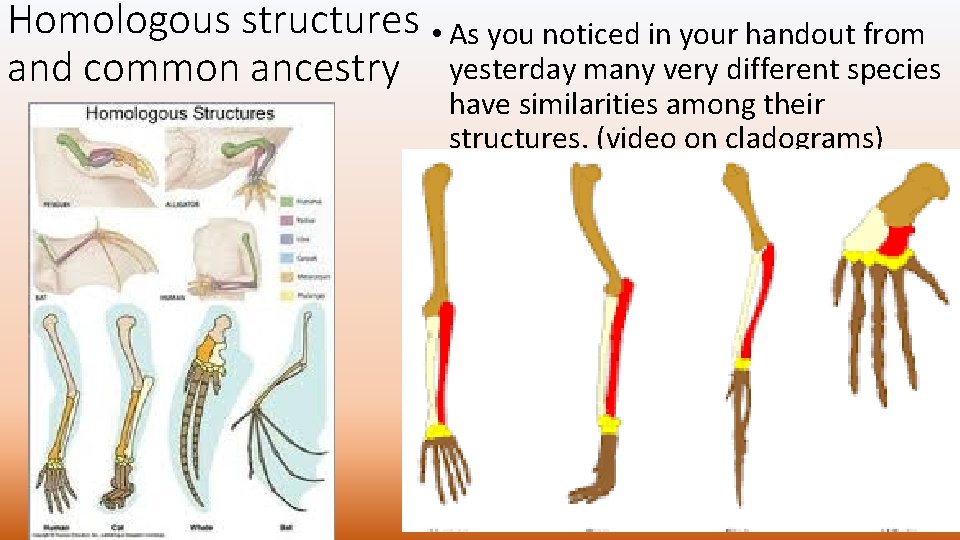
Homologous structures • As you noticed in your handout from and common ancestry yesterday many very different species have similarities among their structures. (video on cladograms)
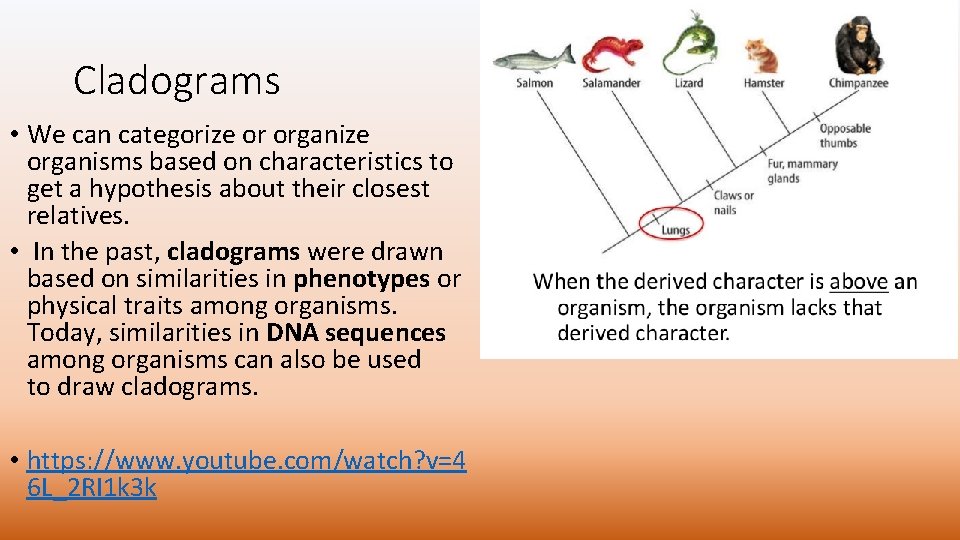
Cladograms • We can categorize or organize organisms based on characteristics to get a hypothesis about their closest relatives. • In the past, cladograms were drawn based on similarities in phenotypes or physical traits among organisms. Today, similarities in DNA sequences among organisms can also be used to draw cladograms. • https: //www. youtube. com/watch? v=4 6 L_2 RI 1 k 3 k
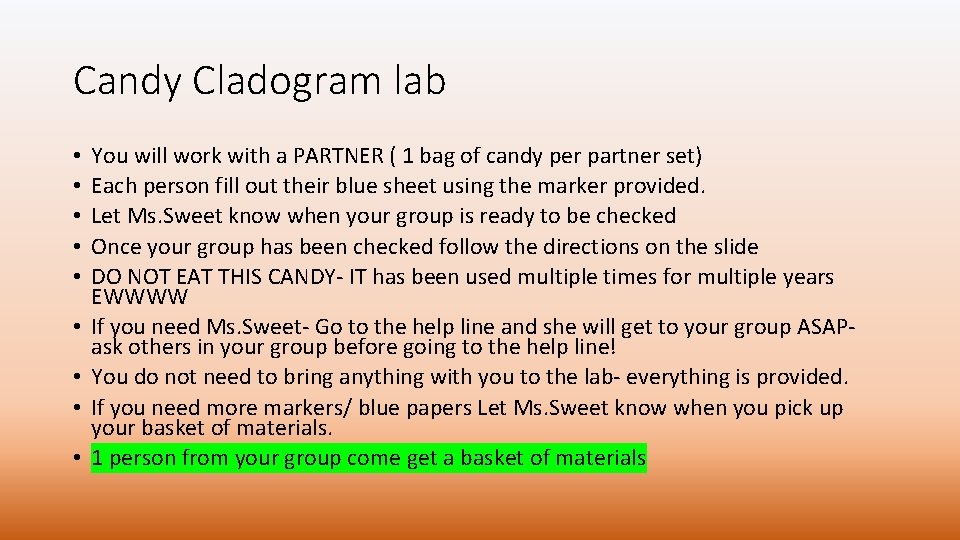
Candy Cladogram lab • • • You will work with a PARTNER ( 1 bag of candy per partner set) Each person fill out their blue sheet using the marker provided. Let Ms. Sweet know when your group is ready to be checked Once your group has been checked follow the directions on the slide DO NOT EAT THIS CANDY- IT has been used multiple times for multiple years EWWWW If you need Ms. Sweet- Go to the help line and she will get to your group ASAP- ask others in your group before going to the help line! You do not need to bring anything with you to the lab- everything is provided. If you need more markers/ blue papers Let Ms. Sweet know when you pick up your basket of materials. 1 person from your group come get a basket of materials
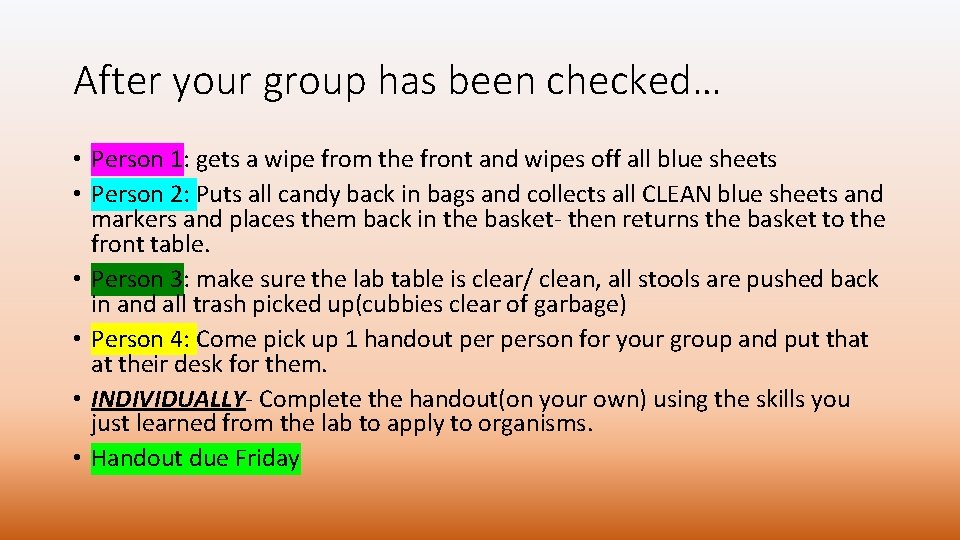
After your group has been checked… • Person 1: gets a wipe from the front and wipes off all blue sheets • Person 2: Puts all candy back in bags and collects all CLEAN blue sheets and markers and places them back in the basket- then returns the basket to the front table. • Person 3: make sure the lab table is clear/ clean, all stools are pushed back in and all trash picked up(cubbies clear of garbage) • Person 4: Come pick up 1 handout person for your group and put that at their desk for them. • INDIVIDUALLY- Complete the handout(on your own) using the skills you just learned from the lab to apply to organisms. • Handout due Friday