
Frictional Finance Fricofinance Lasse H Pedersen NYU CEPR

- Slides: 41
Frictional Finance “Fricofinance” Lasse H. Pedersen NYU, CEPR, and NBER Copyright 2010 © Lasse H. Pedersen Frictional Finance - Lasse H. Pedersen 1
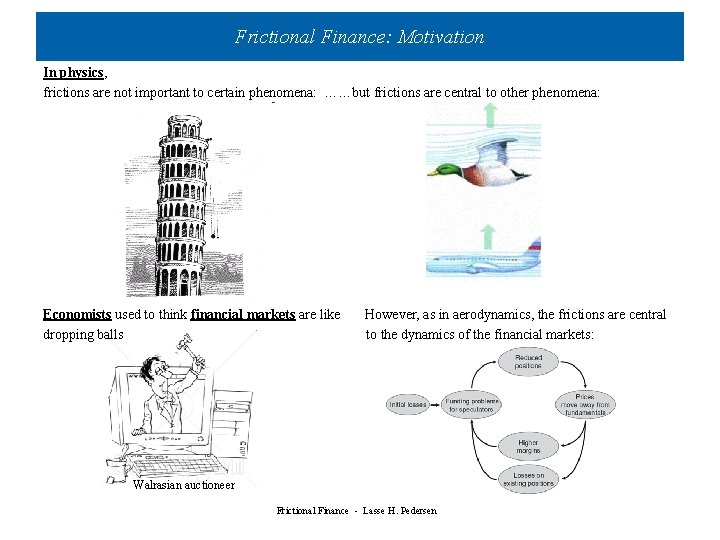
Frictional Finance: Motivation In physics, frictions are not important to certain phenomena: ……but frictions are central to other phenomena: Economists used to think financial markets are like dropping balls However, as in aerodynamics, the frictions are central to the dynamics of the financial markets: Walrasian auctioneer Frictional Finance - Lasse H. Pedersen
Frictional Finance: Implications Ø Financial frictions affect – – – Asset prices Macroeconomy (business cycles and allocation across sectors) Monetary policy Ø Parsimonious model provides unified explanation of a wide variety of phenomena Ø Empirical evidence is very strong – Stronger than almost any other influence on the markets, including systematic risk Frictional Finance - Lasse H. Pedersen
Frictional Finance: Definitions Ø Market liquidity risk: – Market liquidity = ability to trade at low cost (conversely, market illiquidity = trading cost) – Measured as bid-ask spread or as market impact – Market liquidity risk = risk that trading costs will rise – We will see there are 3 relevant liquidity betas Ø Funding liquidity risk: – Funding liquidity for a security = ability to borrow against that security – Measured as the security’s margin requirement or haircut – Funding liquidity for an investor = investor’s availability of capital relative to his need – “Measured” as Lagrange multiplier of margin constraint – Funding liquidity risk = risk of hitting margin constraint – Happens if margin requirement increases or capital decreases Frictional Finance - Lasse H. Pedersen
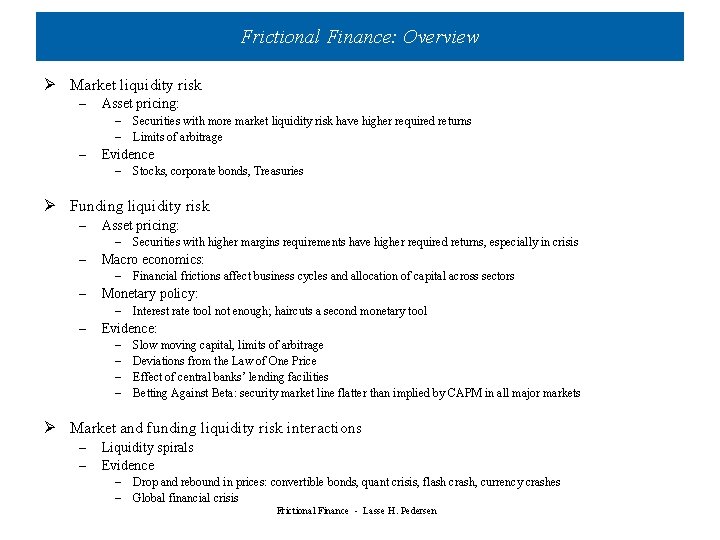
Frictional Finance: Overview Ø Market liquidity risk – Asset pricing: – Securities with more market liquidity risk have higher required returns – Limits of arbitrage – Evidence – Stocks, corporate bonds, Treasuries Ø Funding liquidity risk – Asset pricing: – Securities with higher margins requirements have higher required returns, especially in crisis – Macro economics: – Financial frictions affect business cycles and allocation of capital across sectors – Monetary policy: – Interest rate tool not enough; haircuts a second monetary tool – Evidence: – – Slow moving capital, limits of arbitrage Deviations from the Law of One Price Effect of central banks’ lending facilities Betting Against Beta: security market line flatter than implied by CAPM in all major markets Ø Market and funding liquidity risk interactions – – Liquidity spirals Evidence – Drop and rebound in prices: convertible bonds, quant crisis, flash crash, currency crashes – Global financial crisis Frictional Finance - Lasse H. Pedersen
Chairman Bernanke: “Crucial Lesson” “Some more-successful firms also consistently embedded market liquidity premiums in their pricing models and valuations. ” “Another crucial lesson from recent events is that financial institutions must understand their [funding] liquidity needs at an enterprise-wide level and be prepared for the possibility that market liquidity may erode quickly and unexpectedly. ” “Consistent with its role as the nation's central bank, the Federal Reserve has responded not only with an easing of monetary policy but also with a number of steps aimed at reducing funding pressures for depository institutions and primary securities dealers and at improving overall market liquidity and market functioning. ” – Chairman Ben S. Bernanke, May 13, 2008 Frictional Finance - Lasse H. Pedersen
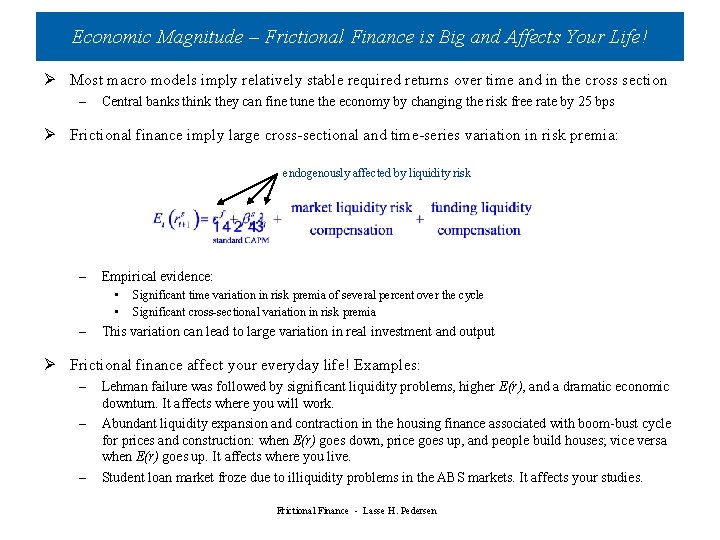
Economic Magnitude – Frictional Finance is Big and Affects Your Life! Ø Most macro models imply relatively stable required returns over time and in the cross section – Central banks think they can fine tune the economy by changing the risk free rate by 25 bps Ø Frictional finance imply large cross-sectional and time-series variation in risk premia: endogenously affected by liquidity risk – Empirical evidence: • • – Significant time variation in risk premia of several percent over the cycle Significant cross-sectional variation in risk premia This variation can lead to large variation in real investment and output Ø Frictional finance affect your everyday life! Examples: – – – Lehman failure was followed by significant liquidity problems, higher E(r), and a dramatic economic downturn. It affects where you will work. Abundant liquidity expansion and contraction in the housing finance associated with boom-bust cycle for prices and construction: when E(r) goes down, price goes up, and people build houses; vice versa when E(r) goes up. It affects where you live. Student loan market froze due to illiquidity problems in the ABS markets. It affects your studies. Frictional Finance - Lasse H. Pedersen
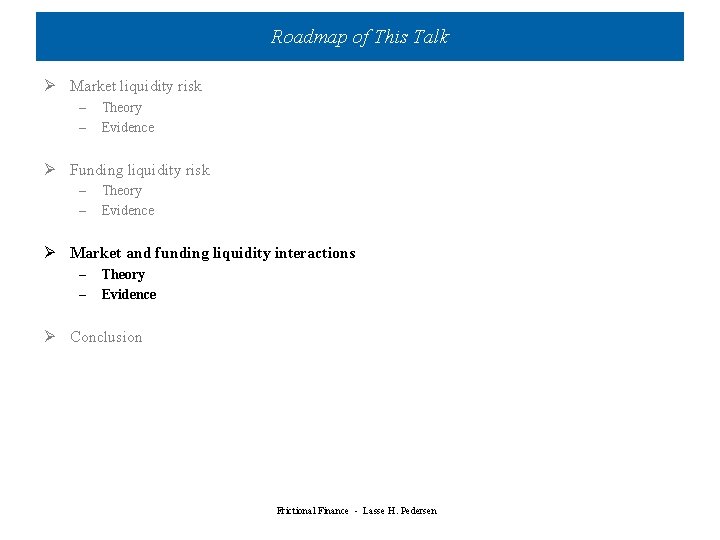
Roadmap of This Talk Ø Market liquidity risk – – Theory Evidence Ø Funding liquidity risk – – Theory Evidence Ø Market and funding liquidity interactions – – Theory Evidence Ø Conclusion Frictional Finance - Lasse H. Pedersen
Models of Market Liquidity Ø Market liquidity as trading costs – – Liquidity level: Amihud and Mendelson (JFE 1986), Constantinides (1986), Vayanos (1998) Liquidity level and risk: Acharya and Pedersen (JFE 2005) Ø Market liquidity as search: – Duffie, Garleanu, and Pedersen (Econometrica 2005, RFS 2007), Garleanu and Pedersen (AER 2007), Weill (2007), Vayanos and Weill (JF 2008), Duffie and Strulovici (2009) Ø Asset pricing with market liquidity as asymmetric information – Wang (1993), Garleanu and Pedersen (RFS 2004) Ø Survey – Amihud, Mendelson, and Pedersen (2005) Ø This presentation: follows Acharya and Pedersen (JFE 2005) Frictional Finance - Lasse H. Pedersen
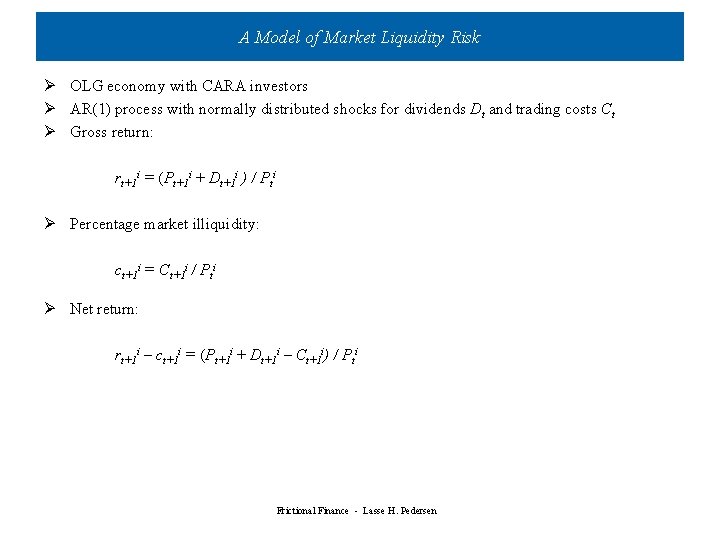
A Model of Market Liquidity Risk Ø OLG economy with CARA investors Ø AR(1) process with normally distributed shocks for dividends Dt and trading costs Ct Ø Gross return: rt+1 i = (Pt+1 i + Dt+1 i ) / Pti Ø Percentage market illiquidity: ct+1 i = Ct+1 i / Pti Ø Net return: rt+1 i – ct+1 i = (Pt+1 i + Dt+1 i – Ct+1 i) / Pti Frictional Finance - Lasse H. Pedersen
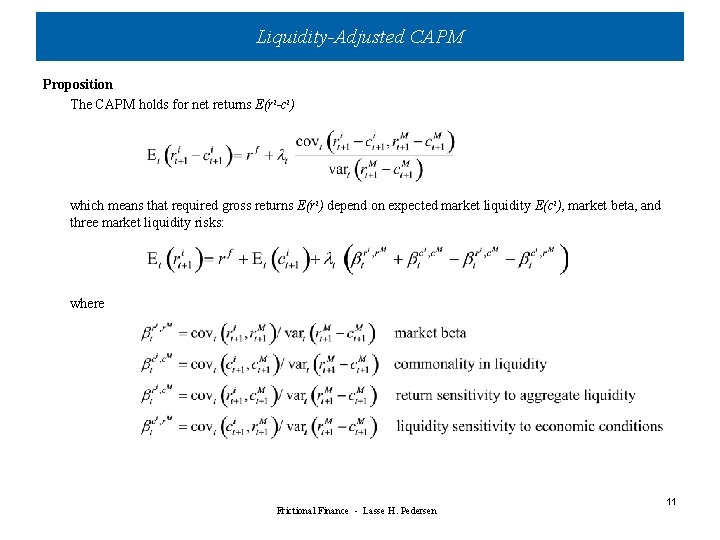
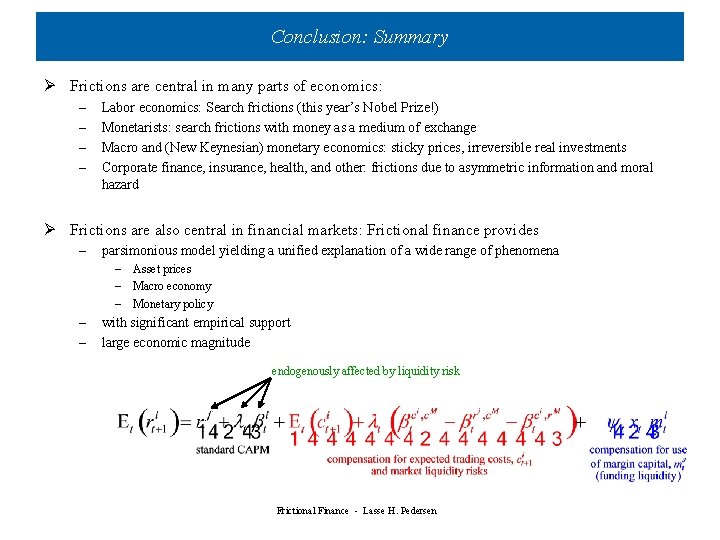
Liquidity-Adjusted CAPM Proposition The CAPM holds for net returns E(ri-ci) which means that required gross returns E(ri) depend on expected market liquidity E(ci), market beta, and three market liquidity risks: where Frictional Finance - Lasse H. Pedersen 11
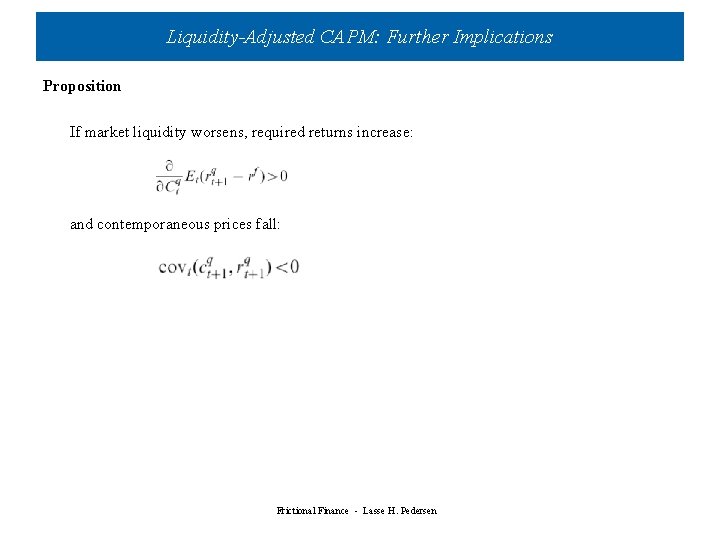
Liquidity-Adjusted CAPM: Further Implications Proposition If market liquidity worsens, required returns increase: and contemporaneous prices fall: Frictional Finance - Lasse H. Pedersen
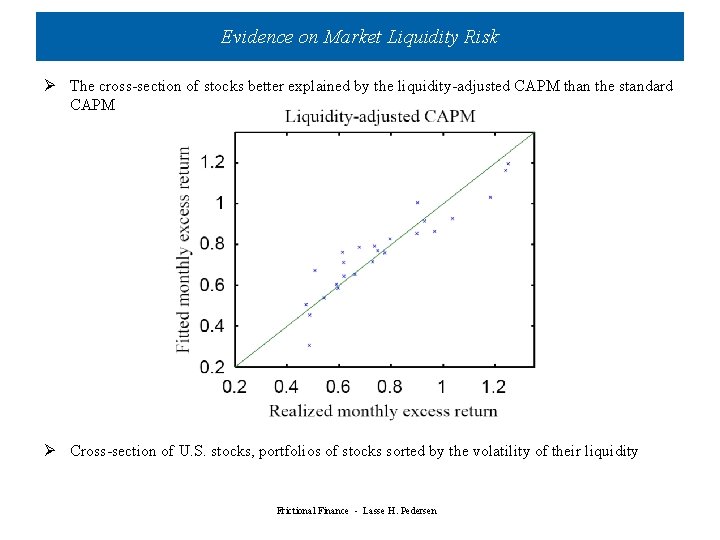
Evidence on Market Liquidity Risk Ø The cross-section of stocks better explained by the liquidity-adjusted CAPM than the standard CAPM Ø Cross-section of U. S. stocks, portfolios of stocks sorted by the volatility of their liquidity Frictional Finance - Lasse H. Pedersen
Roadmap of This Talk Ø Market liquidity risk – – Theory Evidence Ø Funding liquidity risk – – Theory Evidence Ø Market and funding liquidity interactions – – Theory Evidence Ø Conclusion Frictional Finance - Lasse H. Pedersen
Models of Funding Liquidity Ø Margin requirements, asset pricing, and deviations from the Law of One Price: – Garleanu and Pedersen (WP 2010) Ø Margin requirements and leverage constraints and the returns of stocks, bonds, credit: – Frazzini and Pedersen (WP 2010) Ø Margin requirements, macro economics, and monetary policy: – Ashcraft, Garleanu, Pedersen (NBER Macroannual 2010) Ø Funding liquidity and systemic risk – Acharya, Pedersen, Philippon, and Richardson (WP 2010) Ø This presentation: follows Ashcraft, Garleanu, Pedersen (2010), which relies on Garleanu and Pedersen (2010) and further implications are explored in Frazzini and Pedersen (2010) Frictional Finance - Lasse H. Pedersen
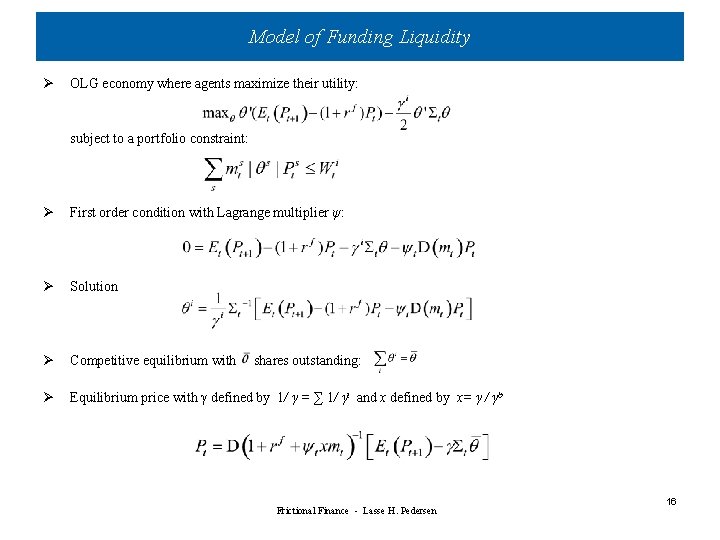
Model of Funding Liquidity Ø OLG economy where agents maximize their utility: subject to a portfolio constraint: Ø First order condition with Lagrange multiplier ψ: Ø Solution Ø Competitive equilibrium with Ø Equilibrium price with γ defined by 1/ γ = ∑ 1/ γi and x defined by x= γ / γb shares outstanding: Frictional Finance - Lasse H. Pedersen 16
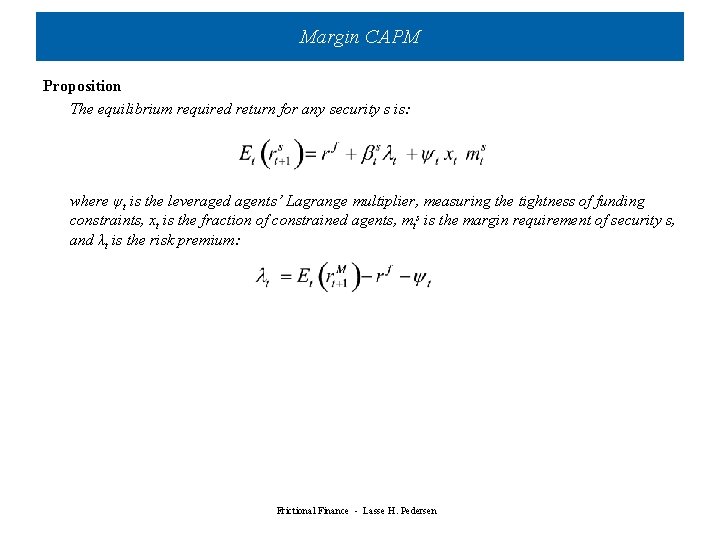
Margin CAPM Proposition The equilibrium required return for any security s is: where ψt is the leveraged agents’ Lagrange multiplier, measuring the tightness of funding constraints, xt is the fraction of constrained agents, mts is the margin requirement of security s, and λt is the risk premium: Frictional Finance - Lasse H. Pedersen
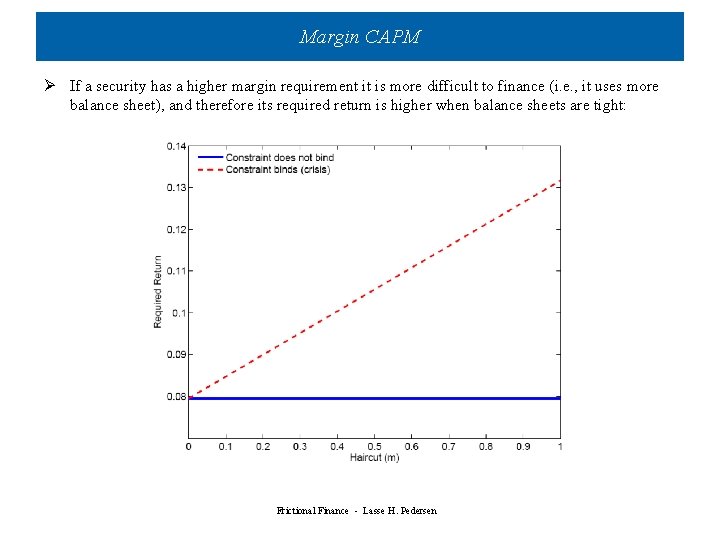
Margin CAPM Ø If a security has a higher margin requirement it is more difficult to finance (i. e. , it uses more balance sheet), and therefore its required return is higher when balance sheets are tight: Frictional Finance - Lasse H. Pedersen
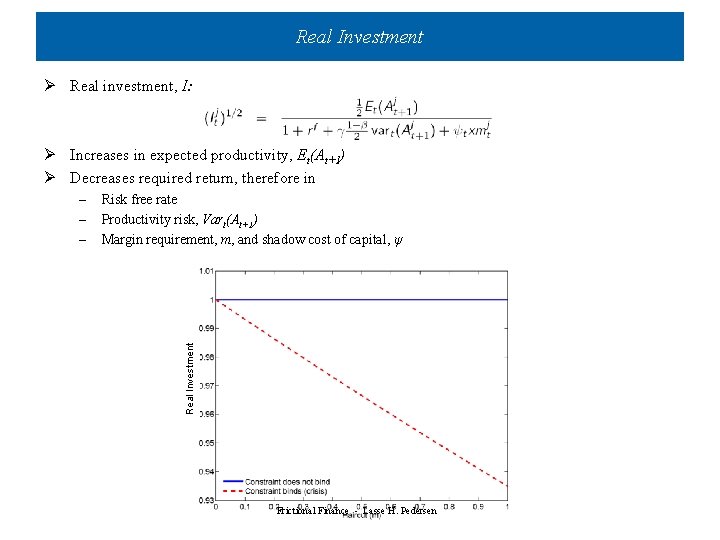
Real Investment Ø Real investment, I: Ø Increases in expected productivity, Et(At+1) Ø Decreases required return, therefore in Risk free rate Productivity risk, Vart(At+1) Margin requirement, m, and shadow cost of capital, ψ Real Investment – – – Frictional Finance - Lasse H. Pedersen
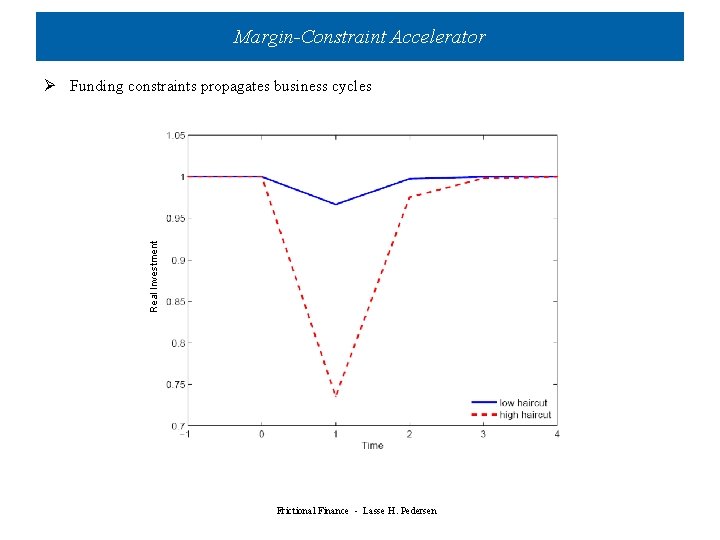
Margin-Constraint Accelerator Real Investment Ø Funding constraints propagates business cycles Frictional Finance - Lasse H. Pedersen
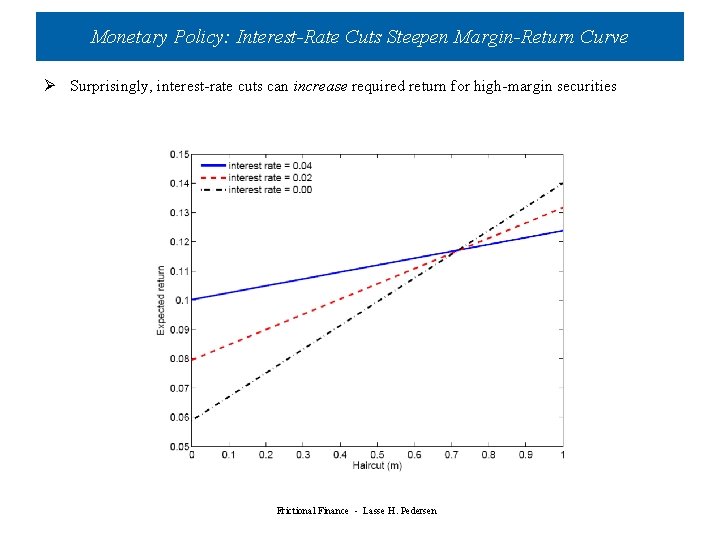
Monetary Policy: Interest-Rate Cuts Steepen Margin-Return Curve Ø Surprisingly, interest-rate cuts can increase required return for high-margin securities Frictional Finance - Lasse H. Pedersen
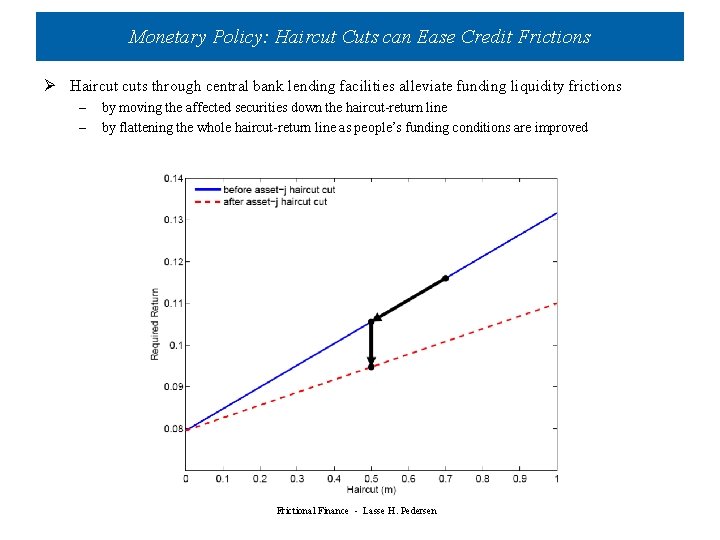
Monetary Policy: Haircut Cuts can Ease Credit Frictions Ø Haircut cuts through central bank lending facilities alleviate funding liquidity frictions – – by moving the affected securities down the haircut-return line by flattening the whole haircut-return line as people’s funding conditions are improved Frictional Finance - Lasse H. Pedersen
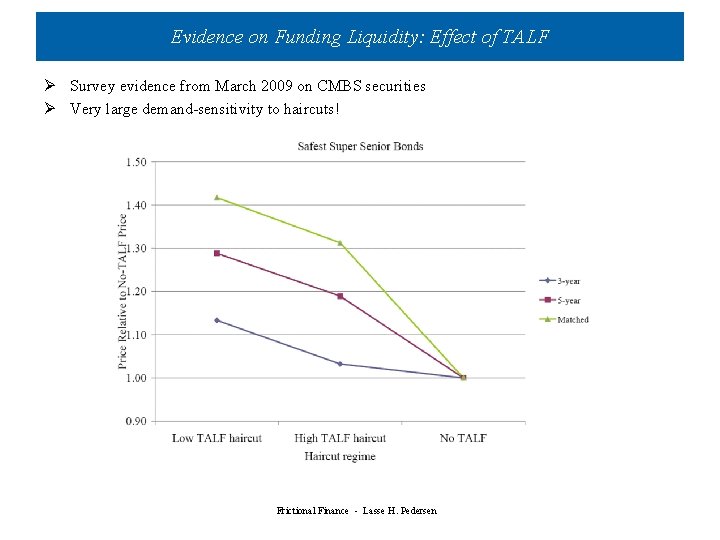
Evidence on Funding Liquidity: Effect of TALF Ø Survey evidence from March 2009 on CMBS securities Ø Very large demand-sensitivity to haircuts! Frictional Finance - Lasse H. Pedersen
Evidence on Funding Liquidity: Effect of TALF Ø Survey evidence from March 2009 on CMBS securities Ø Demand sensitivity measured in terms of yields – – Improving funding conditions can lower required returns by several percentage points Note that the Fed had lowered the short rate from 5% to zero and hit the zero lower bound Frictional Finance - Lasse H. Pedersen
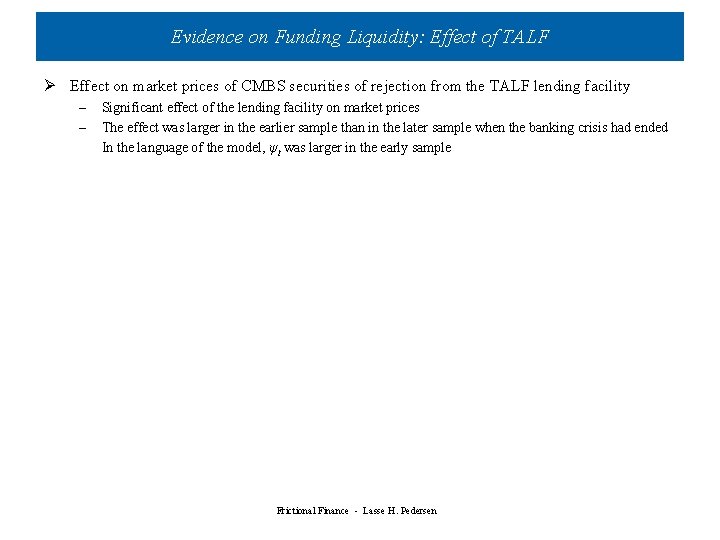
Evidence on Funding Liquidity: Effect of TALF Ø Effect on market prices of CMBS securities of rejection from the TALF lending facility – – Significant effect of the lending facility on market prices The effect was larger in the earlier sample than in the later sample when the banking crisis had ended In the language of the model, ψt was larger in the early sample Frictional Finance - Lasse H. Pedersen
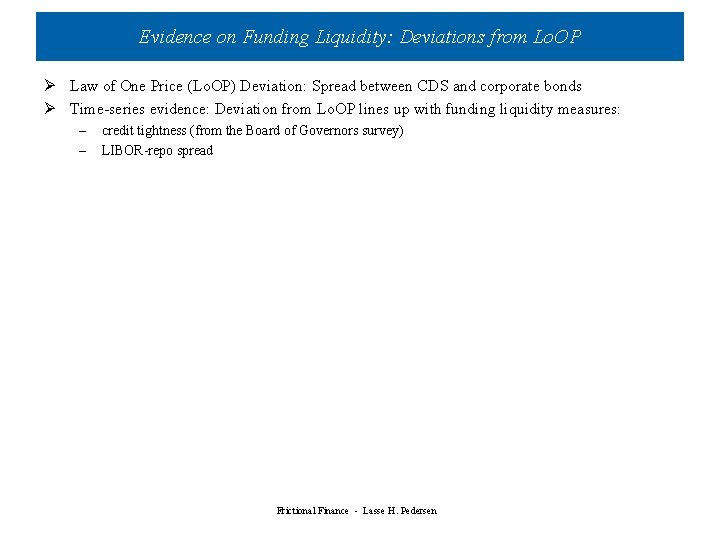
Evidence on Funding Liquidity: Deviations from Lo. OP Ø Law of One Price (Lo. OP) Deviation: Spread between CDS and corporate bonds Ø Time-series evidence: Deviation from Lo. OP lines up with funding liquidity measures: – – credit tightness (from the Board of Governors survey) LIBOR-repo spread Frictional Finance - Lasse H. Pedersen
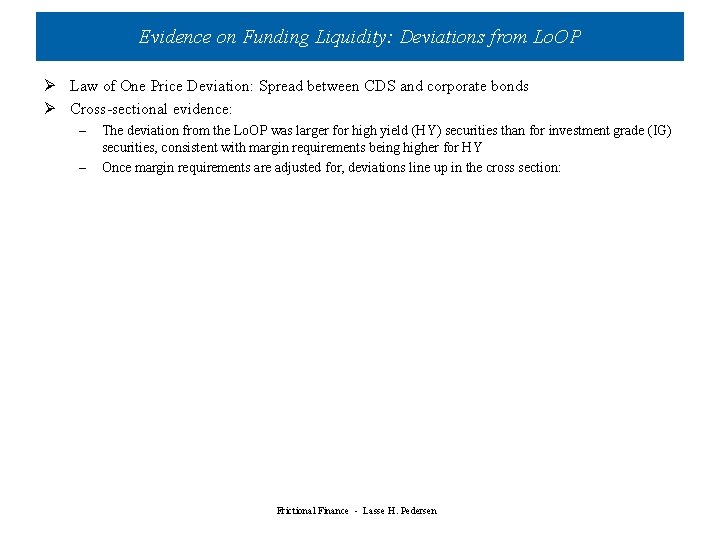
Evidence on Funding Liquidity: Deviations from Lo. OP Ø Law of One Price Deviation: Spread between CDS and corporate bonds Ø Cross-sectional evidence: – – The deviation from the Lo. OP was larger for high yield (HY) securities than for investment grade (IG) securities, consistent with margin requirements being higher for HY Once margin requirements are adjusted for, deviations line up in the cross section: Frictional Finance - Lasse H. Pedersen
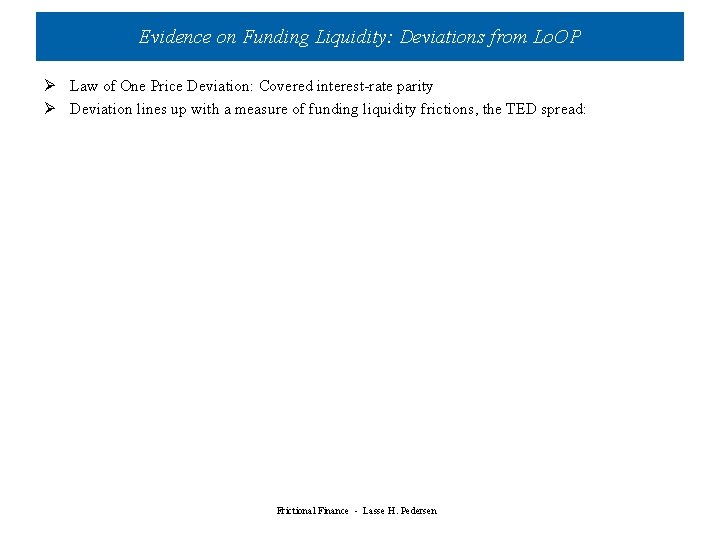
Evidence on Funding Liquidity: Deviations from Lo. OP Ø Law of One Price Deviation: Covered interest-rate parity Ø Deviation lines up with a measure of funding liquidity frictions, the TED spread: Frictional Finance - Lasse H. Pedersen
Roadmap of This Talk Ø Market liquidity risk – – Theory Evidence Ø Funding liquidity risk – – Theory Evidence Ø Market and funding liquidity interactions – – Theory Evidence Ø Conclusion Frictional Finance - Lasse H. Pedersen
Models of Market and Funding Liquidity Interaction Ø Liquidity spirals, fragility, and bank balance sheets as drivers of crises: – Brunnermeier and Pedersen (JF 2005, RFS 2009) Ø Amplification when everyone tries to manage risk: – Garleanu and Pedersen (AER 2007) Ø When everyone runs for the exit: – Pedersen (IJCB 2009) Frictional Finance - Lasse H. Pedersen
Liquidity Spirals Ø Market and funding liquidity problems can reinforce each other, creating a systemic crisis Ø Source: Brunnermeier and Pedersen (RFS 2009) Frictional Finance - Lasse H. Pedersen
Implications of Market and Funding Liquidity Interactions Ø Fragility: a small shock can lead to large changes in liquidity and prices – Because of liquidity spirals and discontinuous switch from liquid equilibrium to illiquid equilibrium Ø Commonality in market liquidity: – Different securities’ market liquidity co-move since they are driven by common funding shocks Ø Spillover effects: – A shock to one market spills over to the markets when it significantly impairs to capital of financial institutions Ø Market liquidity related to risk – Because funding terms are Ø Flight to quality Ø Negative skewness of assets held by leveraged investors and leveraged investors’ portfolio returns – Since losses are amplified by liquidity spirals, while gains are not Ø Source: Brunnermeier and Pedersen (RFS 2009) Frictional Finance - Lasse H. Pedersen
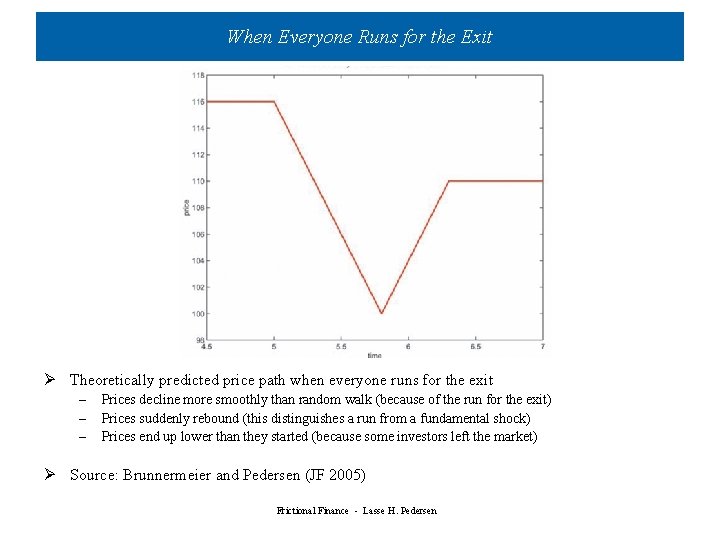
When Everyone Runs for the Exit Ø Theoretically predicted price path when everyone runs for the exit – – – Prices decline more smoothly than random walk (because of the run for the exit) Prices suddenly rebound (this distinguishes a run from a fundamental shock) Prices end up lower than they started (because some investors left the market) Ø Source: Brunnermeier and Pedersen (JF 2005) Frictional Finance - Lasse H. Pedersen
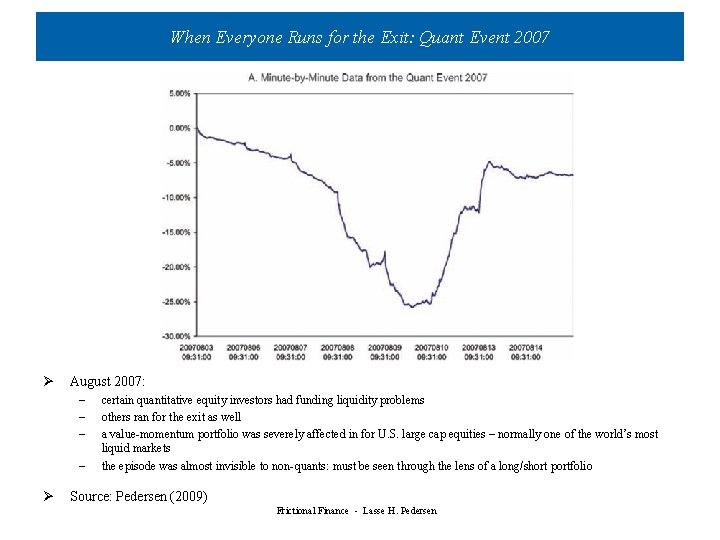
When Everyone Runs for the Exit: Quant Event 2007 Ø August 2007: – – Ø certain quantitative equity investors had funding liquidity problems others ran for the exit as well a value-momentum portfolio was severely affected in for U. S. large cap equities – normally one of the world’s most liquid markets the episode was almost invisible to non-quants: must be seen through the lens of a long/short portfolio Source: Pedersen (2009) Frictional Finance - Lasse H. Pedersen
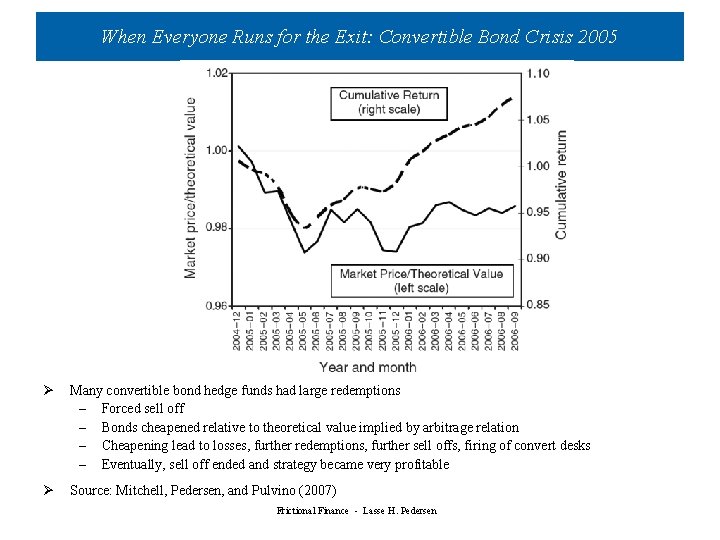
When Everyone Runs for the Exit: Convertible Bond Crisis 2005 Ø Many convertible bond hedge funds had large redemptions – Forced sell off – Bonds cheapened relative to theoretical value implied by arbitrage relation – Cheapening lead to losses, further redemptions, further sell offs, firing of convert desks – Eventually, sell off ended and strategy became very profitable Ø Source: Mitchell, Pedersen, and Pulvino (2007) Frictional Finance - Lasse H. Pedersen
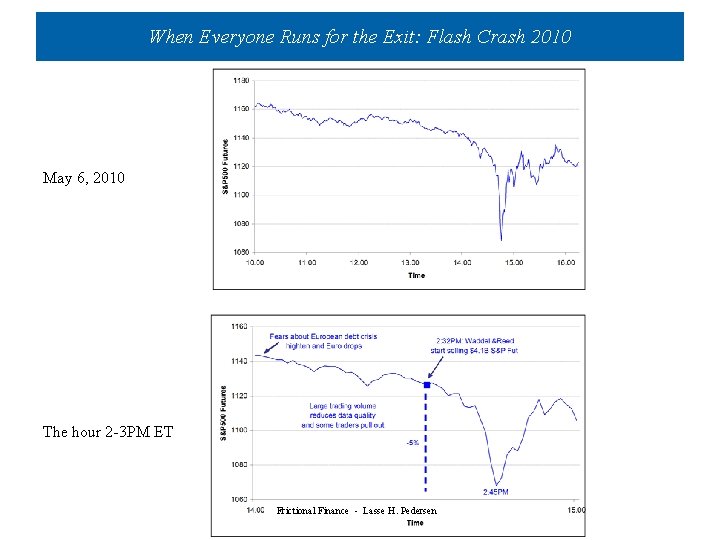
When Everyone Runs for the Exit: Flash Crash 2010 May 6, 2010 The hour 2 -3 PM ET Frictional Finance - Lasse H. Pedersen
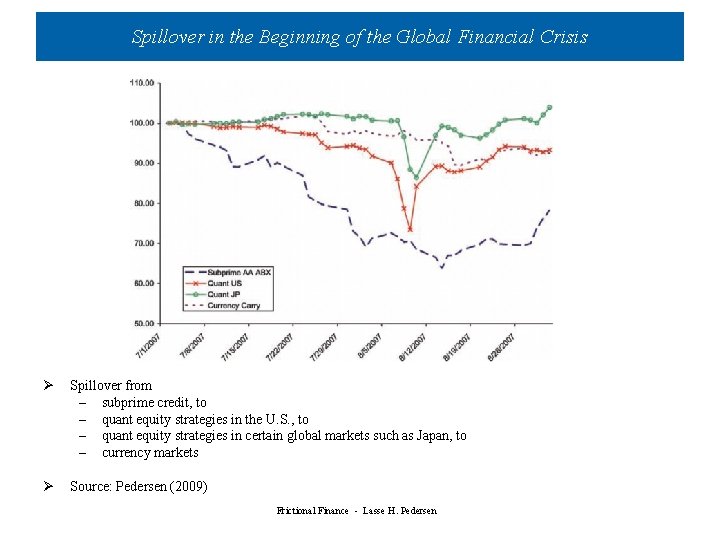
Spillover in the Beginning of the Global Financial Crisis Ø Spillover from – subprime credit, to – quant equity strategies in the U. S. , to – quant equity strategies in certain global markets such as Japan, to – currency markets Ø Source: Pedersen (2009) Frictional Finance - Lasse H. Pedersen
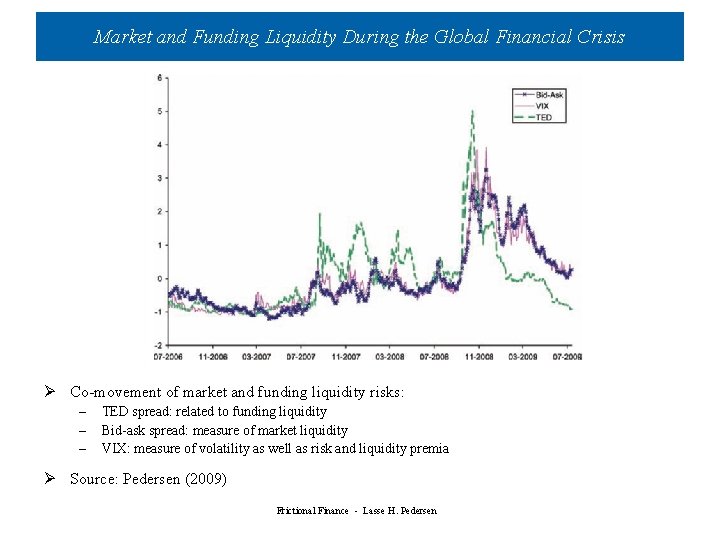
Market and Funding Liquidity During the Global Financial Crisis Ø Co-movement of market and funding liquidity risks: – – – TED spread: related to funding liquidity Bid-ask spread: measure of market liquidity VIX: measure of volatility as well as risk and liquidity premia Ø Source: Pedersen (2009) Frictional Finance - Lasse H. Pedersen
Conclusion: Summary Ø Frictions are central in many parts of economics: – – Labor economics: Search frictions (this year’s Nobel Prize!) Monetarists: search frictions with money as a medium of exchange Macro and (New Keynesian) monetary economics: sticky prices, irreversible real investments Corporate finance, insurance, health, and other: frictions due to asymmetric information and moral hazard Ø Frictions are also central in financial markets: Frictional finance provides – parsimonious model yielding a unified explanation of a wide range of phenomena – Asset prices – Macro economy – Monetary policy – – with significant empirical support large economic magnitude endogenously affected by liquidity risk Frictional Finance - Lasse H. Pedersen
Frictional Finance: Some Interesting Questions for Further Research Ø Macro and real consequences of financial frictions – Analyze how financial frictions affect allocation of capital, real investment, output, R&D, etc. – – Ø In theory and empirically. Also, why are funding markets so opaque? What if they are made more transparent? What is the best structure for the funding markets? Various forms of repo, tri-party repo, prime brokerage, leverage through derivatives, or other forms? What is the best market structure for trading, e. g. the structure that best prevents market breakdown? – Ø Ø As long as an investor can either sell a security or borrow against it, he can mitigate his liquidity problem (though market and funding liquidity often disappear at the same time due to liquidity spirals) What are the underlying determinants of margin requirements/haircuts and repo rates? – – – Ø Lots more theoretical implications and empirical tests to do! E. g. , can the effects of market liquidity and funding liquidity be empirically distinguished? Market and funding liquidity as substitutes – Ø How do financial frictions affect the monetary transmission mechanism? What happens when bank capital is low? DSGE model with margin requirements: quantify effects of financial frictions with price rigidities and Taylor rule Asset pricing implications of financial frictions – – Ø Welfare implications: Why do people want/need to trade so much? Theory of trading volume? How can financial frictions be alleviated? How much would this change welfare quantitatively? Monetary economics – – Ø Over time Across firms/ industries/ sectors Across countries/ regions E. g. what if continuous trading is replaced by having an auction every minute so that some people don’t have an advantage from being faster than others? What is the optimal liquidity risk management for a trader? What other areas of economics are affected by financial frictions? Frictional Finance - Lasse H. Pedersen
Other Related Papers (Incomplete List) Ø Macro and general equilibrium models: – Ø Monetary models with frictions: – Ø Diamond and Dybvig (1983), Shleifer and Vishny (1992), Holmstrom and Tirole (1997, 2001), Acharya and Viswanathan (2010) Dynamic trading with predictable returns and transaction costs: – Ø Duffie (2010, AFA Presidential address) Corporate finance and banking: – Ø Gromb and Vayanos (2002) Limited attention and slow moving capital: – Ø Shleifer and Vishny (1997) Liquidity and welfare when arbitrageurs have margin constraints – Ø Hindy (1995), Cuoco (1997), Detemple and Murthy (1997), Basak and Croitoru (2000), Coen-Pirani (2005), Gorton and Metrick (2009), Adrian and Shin (2010), Greenwood and Vayanos (2010) Limits of arbitrage: – Ø Curdia and Woodford (2009), Gertler and Karadi (2009) Asset pricing and constraints: – Ø Bernanke and Gertler (1989), Constantinides and Duffie (1996), Geanakoplos (1997), Kiyotaki and Moore (1997, 2008), Aiyagari and Gertler (1999), Lorenzoni (2008), Brunnermeier and Sannikov (2010), He and Krishnamurthy (2010) Garleanu and Pedersen (2008) Informational frictions in asset markets – Grossman and Stiglitz (1980) Frictional Finance - Lasse H. Pedersen