
Friction Objectives of The Lesson Explain what Friction
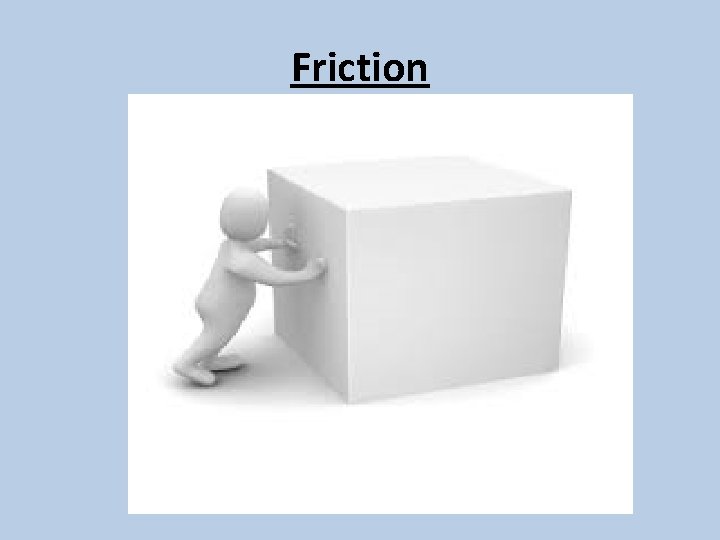
Friction
Objectives of The Lesson • Explain what Friction is • Identify the Four types of Friction • Explain the Coefficient of Friction and how to work it out
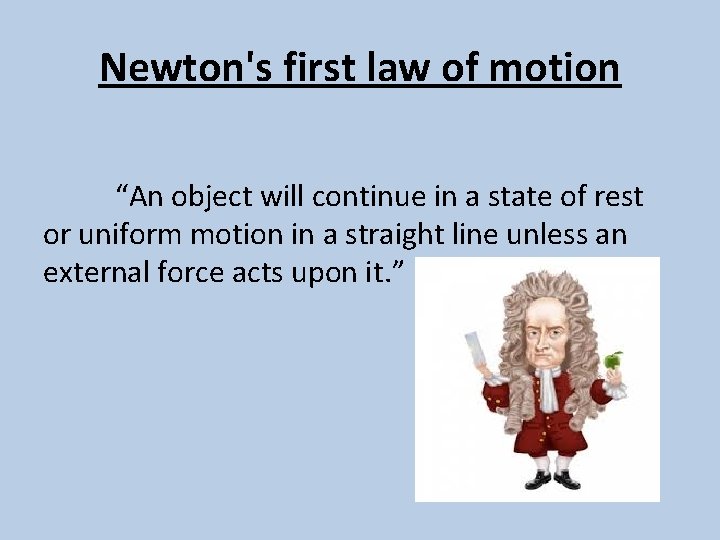
Newton's first law of motion “An object will continue in a state of rest or uniform motion in a straight line unless an external force acts upon it. ”
Introduction To Friction • On Earth, experience suggests that moving objects soon stop moving if there is nothing to keep pushing them. • But on Earth, virtually all moving objects have Frictional Forces acting against them.
Friction The Force That Slows • Friction is the name given to the Force that tries to stop Materials sliding across each other. – There is Friction between your hands when you rub them together. – There is Friction between your shoes and the ground when you walk along.
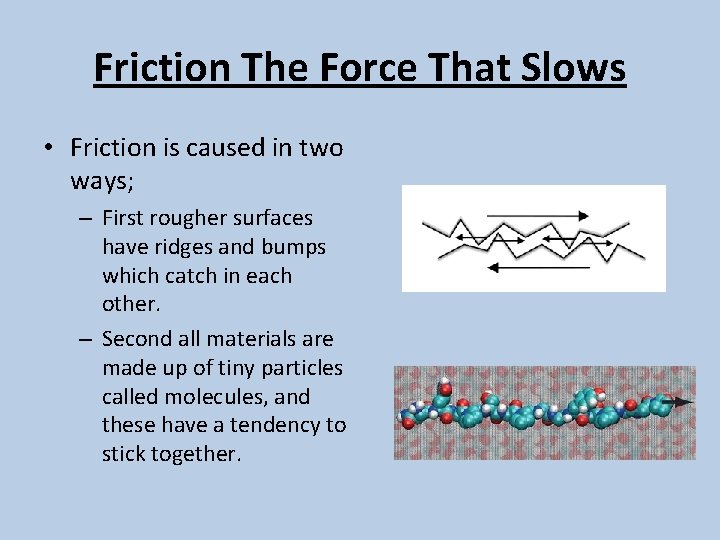
Friction The Force That Slows • Friction is caused in two ways; – First rougher surfaces have ridges and bumps which catch in each other. – Second all materials are made up of tiny particles called molecules, and these have a tendency to stick together.
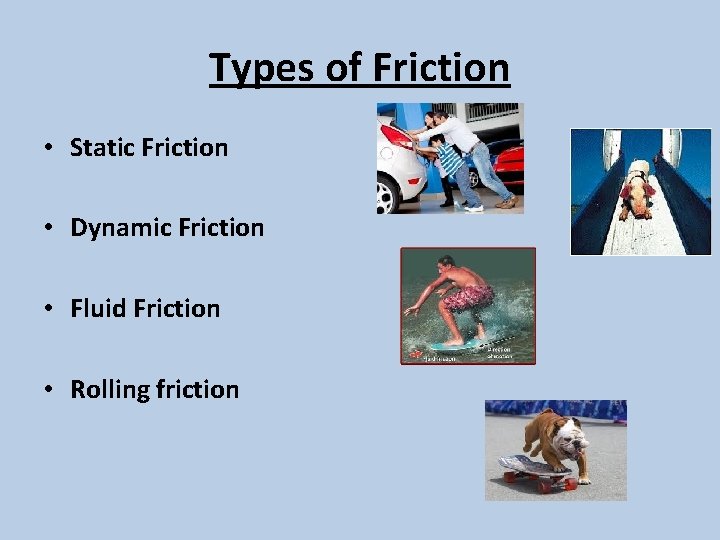
Types of Friction • Static Friction • Dynamic Friction • Fluid Friction • Rolling friction
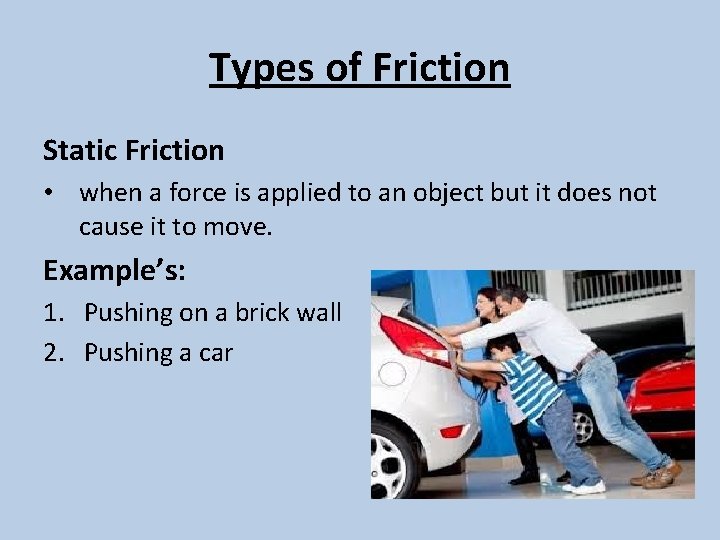
Types of Friction Static Friction • when a force is applied to an object but it does not cause it to move. Example’s: 1. Pushing on a brick wall 2. Pushing a car
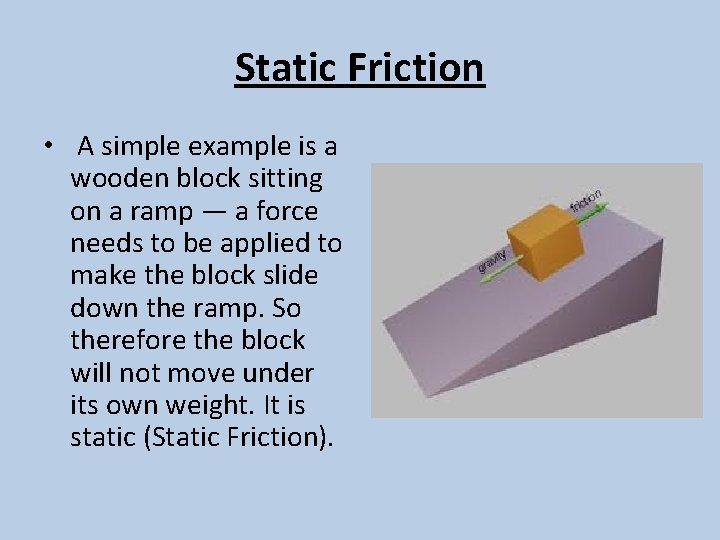
Static Friction • A simple example is a wooden block sitting on a ramp — a force needs to be applied to make the block slide down the ramp. So therefore the block will not move under its own weight. It is static (Static Friction).
Static Friction • Friction between two or more solid objects that are not moving relative to each other. For example, Static Friction can prevent an object from sliding down a sloped surface. • It resists the movement of two objects against one another when the objects are initially at rest.
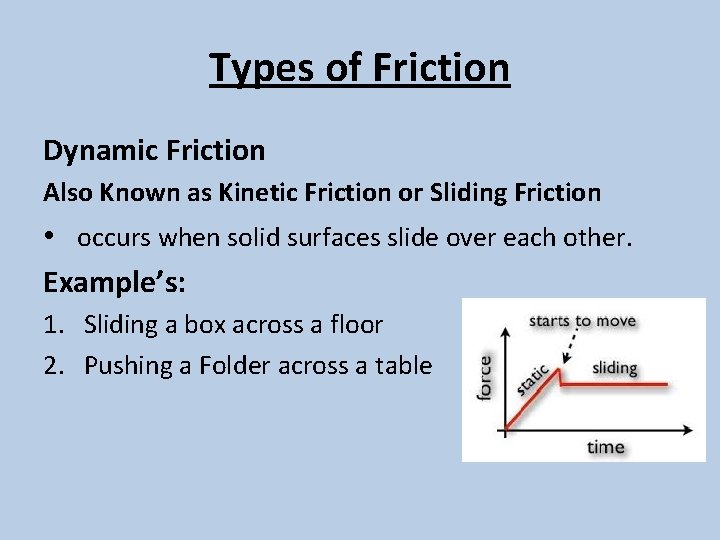
Types of Friction Dynamic Friction Also Known as Kinetic Friction or Sliding Friction • occurs when solid surfaces slide over each other. Example’s: 1. Sliding a box across a floor 2. Pushing a Folder across a table
Dynamic Friction • Dynamic friction, applies to the force that opposes objects that are already moving against one another. The strength of these forces can be calculated and is known as the Coefficient of Friction.
Coefficient of Friction • The coefficient of friction (COF), often symbolized by the Greek letter µ (mu), is a dimensionless scalar value which describes the ratio of the force of friction between two bodies and the force pressing them together.
Coefficient of Friction • What is meant by a dimensionless scalar? • A scalar is a physical quantity which has no magnitude or direction. • For example 50, is a scalar 50 mm is not as it is a distance measurement.

Types of Friction Fluid Friction • occurs when a object moves through a fluid, meaning either a liquid or gas. Example’s: 1. A boat moving through water 2. A plane flying through the air
Fluid Friction • Fluid Friction is observed in the flow of liquids and gases. • Its causes are similar to those responsible for friction between solid surfaces. • It also depends on the chemical nature of the fluid and the nature of the surface over which the fluid is flowing.
Fluid Friction • The tendency of the liquid to resist flow, i. e. , its degree of viscosity, is another important factor. • Viscosity of a fluid is a measure of its resistance to gradual deformation by shear stress or tensile stress. The shear resistance in a fluid is caused by intermolecular friction exerted when layers of fluid attempt to slide by one another.
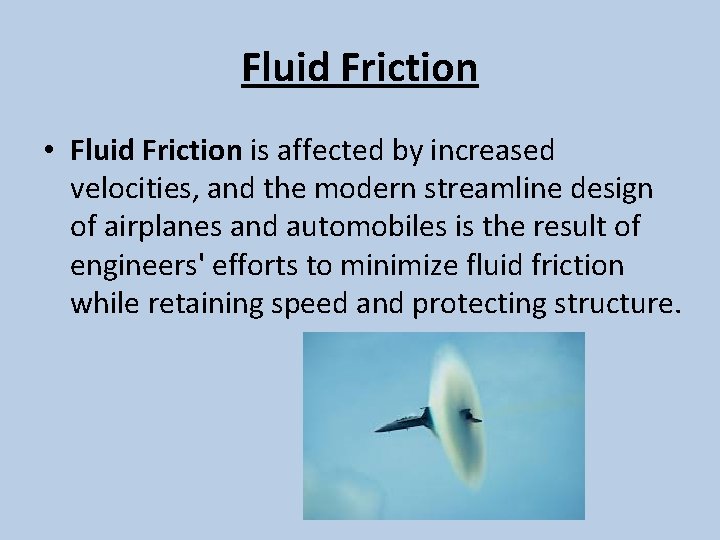
Fluid Friction • Fluid Friction is affected by increased velocities, and the modern streamline design of airplanes and automobiles is the result of engineers' efforts to minimize fluid friction while retaining speed and protecting structure.
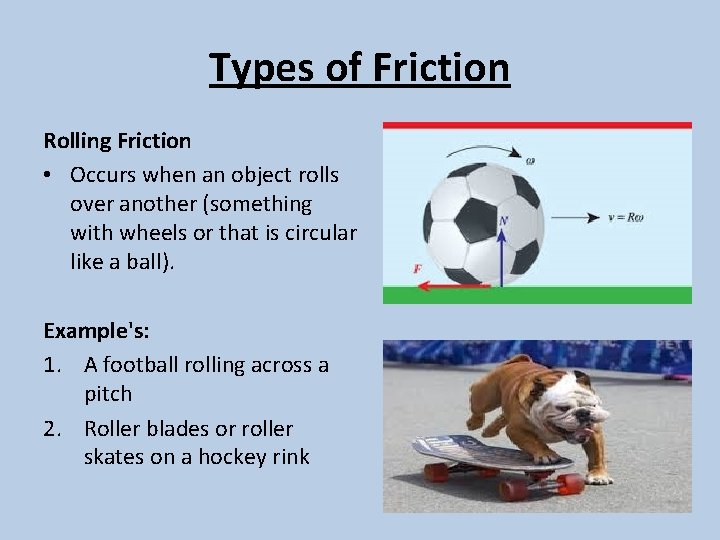
Types of Friction Rolling Friction • Occurs when an object rolls over another (something with wheels or that is circular like a ball). Example's: 1. A football rolling across a pitch 2. Roller blades or roller skates on a hockey rink
Rolling Friction • Rolling Resistance, sometimes called Rolling Friction or Rolling Drag, is the force resisting the motion when a body (such as a ball, tire, or wheel) rolls on a surface. • The amount of Friction created by a rolling object is less than the Friction created by normal force. It is dramatically less than other types of Friction, such as Sliding Friction.
Rolling Friction • There are various factors that can affect Rolling Friction such as: – Shape of wheel – The type of surface on which the wheel is rolling – Original speed of the wheel – Diameter of the wheel – Amount of pressure on the wheel – Material that wheel or ball is made of
Rolling Friction Now take 5 minuets to look up: • 3 more factors which effect Rolling Friction • 3 examples of Rolling Friction
Coefficient of Friction • Friction is the heat producing resistive force generated by the motion of two contacting surfaces against each other. • It is indirectly the product of one of the four known fundamental forces. • The Friction of a system is impossible to predetermine strictly from theoretical first principles.
Coefficient of Friction • Mathematically, the expression for Friction includes a single constant that incorporates all causative factors • A coefficient of Friction (COF), symbolized by the Greek letter, μ (mu). • The equation is simply written fx = μx. F, where fx defines the form and measure of Friction, while F is the perpendicular or "normal" force exerted by both surfaces, one upon the other.
Coefficient of Friction • The coefficient, when used in formulae and equations, is given the symbol μ — the Greek letter mu. A subscript is usually employed to distinguish the two: • μs indicates Static Friction. • μk means Kinetic Friction.
Coefficient of Friction • For example, the μs for steel on steel is 0. 74, while the μk for this material is 0. 57. • These values are for typical real-life situations, and may vary a little, depending on circumstances.
Coefficient of Friction • Since the μs value can be affected by surface irregularities, dirt, and traces of other substances, the μk value is regarded as more accurate, and is the one usually given when a simple coefficient of Friction is required. ARE YOU • coefficient of Friction

QUESTIONS
QUESTIONS • What is Friction? • Friction is the name given to the Force that tries to stop Materials sliding across each other. • What are the Four main types of Friction? • Static • Dynamic • Fluid • Rolling
QUESTIONS • What is the Coefficient of Friction? • The coefficient of friction is a dimensionless scalar value which describes the ratio of the force of friction between two bodies and the force pressing them together. • How is the Coefficient of friction symbolized? • It is symbolized by the Greek letter, μ (mu).
Summary • Friction is the heat producing, resistive force, generated by the motion of two contacting surfaces against each other. • The four main types of friction are; • Static, kinetic, dynamic and rolling. • Static being the frictional force stopping an object from moving, dynamic the force trying to stop object that is already moving, rolling being the force trying to slow a rolling object down and fluid being the force opposing any object moving through a fluid.
Summary • Friction is the opposing force to any object, the force trying to stop an object from moving be it either in fluid or any other state. • The coefficient of friction is the value which describes the ratio of the force of friction between two bodies and the force pressing them together.
- Slides: 32