
Friction Friction is a retarding force It acts
- Slides: 12
Friction
Friction is a retarding force. It acts to slow down moving objects by generating heat. It is always present when things are moving (or trying to move) but the size of the force can vary. This will depend on 2 things: 1. Surfaces – their roughness 2. The closing force, which holds the objects together.
Friction is useful… Friction can be useful in some situations. Two examples are: 1. Grips on shoes or tyres. Without friction neither would ‘stick’ to the floor, and on cars we would get wheel spins. 2. Brakes. It is friction that allows the kinetic energy of a vehicle to be dumped as heat, and thus slow down.
Friction is a problem… Whenever we want to move something by sliding, we have to overcome friction. This wastes energy, energy we normally have to pay for! If we want to move heavy items we need to find a low friction solution. During the industrial revolution heavy goods were transported by barges on canals. The water touching the boat produced little friction, allowing a single horse to pull several tonnes of coal, for example.
Three more, low friction ways of getting around are:
Reducing friction In order to make things move more easily (with less friction) we can use Lubricants. These lubricants are normally oils. Some are thick, like grease, and some are thin like 3 -in-1. In fact ice skates work so well because they actually glide on a small amount of melted ice – water!
Friction in fluids When an object moves through a fluid (something that flows – liquid or gas) there is a frictional force, as it pushes the fluid out of the way. The more fluid an object has to push out of the way the bigger the resistance. So… the bigger the object the bigger the force the faster the object the bigger the force
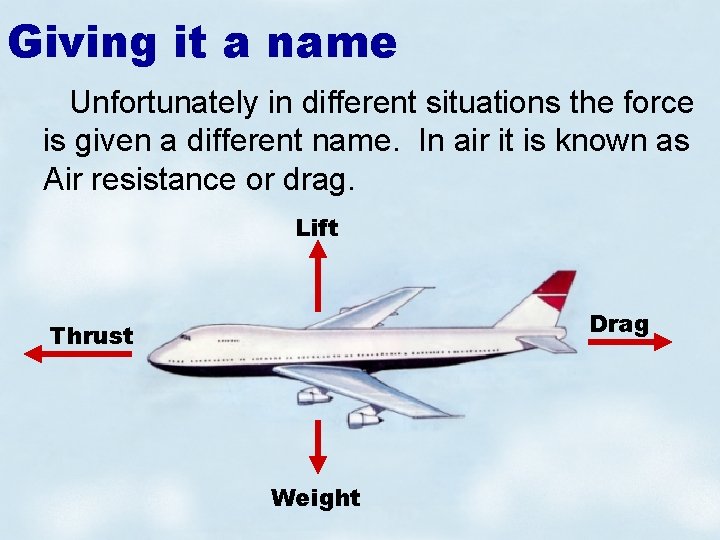
Giving it a name Unfortunately in different situations the force is given a different name. In air it is known as Air resistance or drag. Lift Drag Thrust Weight
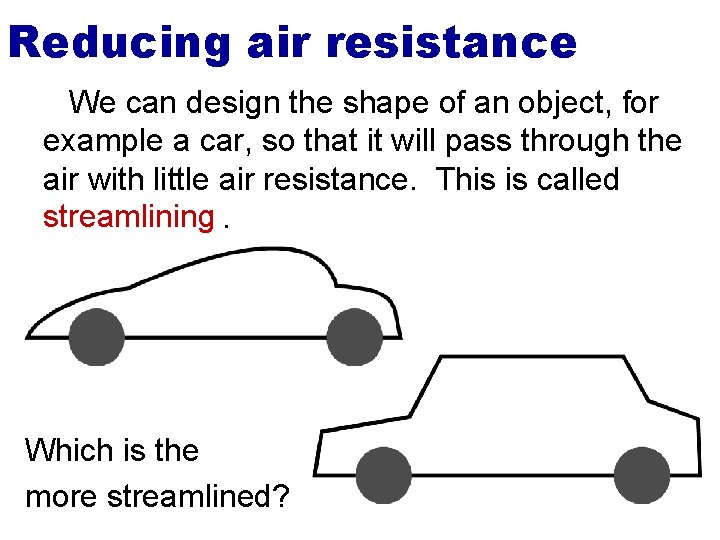
Reducing air resistance We can design the shape of an object, for example a car, so that it will pass through the air with little air resistance. This is called streamlining. Which is the more streamlined?
Remember Friction always acts in the opposite direction to the movement – slowing things down.
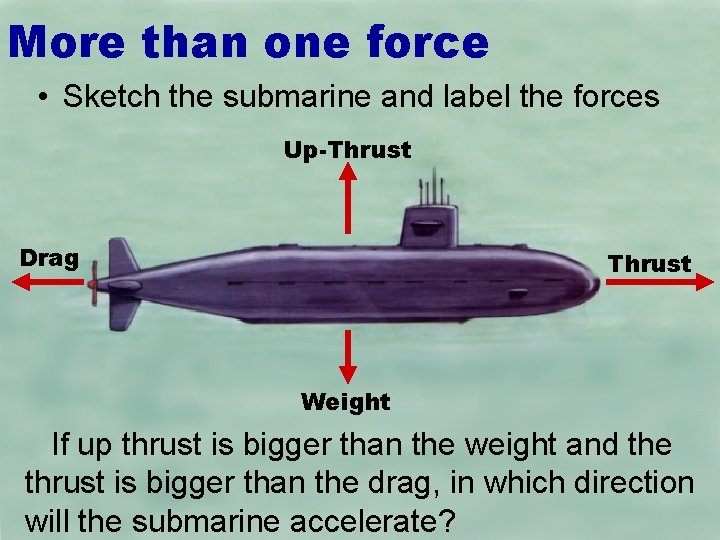
More than one force • Sketch the submarine and label the forces Up-Thrust Drag Thrust Weight If up thrust is bigger than the weight and the thrust is bigger than the drag, in which direction will the submarine accelerate?
Forces Recap – Copy & Answer 1. If an object is not accelerating, what must be true? There must be balanced forces 2. Which force always acts towards the centre of the Earth? Weight (force due to gravity) 3. Which force keeps a boat afloat? Up-thrust 4. Which force slows down a parachute? Air resistance / Drag 5. a) What force tries to stop things slide? Friction 6. b) How can we reduce it? Use Lubricants Speed