
Friction and Net Force Review Have out Study
- Slides: 48
Friction and Net Force Review Have out: • Study Guide • Workbook pages 81 -84 (with sub) • Friction and Free body diagram review (with sub)
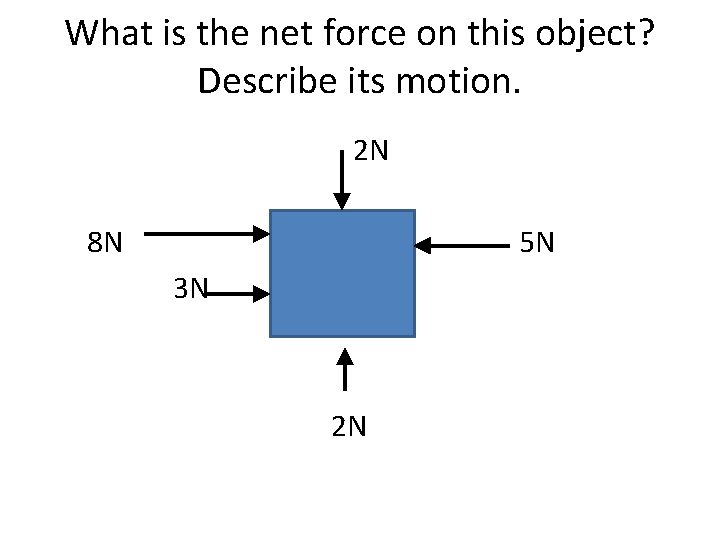
What is the net force on this object? Describe its motion. 2 N 8 N 5 N 3 N 2 N
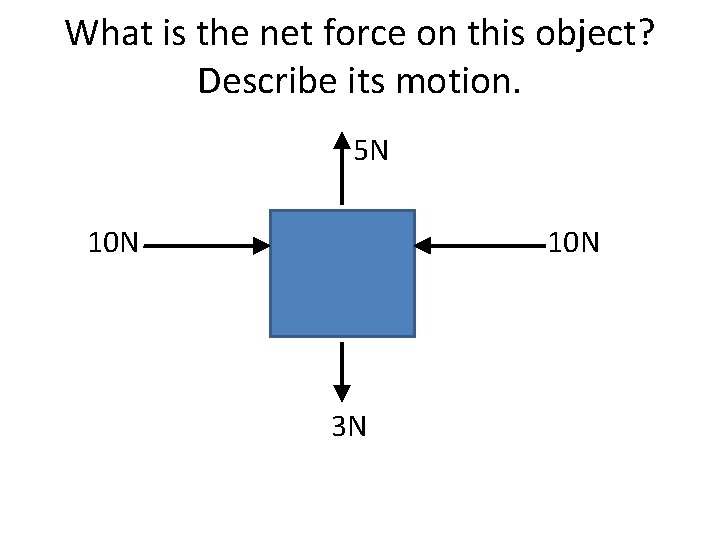
What is the net force on this object? Describe its motion. 5 N 10 N 3 N
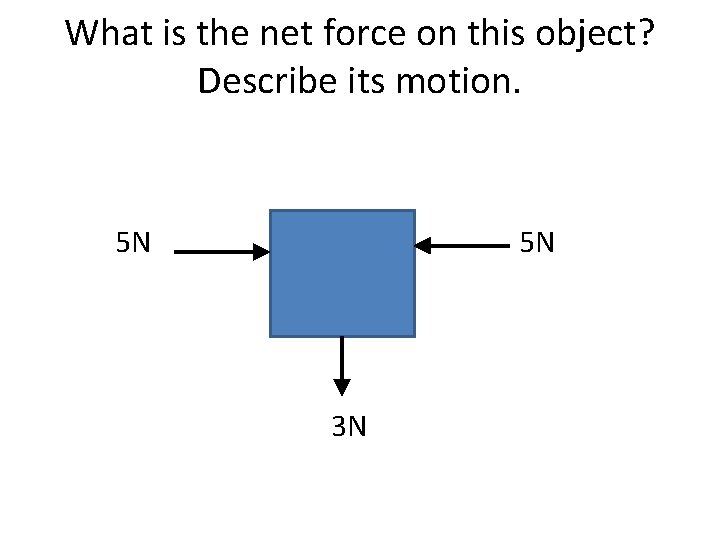
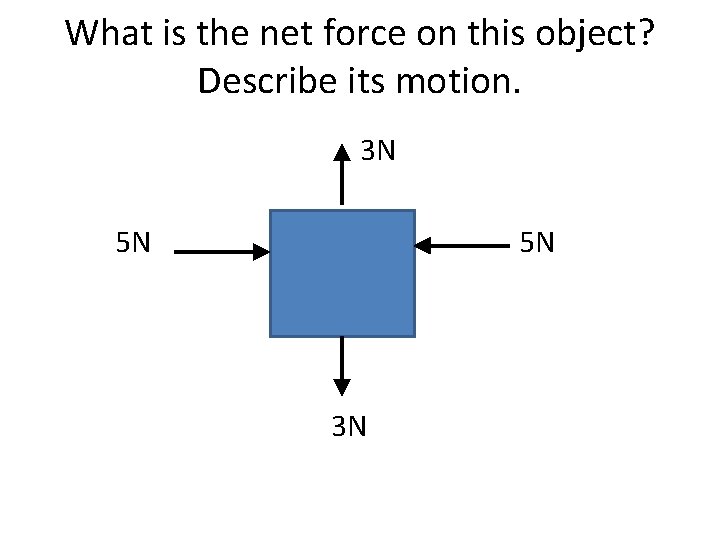
What is the net force on this object? Describe its motion. 5 N 5 N 3 N
What is the net force on this object? Describe its motion. 3 N 5 N 5 N 3 N
A ball is rolling across the tennis court. It slows down and finally stops. • What forces are causing it to slow down? • Are these forces balanced or unbalanced?
A ball is rolling across the tennis court. It slows down and finally stops. • What forces are causing it to slow down? • Gravity pulls downward Normal force pushes upward • Friction opposes the motion, slowing it down rolling friction on the ground + fluid friction (air) • Are these forces balanced or unbalanced? • Gravity and normal are balanced • Friction is unbalanced, causing deceleration
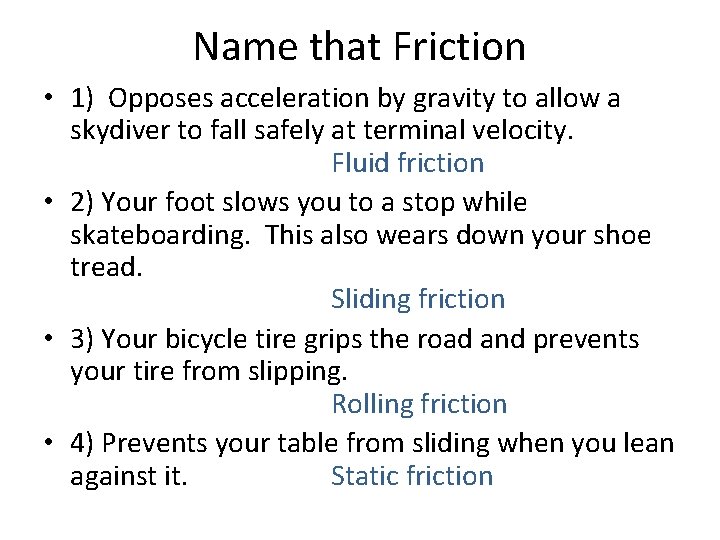
Name that Friction • 1) Opposes acceleration by gravity to allow a skydiver to fall safely at terminal velocity. • 2) Your foot slows you to a stop while skateboarding. This also wears down your shoe tread. • 3) Your bicycle tire grips the road and prevents your tire from slipping. • 4) Prevents your table from sliding when you lean against it.
Name that Friction • 1) Opposes acceleration by gravity to allow a skydiver to fall safely at terminal velocity. Fluid friction • 2) Your foot slows you to a stop while skateboarding. This also wears down your shoe tread. Sliding friction • 3) Your bicycle tire grips the road and prevents your tire from slipping. Rolling friction • 4) Prevents your table from sliding when you lean against it. Static friction
Name that Law! 1. Driving a car, your tires push against ground and friction prevents the tires from slipping, thus causing your car to move forward. 2. In a football game, the offensive linemen protect the quarterback by preventing other players from getting past them. Which law helps them to not move (Hint: They are usually very large players).
Name that Law! Drivers of large trucks are required to stop at the top of a mountain to check their brakes. Cars are not required to do this inspection. Which of Newton’s Laws explains why this is a requirement for large trucks but not as urgent for cars.
Name that Law! Riding in a car, the driver suddenly brakes. Thankfully, you have fastened your seatbelt, but the belt hurts your shoulder. Which of Newton’s Laws caused you to press forward so much on the seatbelt?
What causes friction between surfaces?
What causes friction between surfaces? • The hills and valleys (ridges and bumps on a surface)
Define the four types of friction and give an example of each.
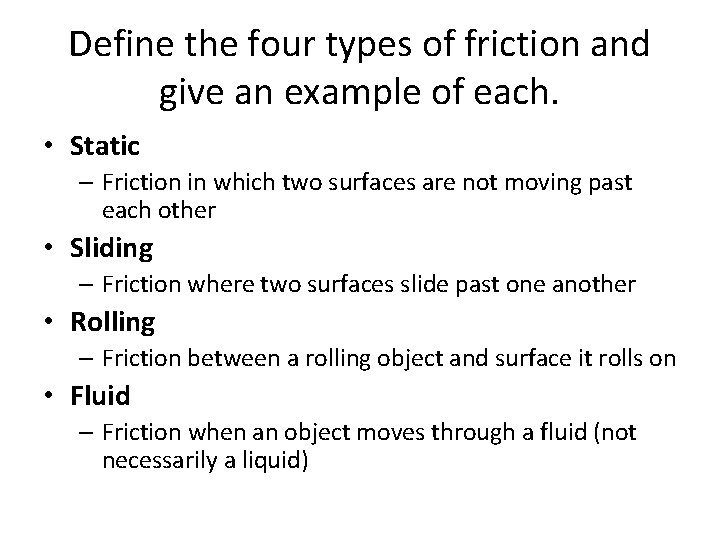
Define the four types of friction and give an example of each. • Static – Friction in which two surfaces are not moving past each other • Sliding – Friction where two surfaces slide past one another • Rolling – Friction between a rolling object and surface it rolls on • Fluid – Friction when an object moves through a fluid (not necessarily a liquid)
How does mass affect the force needed to move an object?
How does mass affect the force needed to move an object? • The more mass, the more force needed to move an object
How can we increase friction? How can we decrease friction?
How can we increase friction? How can we decrease friction? • Increase Friction – salt/sand on icy roads, increasing the force • Decreasing – using lubricants (motor oil, wax, grease) and rolling rather than sliding, smoothing down a surface
When forces are acting in the same direction we _________ them together.
When forces are acting in the same direction we _________ them together. • ADD
When forces are acting in different directions we _________ them from one another.
When forces are acting in different directions we _________ them from one another. • SUBTRACT
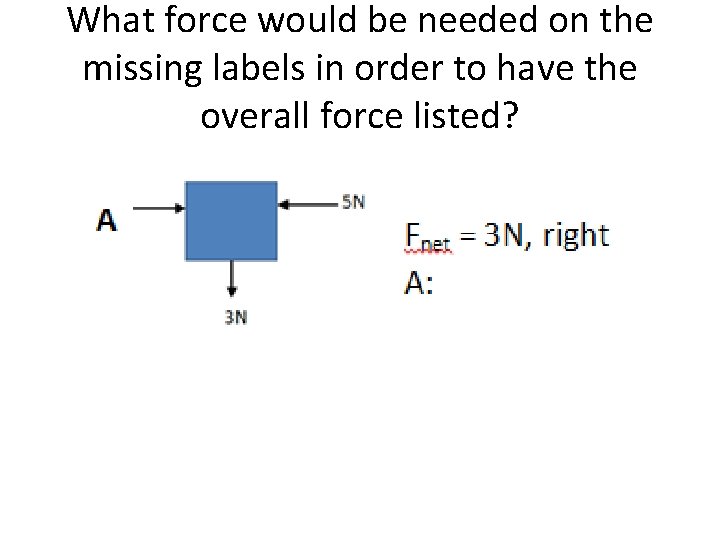
What force would be needed on the missing labels in order to have the overall force listed?
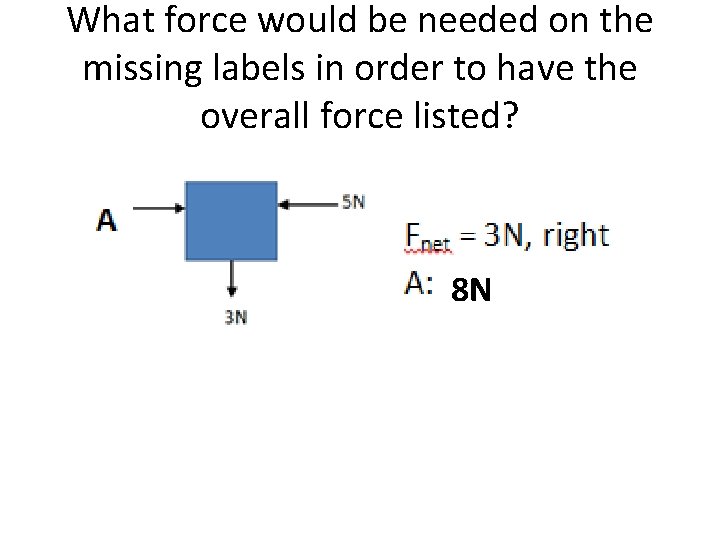
What force would be needed on the missing labels in order to have the overall force listed? 8 N
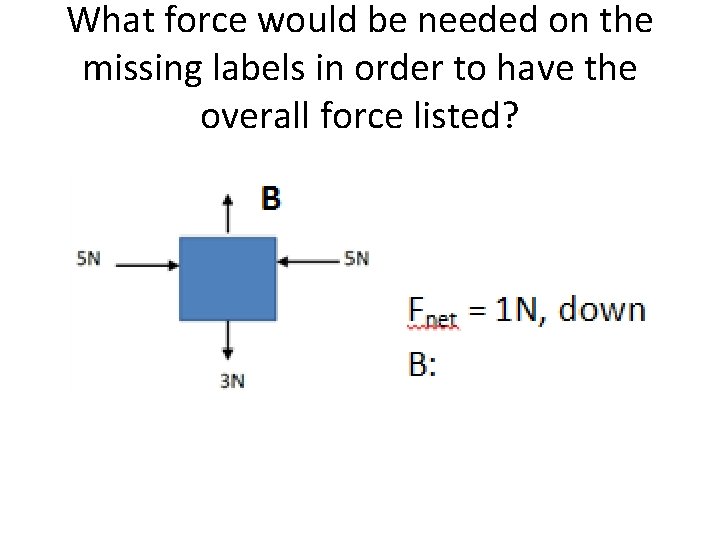
What force would be needed on the missing labels in order to have the overall force listed?
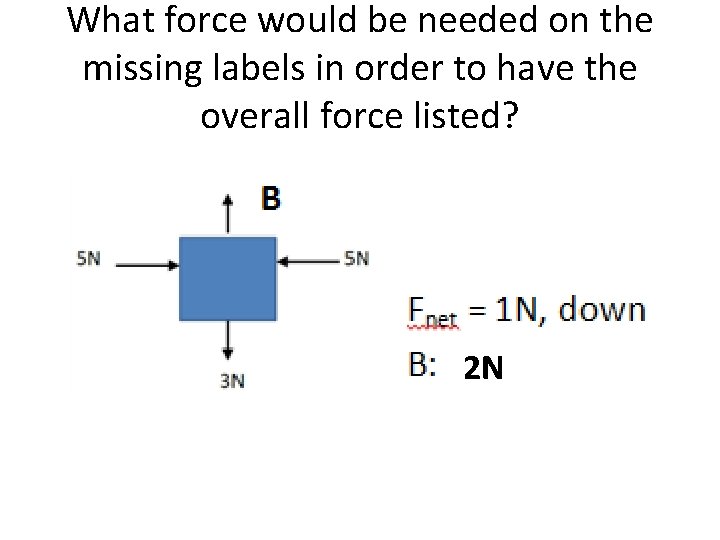
What force would be needed on the missing labels in order to have the overall force listed? 2 N
What are Newton’s 3 laws?
What are Newton’s 3 laws? 1. Newton’s 1 st law – an object in motion tends to stay in motion and an object at rest tends to stay in rest unless acted on by an outside force 2. Newton’s 2 nd law – The acceleration of an object depends on the mass of the object and the amount of force applied. (F=MA) 3. Newton’s 3 rd law – Whenever one object exerts a force on a second object, the second object exerts an equal and opposite force on the first
the initial push or pull of one object on another object
Action Force the initial push or pull of one object on another object
a push or pull extended on an object in order to change the motion of the object; has size and direction
Force a push or pull extended on an object in order to change the motion of the object; has size and direction
A force that act's in the opposite direction from an action force
Reaction Force A force that act's in the opposite direction from an action force
the combination of all the forces acting on an object
Net Force the combination of all the forces acting on an object
the tendency of an object to resist being moved, or if the object is moving, to resist a change in speed or direction until an outside force acts on the object
Interia the tendency of an object to resist being moved, or if the object is moving, to resist a change in speed or direction until an outside force acts on the object
Equal forces acting on an object in opposite directions
Balanced Force Equal forces acting on an object in opposite directions
a measure of the amount of matter in an object
Mass a measure of the amount of matter in an object
the rate at which velocity changes over time; caused by a change in speed, direction, or both.
Acceleration the rate at which velocity changes over time; caused by a change in speed, direction, or both.
two or more forces that are not equal and opposite of one another; can cause change in motion
Unbalanced Force two or more forces that are not equal and opposite of one another; can cause change in motion