
FRIB Theory Alliance Filomena Nunes Head of Department
FRIB Theory Alliance Filomena Nunes Head of Department of Theoretical Nuclear Science Chair of the FRIB theory center steering committee East Lansing, May 2015
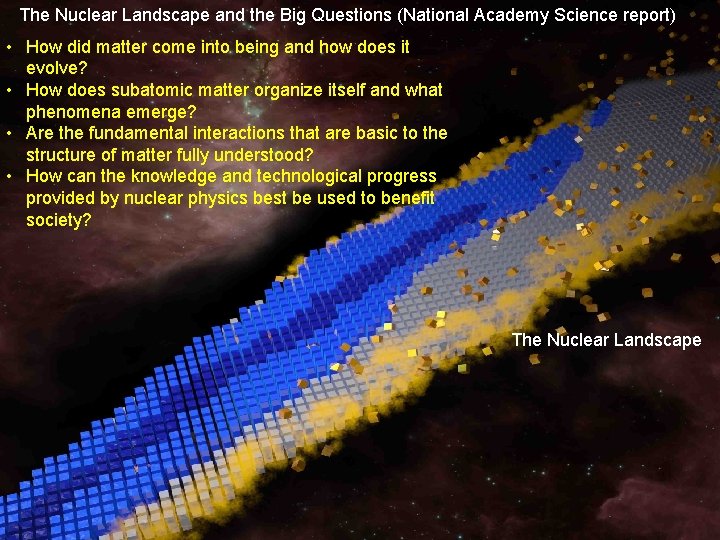
The Nuclear Landscape and the Big Questions (National Academy Science report) • How did matter come into being and how does it evolve? • How does subatomic matter organize itself and what phenomena emerge? • Are the fundamental interactions that are basic to the structure of matter fully understood? • How can the knowledge and technological progress provided by nuclear physics best be used to benefit society? The Nuclear Landscape
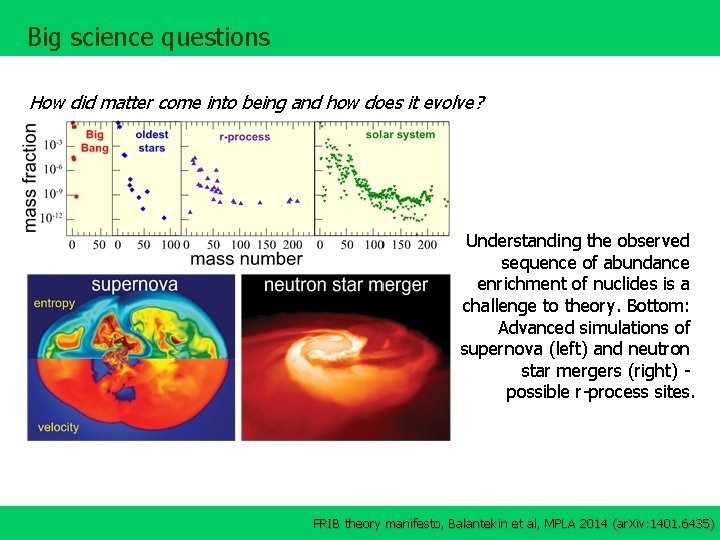
Big science questions How did matter come into being and how does it evolve? Understanding the observed sequence of abundance enrichment of nuclides is a challenge to theory. Bottom: Advanced simulations of supernova (left) and neutron star mergers (right) possible r-process sites. FRIB theory manifesto, Balantekin et al, MPLA 2014 (ar. Xiv: 1401. 6435)
Enhancing the coupling between experiment and theory Theory can: – assess the scientific impact of experiments – help identify critical measurements – evaluate whether anticipated experimental errors are sufficient for the goal – interpret experimental results – make sense of surprises we will find along the way – provide input for planning experimental programs
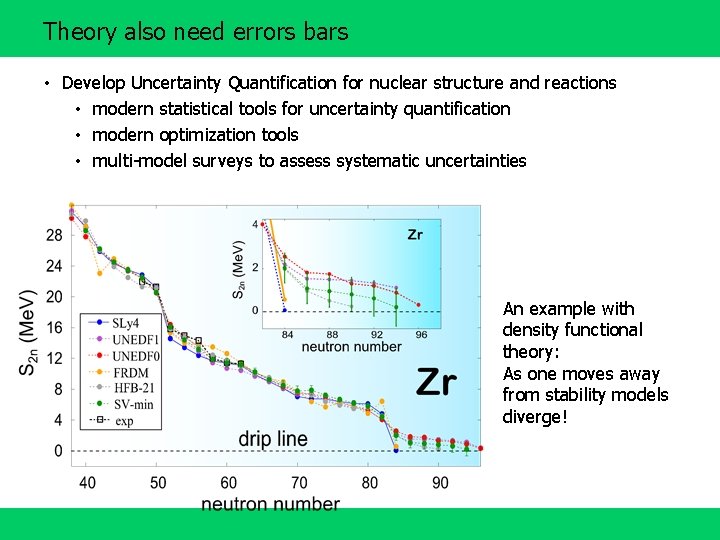
Theory also need errors bars • Develop Uncertainty Quantification for nuclear structure and reactions • modern statistical tools for uncertainty quantification • modern optimization tools • multi-model surveys to assess systematic uncertainties An example with density functional theory: As one moves away from stability models diverge!
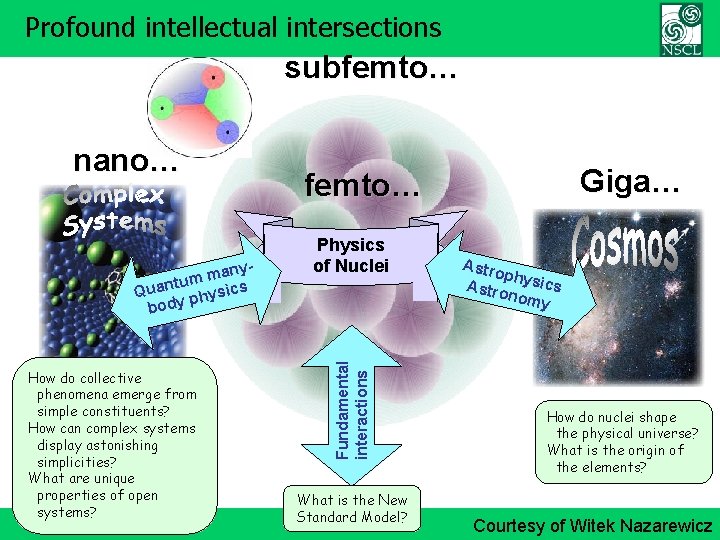
Profound intellectual intersections subfemto… nano… Physics of Nuclei Fundamental interactions - any m m u t Quan physics body How do collective phenomena emerge from simple constituents? How can complex systems display astonishing simplicities? What are unique properties of open systems? Giga… femto… What is the New Standard Model? Astro ph Astro ysics nomy How do nuclei shape the physical universe? What is the origin of the elements? Courtesy of Witek Nazarewicz
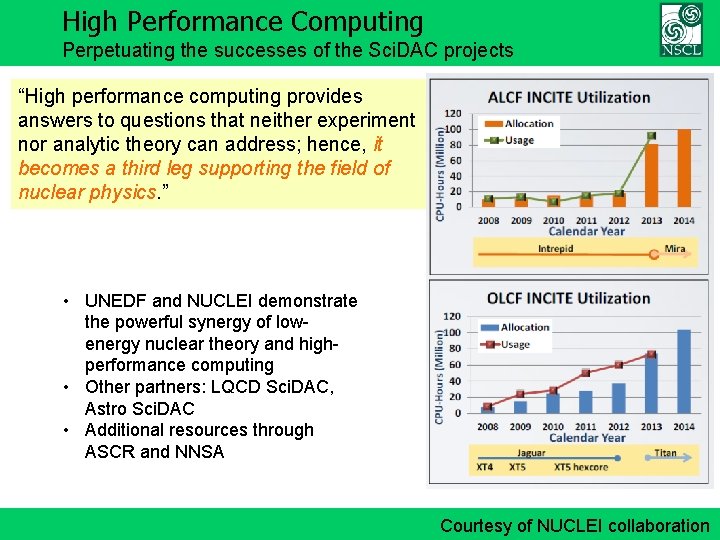
High Performance Computing Perpetuating the successes of the Sci. DAC projects “High performance computing provides answers to questions that neither experiment nor analytic theory can address; hence, it becomes a third leg supporting the field of nuclear physics. ” • UNEDF and NUCLEI demonstrate the powerful synergy of lowenergy nuclear theory and highperformance computing • Other partners: LQCD Sci. DAC, Astro Sci. DAC • Additional resources through ASCR and NNSA Courtesy of NUCLEI collaboration
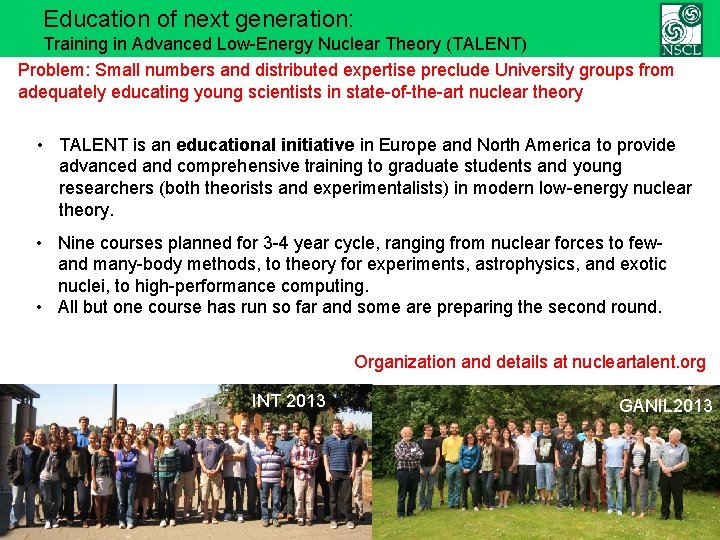
Education of next generation: Training in Advanced Low-Energy Nuclear Theory (TALENT) Problem: Small numbers and distributed expertise preclude University groups from adequately educating young scientists in state-of-the-art nuclear theory • TALENT is an educational initiative in Europe and North America to provide advanced and comprehensive training to graduate students and young researchers (both theorists and experimentalists) in modern low-energy nuclear theory. • Nine courses planned for 3 -4 year cycle, ranging from nuclear forces to few- and many-body methods, to theory for experiments, astrophysics, and exotic nuclei, to high-performance computing. • All but one course has run so far and some are preparing the second round. Organization and details at nucleartalent. org INT 2013 GANIL 2013
FRIB theory center steering committee Constituted in Spring 2013 by NSCL director with the mandate to “determine the required ingredients, including ramp-up funding options and an appropriate organizational structure for a future FRIB theory center, and then proceed to work with the agencies and develop a path forward. ” • • • • Baha Balantekin (University of Wisconsin) Joseph Carlson (Los Alamos National Laboratory) David Dean (Oak Ridge National Laboratory) George Fuller (University of California San Diego) Richard Furnstahl (Ohio State University) Morten Hjorth-Jensen (NSCL, Michigan State University) Robert Janssens (Argonne National Laboratory) Bao-An Li (Texas A&M University - Commerce) Witek Nazarewicz (University of Tennessee) Filomena Nunes (Chair) (NSCL, Michigan State University) Erich Ormand (Lawrence Livermore National Laboratory) Sanjay Reddy (INT, University of Washington) Brad Sherrill (FRIB, Michigan State University)
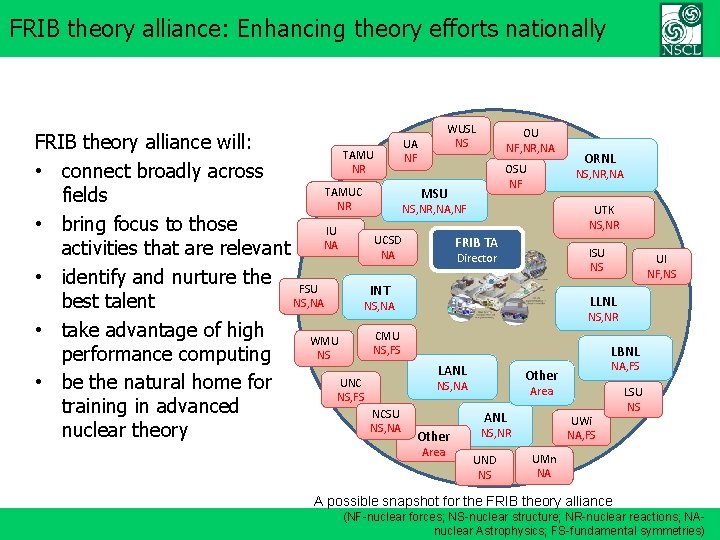
FRIB theory alliance: Enhancing theory efforts nationally WUSL NS OU FRIB theory alliance will: NF, NR, NA TAMU OSU NR • connect broadly across NF TAMUC MSU fields NR NS, NR, NA, NF • bring focus to those IU UCSD FRIB TA NA activities that are relevant NA Director • identify and nurture the FSU INT NS, NA best talent NS, NA • take advantage of high CMU WMU NS, FS NS performance computing LANL Other UNC • be the natural home for NS, NA Area NS, FS training in advanced NCSU ANL NS, NA NS, NR nuclear theory Other UA NF Area UND NS ORNL NS, NR, NA UTK NS, NR ISU NS UI NF, NS LLNL NS, NR LBNL NA, FS UWi NA, FS LSU NS UMn NA A possible snapshot for the FRIB theory alliance (NF-nuclear forces; NS-nuclear structure; NR-nuclear reactions; NAnuclear Astrophysics; FS-fundamental symmetries)
Key elements of FRIB theory alliance Essential elements to strengthen FRIB theory nationwide • A prestigious national fellow program (already started) • Bridge tenure-track positions nuclear theory • Vibrant national/international visitors program (already started)
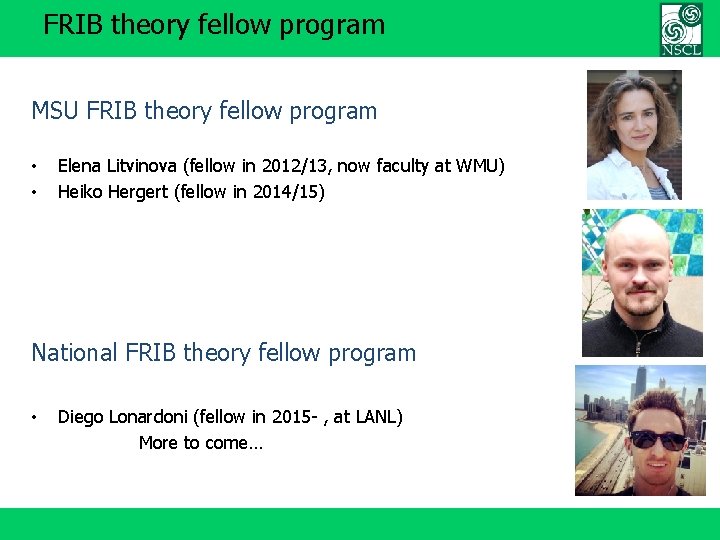
FRIB theory fellow program MSU FRIB theory fellow program • • Elena Litvinova (fellow in 2012/13, now faculty at WMU) Heiko Hergert (fellow in 2014/15) National FRIB theory fellow program • Diego Lonardoni (fellow in 2015 - , at LANL) More to come…
International Collaboration in Nuclear Theory • Jul-Aug 2013: Symmetry energy in the context of new radioactive ion beam facilities and astrophysics: JPG 41, 093001 • May 2015: Theory for open shell nuclei near the limits of stability • New call for proposals coming soon (watch out for an email from Alex Brown!)
Added value of the FRIB theory alliance The theory alliance: • • • brings a focal point for stimulating continuous interactions with experiment can be a home for initiatives such as CUSTIPEN and FUSTIPEN serves as a partner for larger international collaborations The FRIB theory alliance: • • • enables a prestigious national fellow program: enhances the visibility of the field and attracts the brightest young people emphasizes the importance of low-energy nuclear theory: enhances the opportunity to create permanent positions in nuclear theory fosters interdisciplinary collaborations coordinates an educational program in advanced nuclear theory brings multiple opportunities to leverage efforts and funding
FRIB theory alliance - opportunities The theory alliance serves as: • a partner for larger international collaborations and there are many opportunities… Thank you for your attention!
- Slides: 15