
FRIB Cavity Status SRF issues and challenges John
FRIB Cavity Status: SRF issues and challenges John Popielarski EM Modeling and RF Measurement Group Leader SRF Department This material is based upon work supported by the U. S. Department of Energy Office of Science under Cooperative Agreement DE-SC 0000661. Michigan State University designs and establishes FRIB as a DOE Office of Science National User Facility in support of the mission of the Office of Nuclear Physics.
Outline § FRIB SRF Scope and evolving Cavity Requirements § FRIB SRF Department Highlights in the Last Year § QWR Status, Experimental results, and Design Changes • 80. 5 MHz =0. 041 installed in Re. A 3, =0. 085 developments § HWR Status, Experimental Results, and Design Changes • 322 MHz =0. 530, =0. 290 § Summary J. Popielarski, December 2011 TTC, Slide 2

The FRIB Driver Linac: 327 SRF Resonators 12 96 147 76 J. Popielarski, December 2011 TTC, Slide 3

SRF Department Main Deliverable: All FRIB Cold Masses β=0. 085 QTY 11 + 2 matching (under design optimization) β=0. 29 QTY 12 + 2 matching (under design optimization) β=0. 53 QTY 18 + 1 matching Total 47 plus 3 spares J. Popielarski, December 2011 TTC, Slide 4
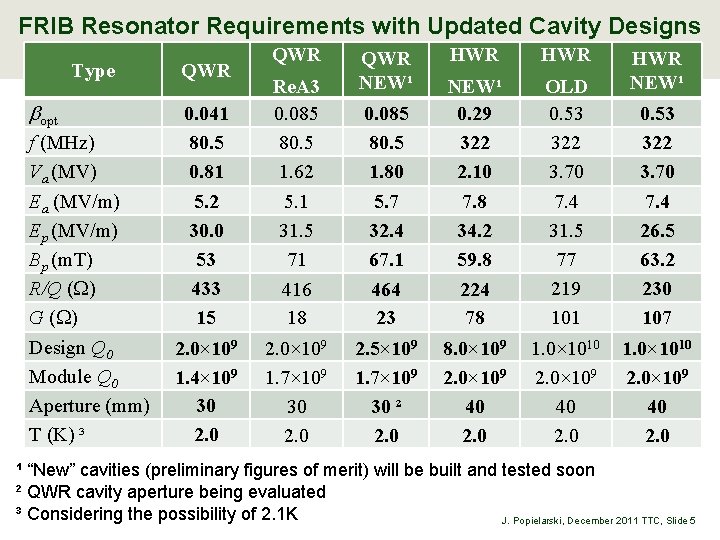
FRIB Resonator Requirements with Updated Cavity Designs Type bopt f (MHz) Va (MV) Ea (MV/m) Ep (MV/m) Bp (m. T) R/Q ( ) G ( ) Design Q 0 Module Q 0 Aperture (mm) T (K) ³ QWR 0. 041 80. 5 0. 81 5. 2 30. 0 53 433 15 2. 0× 109 1. 4× 10⁹ 30 2. 0 QWR HWR 0. 085 80. 5 1. 80 5. 7 32. 4 67. 1 NEW¹ 0. 29 322 2. 10 7. 8 34. 2 59. 8 416 18 464 23 224 78 OLD 0. 53 322 3. 70 7. 4 31. 5 77 219 101 2. 0× 109 1. 7× 10⁹ 30 2. 5× 10⁹ 1. 7× 10⁹ 30 ² 2. 0 8. 0× 109 2. 0× 109 40 2. 0 1. 0× 1010 2. 0× 109 40 2. 0 Re. A 3 0. 085 80. 5 1. 62 5. 1 31. 5 71 QWR NEW¹ HWR NEW¹ 0. 53 322 3. 70 7. 4 26. 5 63. 2 230 107 1. 0× 1010 2. 0× 109 40 2. 0 ¹ “New” cavities (preliminary figures of merit) will be built and tested soon ² QWR cavity aperture being evaluated ³ Considering the possibility of 2. 1 K J. Popielarski, December 2011 TTC, Slide 5
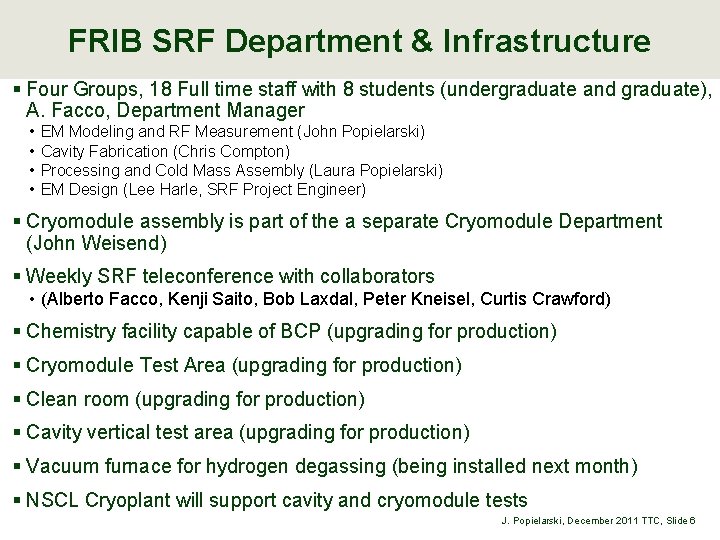
FRIB SRF Department & Infrastructure § Four Groups, 18 Full time staff with 8 students (undergraduate and graduate), A. Facco, Department Manager • • EM Modeling and RF Measurement (John Popielarski) Cavity Fabrication (Chris Compton) Processing and Cold Mass Assembly (Laura Popielarski) EM Design (Lee Harle, SRF Project Engineer) § Cryomodule assembly is part of the a separate Cryomodule Department (John Weisend) § Weekly SRF teleconference with collaborators • (Alberto Facco, Kenji Saito, Bob Laxdal, Peter Kneisel, Curtis Crawford) § Chemistry facility capable of BCP (upgrading for production) § Cryomodule Test Area (upgrading for production) § Clean room (upgrading for production) § Cavity vertical test area (upgrading for production) § Vacuum furnace for hydrogen degassing (being installed next month) § NSCL Cryoplant will support cavity and cryomodule tests J. Popielarski, December 2011 TTC, Slide 6
2011 SRF Highlights § All FRIB cavities will operate at 2 K (still evaluating 2. 1 K vs. 2. 0 K), originally just 322 MHz HWRs would run at 2 K § All FRIB cavities will be hydrogen degassed via 600 C furnace treatment § The prototypes have reliably exceeded the FRIB accelerating field at the specified Q for 3 of the 4 FRIB cavity types; the 4 th cavity type is now ready for prototyping (β=0. 290 HWR, very similar design as the β=0. 530 HWR) § The β=0. 085 QWR cavities have been refurbished leading to top level performance of the new prototypes § The first two SRF cryomodules with seven β=0. 041 QWRs are now successfully operating in the Re. A 3 linac (NSCL) § The SRF Department is presently designing and producing low-β SRF resonators with high performance and high reproducibility § We have upgraded the previous design of the β=0. 085, β=0. 029 and β=0. 53 FRIB resonators with significant improvement in their parameters J. Popielarski, December 2011 TTC, Slide 7
FRIB Resonator Production Steps § Niobium material will be purchased by FRIB § Cavities will be fabricated to meet mechanical and frequency specifications § Bulk BCP (remove 150 micrometers) § 600 C furnace treatment for degassing § Light BCP § High pressure rinse § Vertical tests for certification § Cold mass assembly § 120 C bake of cold mass § Cryomodule fabrication § Cryomodule certification tests (high power RF) J. Popielarski, December 2011 TTC, Slide 8

FRIB Beta=0. 041 QWR & Re. A 3 § Michigan State University funded the Reaccelerator project at NSCL prior to FRIB site selection § The beta=0. 041 resonators installed in Re. A 3 are being used as a test bed for FRIB cavities. FRIB production cavities will be slightly different after production experience for Re. A 3. Beta=0. 085 R&D has benefitted from the Re. A 3 project § Two cryomodules (seven 041 cavities) have been installed and are being commissioned on Re. A 3 Cold Mass Beta=0. 041 QWR J. Popielarski, December 2011 TTC, Slide 9
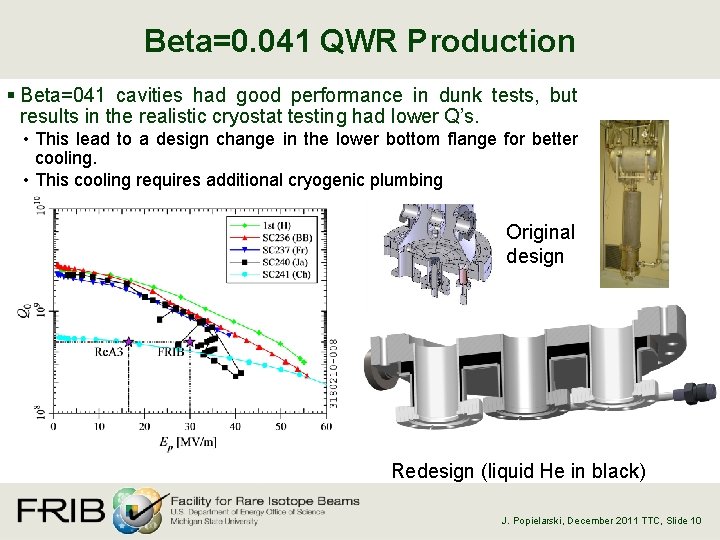
Beta=0. 041 QWR Production § Beta=041 cavities had good performance in dunk tests, but results in the realistic cryostat testing had lower Q’s. • This lead to a design change in the lower bottom flange for better cooling. • This cooling requires additional cryogenic plumbing Original design Redesign (liquid He in black) J. Popielarski, December 2011 TTC, Slide 10

Beta=0. 041 QWR Production (without cooling bottom flange) Bp/Ep=1. 77 J. Popielarski, December 2011 TTC, Slide 11

Beta=0. 041 QWR Production (with cooling bottom flange) J. Popielarski, December 2011 TTC, Slide 12

Beta=0. 041 Summary § Initial problems with tuning plate cooling was solved by adding a liquid helium reservoir on the bottom flange assembly. § 2 K dunk tests show promising results (right), additional testing at 2 K is planned for next week. FRIB Re. A § The bottom reservoir flange did not help the cooling of the larger beta=0. 085 cavities, so additional changes have been made on the 0. 085 cavities which eliminate the need for additional cryogenic plumbing. § Seven QWR’s have been produced, and are running in the Re. A 3 linac. They can all reach the FRIB requirements in gradient, but need additional testing at 2 K. Beta=0. 041 cavity with cold BPM J. Popielarski, December 2011 TTC, Slide 13
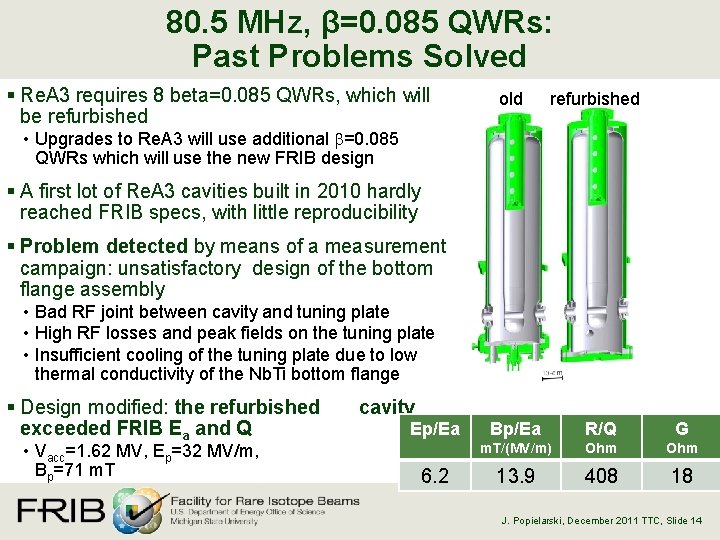
80. 5 MHz, β=0. 085 QWRs: Past Problems Solved § Re. A 3 requires 8 beta=0. 085 QWRs, which will be refurbished old refurbished • Upgrades to Re. A 3 will use additional =0. 085 QWRs which will use the new FRIB design § A first lot of Re. A 3 cavities built in 2010 hardly reached FRIB specs, with little reproducibility § Problem detected by means of a measurement campaign: unsatisfactory design of the bottom flange assembly • Bad RF joint between cavity and tuning plate • High RF losses and peak fields on the tuning plate • Insufficient cooling of the tuning plate due to low thermal conductivity of the Nb. Ti bottom flange § Design modified: the refurbished exceeded FRIB Ea and Q • Vacc=1. 62 MV, Ep=32 MV/m, Bp=71 m. T cavity Ep/Ea 6. 2 Bp/Ea R/Q G m. T/(MV/m) Ohm 13. 9 408 18 J. Popielarski, December 2011 TTC, Slide 14
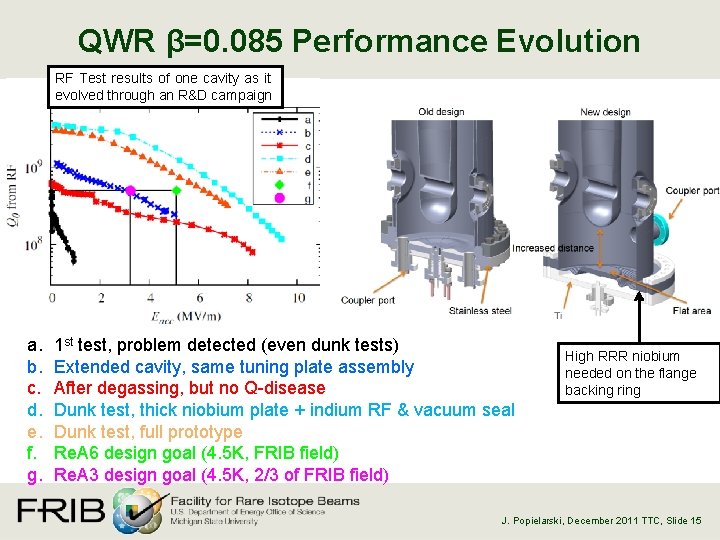
QWR β=0. 085 Performance Evolution RF Test results of one cavity as it evolved through an R&D campaign a. b. c. d. e. f. g. 1 st test, problem detected (even dunk tests) Extended cavity, same tuning plate assembly After degassing, but no Q-disease Dunk test, thick niobium plate + indium RF & vacuum seal Dunk test, full prototype Re. A 6 design goal (4. 5 K, FRIB field) Re. A 3 design goal (4. 5 K, 2/3 of FRIB field) High RRR niobium needed on the flange backing ring J. Popielarski, December 2011 TTC, Slide 15
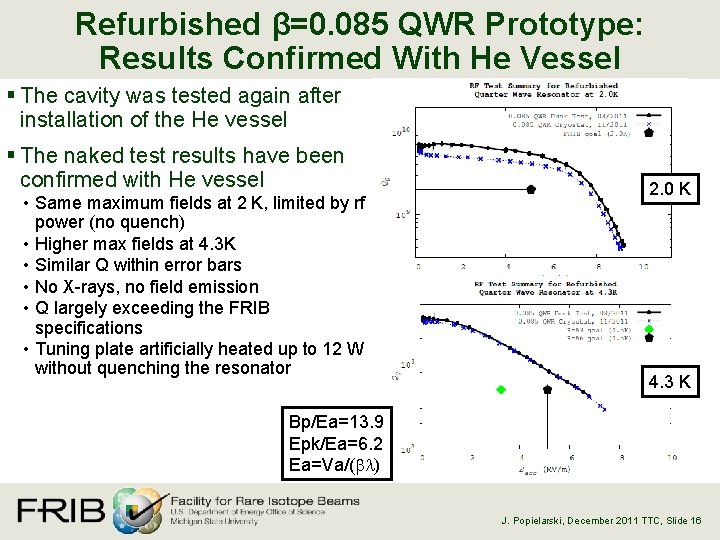
Refurbished β=0. 085 QWR Prototype: Results Confirmed With He Vessel § The cavity was tested again after installation of the He vessel § The naked test results have been confirmed with He vessel • Same maximum fields at 2 K, limited by rf power (no quench) • Higher max fields at 4. 3 K • Similar Q within error bars • No X-rays, no field emission • Q largely exceeding the FRIB specifications • Tuning plate artificially heated up to 12 W without quenching the resonator 2. 0 K 4. 3 K Bp/Ea=13. 9 Epk/Ea=6. 2 Ea=Va/( ) J. Popielarski, December 2011 TTC, Slide 16
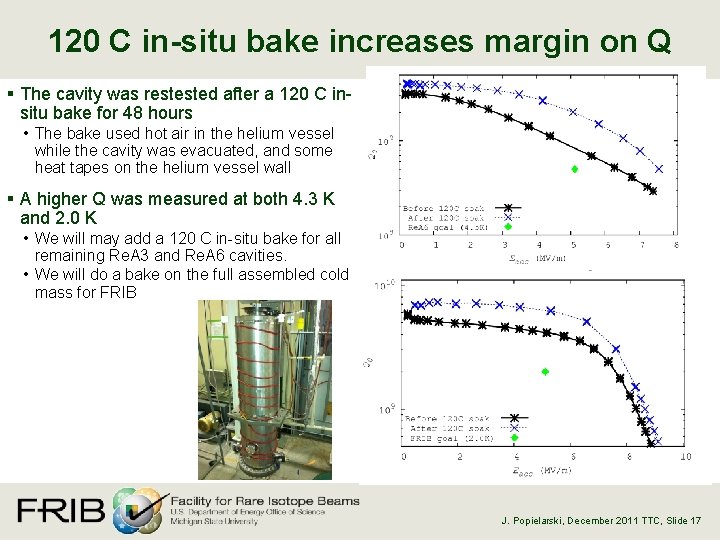
120 C in-situ bake increases margin on Q § The cavity was restested after a 120 C insitu bake for 48 hours • The bake used hot air in the helium vessel while the cavity was evacuated, and some heat tapes on the helium vessel wall § A higher Q was measured at both 4. 3 K and 2. 0 K • We will may add a 120 C in-situ bake for all remaining Re. A 3 and Re. A 6 cavities. • We will do a bake on the full assembled cold mass for FRIB J. Popielarski, December 2011 TTC, Slide 17
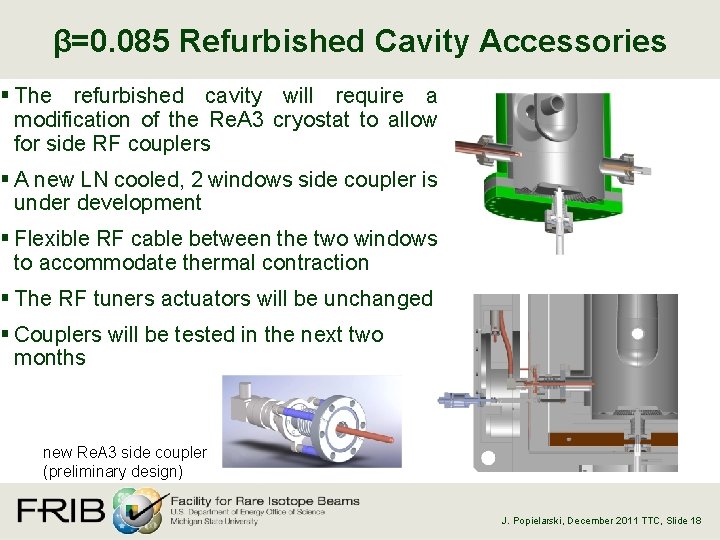
β=0. 085 Refurbished Cavity Accessories § The refurbished cavity will require a modification of the Re. A 3 cryostat to allow for side RF couplers § A new LN cooled, 2 windows side coupler is under development § Flexible RF cable between the two windows to accommodate thermal contraction § The RF tuners actuators will be unchanged § Couplers will be tested in the next two months new Re. A 3 side coupler (preliminary design) J. Popielarski, December 2011 TTC, Slide 18
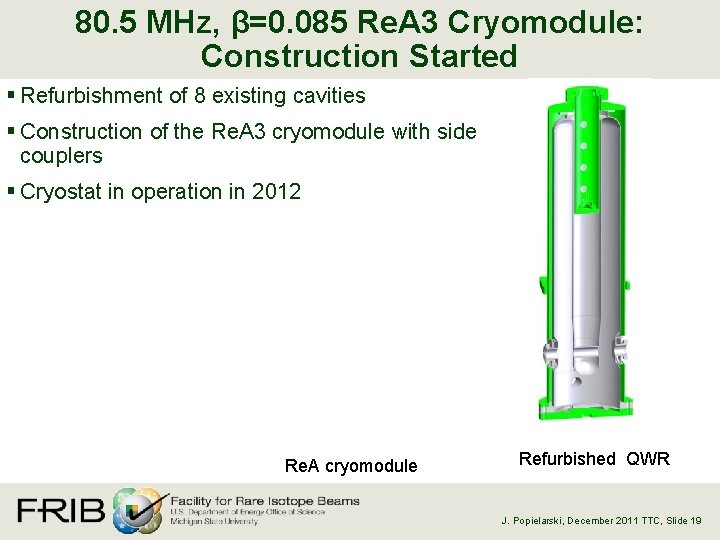
80. 5 MHz, β=0. 085 Re. A 3 Cryomodule: Construction Started § Refurbishment of 8 existing cavities § Construction of the Re. A 3 cryomodule with side couplers § Cryostat in operation in 2012 Re. A cryomodule Refurbished QWR J. Popielarski, December 2011 TTC, Slide 19
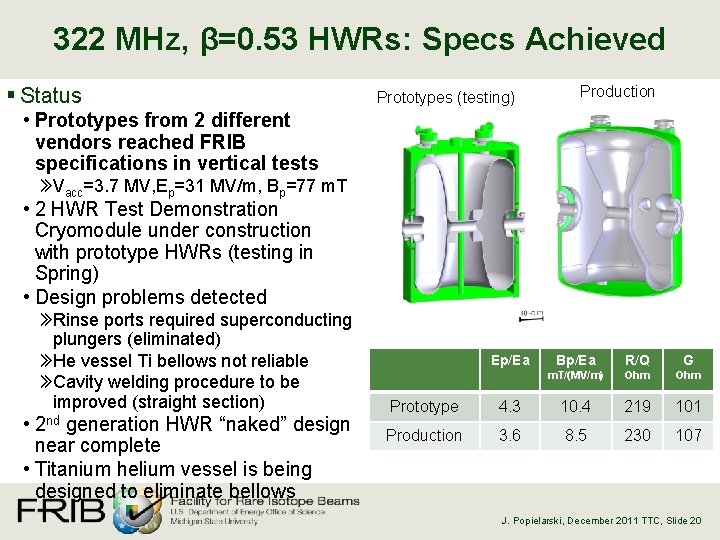
322 MHz, β=0. 53 HWRs: Specs Achieved § Status Prototypes (testing) Production • Prototypes from 2 different vendors reached FRIB specifications in vertical tests » Vacc=3. 7 MV, Ep=31 MV/m, Bp=77 m. T • 2 HWR Test Demonstration Cryomodule under construction with prototype HWRs (testing in Spring) • Design problems detected » Rinse ports required superconducting plungers (eliminated) » He vessel Ti bellows not reliable » Cavity welding procedure to be improved (straight section) • 2 nd generation HWR “naked” design near complete • Titanium helium vessel is being designed to eliminate bellows Ep/Ea Bp/Ea R/Q G m. T/(MV/m) Ohm Prototype 4. 3 10. 4 219 101 Production 3. 6 8. 5 230 107 J. Popielarski, December 2011 TTC, Slide 20

HWR β=0. 53 Performance (Prototypes) § Five cavities so far have been constructed § One was built by MSU completely 2 K results naked § Two vendors built two each § The MSU cavity quenched before reaching the design gradient (no field emission) § Both cavities from vendor ‘D’ quenched at the same field (< 90 m. T). The quench is on the inner conductor short plate weld. • We will look at it more closely with temperature mapping § One test on a vendor ‘C’ cavity reached higher than 100 m. T, and also quenched. This cavity leaked after the helium vessel was added § We will test the other cavity from vendor ‘C’ soon 2 nd sound hot spot detection diagnostics tool J. Popielarski, December 2011 TTC, Slide 21
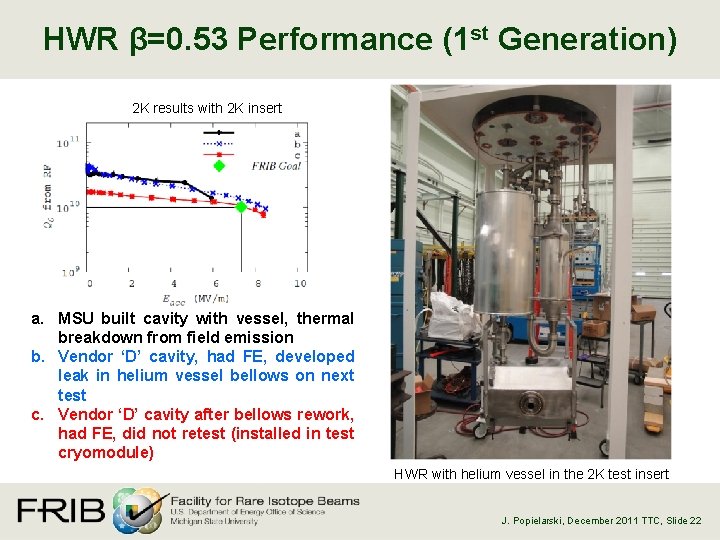
HWR β=0. 53 Performance (1 st Generation) 2 K results with 2 K insert a. MSU built cavity with vessel, thermal breakdown from field emission b. Vendor ‘D’ cavity, had FE, developed leak in helium vessel bellows on next test c. Vendor ‘D’ cavity after bellows rework, had FE, did not retest (installed in test cryomodule) HWR with helium vessel in the 2 K test insert J. Popielarski, December 2011 TTC, Slide 22
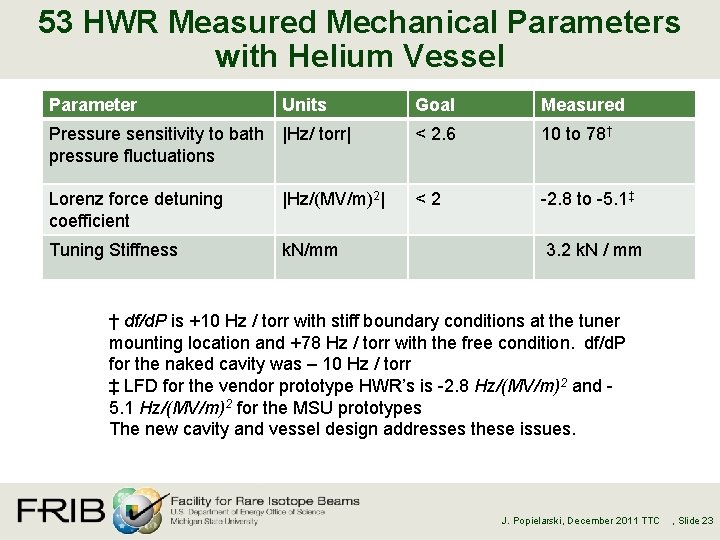
53 HWR Measured Mechanical Parameters with Helium Vessel Parameter Units Goal Measured Pressure sensitivity to bath pressure fluctuations |Hz/ torr| < 2. 6 10 to 78† Lorenz force detuning coefficient |Hz/(MV/m)2| <2 -2. 8 to -5. 1‡ Tuning Stiffness k. N/mm 3. 2 k. N / mm † df/d. P is +10 Hz / torr with stiff boundary conditions at the tuner mounting location and +78 Hz / torr with the free condition. df/d. P for the naked cavity was – 10 Hz / torr ‡ LFD for the vendor prototype HWR’s is -2. 8 Hz/(MV/m)2 and 5. 1 Hz/(MV/m)2 for the MSU prototypes The new cavity and vessel design addresses these issues. J. Popielarski, December 2011 TTC , Slide 23
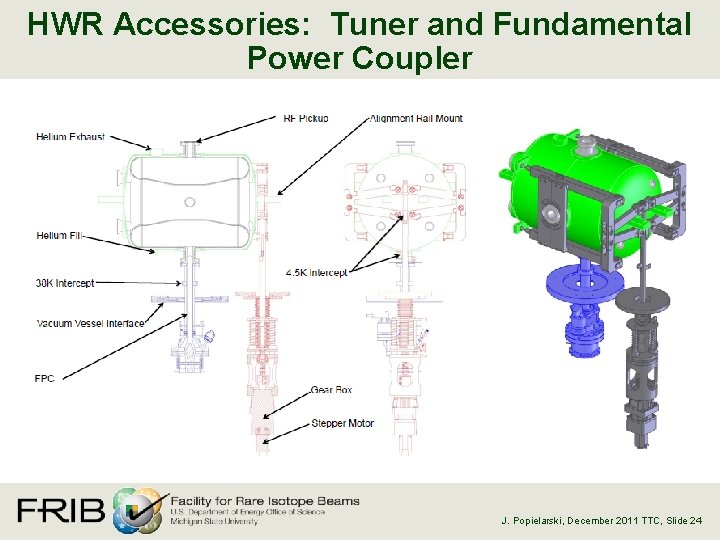
HWR Accessories: Tuner and Fundamental Power Coupler J. Popielarski, December 2011 TTC, Slide 24
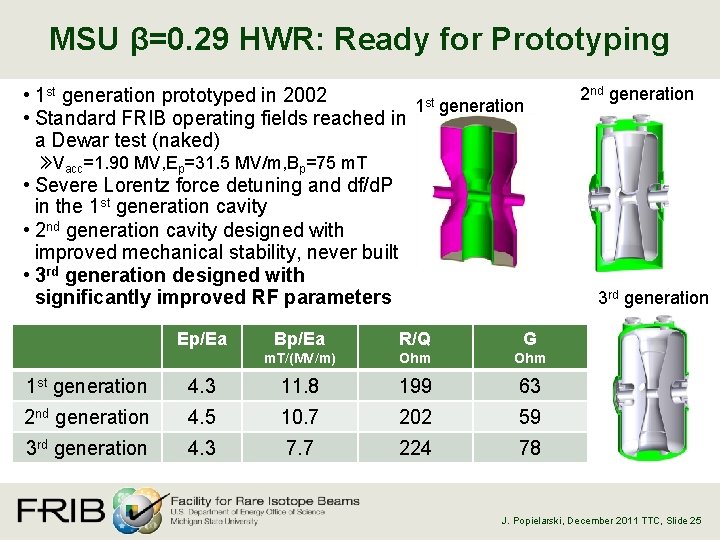
MSU β=0. 29 HWR: Ready for Prototyping • 1 st generation prototyped in 2002 1 st generation • Standard FRIB operating fields reached in a Dewar test (naked) 2 nd generation » Vacc=1. 90 MV, Ep=31. 5 MV/m, Bp=75 m. T • Severe Lorentz force detuning and df/d. P in the 1 st generation cavity • 2 nd generation cavity designed with improved mechanical stability, never built • 3 rd generation designed with significantly improved RF parameters Ep/Ea 3 rd generation Bp/Ea R/Q G m. T/(MV/m) Ohm 1 st generation 4. 3 11. 8 199 63 2 nd generation 4. 5 10. 7 202 59 3 rd generation 4. 3 7. 7 224 78 J. Popielarski, December 2011 TTC, Slide 25

Test Demonstration Cryomodule (“Two Seater”) § Aim • Develop HWR cryostat assembly procedures • Test HWR 53 cavities at full power with final couplers and in the presence of a SC solenoid • Cryogenic test of the module prototype § Components • 2 β=0. 53 HWRs already tested off line • 1 superconducting solenoid • Cryomodule components foreseen for FRIB § Status: under construction, completion by 12/2011, testing in Spring 2011 § Tests planed: • Cavity performance, LLRF performance, microphonics, magnetic sheilding capabilities, cavity-cavity interaction, cavity-magnet interaction, coupler performance, cryogenic performance, tuner performance J. Popielarski, December 2011 TTC, Slide 26
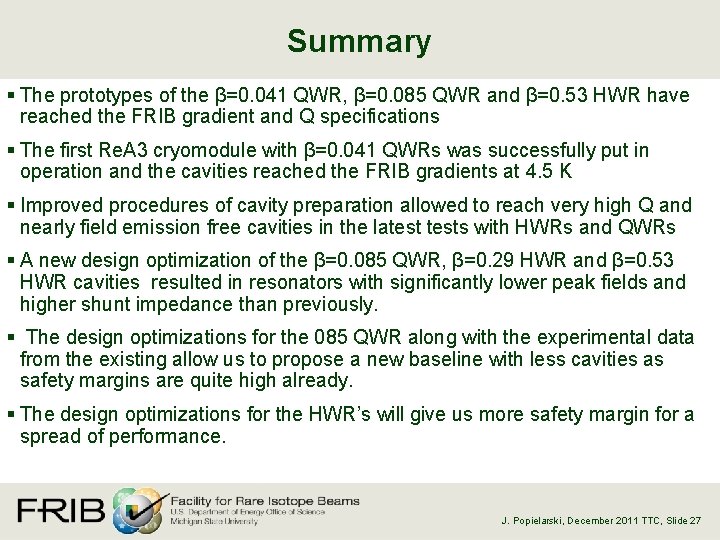
Summary § The prototypes of the β=0. 041 QWR, β=0. 085 QWR and β=0. 53 HWR have reached the FRIB gradient and Q specifications § The first Re. A 3 cryomodule with β=0. 041 QWRs was successfully put in operation and the cavities reached the FRIB gradients at 4. 5 K § Improved procedures of cavity preparation allowed to reach very high Q and nearly field emission free cavities in the latests with HWRs and QWRs § A new design optimization of the β=0. 085 QWR, β=0. 29 HWR and β=0. 53 HWR cavities resulted in resonators with significantly lower peak fields and higher shunt impedance than previously. § The design optimizations for the 085 QWR along with the experimental data from the existing allow us to propose a new baseline with less cavities as safety margins are quite high already. § The design optimizations for the HWR’s will give us more safety margin for a spread of performance. J. Popielarski, December 2011 TTC, Slide 27
- Slides: 27