
Fresnel Equations and EM Power Flow Reading Shen
- Slides: 28
Fresnel Equations and EM Power Flow Reading - Shen and Kong – Ch. 4 Outline • • • Review of Oblique Incidence Review of Snell’s Law Fresnel Equations Evanescence and TIR Brewster’s Angle EM Power Flow
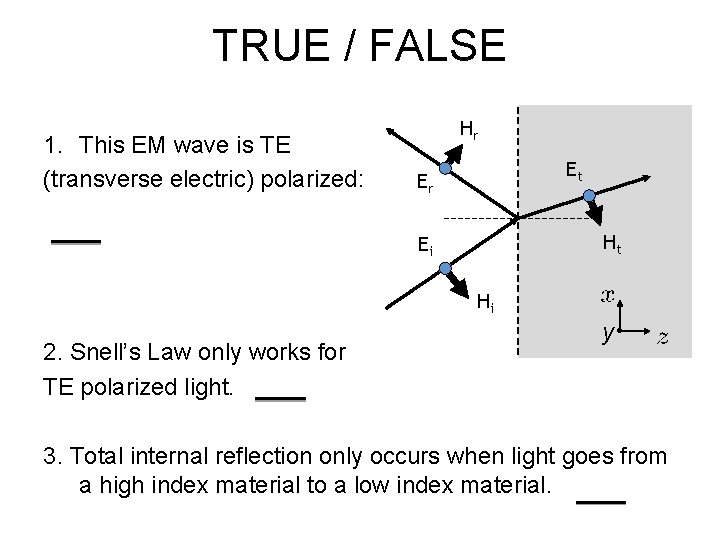
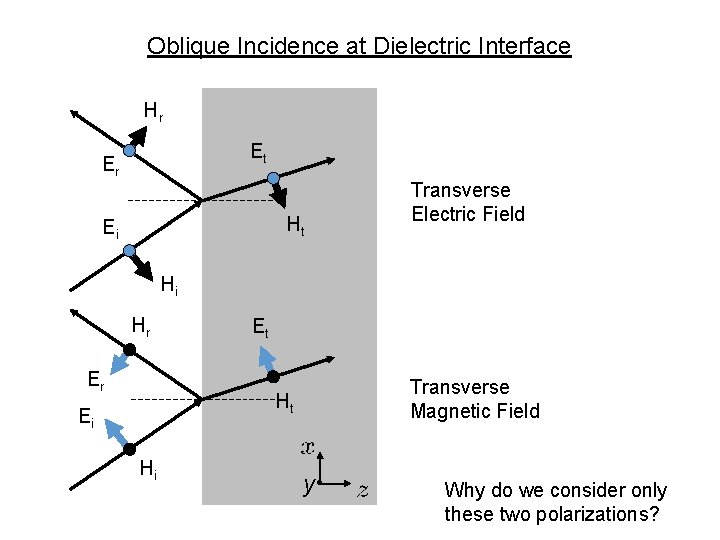
TRUE / FALSE 1. This EM wave is TE (transverse electric) polarized: Hr Et Er Ht Ei Hi 2. Snell’s Law only works for TE polarized light. y • 3. Total internal reflection only occurs when light goes from a high index material to a low index material.
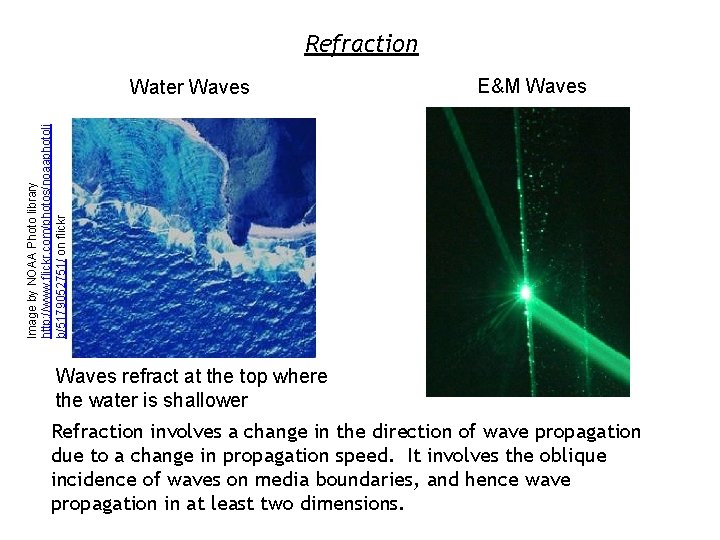
Refraction E&M Waves Image by NOAA Photo library http: //www. flickr. com/photos/noaaphotoli b/5179052751/ on flickr Water Waves refract at the top where the water is shallower Refraction involves a change in the direction of wave propagation due to a change in propagation speed. It involves the oblique incidence of waves on media boundaries, and hence wave propagation in at least two dimensions.
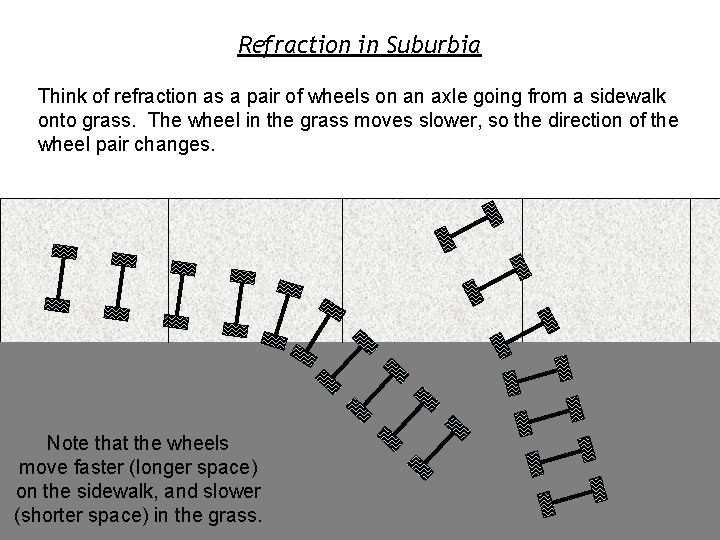
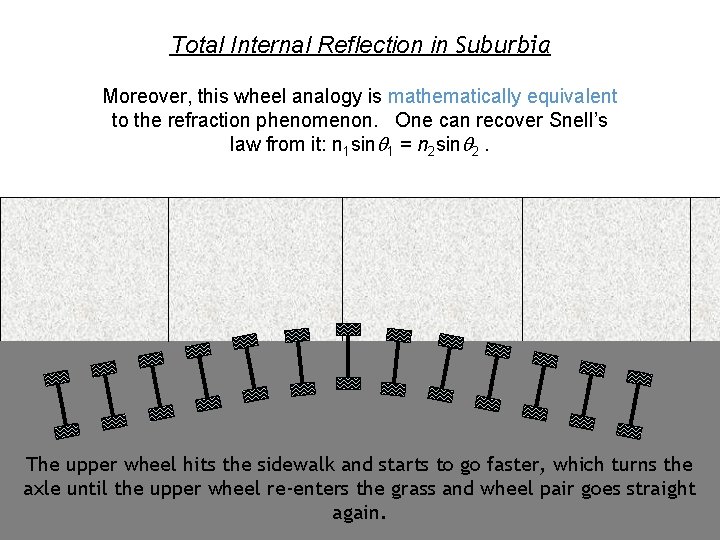
Refraction in Suburbia Think of refraction as a pair of wheels on an axle going from a sidewalk onto grass. The wheel in the grass moves slower, so the direction of the wheel pair changes. Note that the wheels move faster (longer space) on the sidewalk, and slower (shorter space) in the grass.
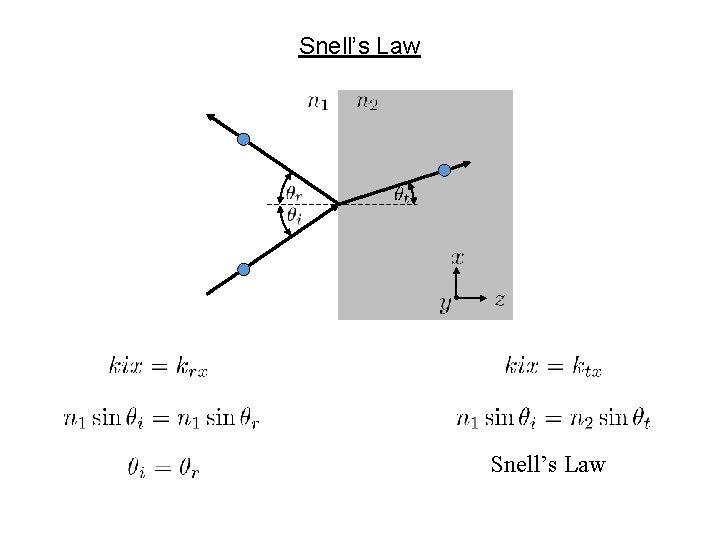
Total Internal Reflection in Suburbia Moreover, this wheel analogy is mathematically equivalent to the refraction phenomenon. One can recover Snell’s law from it: n 1 sin 1 = n 2 sin 2. The upper wheel hits the sidewalk and starts to go faster, which turns the axle until the upper wheel re-enters the grass and wheel pair goes straight again.
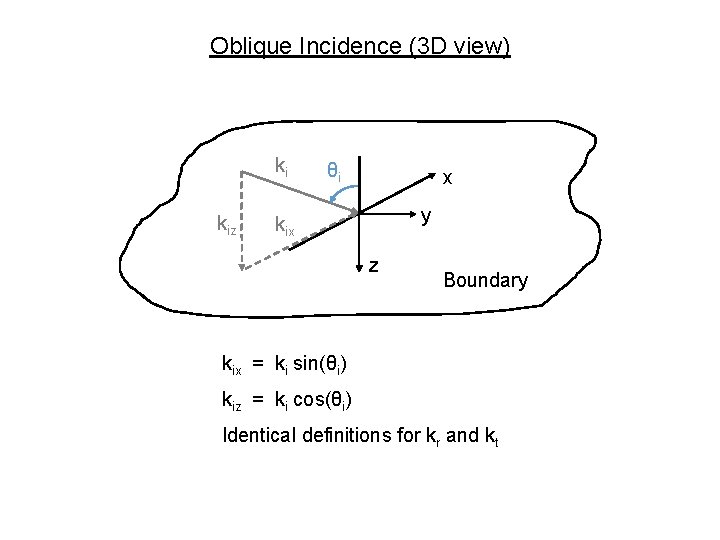
Oblique Incidence (3 D view) ki kiz θi x y kix z Boundary kix = ki sin(θi) kiz = ki cos(θi) Identical definitions for kr and kt
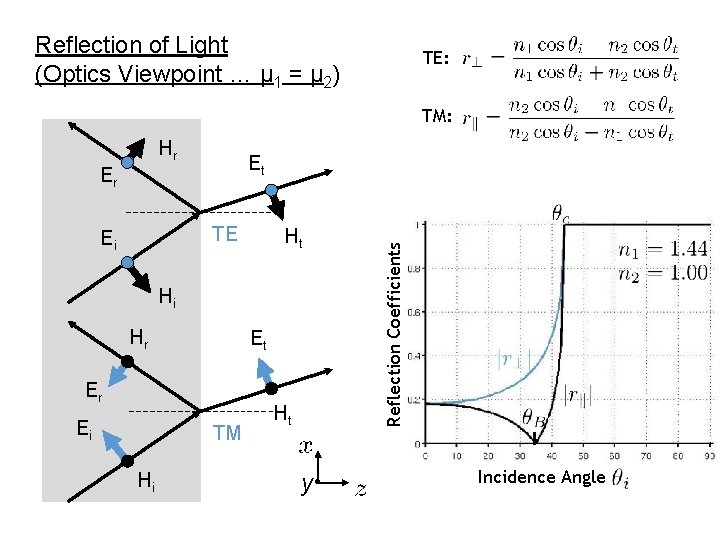
Oblique Incidence at Dielectric Interface Hr Et Er Ht Ei Transverse Electric Field Hi Hr Er Et Transverse Magnetic Field Ht Ei Hi y • Why do we consider only these two polarizations?
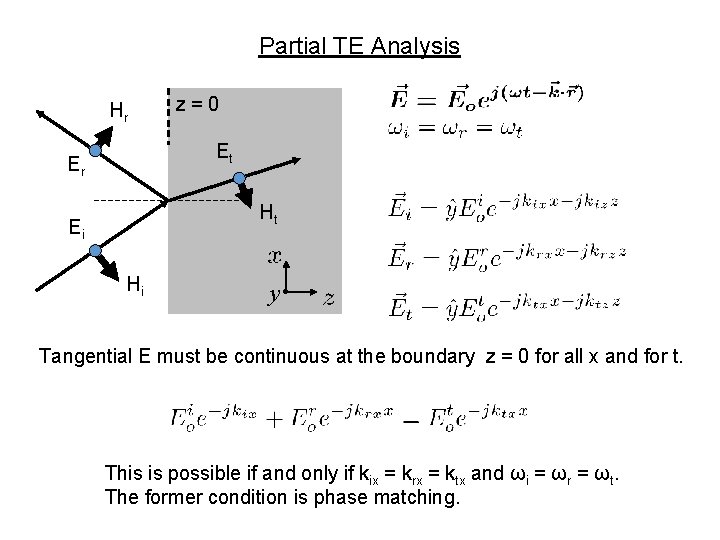
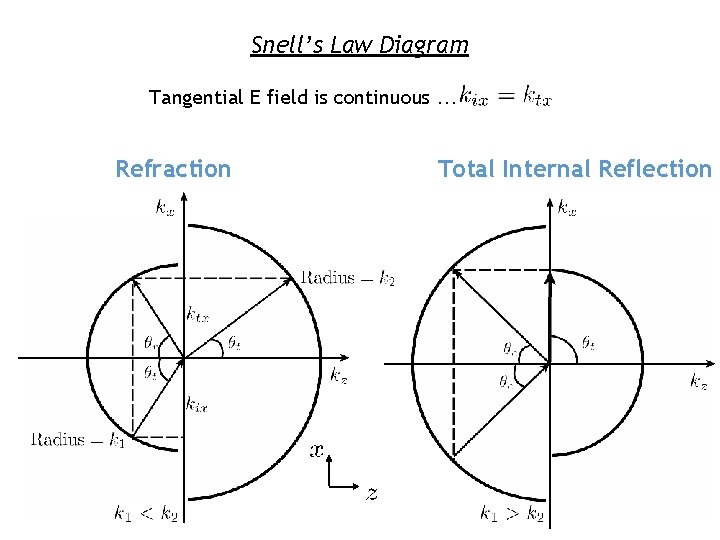
Partial TE Analysis Hr z=0 Et Er Ht Ei Hi y • Tangential E must be continuous at the boundary z = 0 for all x and for t. This is possible if and only if kix = krx = ktx and ωi = ωr = ωt. The former condition is phase matching.
Snell’s Law Diagram Tangential E field is continuous … Refraction Total Internal Reflection
Snell’s Law • Snell’s Law
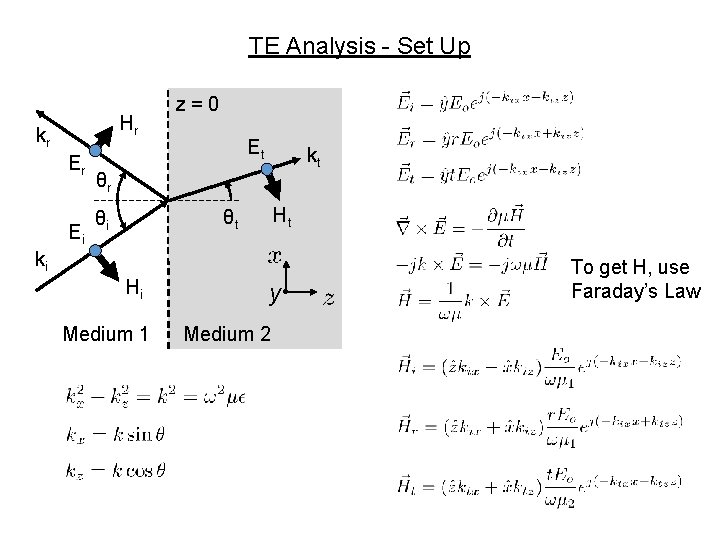
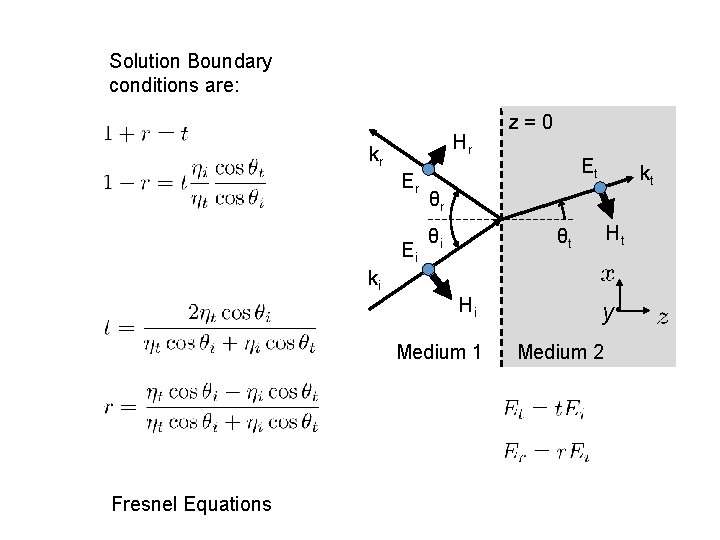
TE Analysis - Set Up Hr kr Er Ei z=0 Et kt θr Ht θt θi ki Hi Medium 1 y • Medium 2 To get H, use Faraday’s Law
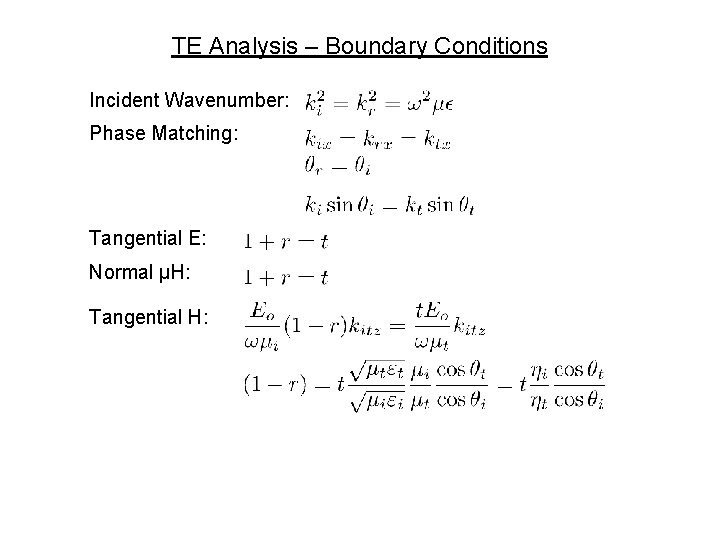
TE Analysis – Boundary Conditions Incident Wavenumber: Phase Matching: Tangential E: Normal μH: Tangential H:
Solution Boundary conditions are: Hr kr Er Ei z=0 Et kt θr Ht θt θi ki Hi Medium 1 Fresnel Equations y • Medium 2
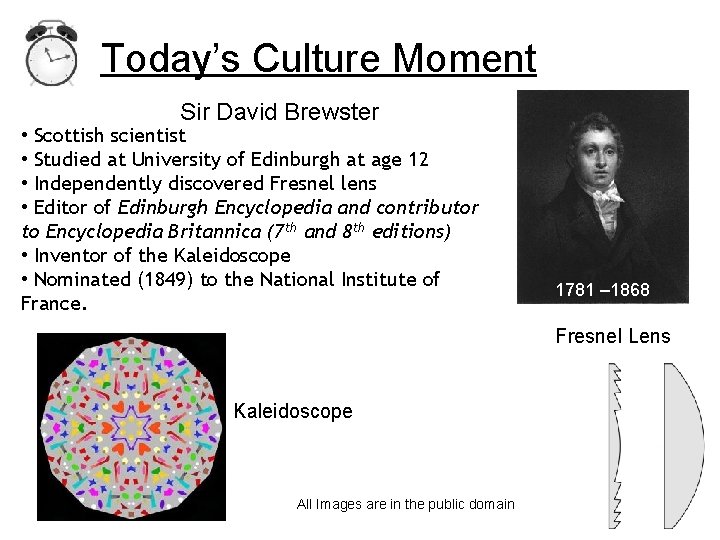
Today’s Culture Moment Sir David Brewster • Scottish scientist • Studied at University of Edinburgh at age 12 • Independently discovered Fresnel lens • Editor of Edinburgh Encyclopedia and contributor to Encyclopedia Britannica (7 th and 8 th editions) • Inventor of the Kaleidoscope • Nominated (1849) to the National Institute of France. 1781 – 1868 Fresnel Lens Kaleidoscope All Images are in the public domain
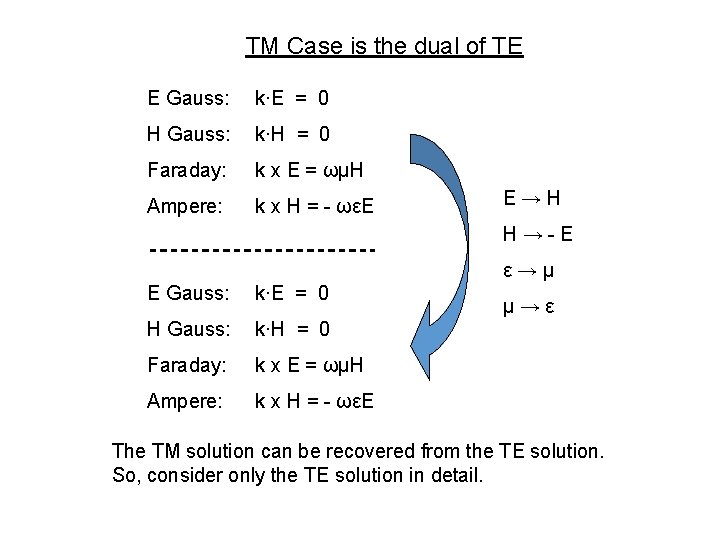
TM Case is the dual of TE E Gauss: k∙E = 0 H Gauss: k∙H = 0 Faraday: k х E = ωμH Ampere: k х H = - ωεE E→H H→-E ε→μ E Gauss: k∙E = 0 H Gauss: k∙H = 0 Faraday: k х E = ωμH Ampere: k х H = - ωεE μ→ε The TM solution can be recovered from the TE solution. So, consider only the TE solution in detail.
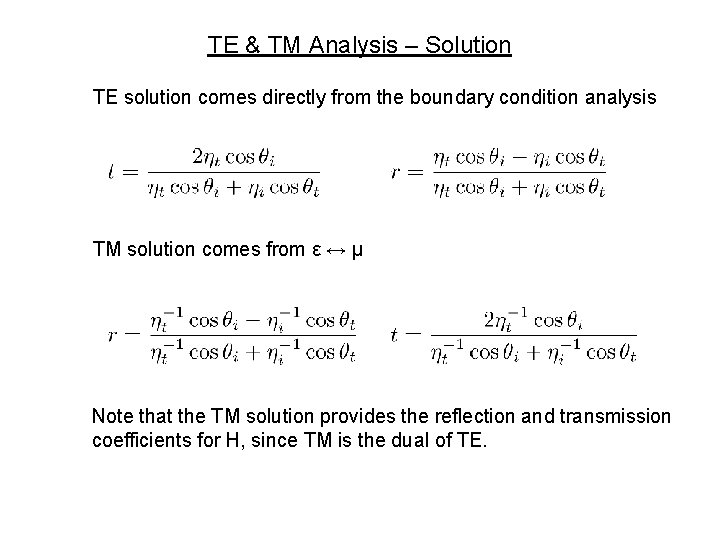
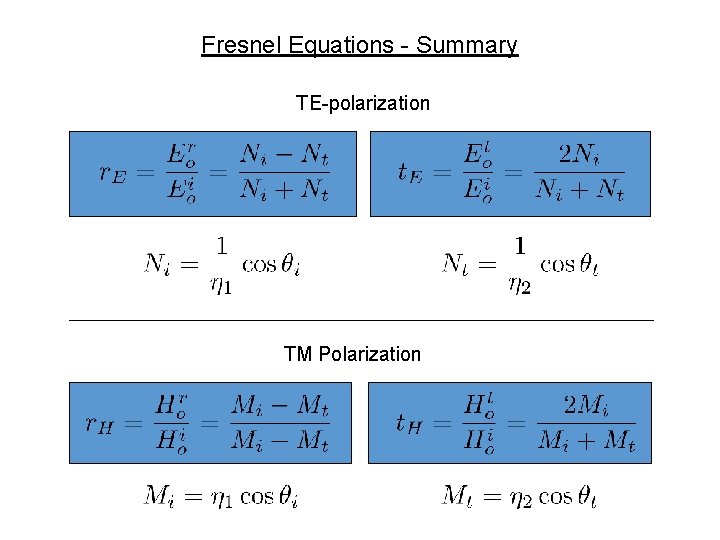
TE & TM Analysis – Solution TE solution comes directly from the boundary condition analysis TM solution comes from ε ↔ μ Note that the TM solution provides the reflection and transmission coefficients for H, since TM is the dual of TE.
Fresnel Equations - Summary TE-polarization TM Polarization
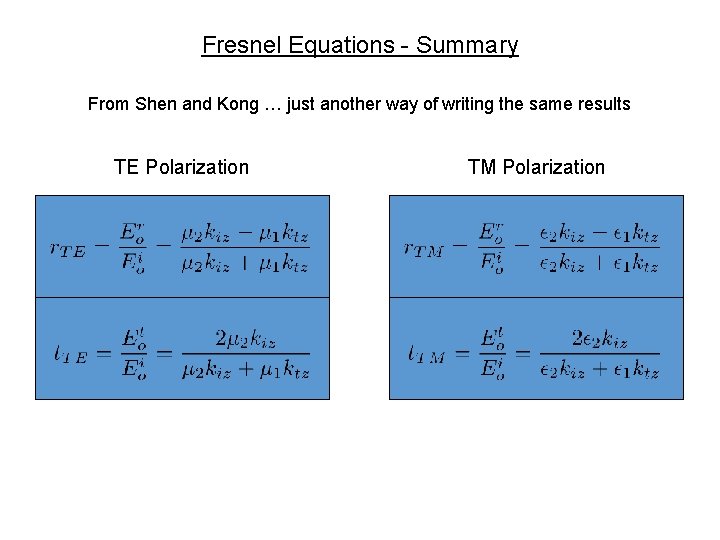
Fresnel Equations - Summary From Shen and Kong … just another way of writing the same results TE Polarization TM Polarization
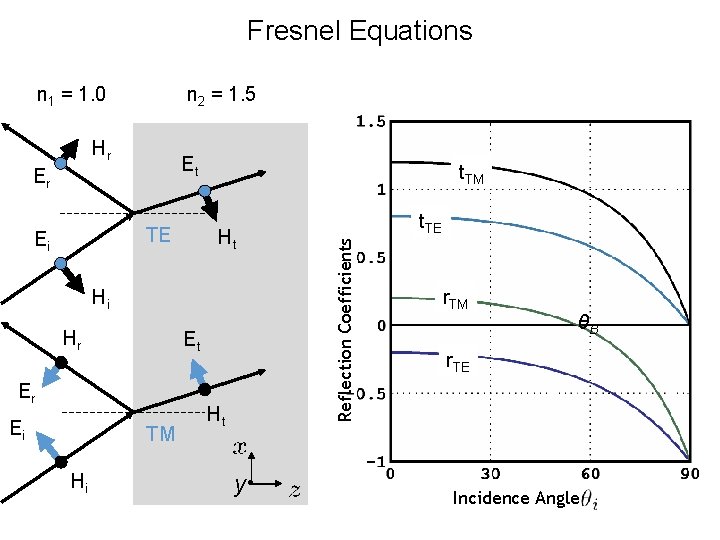
Fresnel Equations n 1 = 1. 0 n 2 = 1. 5 Hr Et TE Ei t. TM Ht Hi Hr Et Er Ei TM Hi Ht y • t. TE Reflection Coefficients Er r. TM θB r. TE Incidence Angle
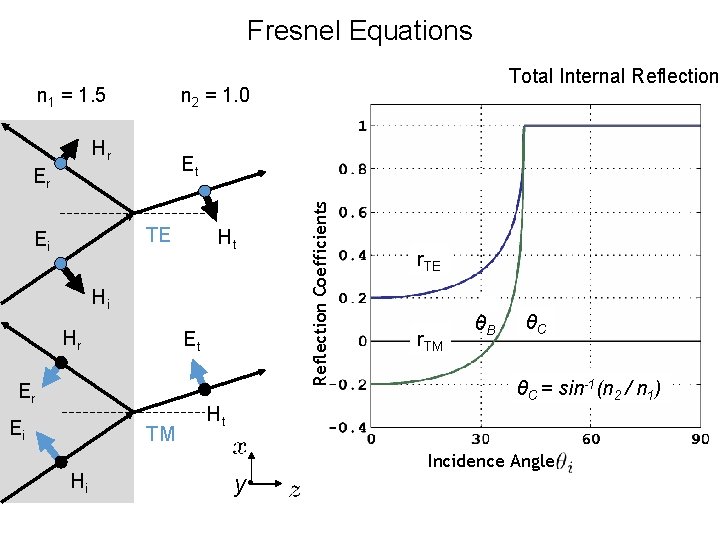
Fresnel Equations n 1 = 1. 5 n 2 = 1. 0 Hr TE Ht Hi Hr Et Er Ei TM Hi Ht y • Reflection Coefficients Et Er Ei Total Internal Reflection r. TE r. TM θB θC θC = sin-1(n 2 / n 1) Incidence Angle
Reflection of Light (Optics Viewpoint … μ 1 = μ 2) TE: TM: Hr TE Ei Ht Hi Hr Et Er Ei TM Hi Ht y • Reflection Coefficients Et Er Incidence Angle
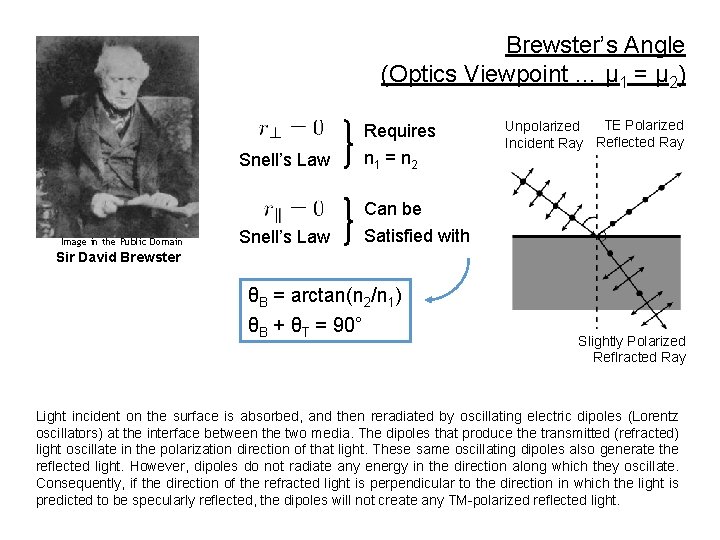
Brewster’s Angle (Optics Viewpoint … μ 1 = μ 2) Requires Snell’s Law n 1 = n 2 TE Polarized Unpolarized Incident Ray Reflected Ray Can be Image in the Public Domain Snell’s Law Satisfied with Sir David Brewster θB = arctan(n 2/n 1) θB + θT = 90° Slightly Polarized Reflracted Ray Light incident on the surface is absorbed, and then reradiated by oscillating electric dipoles (Lorentz oscillators) at the interface between the two media. The dipoles that produce the transmitted (refracted) light oscillate in the polarization direction of that light. These same oscillating dipoles also generate the reflected light. However, dipoles do not radiate any energy in the direction along which they oscillate. Consequently, if the direction of the refracted light is perpendicular to the direction in which the light is predicted to be specularly reflected, the dipoles will not create any TM-polarized reflected light.
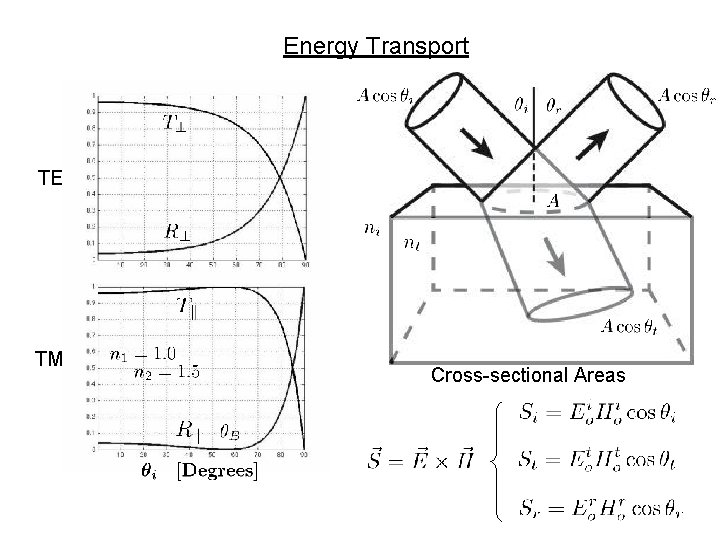
Energy Transport TE TM Cross-sectional Areas
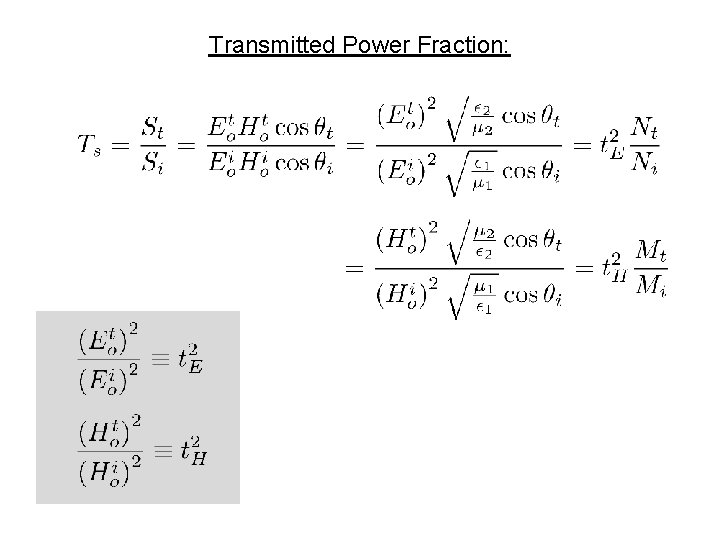
Transmitted Power Fraction:
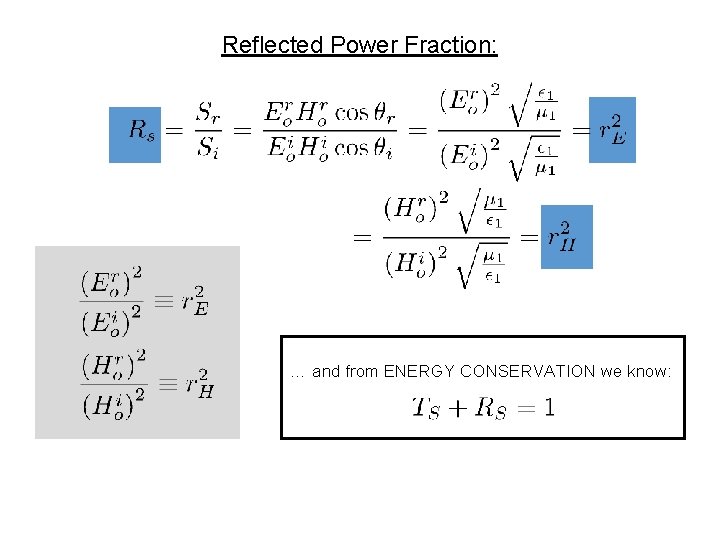
Reflected Power Fraction: … and from ENERGY CONSERVATION we know:
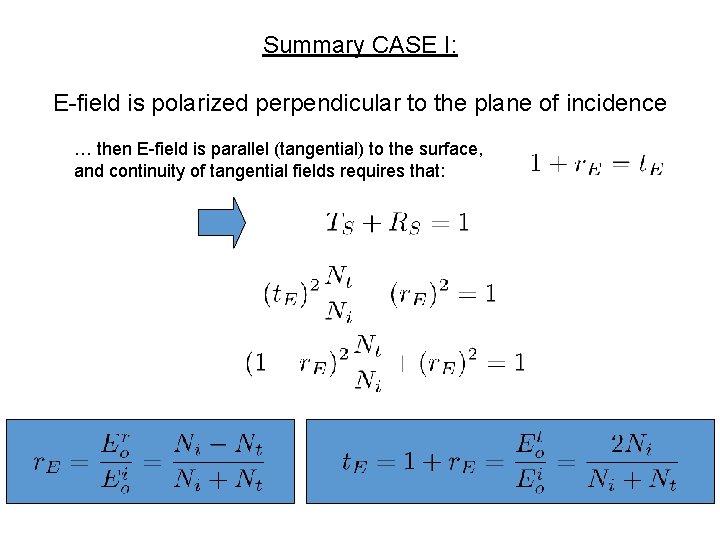
Summary CASE I: E-field is polarized perpendicular to the plane of incidence … then E-field is parallel (tangential) to the surface, and continuity of tangential fields requires that:
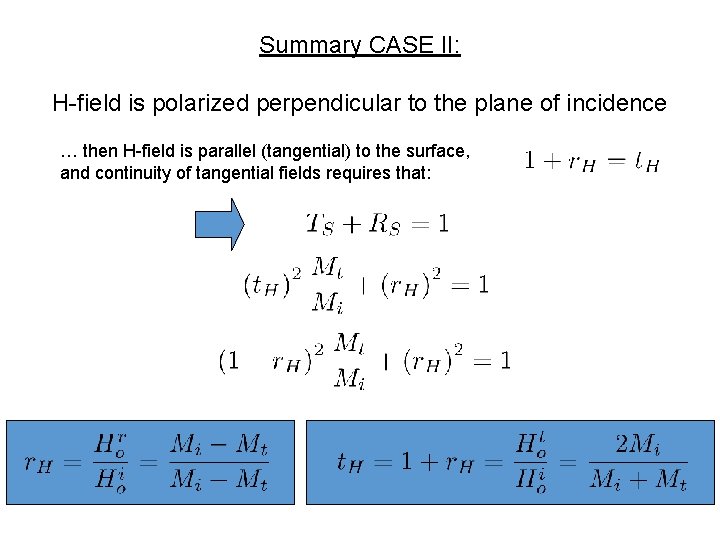
Summary CASE II: H-field is polarized perpendicular to the plane of incidence … then H-field is parallel (tangential) to the surface, and continuity of tangential fields requires that:
MIT Open. Course. Ware http: //ocw. mit. edu 6. 007 Electromagnetic Energy: From Motors to Lasers Spring 2011 For information about citing these materials or our Terms of Use, visit: http: //ocw. mit. edu/terms.