
FRESNEL BIPRISM B RAJESWARA REDDY LECTURER IN PHYSICS

FRESNEL BIPRISM B. RAJESWARA REDDY LECTURER IN PHYSICS III Sem, Optics D. K GOVT COLLEGE FOR WOMEN(A), NELLORE
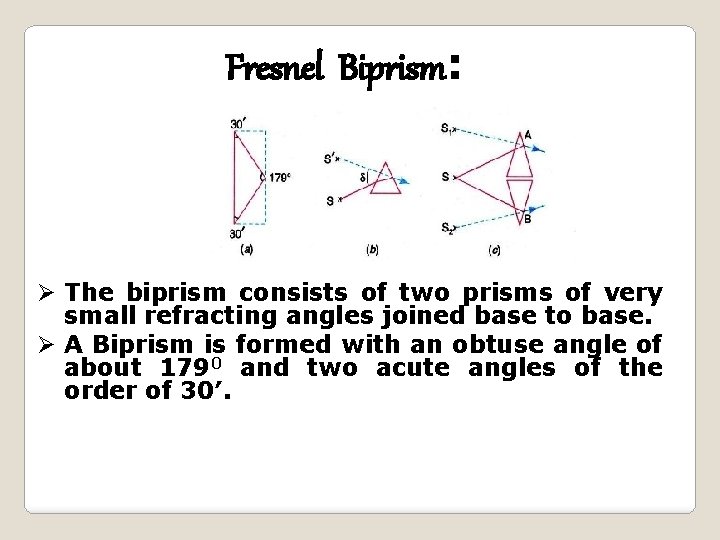
Fresnel Biprism: Ø The biprism consists of two prisms of very small refracting angles joined base to base. Ø A Biprism is formed with an obtuse angle of about 1790 and two acute angles of the order of 30′.
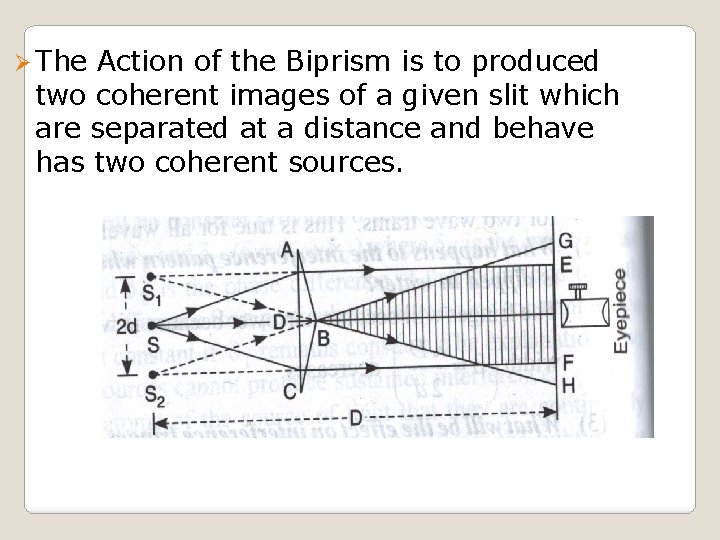
Ø The Action of the Biprism is to produced two coherent images of a given slit which are separated at a distance and behave has two coherent sources.
ØThe top portion of wavefront is refracted downward and appear to have emanated from the virtual image S 1 ØThe lower segment, falling on the lower part of the biprism, is refracted upward and appears to have emanated from the virtual source S 2
Contd: Ø The virtual sources S 1 and S 2 are coherent. Ø The interference fringes are obtained in the overlapping region EF and can seen by eyepiece.
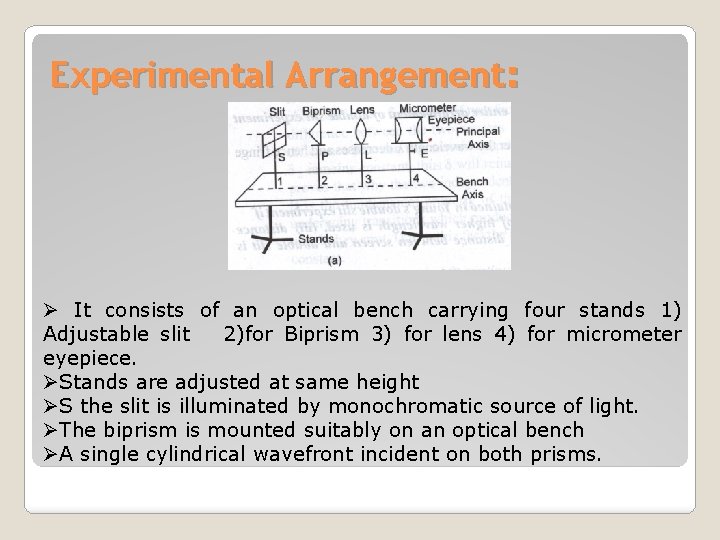
Experimental Arrangement: Ø It consists of an optical bench carrying four stands 1) Adjustable slit 2)for Biprism 3) for lens 4) for micrometer eyepiece. ØStands are adjusted at same height ØS the slit is illuminated by monochromatic source of light. ØThe biprism is mounted suitably on an optical bench ØA single cylindrical wavefront incident on both prisms.
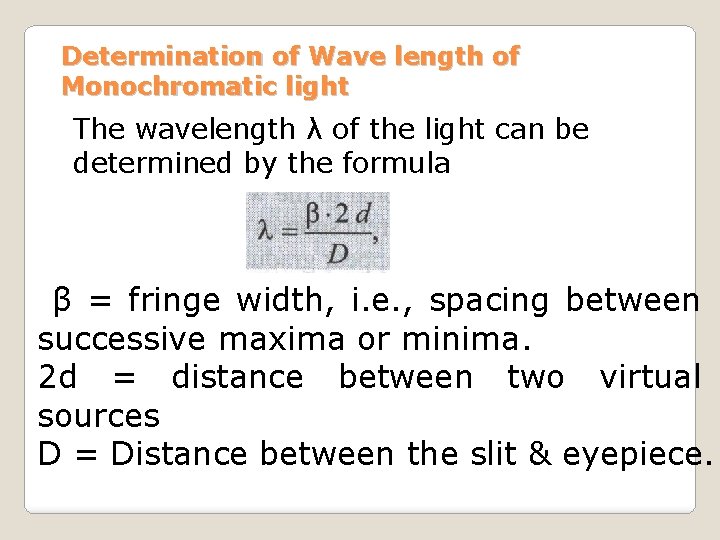
Determination of Wave length of Monochromatic light The wavelength λ of the light can be determined by the formula β = fringe width, i. e. , spacing between successive maxima or minima. 2 d = distance between two virtual sources D = Distance between the slit & eyepiece.
Measurement of fringe width β: The vertical cross wire is adjusted on any bright fringe and the reading on micrometer is noted X 1. Set the cross wire on 10 th bright fringe reading should be noted X 2 Fringe Width β = X 2 - X 1/10. Measurement of D: Distance between slit & eyepiece can be measured by using meter scale on the optical bench. The Distance is D.
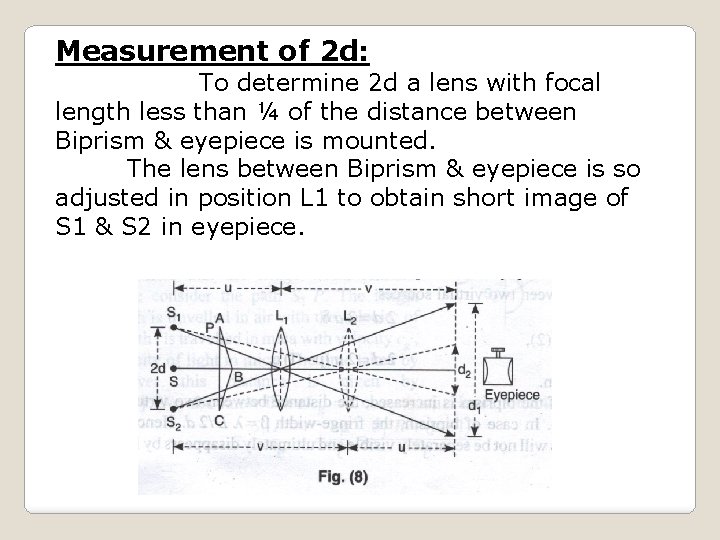
Measurement of 2 d: To determine 2 d a lens with focal length less than ¼ of the distance between Biprism & eyepiece is mounted. The lens between Biprism & eyepiece is so adjusted in position L 1 to obtain short image of S 1 & S 2 in eyepiece.
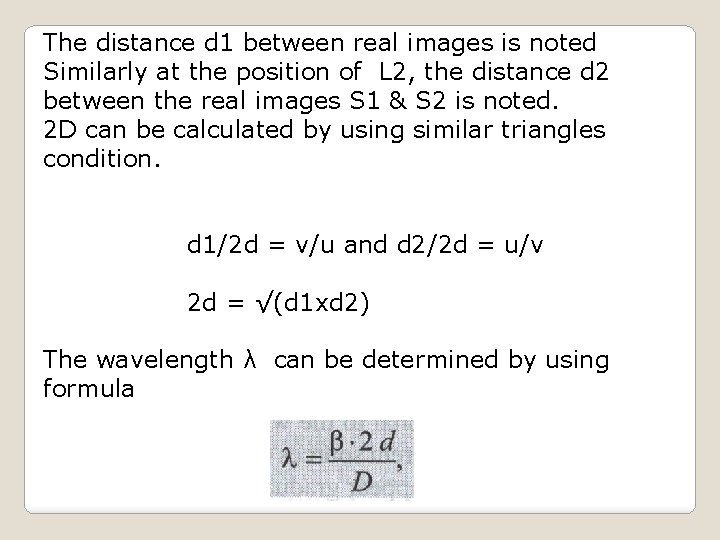
The distance d 1 between real images is noted Similarly at the position of L 2, the distance d 2 between the real images S 1 & S 2 is noted. 2 D can be calculated by using similar triangles condition. d 1/2 d = v/u and d 2/2 d = u/v 2 d = √(d 1 xd 2) The wavelength λ can be determined by using formula

Application of Fresnel's Biprism Fresnel biprism can be used to thickness of a thin transparent sheet/ thin film.
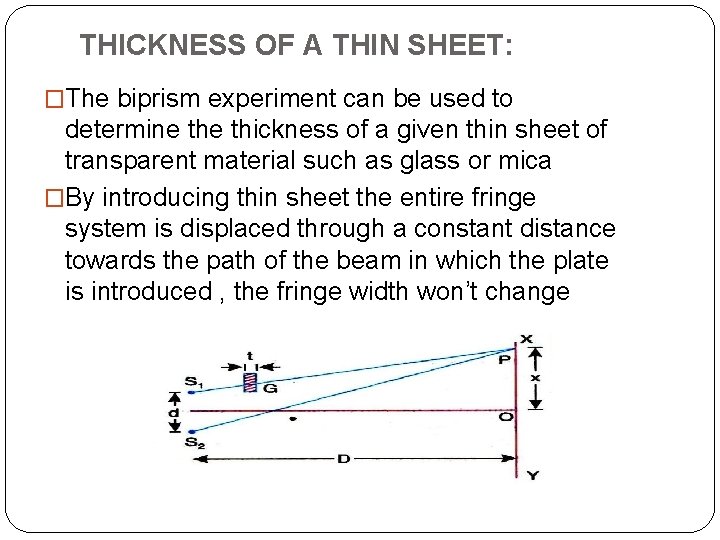
THICKNESS OF A THIN SHEET: �The biprism experiment can be used to determine thickness of a given thin sheet of transparent material such as glass or mica �By introducing thin sheet the entire fringe system is displaced through a constant distance towards the path of the beam in which the plate is introduced , the fringe width won’t change
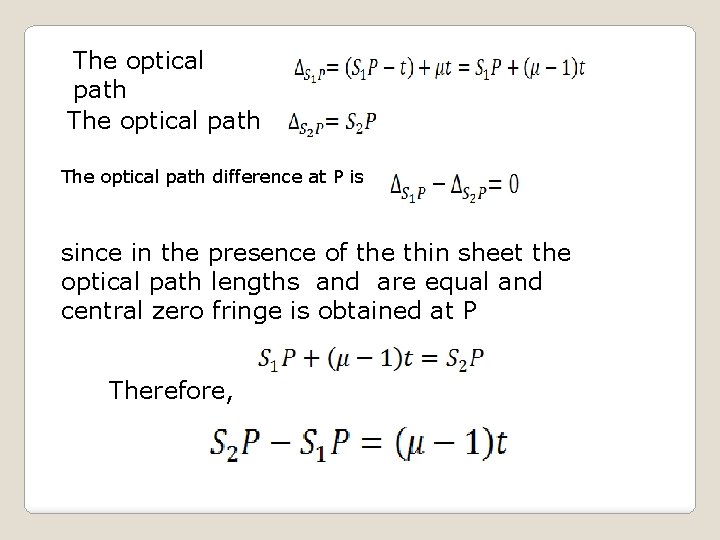
The optical path difference at P is since in the presence of the thin sheet the optical path lengths and are equal and central zero fringe is obtained at P Therefore,
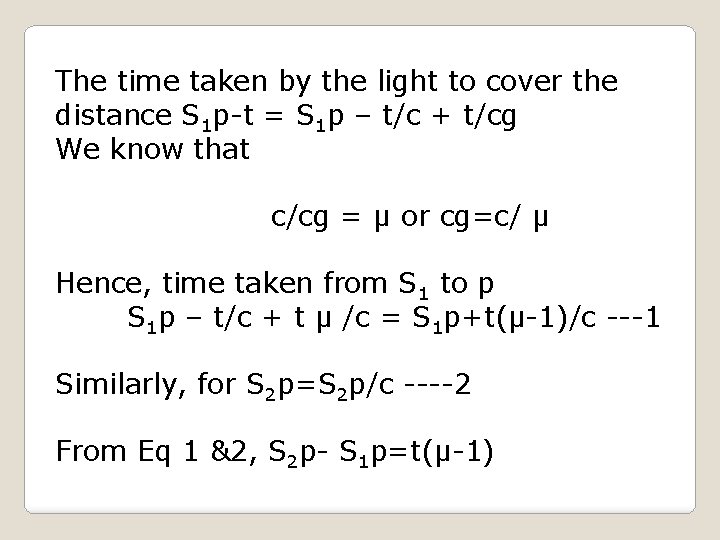
The time taken by the light to cover the distance S 1 p-t = S 1 p – t/c + t/cg We know that c/cg = µ or cg=c/ µ Hence, time taken from S 1 to p S 1 p – t/c + t µ /c = S 1 p+t(µ-1)/c ---1 Similarly, for S 2 p=S 2 p/c ----2 From Eq 1 &2, S 2 p- S 1 p=t(µ-1)
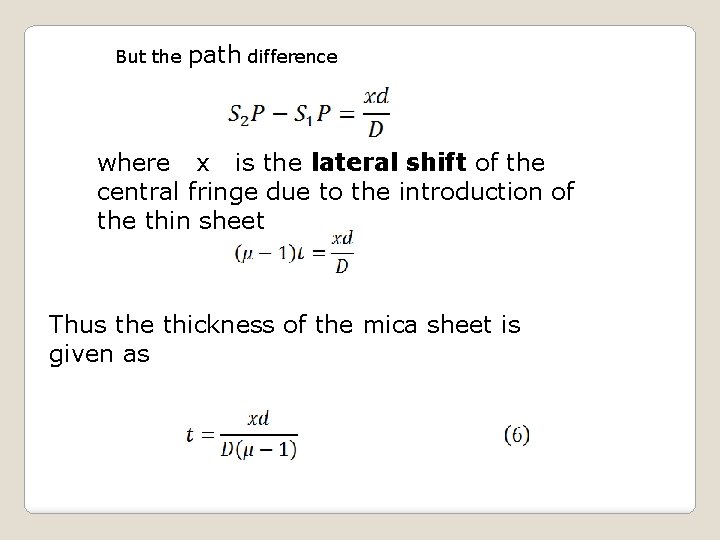
But the path difference where x is the lateral shift of the central fringe due to the introduction of the thin sheet Thus the thickness of the mica sheet is given as

THANK YOU
- Slides: 16