
Freshman English A technique for exposition for explaining
![Freshman English A technique for exposition, for explaining [Comparison. ppt]](https://slidetodoc.com/presentation_image_h2/2c5ebc7d61cca225b3dcfc0a3b46c449/image-1.jpg "Freshman English A technique for exposition, for explaining [Comparison. ppt]")
- Slides: 26
Freshman English A technique for exposition, for explaining [Comparison. ppt]
A type of analysis Parts of two or more subjects are studied, Then discussed in terms of one another.
Comparison n To compare is to discuss similarities and differences between. u people u places u objects u events u ideas
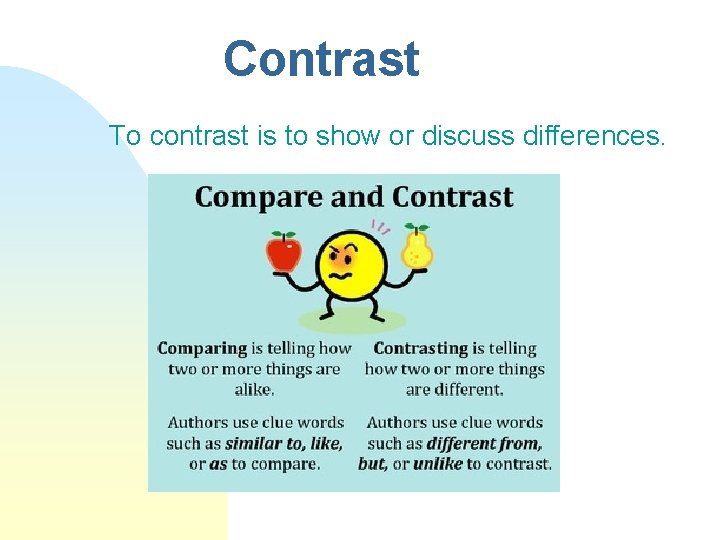
Contrast To contrast is to show or discuss differences.
Uses n Good for a broad range of explanatory situations to clarify and/or explain: u character u design u elements u the nature of something
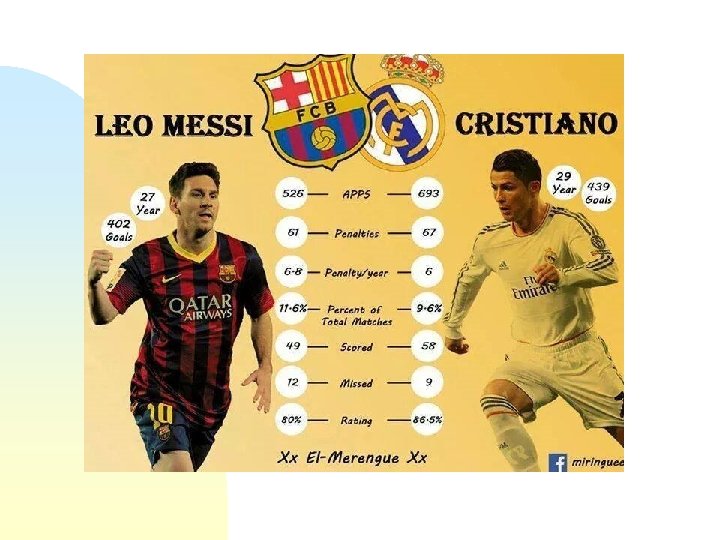
Useful also to: n n Show superiority. Show inferiority.
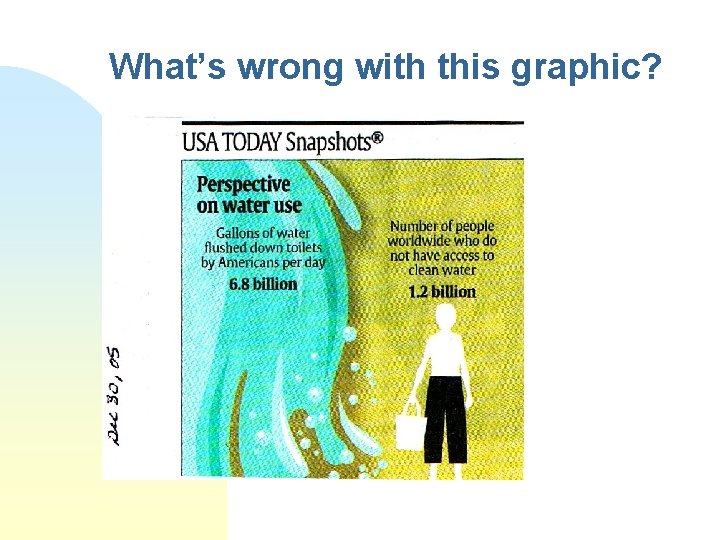
What’s wrong with this graphic?
Requirements n Relationship between the two items must be u logical u self-evident u balanced u sustained.
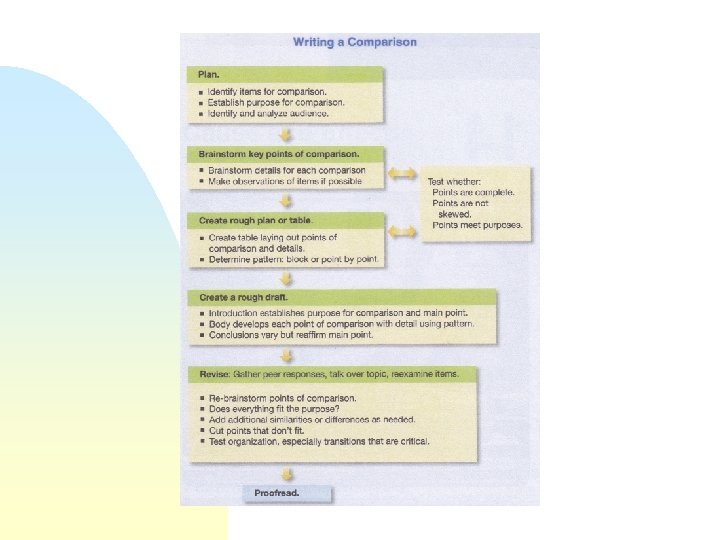
Bases for Comparison n n What elements of the two items are comparable? Have you clearly stated them in the introduction? Are they in the order in which they will be discussed? Have you defined necessary terms?
Organization n n Subject to subject (item to item) Point to point (element to element)
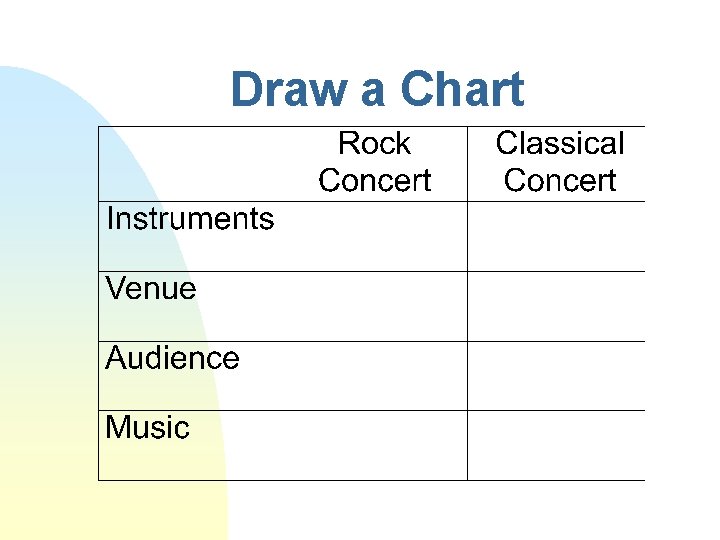
Draw a Chart
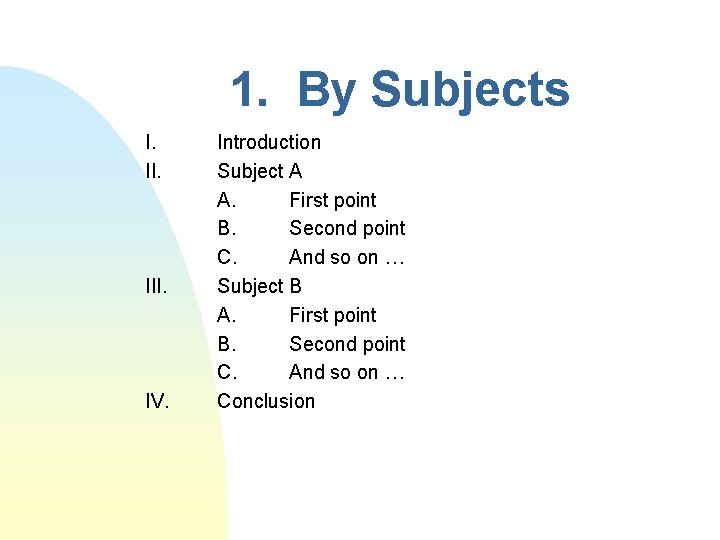
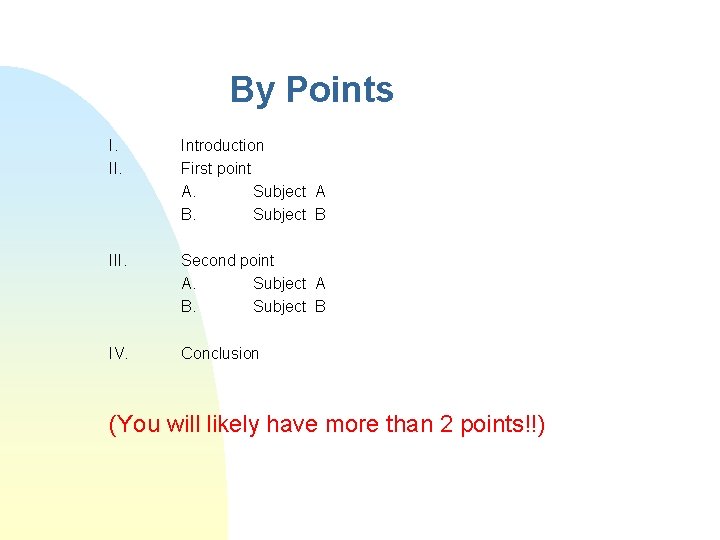
Organization Particular points provide the means by which to observe similarities and differences between subjects. Two patterns for arrangement or organization.
1. By Subjects I. II. IV. Introduction Subject A A. First point B. Second point C. And so on … Subject B A. First point B. Second point C. And so on … Conclusion
By Points I. II. Introduction First point A. Subject A B. Subject B III. Second point A. Subject A B. Subject B IV. Conclusion (You will likely have more than 2 points!!)
Rules to Help
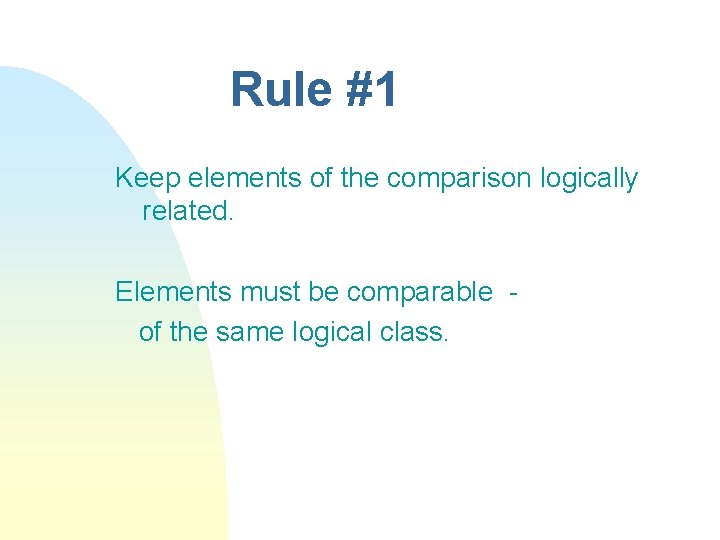
Rule #1 Keep elements of the comparison logically related. Elements must be comparable of the same logical class.
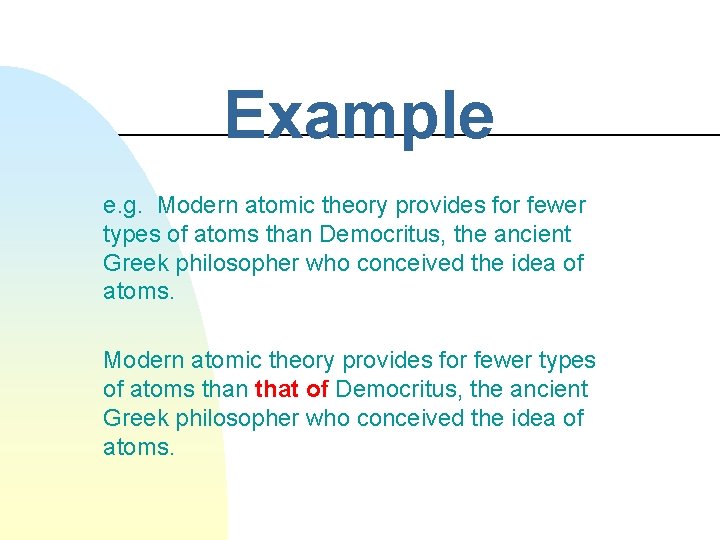
Example e. g. Modern atomic theory provides for fewer types of atoms than Democritus, the ancient Greek philosopher who conceived the idea of atoms. Modern atomic theory provides for fewer types of atoms than that of Democritus, the ancient Greek philosopher who conceived the idea of atoms.
Rule #2 n n Complete all elements of the comparison. The reader must know which elements in a sentence are being compared.
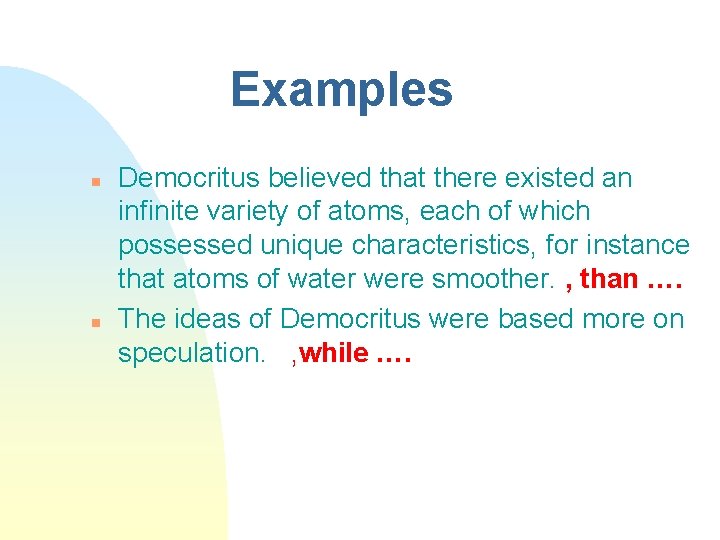
Examples n n Democritus believed that there existed an infinite variety of atoms, each of which possessed unique characteristics, for instance that atoms of water were smoother. , than …. The ideas of Democritus were based more on speculation. , while ….
Rule #3 n n Make comparisons clear and unambiguous. Revise comparisons that invite alternate interpretations.
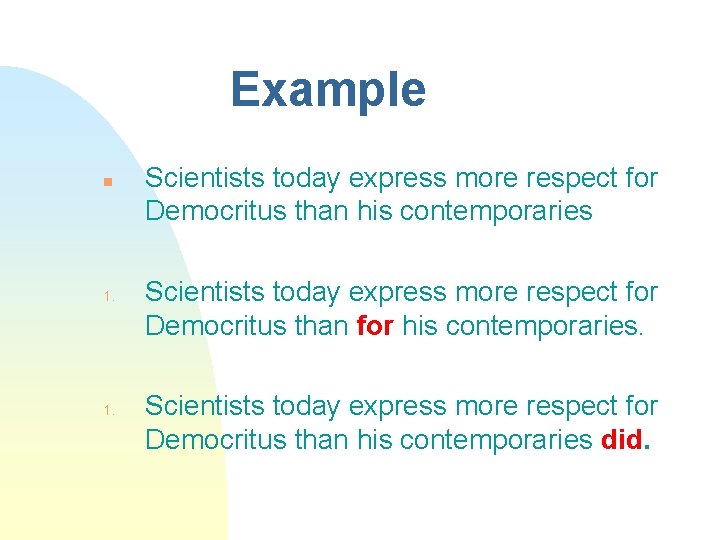
Example n 1. Scientists today express more respect for Democritus than his contemporaries Scientists today express more respect for Democritus than for his contemporaries. Scientists today express more respect for Democritus than his contemporaries did.
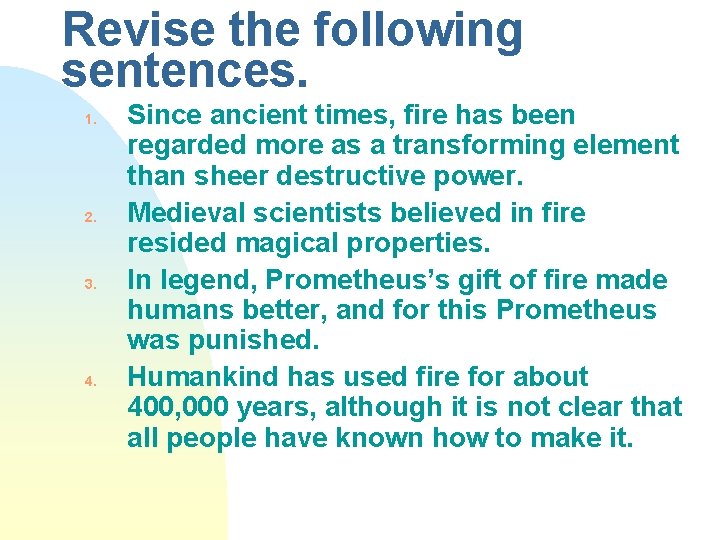
Revise the following sentences. 1. 2. 3. 4. Since ancient times, fire has been regarded more as a transforming element than sheer destructive power. Medieval scientists believed in fire resided magical properties. In legend, Prometheus’s gift of fire made humans better, and for this Prometheus was punished. Humankind has used fire for about 400, 000 years, although it is not clear that all people have known how to make it.
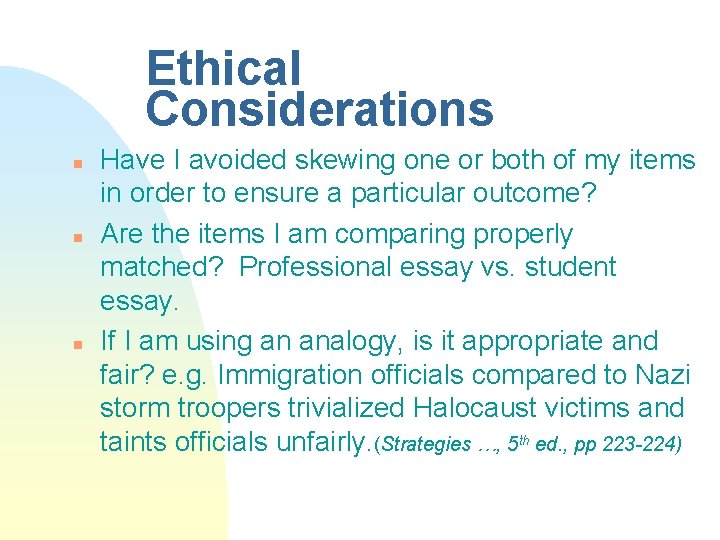
Ethical Considerations n n n Have I avoided skewing one or both of my items in order to ensure a particular outcome? Are the items I am comparing properly matched? Professional essay vs. student essay. If I am using an analogy, is it appropriate and fair? e. g. Immigration officials compared to Nazi storm troopers trivialized Halocaust victims and taints officials unfairly. (Strategies …, 5 th ed. , pp 223 -224)
What’s next? Go to: http: //eduventure. ca/Comparison. htm Assignment n. Write a properly focussed comparison essay on one of the topics below, or on a topic of your choice. n. Determine the points that you will discuss and how you will develop and arrange them. Emphasize similarities, differences, or both. n. Suggested topics n. Resource Material n. Chapter 11, 5 th ed. Strategies for Successful Writing, pp. 218 -236. n. Organizing an essay of Comparison and/or Contrast n. Revising the Comparison n. Paragraph Hook Words, Transitional Phrases, Link Words and Phrases n. Writing Effective Comparison or Contrast Essays n