
Frequency Tables and Their Statistics Percentiles give the
Frequency Tables and Their Statistics
Percentiles give the percent (usually expressed as a WHOLE number) of data cases below a given case. For example: if 38 percent of the scores, in a distribution of scores, is BELOW Mortimer’s score of 72 then in that distribution of scores, 72 is equivalent to the 38 th percentile. Generally we would say that the Percentile Rank (PR) for a raw score of 72 is 38 PR

Percentiles and Cumulative Frequencies Percentiles can be read directly from the cumulative frequency column in an SPSS frequency table. In this table, the PR for a score of 6 is 20; for a score of 8 it is 56.

Quartiles Certain percentiles are particularly important and are given special names The 25 th percentile is know as the 1 st quartile. The 50 th percentile is the 2 nd quartile AND is also know as the median. The 75 th percentile is the 3 ed quartile. The difference between the 1 st and 3 ed quartile is know as the inter-quartile range.
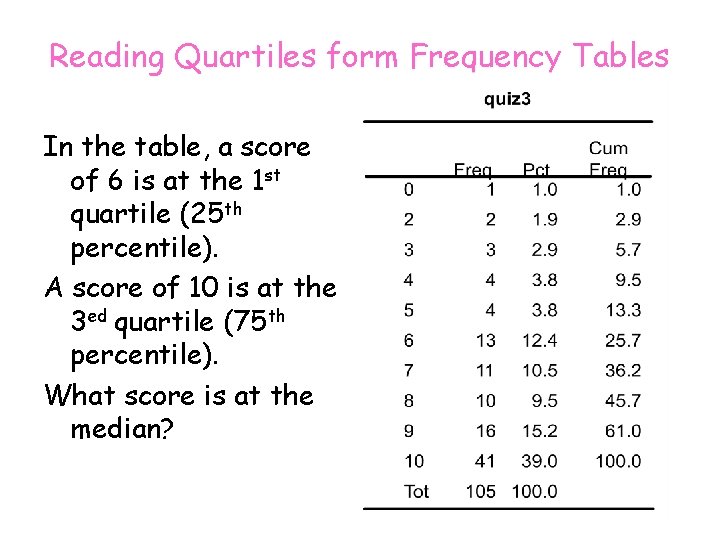
Reading Quartiles form Frequency Tables In the table, a score of 6 is at the 1 st quartile (25 th percentile). A score of 10 is at the 3 ed quartile (75 th percentile). What score is at the median?
Skew Indicates the extent to which a distribution deviates from symmetry around the mean of the distribution. Positive Skew: More scores are LOWER than the mean: the distribution has a long tail in the direction of higher scores (to the right) Negative Skew: More scores are higher than the mean: long tail to the left.
Kurtosis Indicates the “flatness” or “peakedness” of a distribution. Leptokurtic distributions are peaked (scores tend to be tightly packed around the mean). Platakurtic distributions are flat (scores tend to be more evenly spread out). Mesokurtic distribution tend toward normal distributions.
- Slides: 7