
Frequency Reuse Tradeoff and System Capacity in Small
- Slides: 1
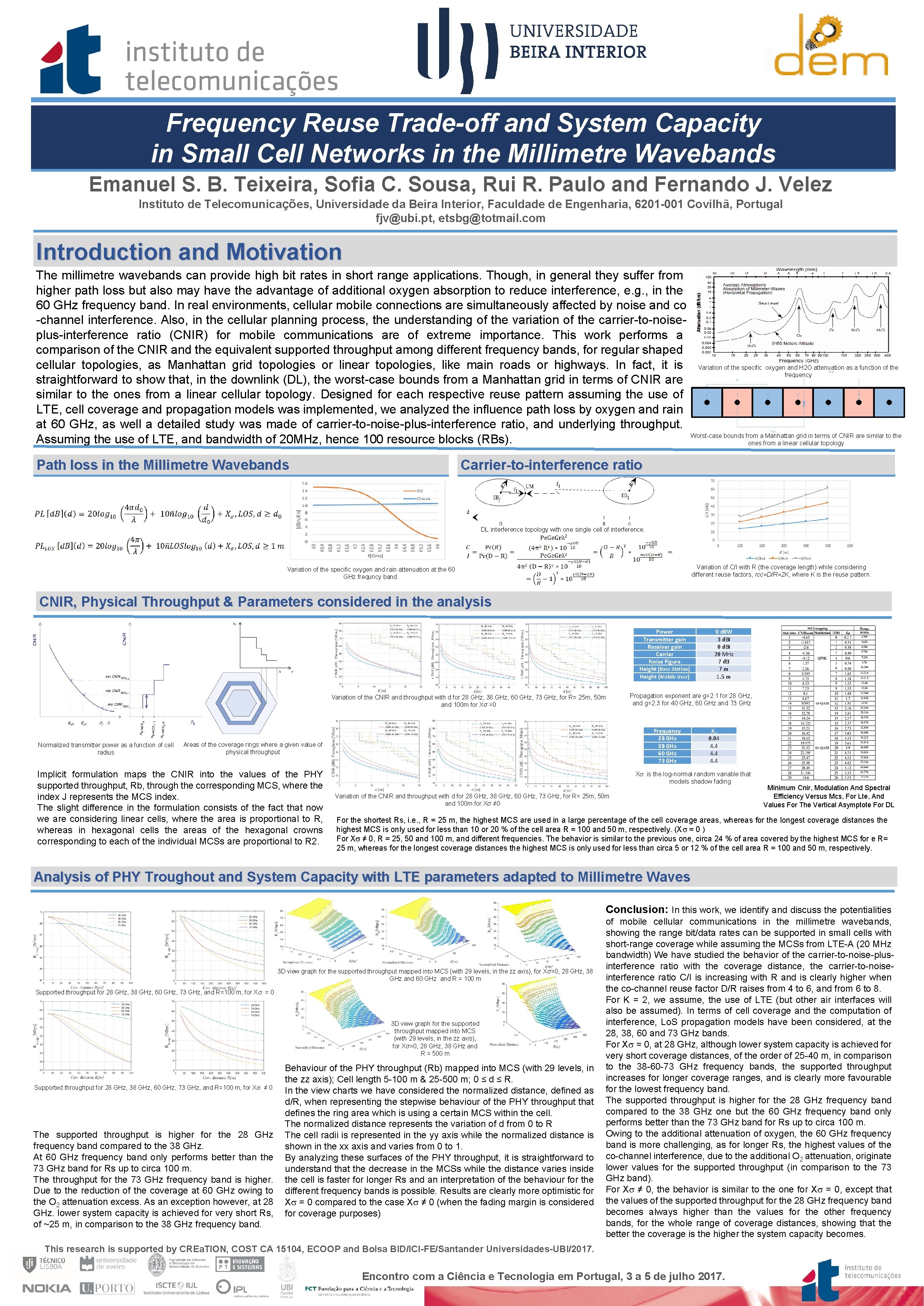
Frequency Reuse Trade-off and System Capacity in Small Cell Networks in the Millimetre Wavebands Emanuel S. B. Teixeira, Sofia C. Sousa, Rui R. Paulo and Fernando J. Velez Instituto de Telecomunicações, Universidade da Beira Interior, Faculdade de Engenharia, 6201 -001 Covilhã, Portugal fjv@ubi. pt, etsbg@totmail. com Introduction and Motivation The millimetre wavebands can provide high bit rates in short range applications. Though, in general they suffer from higher path loss but also may have the advantage of additional oxygen absorption to reduce interference, e. g. , in the 60 GHz frequency band. In real environments, cellular mobile connections are simultaneously affected by noise and co -channel interference. Also, in the cellular planning process, the understanding of the variation of the carrier-to-noiseplus-interference ratio (CNIR) for mobile communications are of extreme importance. This work performs a comparison of the CNIR and the equivalent supported throughput among different frequency bands, for regular shaped cellular topologies, as Manhattan grid topologies or linear topologies, like main roads or highways. In fact, it is straightforward to show that, in the downlink (DL), the worst-case bounds from a Manhattan grid in terms of CNIR are similar to the ones from a linear cellular topology. Designed for each respective reuse pattern assuming the use of LTE, cell coverage and propagation models was implemented, we analyzed the influence path loss by oxygen and rain at 60 GHz, as well a detailed study was made of carrier-to-noise-plus-interference ratio, and underlying throughput. Assuming the use of LTE, and bandwidth of 20 MHz, hence 100 resource blocks (RBs). Path loss in the Millimetre Wavebands Variation of the specific oxygen and H 2 O attenuation as a function of the frequency Worst-case bounds from a Manhattan grid in terms of CNIR are similar to the ones from a linear cellular topology Carrier-to-interference ratio DL interference topology with one single cell of interference. Variation of C/I with R (the coverage length) while considering different reuse factors, rcc=D/R=2 K, where K is the reuse pattern. Variation of the specific oxygen and rain attenuation at the 60 GHz frequncy band. CNIR, Physical Throughput & Parameters considered in the analysis Power Transmitter gain Receiver gain Carrier Noise Figure Height (Base Station) Height (Mobile User) Variation of the CNIR and throughput with d for 28 GHz, 38 GHz, 60 GHz, 73 GHz, for R= 25 m, 50 m and 100 m for Xσ =0 Normalized transmitter power as a function of cell radius Implicit formulation maps the CNIR into the values of the PHY supported throughput, Rb, through the corresponding MCS, where the index J represents the MCS index. The slight difference in the formulation consists of the fact that now we are considering linear cells, where the area is proportional to R, whereas in hexagonal cells the areas of the hexagonal crowns corresponding to each of the individual MCSs are proportional to R 2. Propagation exponent are g=2. 1 for 28 GHz, and g=2. 3 for 40 GHz, 60 GHz and 73 GHz Frequency 28 GHz 38 GHz 60 GHz 73 GHz Areas of the coverage rings where a given value of physical throughput 0 d. BW 3 d. Bi 0 d. Bi 20 MHz 7 d. B 7 m 1. 5 m Xσ 0. 04 4. 4 X is the log-normal random variable that models shadow fading Variation of the CNIR and throughput with d for 28 GHz, 38 GHz, 60 GHz, 73 GHz, for R= 25 m, 50 m and 100 m for Xσ ≠ 0 Minimum Cnir, Modulation And Spectral Efficiency Versus Mcs, For Lte, And Values For The Vertical Asymptote For DL For the shortest Rs, i. e. , R = 25 m, the highest MCS are used in a large percentage of the cell coverage areas, whereas for the longest coverage distances the highest MCS is only used for less than 10 or 20 % of the cell area R = 100 and 50 m, respectively. (X = 0 ) For X ≠ 0, R = 25, 50 and 100 m, and different frequencies. The behavior is similar to the previous one, circa 24 % of area covered by the highest MCS for e R= 25 m, whereas for the longest coverage distances the highest MCS is only used for less than circa 5 or 12 % of the cell area R = 100 and 50 m, respectively. Analysis of PHY Troughout and System Capacity with LTE parameters adapted to Millimetre Waves Conclusion: In this work, we identify and discuss the potentialities 3 D view graph for the supported throughput mapped into MCS (with 29 levels, in the zz axis), for Xσ=0, 28 GHz, 38 GHz and 60 GHz and R = 100 m Supported throughput for 28 GHz, 38 GHz, 60 GHz, 73 GHz, and R=100 m, for X = 0 3 D view graph for the supported throughput mapped into MCS (with 29 levels, in the zz axis), for Xσ=0, 28 GHz, 38 GHz and R = 500 m Supported throughput for 28 GHz, 38 GHz, 60 GHz, 73 GHz, and R=100 m, for X ≠ 0 The supported throughput is higher for the 28 GHz frequency band compared to the 38 GHz. At 60 GHz frequency band only performs better than the 73 GHz band for Rs up to circa 100 m. The throughput for the 73 GHz frequency band is higher. Due to the reduction of the coverage at 60 GHz owing to the O 2 attenuation excess. As an exception however, at 28 GHz. lower system capacity is achieved for very short Rs, of ~25 m, in comparison to the 38 GHz frequency band. Behaviour of the PHY throughput (Rb) mapped into MCS (with 29 levels, in the zz axis); Cell length 5 -100 m & 25 -500 m; 0 ≤ d ≤ R. In the view charts we have considered the normalized distance, defined as d/R, when representing the stepwise behaviour of the PHY throughput that defines the ring area which is using a certain MCS within the cell. The normalized distance represents the variation of d from 0 to R The cell radii is represented in the yy axis while the normalized distance is shown in the xx axis and varies from 0 to 1. By analyzing these surfaces of the PHY throughput, it is straightforward to understand that the decrease in the MCSs while the distance varies inside the cell is faster for longer Rs and an interpretation of the behaviour for the different frequency bands is possible. Results are clearly more optimistic for X = 0 compared to the case X ≠ 0 (when the fading margin is considered for coverage purposes) of mobile cellular communications in the millimetre wavebands, showing the range bit/data rates can be supported in small cells with short-range coverage while assuming the MCSs from LTE-A (20 MHz bandwidth) We have studied the behavior of the carrier-to-noise-plusinterference ratio with the coverage distance, the carrier-to-noiseinterference ratio C/I is increasing with R and is clearly higher when the co-channel reuse factor D/R raises from 4 to 6, and from 6 to 8. For K = 2, we assume, the use of LTE (but other air interfaces will also be assumed). In terms of cell coverage and the computation of interference, Lo. S propagation models have been considered, at the 28, 38, 60 and 73 GHz bands. For X = 0, at 28 GHz, although lower system capacity is achieved for very short coverage distances, of the order of 25 -40 m, in comparison to the 38 -60 -73 GHz frequency bands, the supported throughput increases for longer coverage ranges, and is clearly more favourable for the lowest frequency band. The supported throughput is higher for the 28 GHz frequency band compared to the 38 GHz one but the 60 GHz frequency band only performs better than the 73 GHz band for Rs up to circa 100 m. Owing to the additional attenuation of oxygen, the 60 GHz frequency band is more challenging, as for longer Rs, the highest values of the co-channel interference, due to the additional O 2 attenuation, originate lower values for the supported throughput (in comparison to the 73 GHz band). For X ≠ 0, the behavior is similar to the one for X = 0, except that the values of the supported throughput for the 28 GHz frequency band becomes always higher than the values for the other frequency bands, for the whole range of coverage distances, showing that the better the coverage is the higher the system capacity becomes. This research is supported by CREa. TION, COST CA 15104, ECOOP and Bolsa BID/ICI-FE/Santander Universidades-UBI/2017. Encontro com a Ciência e Tecnologia em Portugal, 3 a 5 de julho 2017.