
Frequency representation The ability to use the spectrum
Frequency representation The ability to use the spectrum or the fine structure of sound to detect, discriminate, or identify sound.
Frequency representation 1. 2. Development of frequency discrimination and frequency resolution Development of mechanisms involved in frequency representation
Tasks involving frequency representation Frequency discrimination n Masking n Pitch and timbre perception n Speech perception and much, much more. n
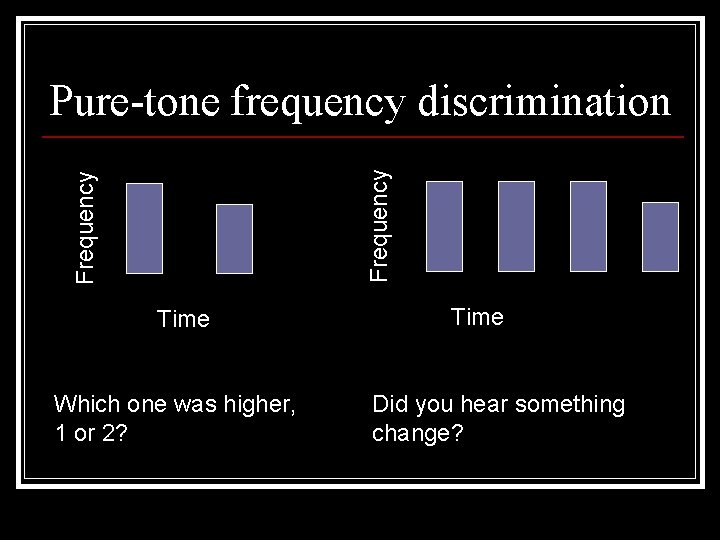
Frequency Pure-tone frequency discrimination Time Which one was higher, 1 or 2? Time Did you hear something change?
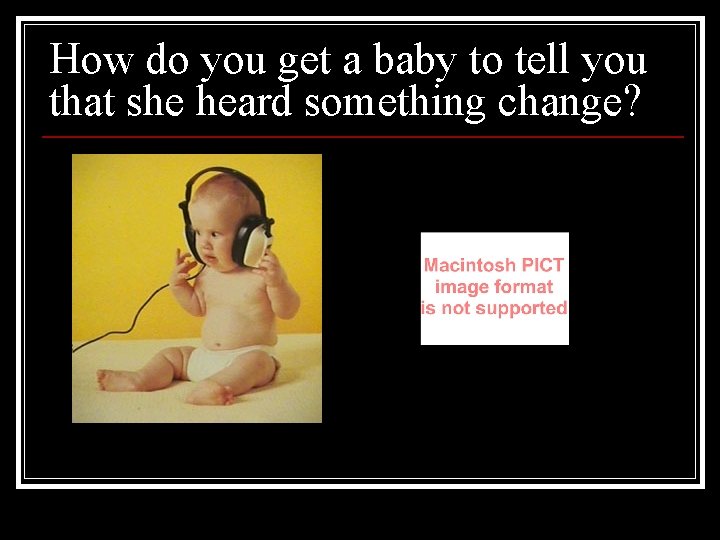
How do you get a baby to tell you that she heard something change?
Habituation-based procedures n n One stimulus or type of stimulus is presented to the infant repeatedly. The infant responds to the stimulus in some way, but on repeated presentations the response decreases (“habituates”). Once habituation has occurred, the stimulus is changed. If the infant’s response increases (“recovers”) then discrimination has occurred; if not, we don’t know anything.
Variations on habituation-based procedure Habituation (heart rate deceleration) n High amplitude sucking n Visual fixation n

High amplitude sucking
Advantages and disadvantages of habituation-based procedures. n n Based on naturally occurring infant responses Relatively easy to get data from an infant n n Can’t test adults as comparison Can’t measure thresholds Interpretation of negative result. Depends on infant wanting to hear the sound you are studying.
Conditioned response procedures The stimulus is a sound or a change in an ongoing sound, but it serves as a signal to the infant that he should respond. n If the infant responds when he hears this “signal”, he gets to see something interesting (e. g. , a mechanical toy or video comes on) n
Variations on conditioned-response procedures n Conditioned head-turn procedures n n n Visual Reinforcement procedures 2 spatial alternative procedures Observer-based procedures


Observer-based methods
Advantages and disadvantages of conditioned-response methods n n n Can test adults as comparison Can measure thresholds If the baby likes the reinforcer, it doesn’t matter if he likes the sound n n May need to train response in some infants (head turns) May exclude infants who don’t meet control conditions.
Back to frequency representation
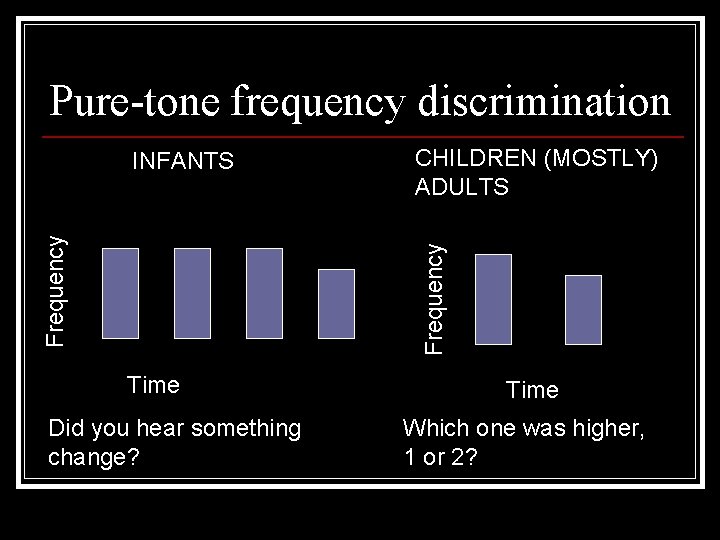
Pure-tone frequency discrimination CHILDREN (MOSTLY) ADULTS Frequency INFANTS Time Did you hear something change? Time Which one was higher, 1 or 2?
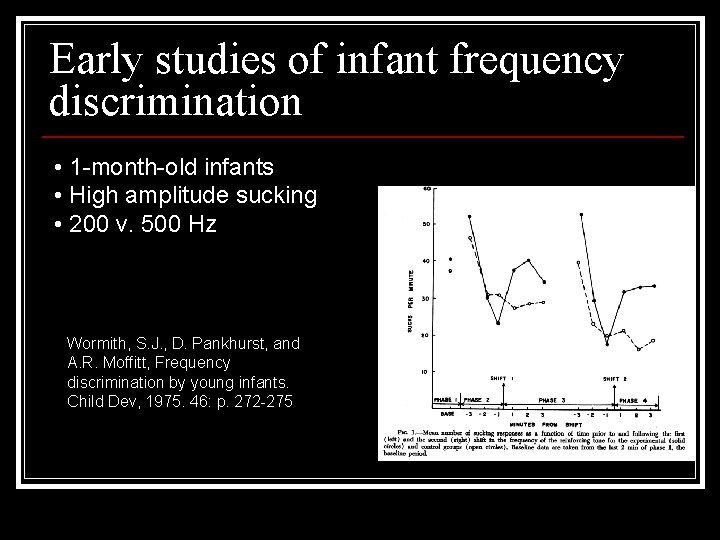
Early studies of infant frequency discrimination • 1 -month-old infants • High amplitude sucking • 200 v. 500 Hz Wormith, S. J. , D. Pankhurst, and A. R. Moffitt, Frequency discrimination by young infants. Child Dev, 1975. 46: p. 272 -275
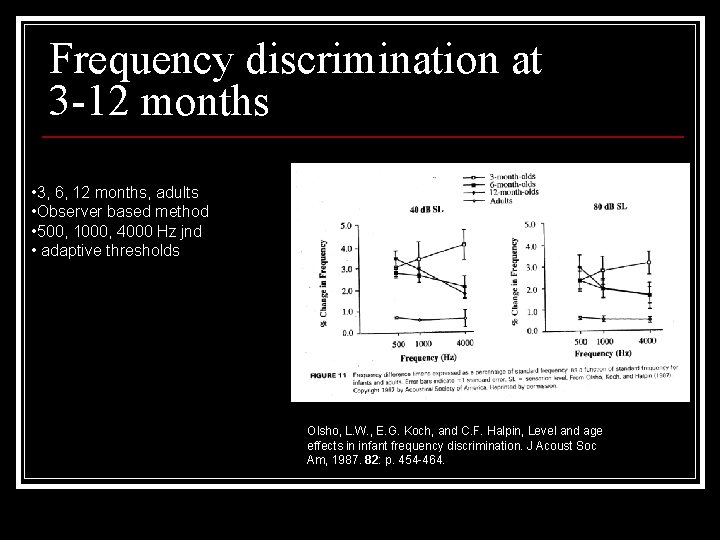
Frequency discrimination at 3 -12 months • 3, 6, 12 months, adults • Observer based method • 500, 1000, 4000 Hz jnd • adaptive thresholds Olsho, L. W. , E. G. Koch, and C. F. Halpin, Level and age effects in infant frequency discrimination. J Acoust Soc Am, 1987. 82: p. 454 -464.
Frequency discrimination in older children } conditioned response 100 Did those sound the same or different? 3 AFC AXB Wier et al. 1977 Low frequency Highfrequency Frequency High

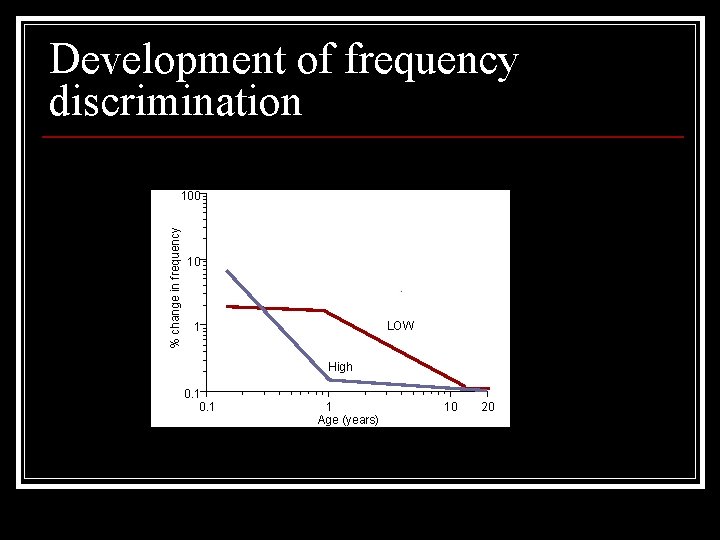
Development of frequency discrimination % change in frequency 100 10 LOW 1 High 0. 1 1 Age (years) 10 20
Possible explanations for differences in development of low and high frequency discrimination It takes longer to learn low frequency discrimination and infants/kids need even more practice than adults. n The codes for low and high frequencies develop differently n
Development of frequency resolution (place code) Thresholds in noise n Psychophysical tuning curves n Critical bandwidth n Auditory filter width n
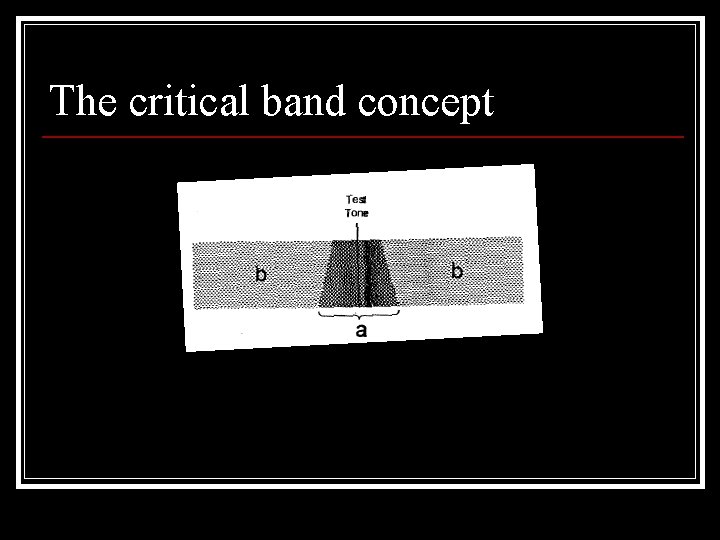
The critical band concept
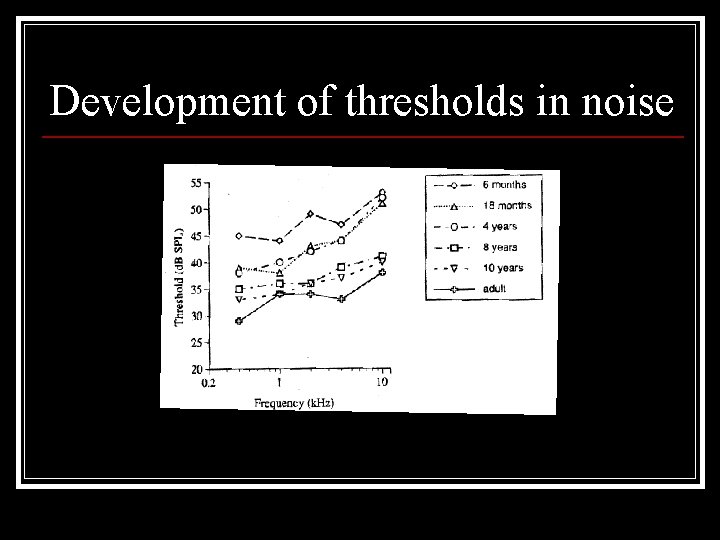
Development of thresholds in noise
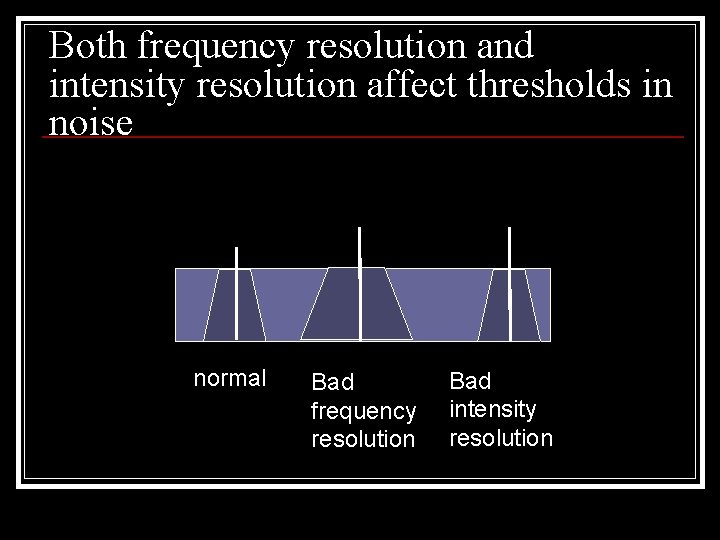
Both frequency resolution and intensity resolution affect thresholds in noise normal Bad frequency resolution Bad intensity resolution
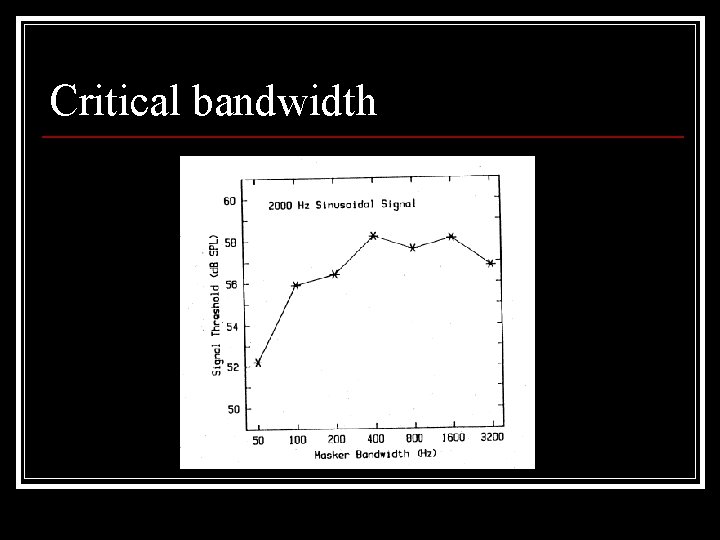
Critical bandwidth
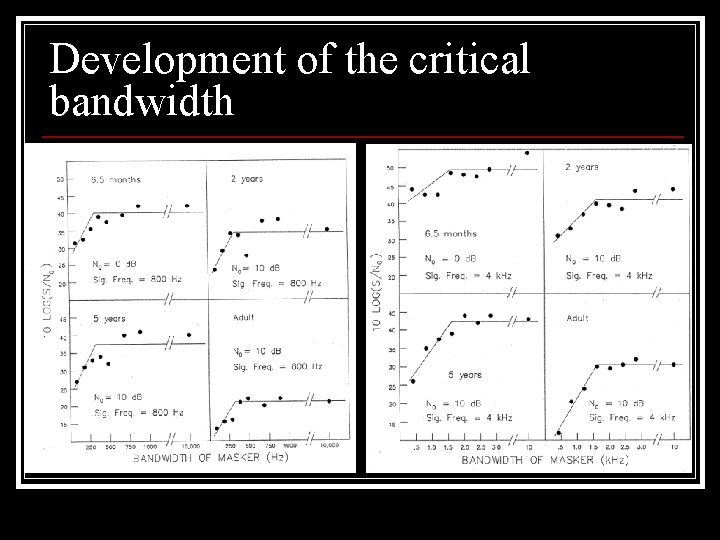
Development of the critical bandwidth
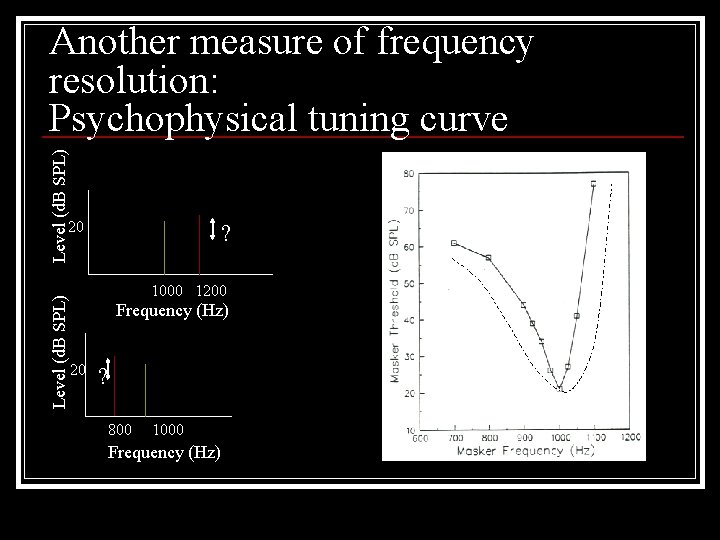
Level (d. B SPL) Another measure of frequency resolution: Psychophysical tuning curve Level (d. B SPL) 20 ? 1000 1200 Frequency (Hz) 20 ? 800 1000 Frequency (Hz)
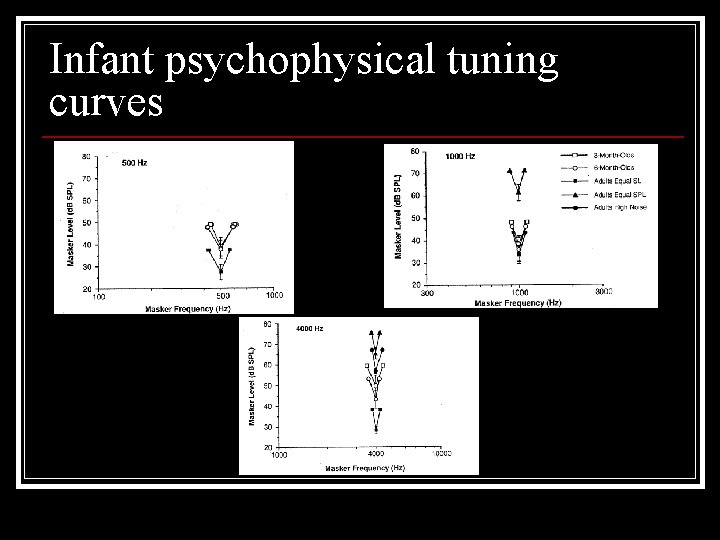
Infant psychophysical tuning curves
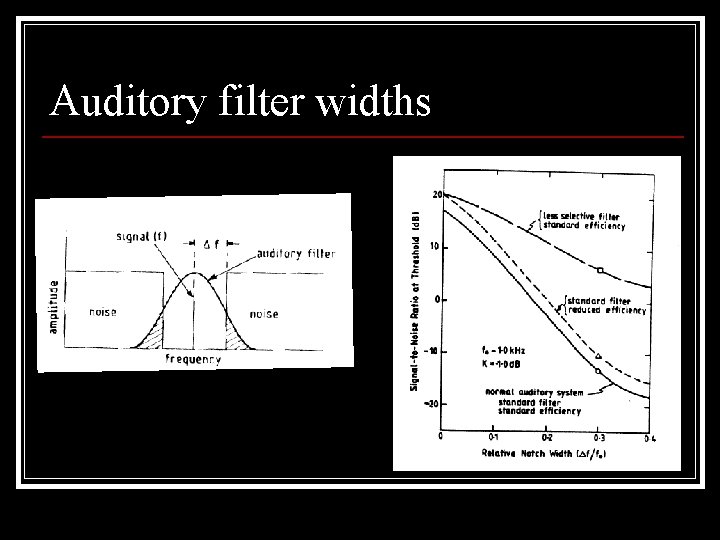
Auditory filter widths
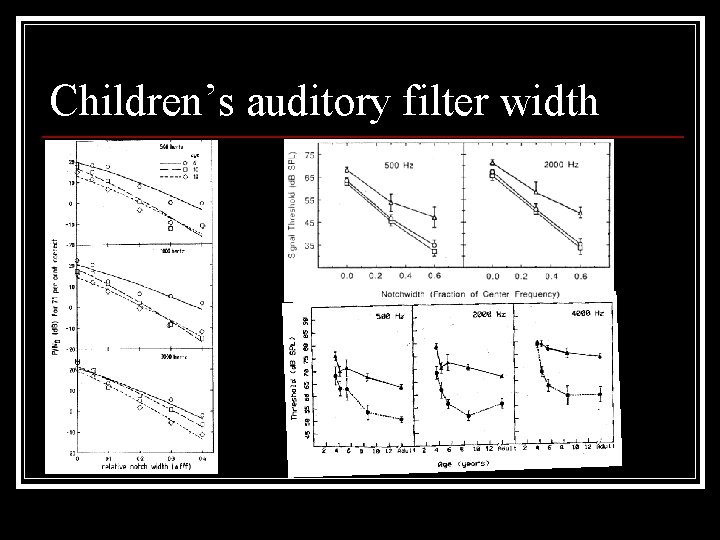
Children’s auditory filter width

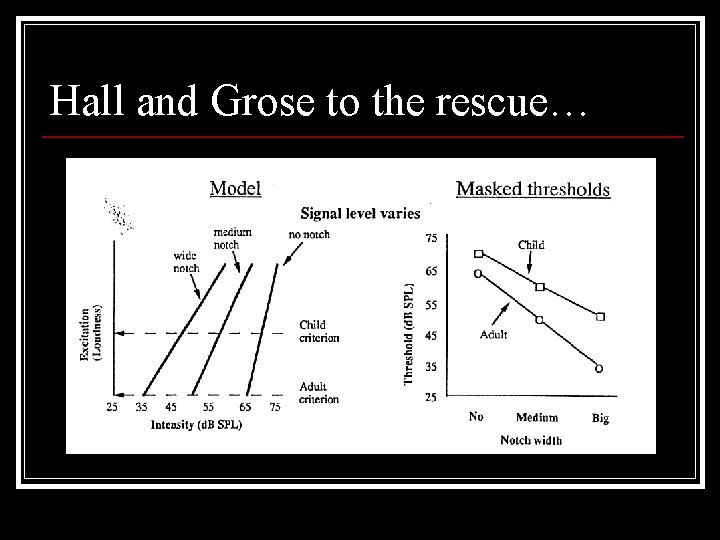
Hall and Grose to the rescue…
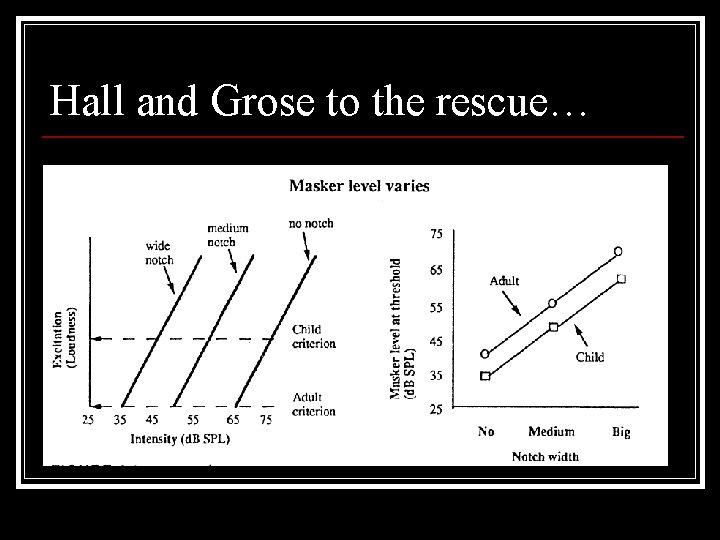
Hall and Grose to the rescue…
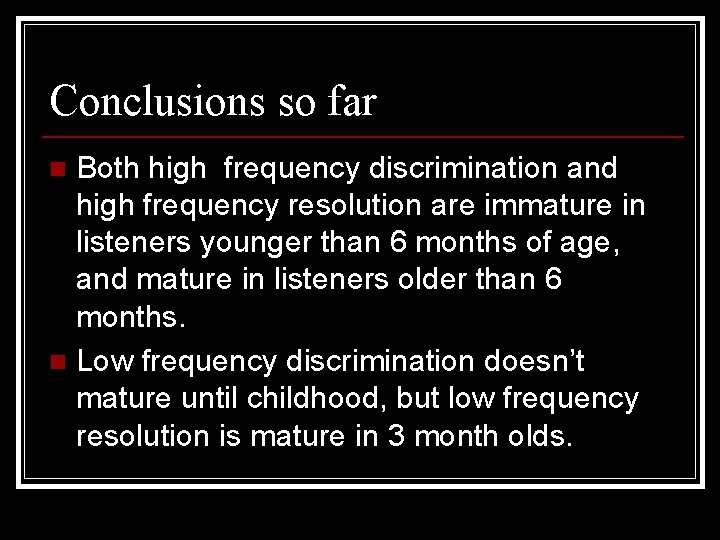
Conclusions so far Both high frequency discrimination and high frequency resolution are immature in listeners younger than 6 months of age, and mature in listeners older than 6 months. n Low frequency discrimination doesn’t mature until childhood, but low frequency resolution is mature in 3 month olds. n
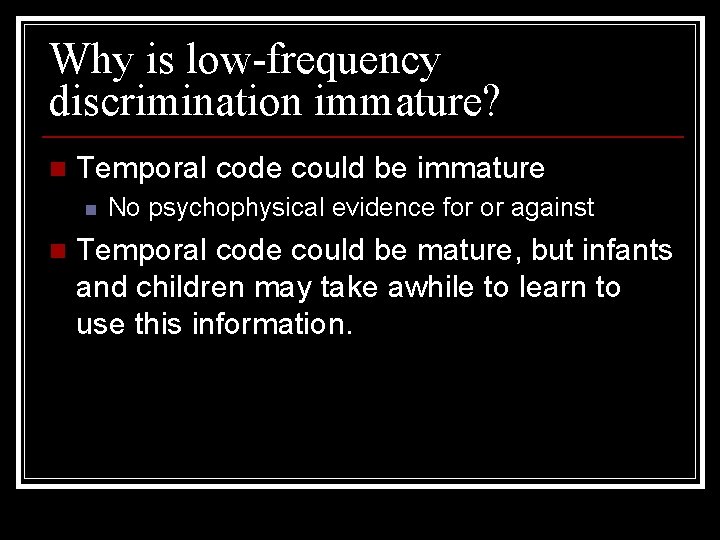
Why is low-frequency discrimination immature? n Temporal code could be immature n n No psychophysical evidence for or against Temporal code could be mature, but infants and children may take awhile to learn to use this information.
Development of frequency representation Frequency resolution, the accuracy of the place code for frequency, is immature at birth. n Frequency resolution is adultlike by 6 months of age. n The development of the temporal code for frequency is less well understood. n
- Slides: 38