
Frequency Polygons T Madas Frequency Polygons can be
Frequency Polygons © T Madas
Frequency Polygons can be used for grouped data Discrete or Continuous © T Madas

Frequency Polygons for Discrete Data Exam marks Mark (%) Frequency Midpoint 0 -19 2 9. 5 20 -39 6 29. 5 40 -59 8 49. 5 60 -79 11 69. 5 80 -100 5 90 Plot a graph of frequency against marks Which values do we plot for marks? The midpoint of each class is treated as being typical for all data in that class f 12 10 8 6 4 2 00 20 40 60 80 100 mark © T Madas
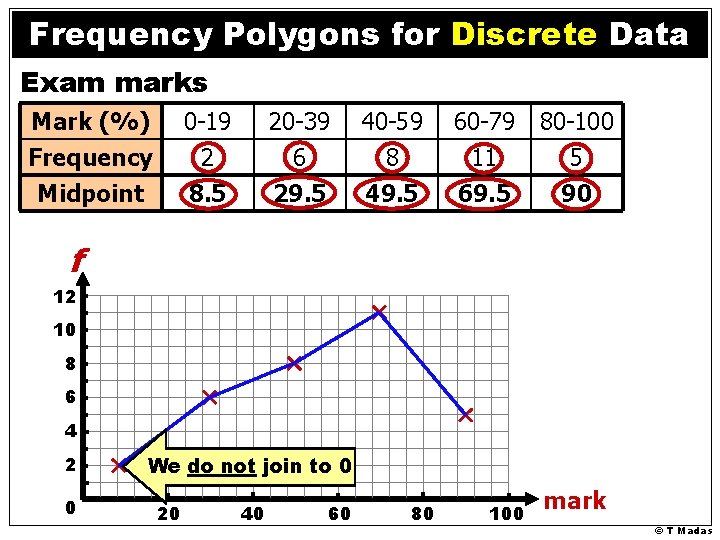
Frequency Polygons for Discrete Data Exam marks Mark (%) Frequency Midpoint 0 -19 2 8. 5 20 -39 6 29. 5 40 -59 8 49. 5 60 -79 11 69. 5 80 -100 5 90 f 12 10 8 6 4 2 00 We do not join to 0 20 40 60 80 100 mark © T Madas

© T Madas
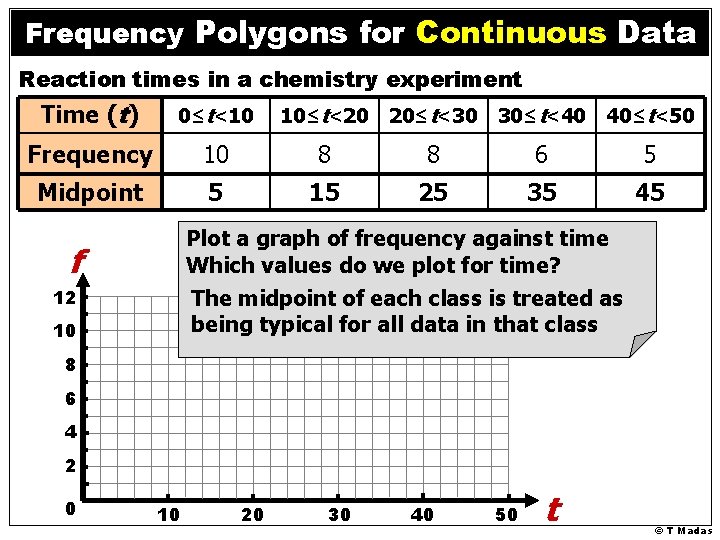
Frequency Polygons for Continuous Data Reaction times in a chemistry experiment Time (t) 0≤t<10 10≤t<20 20≤t<30 30≤t<40 40≤t<50 Frequency 10 8 8 6 5 Midpoint 5 15 25 35 45 Plot a graph of frequency against time Which values do we plot for time? f The midpoint of each class is treated as being typical for all data in that class 12 10 8 6 4 2 00 10 20 30 40 50 t © T Madas
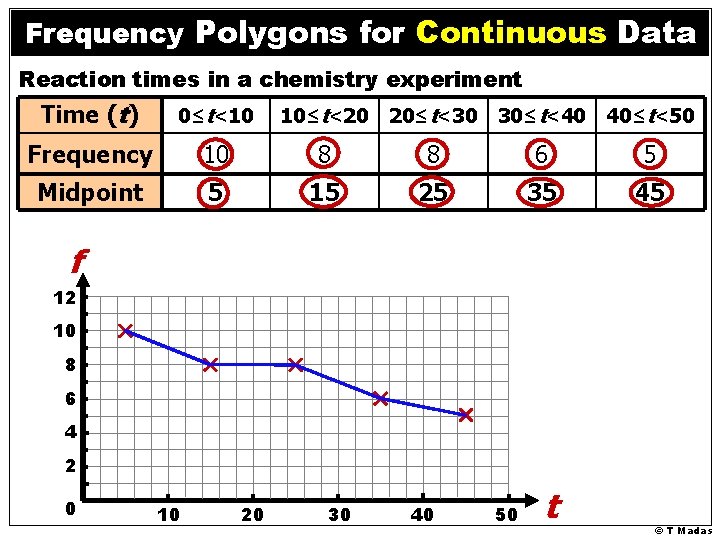
Frequency Polygons for Continuous Data Reaction times in a chemistry experiment Time (t) 0≤t<10 10≤t<20 20≤t<30 30≤t<40 40≤t<50 Frequency 10 8 8 6 5 Midpoint 5 15 25 35 45 f 12 10 8 6 4 2 00 10 20 30 40 50 t © T Madas
What kind of information can we get from Frequency Polygons? © T Madas
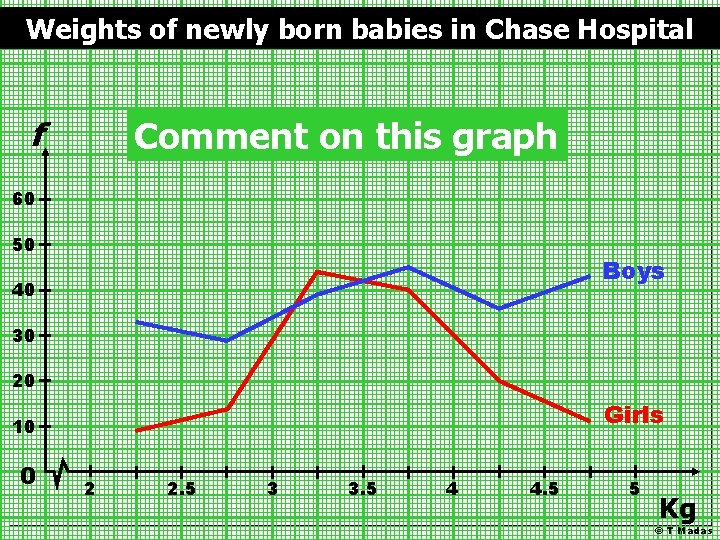
Weights of newly born babies in Chase Hospital f Comment on this graph 60 50 Boys 40 30 20 Girls 10 0 2 2. 5 3 3. 5 4 4. 5 5 Kg © T Madas

© T Madas
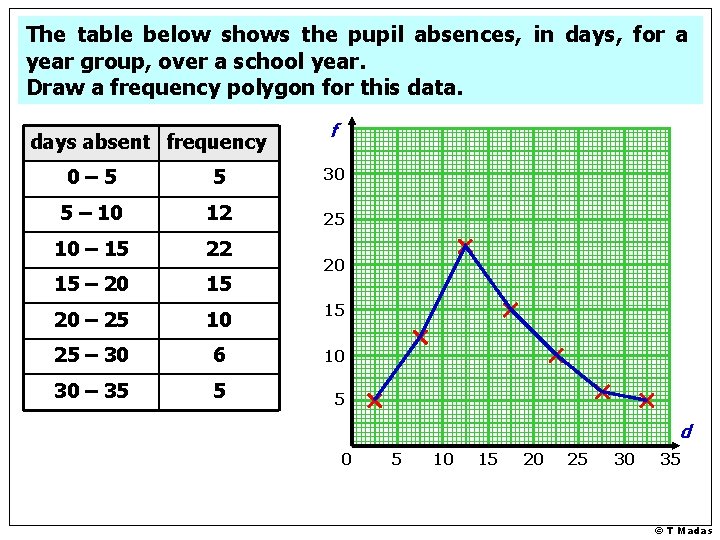
The table below shows the pupil absences, in days, for a year group, over a school year. Draw a frequency polygon for this data. days absent frequency f 0– 5 5 30 5 – 10 12 25 10 – 15 22 15 – 20 15 20 – 25 10 15 25 – 30 6 10 30 – 35 5 5 20 d 0 5 10 15 20 25 30 35 © T Madas

© T Madas
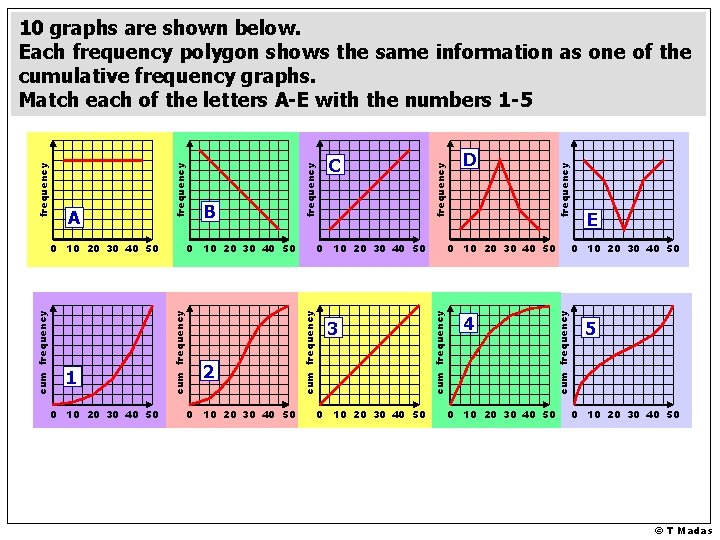
0 10 20 30 40 50 3 0 10 20 30 40 50 frequency 0 10 20 30 40 50 D 0 10 20 30 40 50 4 0 10 20 30 40 50 E 0 10 20 30 40 50 cum frequency 2 C cum frequency 1 0 10 20 30 40 50 cum frequency 0 10 20 30 40 50 B cum frequency A frequency 10 graphs are shown below. Each frequency polygon shows the same information as one of the cumulative frequency graphs. Match each of the letters A-E with the numbers 1 -5 5 0 10 20 30 40 50 © T Madas

© T Madas
- Slides: 14