
Frequency of contact allergy in children with atopic
- Slides: 1
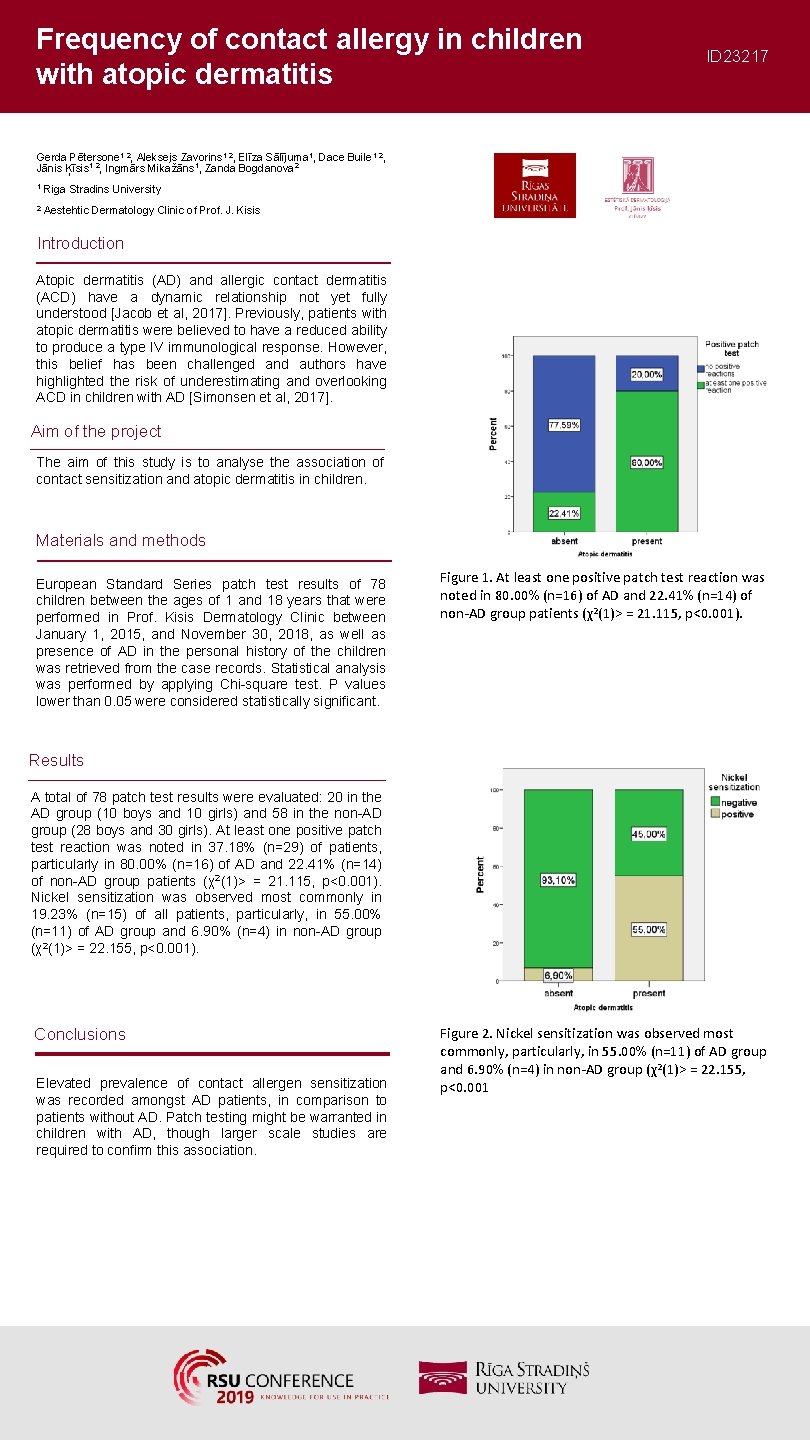
Frequency of contact allergy in children with atopic dermatitis ID 23217 Gerda Pētersone 1, 2, Aleksejs Zavorins 1, 2, Elīza Sālījuma 1, Dace Buile 1, 2, Jānis Ķīsis 1, 2, Ingmārs Mikažāns 1, Zanda Bogdanova 2 1 Riga Stradins University 2 Aestehtic Dermatology Clinic of Prof. J. Kisis Introduction Atopic dermatitis (AD) and allergic contact dermatitis (ACD) have a dynamic relationship not yet fully understood [Jacob et al, 2017]. Previously, patients with atopic dermatitis were believed to have a reduced ability to produce a type IV immunological response. However, this belief has been challenged and authors have highlighted the risk of underestimating and overlooking ACD in children with AD [Simonsen et al, 2017]. Aim of the project The aim of this study is to analyse the association of contact sensitization and atopic dermatitis in children. Materials and methods European Standard Series patch test results of 78 children between the ages of 1 and 18 years that were performed in Prof. Kisis Dermatology Clinic between January 1, 2015, and November 30, 2018, as well as presence of AD in the personal history of the children was retrieved from the case records. Statistical analysis was performed by applying Chi-square test. P values lower than 0. 05 were considered statistically significant. Figure 1. At least one positive patch test reaction was noted in 80. 00% (n=16) of AD and 22. 41% (n=14) of non-AD group patients (χ2(1)> = 21. 115, p<0. 001). Results A total of 78 patch test results were evaluated: 20 in the AD group (10 boys and 10 girls) and 58 in the non-AD group (28 boys and 30 girls). At least one positive patch test reaction was noted in 37. 18% (n=29) of patients, particularly in 80. 00% (n=16) of AD and 22. 41% (n=14) of non-AD group patients (χ2(1)> = 21. 115, p<0. 001). Nickel sensitization was observed most commonly in 19. 23% (n=15) of all patients, particularly, in 55. 00% (n=11) of AD group and 6. 90% (n=4) in non-AD group (χ2(1)> = 22. 155, p<0. 001). Conclusions Elevated prevalence of contact allergen sensitization was recorded amongst AD patients, in comparison to patients without AD. Patch testing might be warranted in children with AD, though larger scale studies are required to confirm this association. Figure 2. Nickel sensitization was observed most commonly, particularly, in 55. 00% (n=11) of AD group and 6. 90% (n=4) in non-AD group (χ2(1)> = 22. 155, p<0. 001