
Frequency combs optical clocks and the future of
Frequency combs, optical clocks and the future of the unit of time 10/15/2021
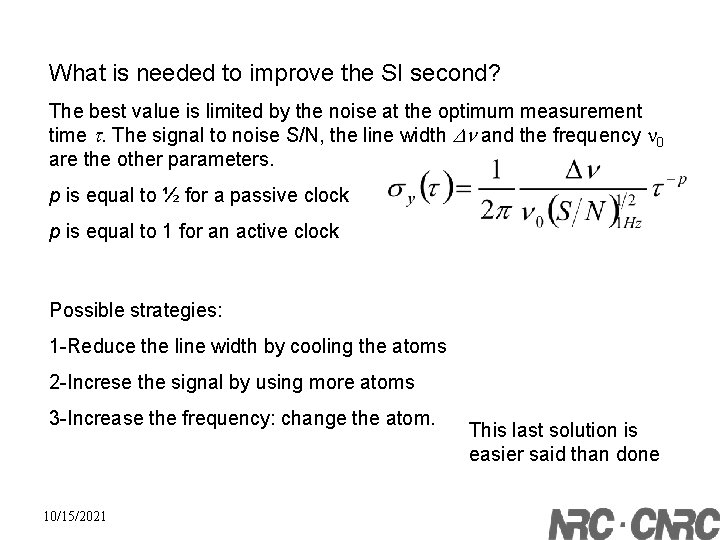
What is needed to improve the SI second? The best value is limited by the noise at the optimum measurement time t. The signal to noise S/N, the line width Dn and the frequency n 0 are the other parameters. p is equal to ½ for a passive clock p is equal to 1 for an active clock Possible strategies: 1 -Reduce the line width by cooling the atoms 2 -Increse the signal by using more atoms 3 -Increase the frequency: change the atom. 10/15/2021 This last solution is easier said than done
The caesium fountain is an elegant answer to the future of the SI second. Cooled slow atoms Dn reduced by two orders of magnitude Spin exchange limits the number of atoms The frequency is obviously not negotiable Ion and atom traps in the optical spectrum are the answer for the future Cooled atoms or ions in optical or RF trap. Frequencies in the 400 THz range! Optical lattice clocks has all the right answers Cooled atoms in a trap No limit on the number of atoms (? ) Optical frequencies 10/15/2021
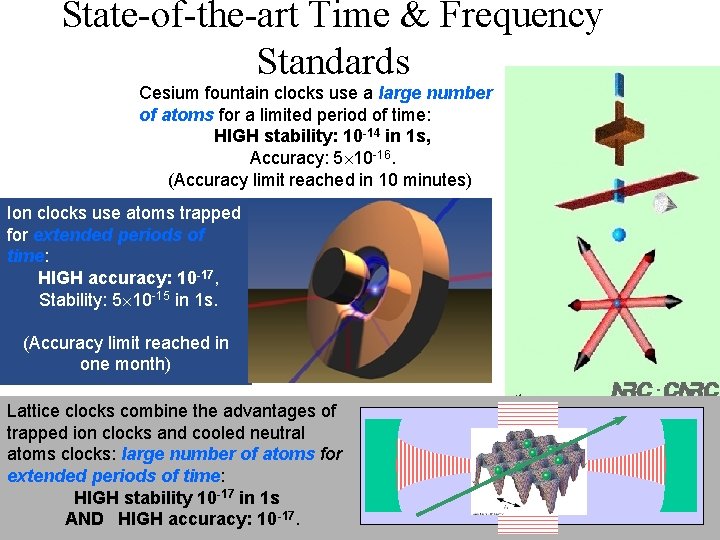
State-of-the-art Time & Frequency Standards Cesium fountain clocks use a large number of atoms for a limited period of time: HIGH stability: 10 -14 in 1 s, Accuracy: 5 10 -16. (Accuracy limit reached in 10 minutes) Ion clocks use atoms trapped for extended periods of time: HIGH accuracy: 10 -17, Stability: 5 10 -15 in 1 s. (Accuracy limit reached in one month) Lattice clocks combine the advantages of trapped ion clocks and cooled neutral atoms clocks: large number of atoms for extended periods of time: HIGH stability 10 -17 in 1 s 10/15/2021 AND HIGH accuracy: 10 -17.
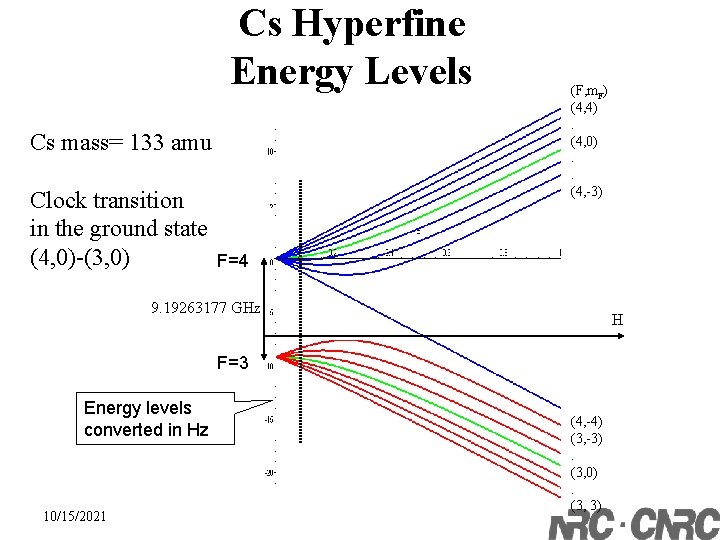
Cs Hyperfine Energy Levels Cs mass= 133 amu Clock transition in the ground state (4, 0)-(3, 0) (F, m. F) (4, 4). (4, 0). . (4, -3) F=4 9. 19263177 GHz H F=3 Energy levels converted in Hz 10/15/2021 (4, -4) (3, -3). (3, 0). (3, 3)
Caesium fountains will probably never be better than 10 -16 due to the intrinsic nature of the caesium atom: spin exchange, microwave frequency. Optical frequency standards have the advantage of a much higher frequency. Then the big question: Why not go immediately to optical frequency sources for the SI second? 10/15/2021
Why not go immediately to optical frequency sources for the SI second? • The optical “clocks” need to be probed by an ultra stable laser. • The drift of these ultra stable lasers has to be under control. • There is a need to link the optical frequencies to microwave signals to use them for clock work. • Can the whole system run continuously? Until a few years ago the main problem was the link between the microwave and the optical frequencies. The frequency comb based on femtosecond laser has change everything. 10/15/2021
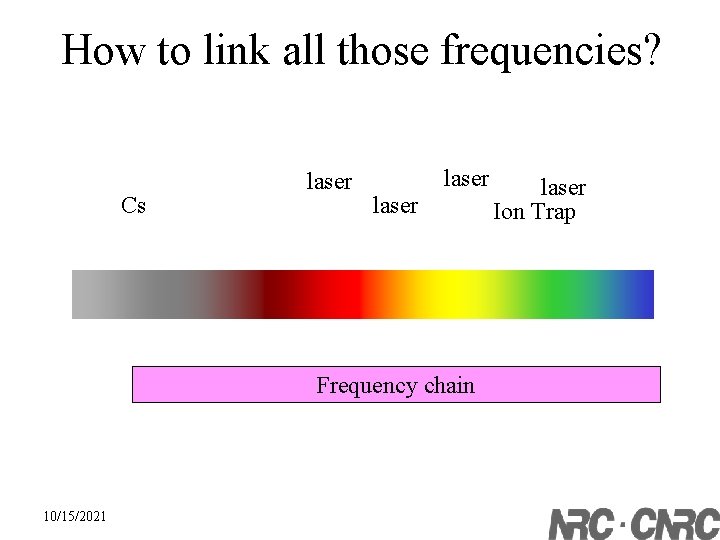
How to link all those frequencies? Cs laser Frequency chain 10/15/2021 laser Ion Trap
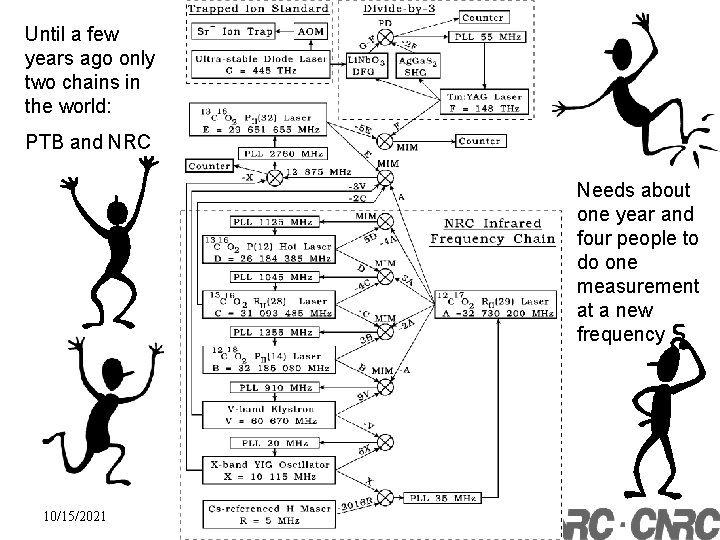
Until a few years ago only two chains in the world: PTB and NRC Needs about one year and four people to do one measurement at a new frequency 10/15/2021
The Optical Frequency Comb 10/15/2021
fbeat 1 10/15/2021 fbeat 2
The comb offset is caused by dispersion 10/15/2021

10/15/2021

10/15/2021

fs Optical Frequency Comb Output Mode-locked Ti: sapphire laser From 532 nm pump laser Micro. Structured fibre 10/15/2021
The probe laser 10/15/2021
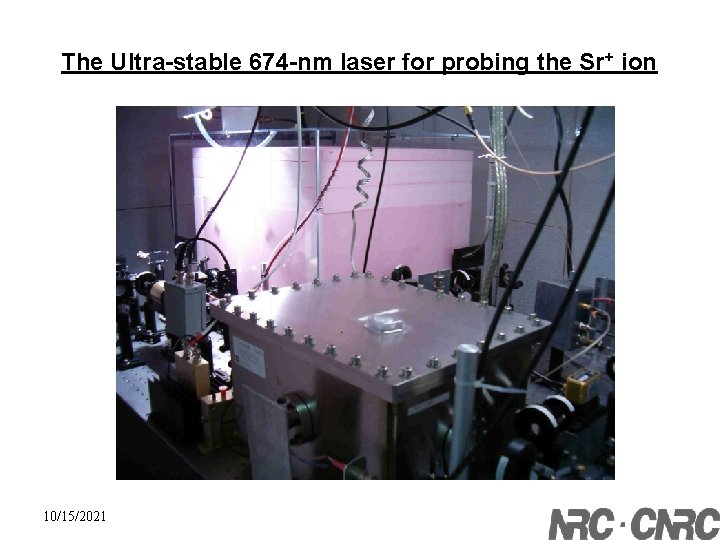
The Ultra-stable 674 -nm laser for probing the Sr+ ion 10/15/2021
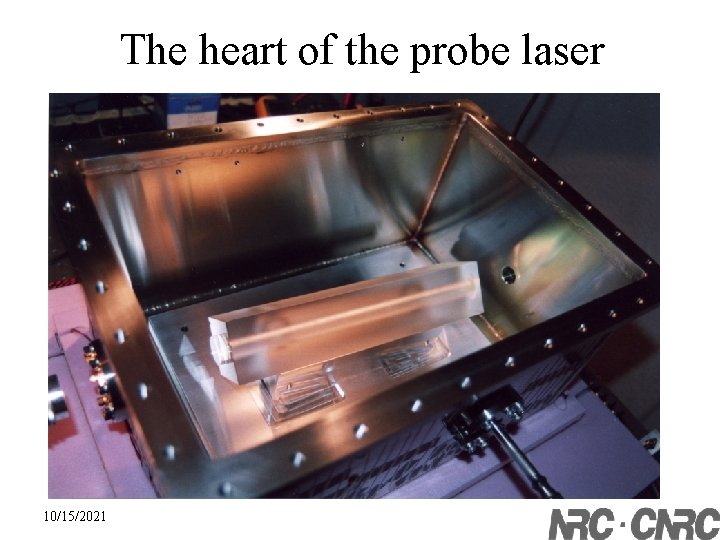
The heart of the probe laser 10/15/2021
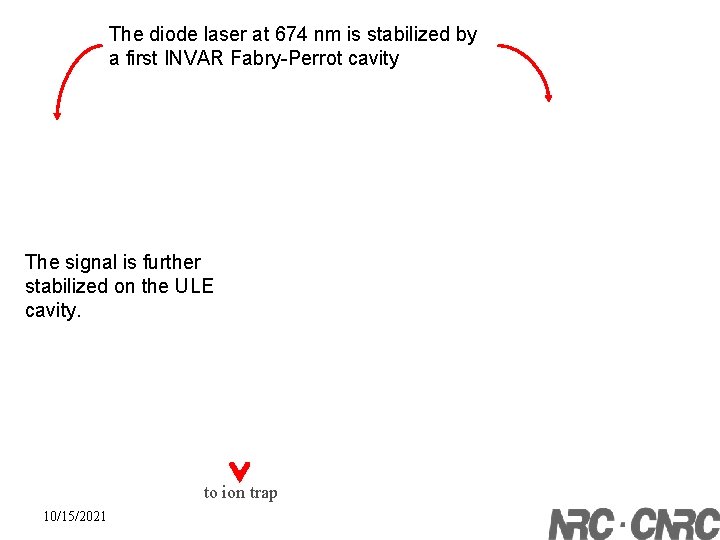
The diode laser at 674 nm is stabilized by a first INVAR Fabry-Perrot cavity The signal is further stabilized on the ULE cavity. to ion trap 10/15/2021
The link with the frequency comb guarantee traceability to the SI second based on caesium. When caesium will be replaced, the frequency chain may be used in reverse, referencing microwaves to the optical SI second 10/15/2021 to ion trap Probe is sent to ion traps or optical lattice.
Single ion trap 10/15/2021

10/15/2021
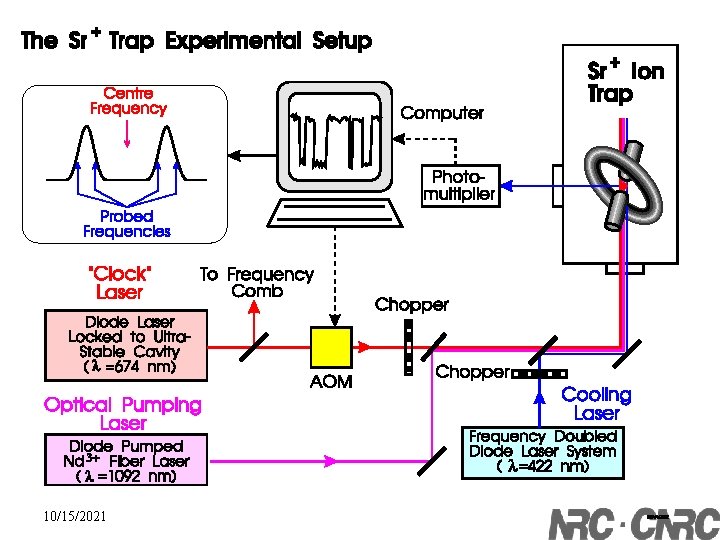
Holding Single Ions With Time Varying Fields Rf Trap: Axial (z) and Radial( r) confinement is provided by a rapidly oscillating quadratic potential created by the electrode configuration. Solution of the equation of motion shows that the ion moves within a time-averaged 3 -D potential well. 10/15/2021
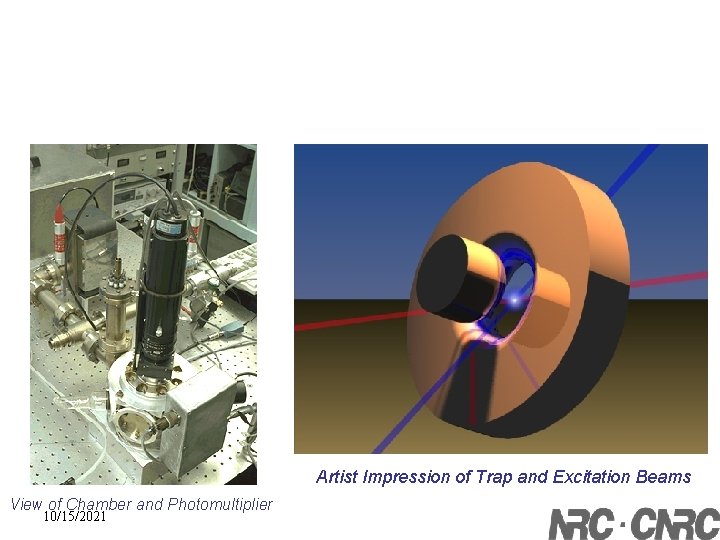
NRC Single Strontium Ion Trap Artist Impression of Trap and Excitation Beams View of Chamber and Photomultiplier 10/15/2021
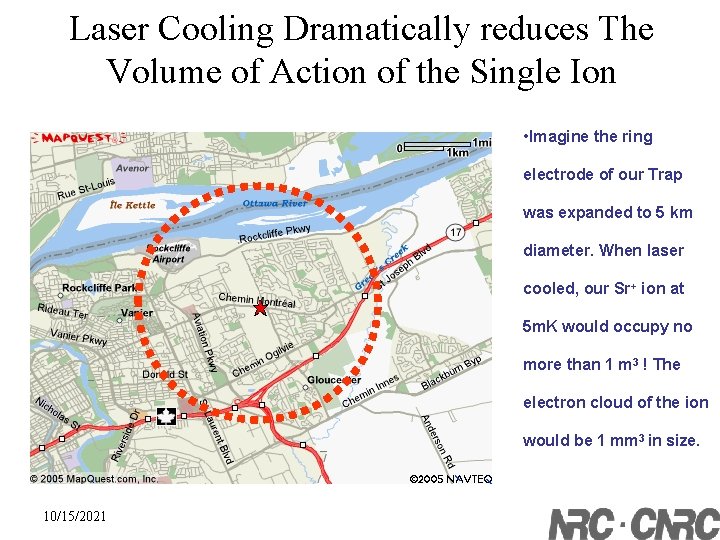
Laser Cooling Dramatically reduces The Volume of Action of the Single Ion • Imagine the ring electrode of our Trap was expanded to 5 km diameter. When laser cooled, our Sr+ ion at 5 m. K would occupy no more than 1 m 3 ! The electron cloud of the ion would be 1 mm 3 in size. 10/15/2021
Frequency Comb Era Frequency Chain Era 10/15/2021
10/15/2021
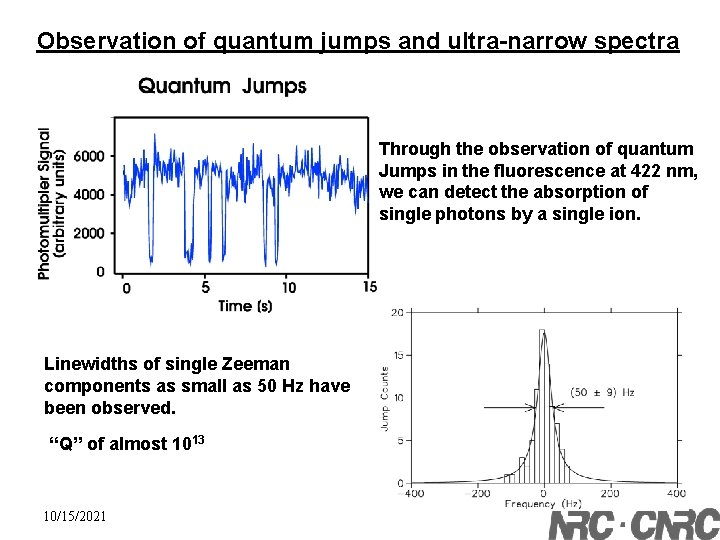
Observation of quantum jumps and ultra-narrow spectra Through the observation of quantum Jumps in the fluorescence at 422 nm, we can detect the absorption of single photons by a single ion. Linewidths of single Zeeman components as small as 50 Hz have been observed. “Q” of almost 1013 10/15/2021
10/15/2021
Optical lattice 10/15/2021
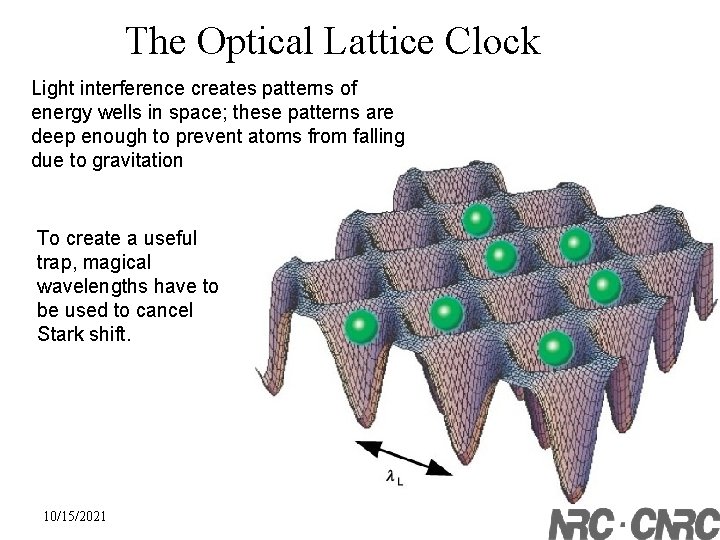
The Optical Lattice Clock Light interference creates patterns of energy wells in space; these patterns are deep enough to prevent atoms from falling due to gravitation To create a useful trap, magical wavelengths have to be used to cancel Stark shift. 10/15/2021
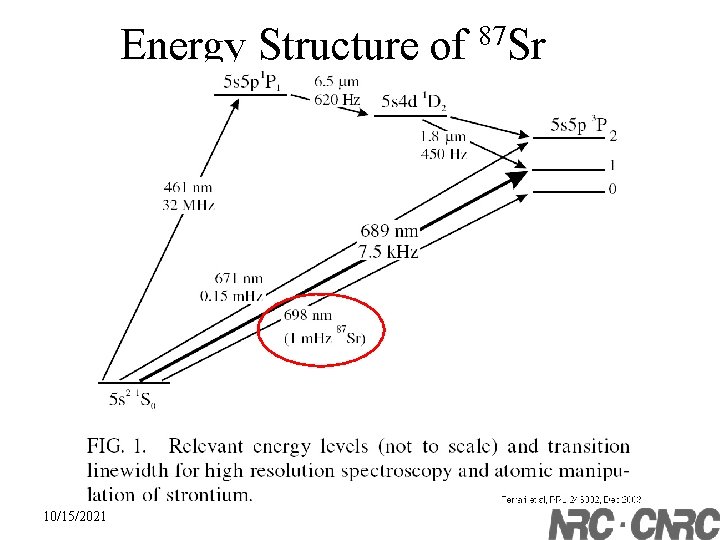
Energy Structure of 87 Sr 10/15/2021
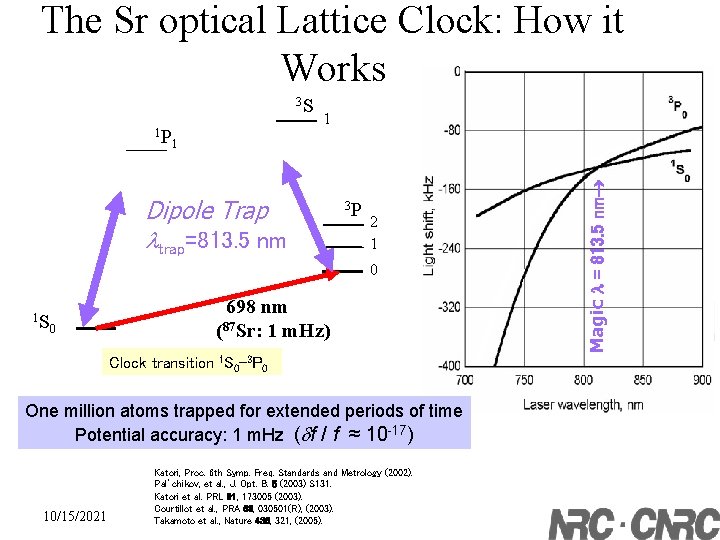
The Sr optical Lattice Clock: How it Works 3 S 1 Dipole Trap ltrap=813. 5 nm 3 P 2 1 0 1 S 0 698 nm (87 Sr: 1 m. Hz) Clock transition 1 S 0 -3 P 0 One million atoms trapped for extended periods of time Potential accuracy: 1 m. Hz (df / f ≈ 10 -17) 10/15/2021 Katori, Proc. 6 th Symp. Freq. Standards and Metrology (2002). Pal’chikov, et al. , J. Opt. B. 5 (2003) S 131. Katori et al. PRL 91, 173005 (2003). Courtillot et al. , PRA 68, 030501(R), (2003). Takamoto et al. , Nature 435, 321, (2005). Magic l = 813. 5 nm 1 P 1
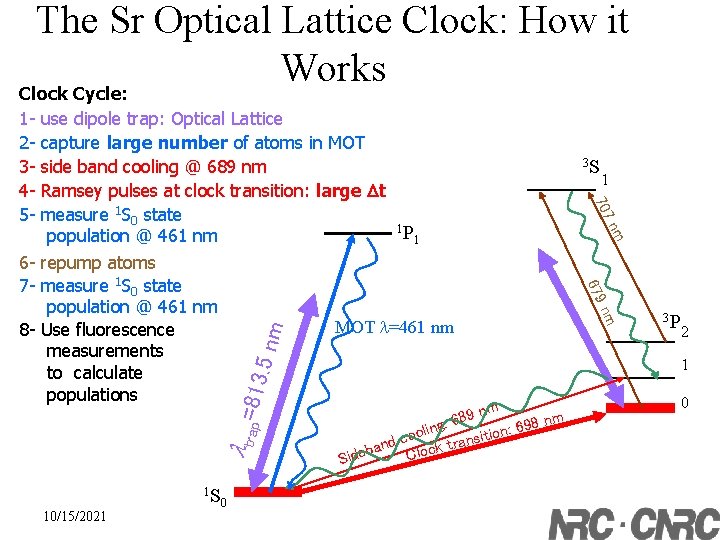
The Sr Optical Lattice Clock: How it Works Clock Cycle: ltr = ap 81 3. 5 n m nm 10/15/2021 0 1 nm 1 S nm 9 8 6 g: 98 nm 6 n i : l n o o i d co ck transit n a b Clo Side 3 S 679 use dipole trap: Optical Lattice capture large number of atoms in MOT side band cooling @ 689 nm Ramsey pulses at clock transition: large t measure 1 S 0 state 1 P population @ 461 nm 1 6 - repump atoms 7 - measure 1 S 0 state population @ 461 nm MOT =461 nm 8 - Use fluorescence measurements to calculate populations 707 12345 - 3 P 2 1 0
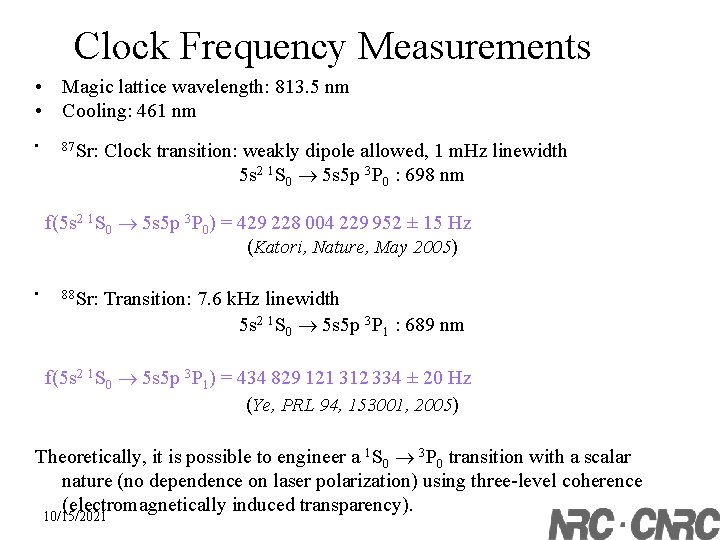
Clock Frequency Measurements • Magic lattice wavelength: 813. 5 nm • Cooling: 461 nm • 87 Sr: Clock transition: weakly dipole allowed, 1 m. Hz linewidth 5 s 2 1 S 0 5 s 5 p 3 P 0 : 698 nm f(5 s 2 1 S 0 5 s 5 p 3 P 0) = 429 228 004 229 952 ± 15 Hz (Katori, Nature, May 2005) • 88 Sr: Transition: 7. 6 k. Hz linewidth 5 s 2 1 S 0 5 s 5 p 3 P 1 : 689 nm f(5 s 2 1 S 0 5 s 5 p 3 P 1) = 434 829 121 312 334 ± 20 Hz (Ye, PRL 94, 153001, 2005) Theoretically, it is possible to engineer a 1 S 0 3 P 0 transition with a scalar nature (no dependence on laser polarization) using three-level coherence (electromagnetically induced transparency). 10/15/2021
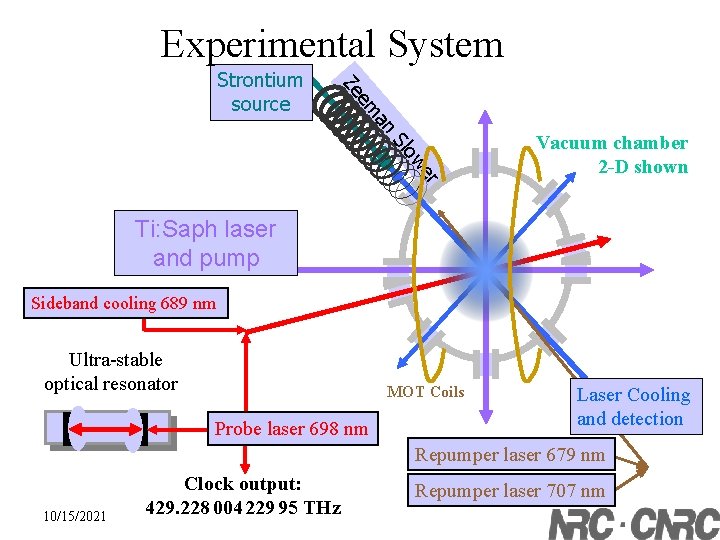
Experimental System an m e Ze Strontium source ow Sl er Vacuum chamber 2 -D shown Ti: Saph laser and pump Sideband cooling 689 nm Ultra-stable optical resonator MOT Coils Probe laser 698 nm Laser Cooling and detection Repumper laser 679 nm 10/15/2021 Clock output: 429. 228 004 229 95 THz Repumper laser 707 nm
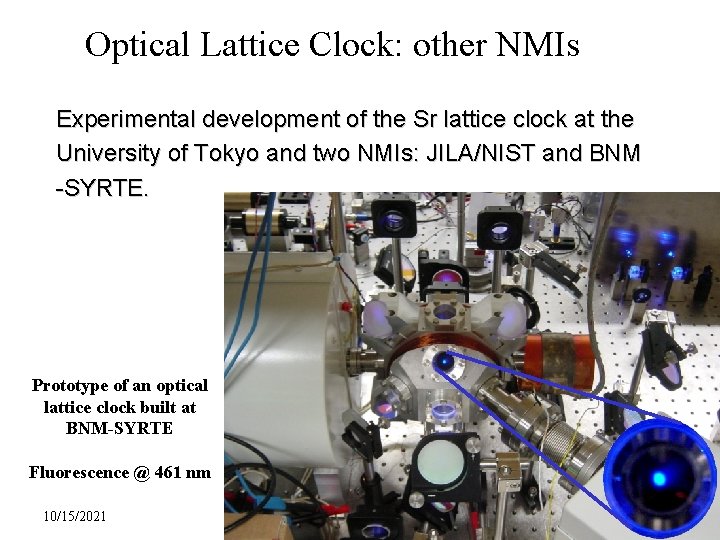
Optical Lattice Clock: other NMIs Experimental development of the Sr lattice clock at the University of Tokyo and two NMIs: JILA/NIST and BNM -SYRTE. Prototype of an optical lattice clock built at BNM-SYRTE Fluorescence @ 461 nm 10/15/2021
Secondary representations of the second Paving the way for a new definition of the second The unperturbed ground-state hyperfine quantum transition of 87 Rb with a frequency of f (87 Rb) = 6 834 682 610. 904 324 Hz and an estimated relative standard uncertainty of 3 × 10 -15, The unperturbed optical 5 d 10 6 s 2 S 1/2 (F = 0) – 5 d 9 6 s 2 2 D 5/2 (F =2) transition of the 199 Hg+ ion with a frequency of f (199 Hg+) = 1 064 721 609 899 145 Hz and a relative standard uncertainty of 3 x 10 -15, The unperturbed optical 5 s 2 S 1/2 – 4 d 2 D 5/2 transition of the 88 Sr+ ion with a frequency of f (88 Sr+) = 444 779 044 095 484 Hz and a relative uncertainty of 7 x 10 -15, The unperturbed optical 6 s 2 S 1/2 (F = 0) – 5 d 2 D 3/2 (F =2) transition of the 171 Yb+ ion with a frequency of f (171 Yb+) = 688 358 979 308 Hz and a relative standard uncertainty of 9 x 10 -15, The unperturbed optical transition 5 s 2 1 S 0 – 5 s 5 p 3 P 0 87 Sr neutral atom with a frequency of f (87 Sr) = 429 228 004 229 877 Hz and a relative standard uncertainty of 1. 5 x 10 -14.
Conclusion • Optical frequencies are doing pretty well • When there will be at least one order, maybe two orders of magnitude better measurements with optical clocks than caesium fountains, the era of caesium will be over. • The SI second will be the central unit for many decades to go, if not forever. 10/15/2021
- Slides: 39