
Frequency Calculations Lecture Comp Chem 3 Chemistry 347
- Slides: 10
Frequency Calculations Lecture Comp. Chem 3 Chemistry 347 Hope College
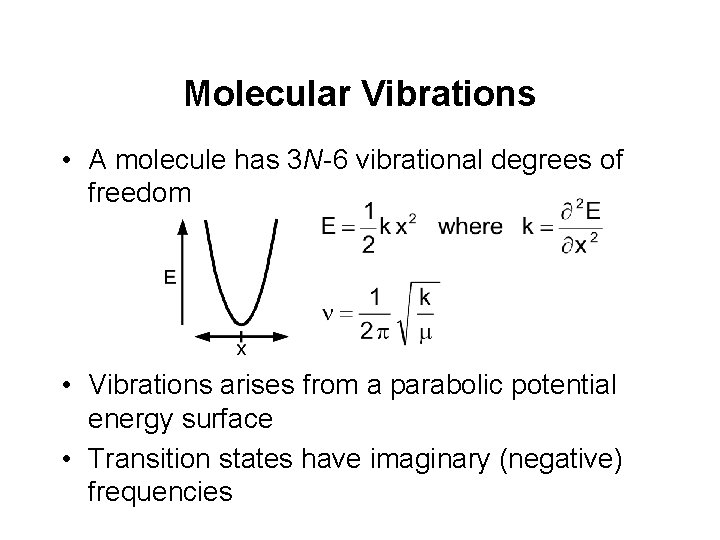
Molecular Vibrations • A molecule has 3 N-6 vibrational degrees of freedom • Vibrations arises from a parabolic potential energy surface • Transition states have imaginary (negative) frequencies
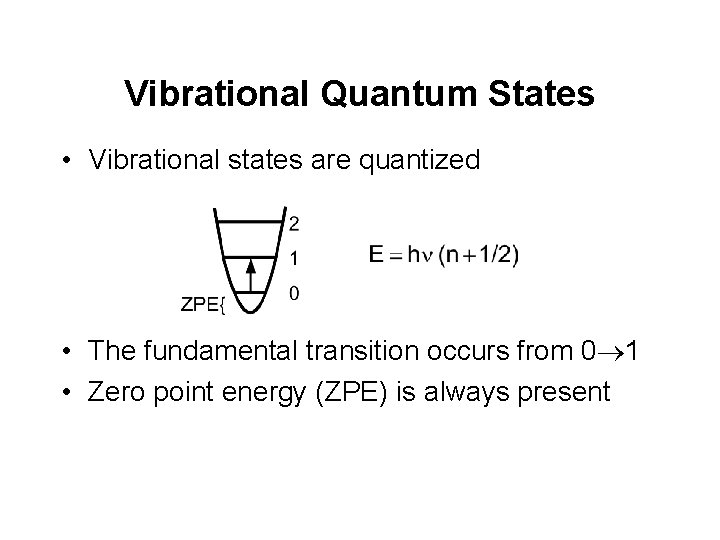
Vibrational Quantum States • Vibrational states are quantized • The fundamental transition occurs from 0® 1 • Zero point energy (ZPE) is always present
Infrared Spectroscopy • FREQ outputs vibrational frequencies and IR, Raman intensities • Frequency calculation must be done at stationary point • Frequency calculation must use same model and basis set as optimization • Ab initio systematically overestimates frequencies by ~10% due to electron correlation and anharmonicity
Normal Modes • FREQ outputs atomic displacement for each normal mode • Gaussian output yields Cartesian displacements • Web. MO displays these displacements as 3 -D vectors
Vibrational Spectroscopy Quick Start – Web. MO – Build H 2 CO – Gaussian – Optimize + Vib Freq, Hartree-Fock, 3 -21 G – View results – View vibrational modes – View vibrational spectrum
Characterizing Stationary Points • Minimum: all positive eigenvalues • Saddle Point: one imaginary (negative) eigenvalue • Hilltop: more than one imaginary (negative) eigenvalue
Transition State Quick Start • Job Manager: View vinyl alcohol transition state from last week • Note route for model chemistry (HF) and basis set (6 -31 G) • New job with this geometry • Gaussian • Vibrational Frequencies calculation at same level of theory • View negative frequency vibrational mode to visualize reaction coordinate
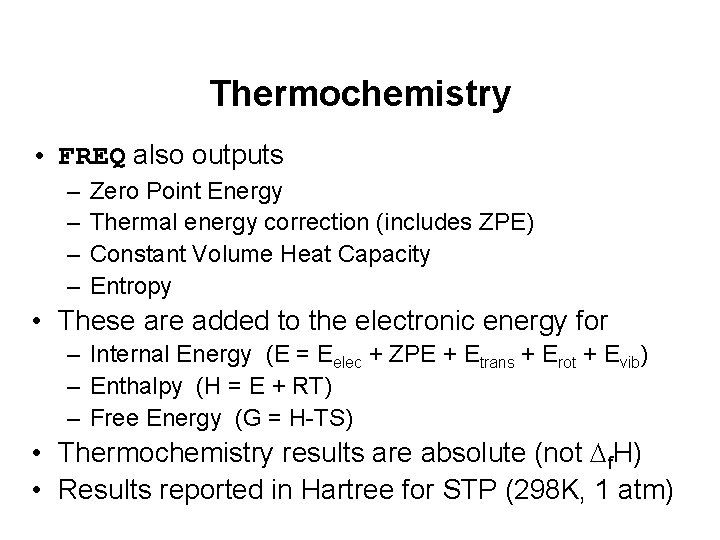
Thermochemistry • FREQ also outputs – – Zero Point Energy Thermal energy correction (includes ZPE) Constant Volume Heat Capacity Entropy • These are added to the electronic energy for – Internal Energy (E = Eelec + ZPE + Etrans + Erot + Evib) – Enthalpy (H = E + RT) – Free Energy (G = H-TS) • Thermochemistry results are absolute (not Df. H) • Results reported in Hartree for STP (298 K, 1 atm)
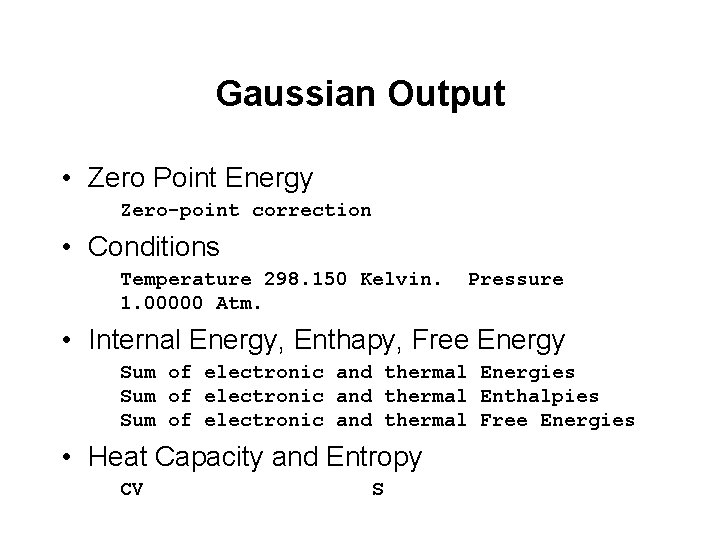
Gaussian Output • Zero Point Energy Zero-point correction • Conditions Temperature 298. 150 Kelvin. 1. 00000 Atm. Pressure • Internal Energy, Enthapy, Free Energy Sum of electronic and thermal Energies Sum of electronic and thermal Enthalpies Sum of electronic and thermal Free Energies • Heat Capacity and Entropy CV S