
FREQUENCY ANALYSIS Determining capacitance and resistance for pole


- Slides: 25
FREQUENCY ANALYSIS Determining capacitance and resistance for pole and zero
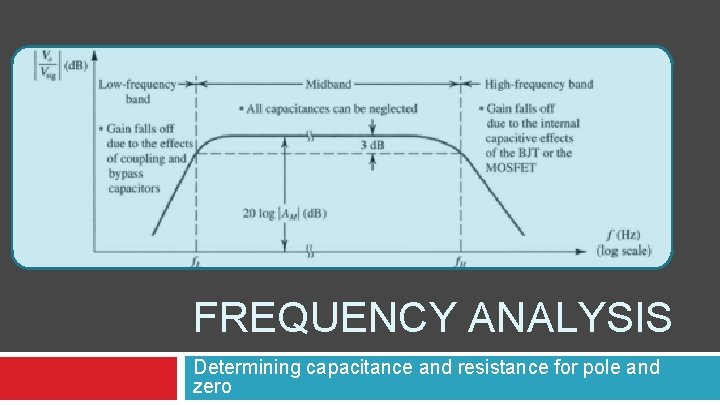
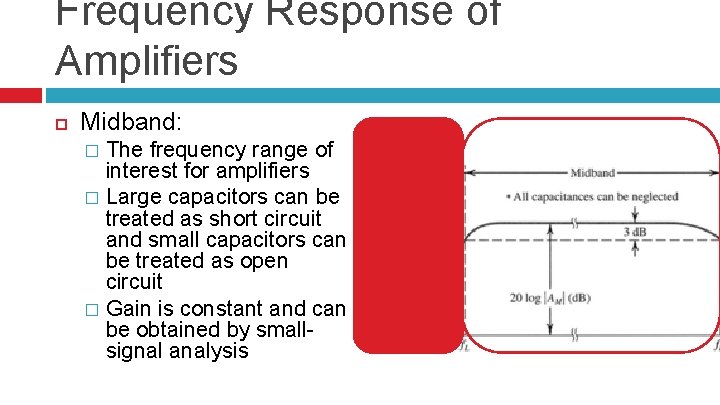
Frequency Response of Amplifiers Midband: The frequency range of interest for amplifiers � Large capacitors can be treated as short circuit and small capacitors can be treated as open circuit � Gain is constant and can be obtained by smallsignal analysis �
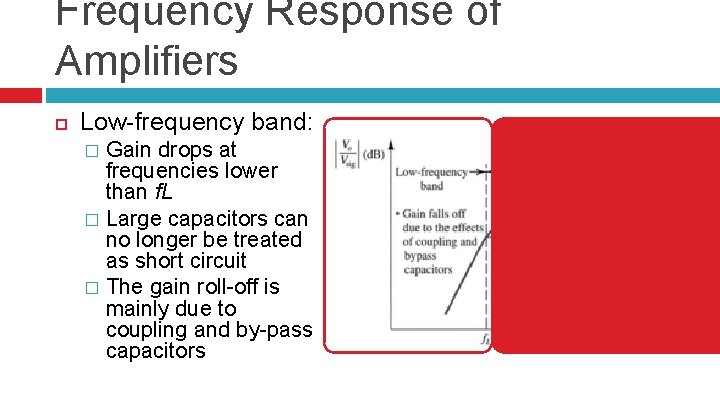
Frequency Response of Amplifiers Low-frequency band: Gain drops at frequencies lower than f. L � Large capacitors can no longer be treated as short circuit � The gain roll-off is mainly due to coupling and by-pass capacitors �
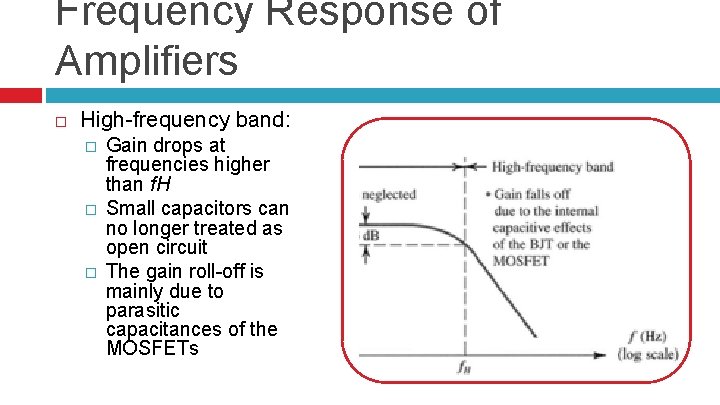
Frequency Response of Amplifiers High-frequency band: � � � Gain drops at frequencies higher than f. H Small capacitors can no longer treated as open circuit The gain roll-off is mainly due to parasitic capacitances of the MOSFETs
Low Frequency Response for Common Source Amplifiers Small Signal Analysis First pole derivation Where
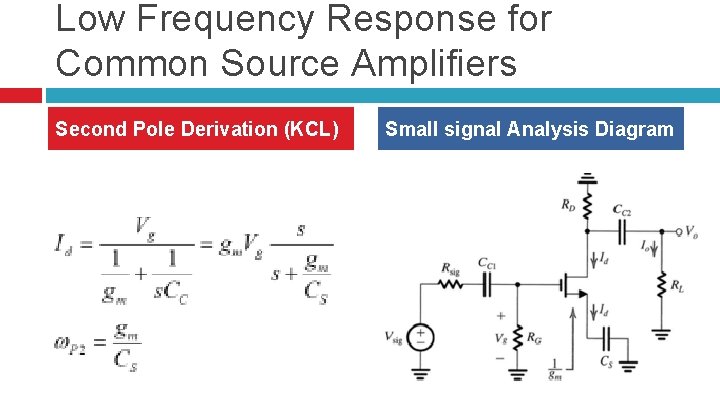
Low Frequency Response for Common Source Amplifiers Second Pole Derivation (KCL) Small signal Analysis Diagram
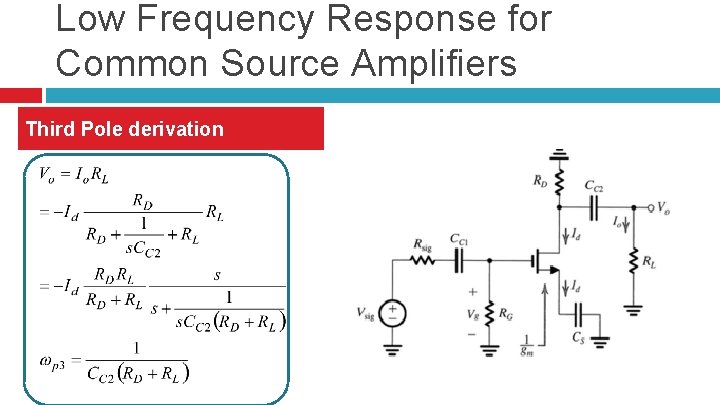
Low Frequency Response for Common Source Amplifiers Third Pole derivation
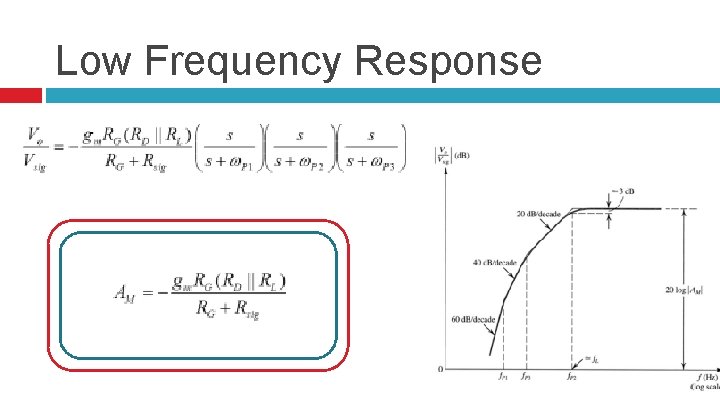
Low Frequency Response
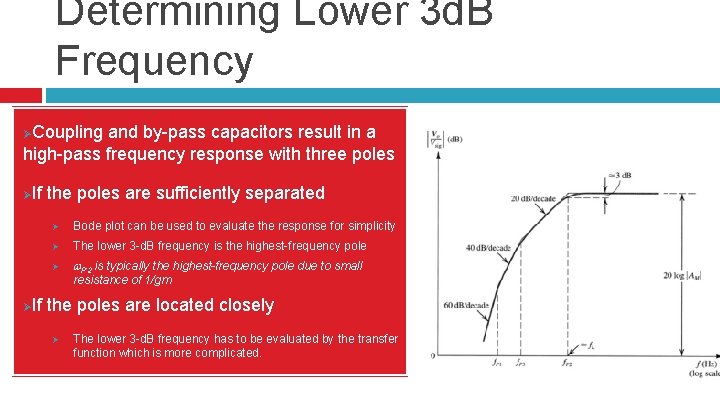
Determining Lower 3 d. B Frequency ØCoupling and by-pass capacitors result in a high-pass frequency response with three poles ØIf the poles are sufficiently separated Ø Bode plot can be used to evaluate the response for simplicity Ø The lower 3 -d. B frequency is the highest-frequency pole Ø w. P 2 is typically the highest-frequency pole due to small resistance of 1/gm ØIf the poles are located closely Ø The lower 3 -d. B frequency has to be evaluated by the transfer function which is more complicated.
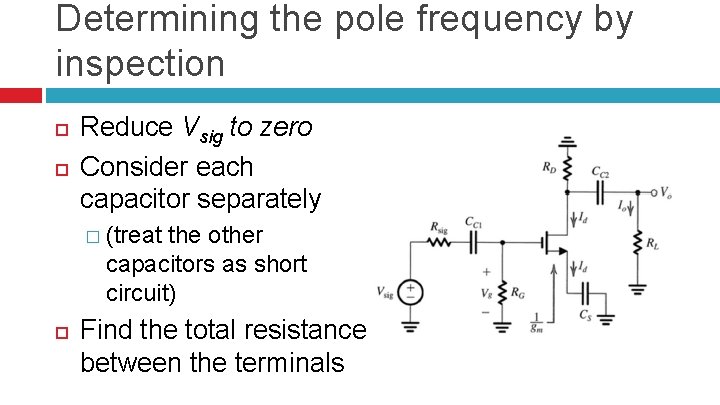
Determining the pole frequency by inspection Reduce Vsig to zero Consider each capacitor separately � (treat the other capacitors as short circuit) Find the total resistance between the terminals
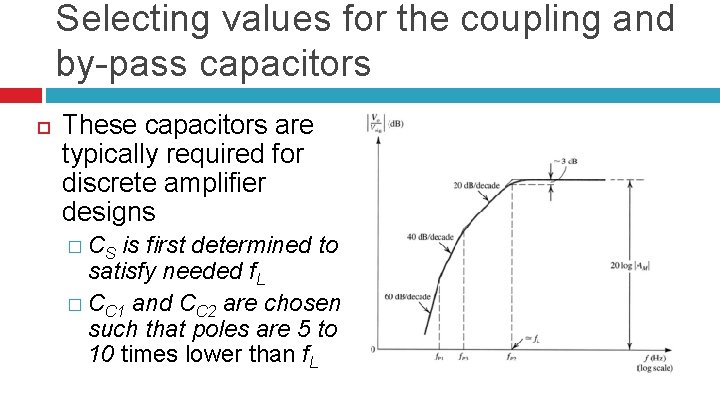
Selecting values for the coupling and by-pass capacitors These capacitors are typically required for discrete amplifier designs � CS is first determined to satisfy needed f. L � CC 1 and CC 2 are chosen such that poles are 5 to 10 times lower than f. L
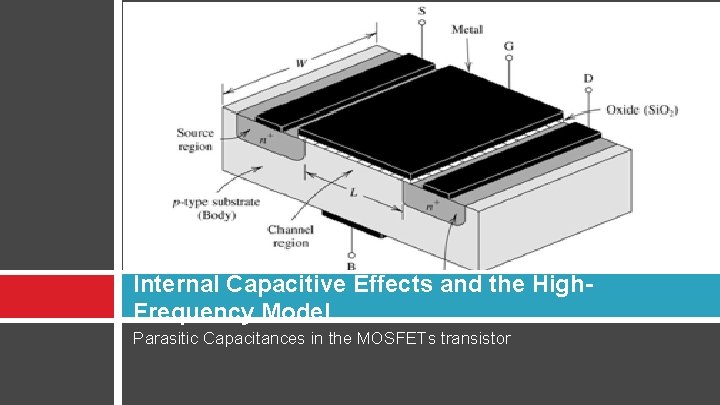
Internal Capacitive Effects and the High. Frequency Model Parasitic Capacitances in the MOSFETs transistor
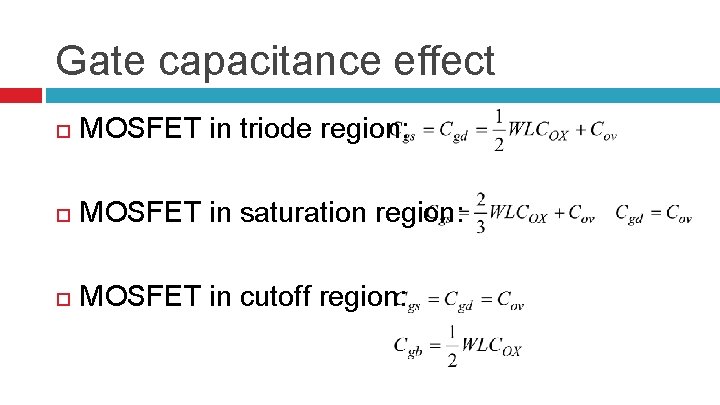
Capacitance in the MOSFET There are basically two types of internal capacitance in the MOSFET � Gate capacitance effect: the gate electrode forms a parallel-plate capacitor with gate oxide in the middle � Junction capacitance effect: the source/body and drain/body are pn-junctions at reverse bias The gate capacitive effects
Gate capacitance effect MOSFET in triode region: MOSFET in saturation region: MOSFET in cutoff region:
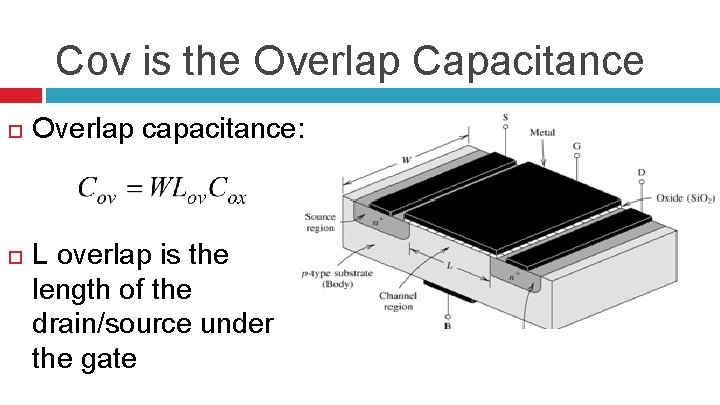
Cov is the Overlap Capacitance Overlap capacitance: L overlap is the length of the drain/source under the gate
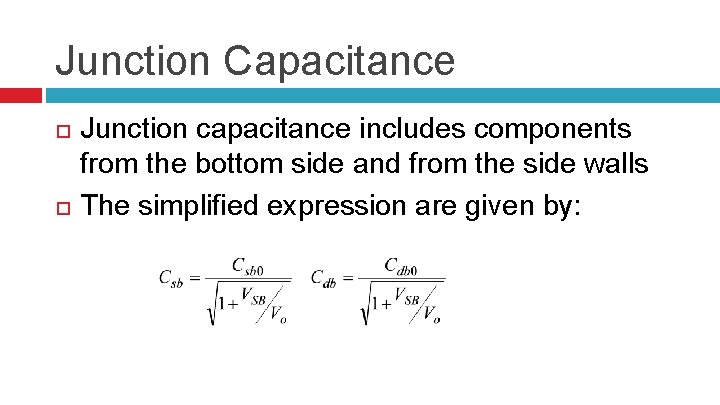
Junction Capacitance Junction capacitance includes components from the bottom side and from the side walls The simplified expression are given by:
MOSFET High Frequency Model Simplified high-frequency MOSFET model Source and body terminals are shorted Cgd plays an important role in the amplifier frequency response Cdb is neglected to simplify the analysis
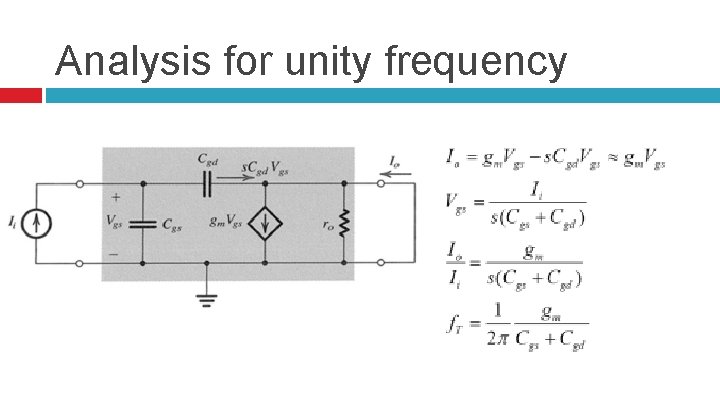
Unity Gain Frequency The frequency at which the current gain becomes unity f. T Is typically used as an indicator to evaluate the high-frequency capability Smaller parasitic capacitances Cgs and Cgd are desirable for higher unity-gain frequency
Analysis for unity frequency
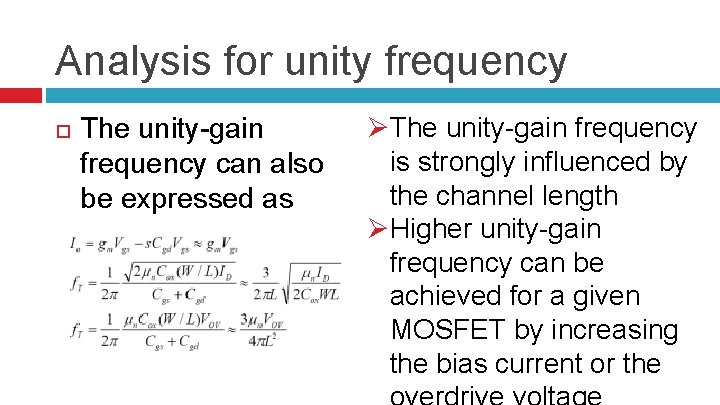
Analysis for unity frequency The unity-gain frequency can also be expressed as ØThe unity-gain frequency is strongly influenced by the channel length ØHigher unity-gain frequency can be achieved for a given MOSFET by increasing the bias current or the
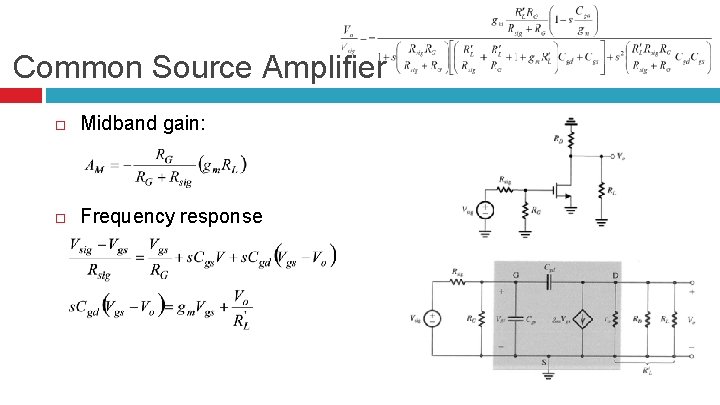
Common Source Amplifier Midband gain: Frequency response
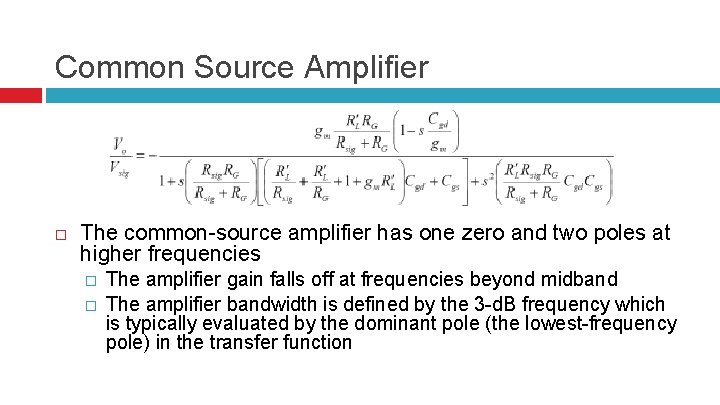
Common Source Amplifier The common-source amplifier has one zero and two poles at higher frequencies � � The amplifier gain falls off at frequencies beyond midband The amplifier bandwidth is defined by the 3 -d. B frequency which is typically evaluated by the dominant pole (the lowest-frequency pole) in the transfer function
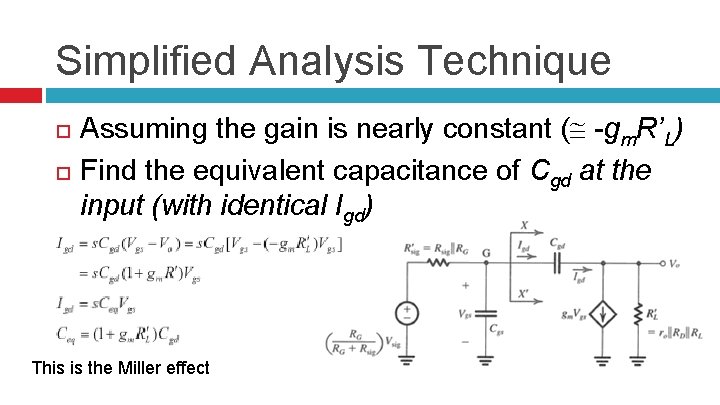
Simplified Analysis Technique Assuming the gain is nearly constant ( -gm. R’L) Find the equivalent capacitance of Cgd at the input (with identical Igd) This is the Miller effect
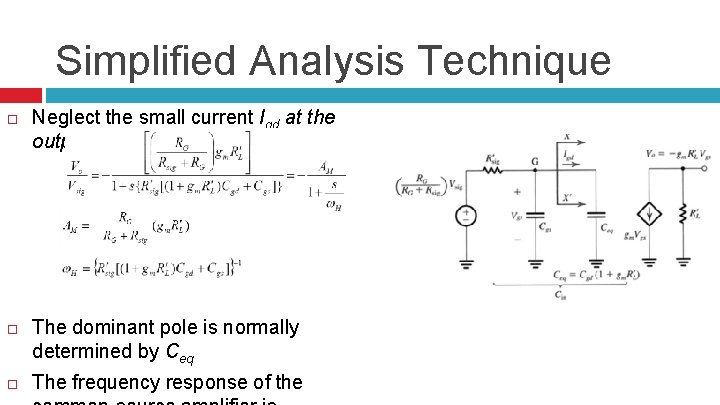
Simplified Analysis Technique Neglect the small current Igd at the output The dominant pole is normally determined by Ceq The frequency response of the
Widescreen Test Pattern (16: 9) Aspect Ratio Test (Should appear circular) 4 x 3 16 x 9