
French Revolution Storyboard Draw a picture representing each
French Revolution Storyboard ► Draw a picture representing each of the scenarios given. ► Box 1: Estates-General Meeting ► Box 2: Tennis Court Oath ► Box 3: Storming the Bastille ► Box 4: Ending special privileges for the 1 st and 2 nd estate ► Box 5: Declaration of the Rights of Man and the Citizen
Chapter 18 Section 2 Reign of Terror
Review ► Last time we met we talked about the causes and the events of the French Revolution. When we left off the king had officially accepted the National Assembly. ► In all, the French Revolution was proving to be a success.
Great Fear ► Rebellion spread from Paris into the countryside. ► A wave of senseless panic called the Great Fear spread through France. § Peasants began to turn into outlaws ►They broke into nobles’ manor houses looking for old legal papers that bound them to pay feudal dues ►In some cases, they burned the manor houses
Reform ► The newly formed national assembly set themselves up with a separation of powers and the government had been officially changed by the people. ► For two years the National Assembly argued over a new constitution for France. § Nat’l Assembly created a limited constitutional monarchy. § Legislative Assembly - had the power to create laws and to approve or prevent any war the king declared on other nations. § Despite the new government, old problems such as food shortages and government debt remained. ► So what happened to the King? ? ?
What Happened to Louis? ► Louis sent into exile. Then escaped. ► In the spring of 1792, Prussian and Austrian armies invade France and try to restore the Monarchy. ► The French people now had to protect their own country. ► Patriotic citizens then drove the Austrians/Prussians out of France.
Jacobins ► During the chaotic summer of 1792, both men and women joined political groups. ► Most radical group was the Jacobins. § They wanted to remove the king and establish a republic. § Reduced Louis XVI’s role to that of a common citizen and prisoner. ► Then, guided by radical Jacobins they tried Louis for treason and found him guilty. § Sentenced him to death. ► On Jan. 21, 1793 the ex-king was beheaded by a machine called the Guillotine. § One of the first persons to be executed by the Guillotine.
Guillotine ► Thousands died by the Guillotine during the French Revolution. ► Dr. Joseph Guillotin proposed a machine that satisfied many needs: § It was efficient, humane and democratic. ► Prior to the Guillotine’s introduction French criminals had suffered through horrible punishments. § Burning, strangulation, hanging, dismemberment, beheading, being pulled apart by horses. ► Made a public spectacle to help deter criminal behavior. § Helped keep restless armed mobs from attacking the government.
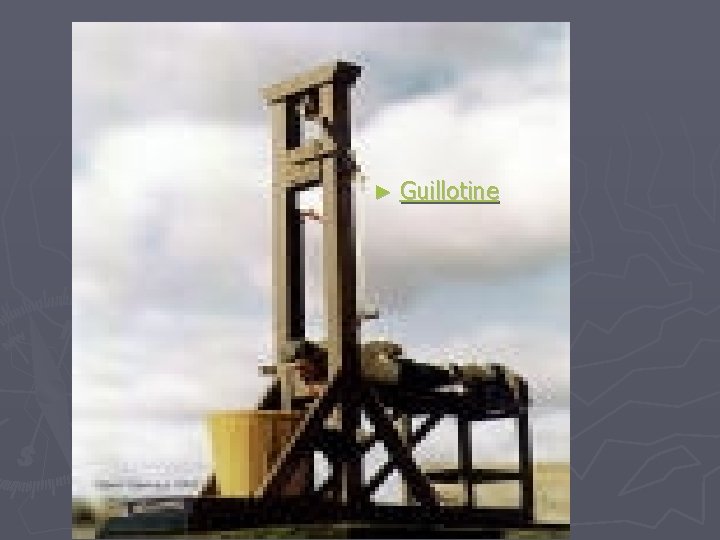
► Guillotine
Arming the Army ► The new republic’s first problem was the continuing war with Austria and Prussia. § Other European countries joined and with so many enemies France suffered a string of defeats. ► The French took extreme steps to meet the new danger. § Instituted a draft § Eventually grew to a force of 800, 000 citizen-soldiers ► This citizen-army was eventually led by Maximilien Robespierre. § Robespierre and his supporters tried to wipe out every trace of France’s past monarchy and nobility.
Committee for Public Safety ► Under the command of Robespierre the Committee for Public Safety was formed. ► Main task of the Committee was to protect the revolution from its “enemies” ► The Committee for Public Safety and Robespierre put many men who had led the revolution to death.
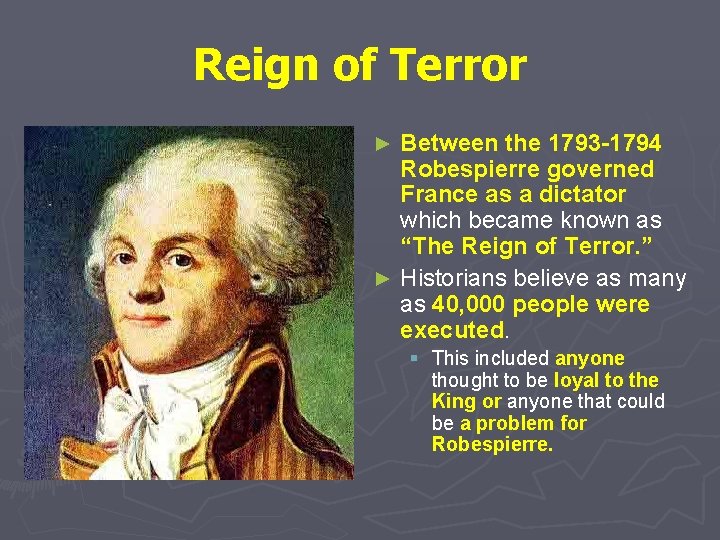
Reign of Terror Between the 1793 -1794 Robespierre governed France as a dictator which became known as “The Reign of Terror. ” ► Historians believe as many as 40, 000 people were executed. ► § This included anyone thought to be loyal to the King or anyone that could be a problem for Robespierre.
No Rhyme or Reason ► Often times there was no rhyme or reason to the executions. ► The terror claimed not only the famous, such as Marie Antoinette, but thousands of unknown people (many of which were from the former 3 rd Estate). ► Many fellow revolutionaries that challenged Robespierre’s leadership became victims.
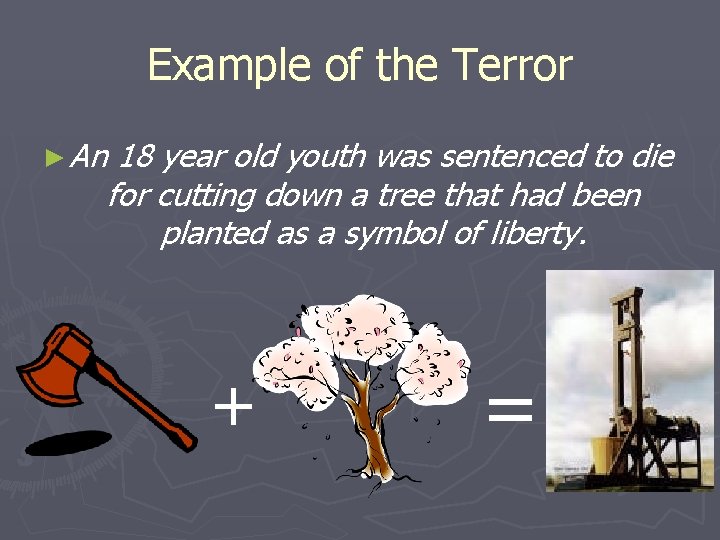
Example of the Terror ► An 18 year old youth was sentenced to die for cutting down a tree that had been planted as a symbol of liberty. + =
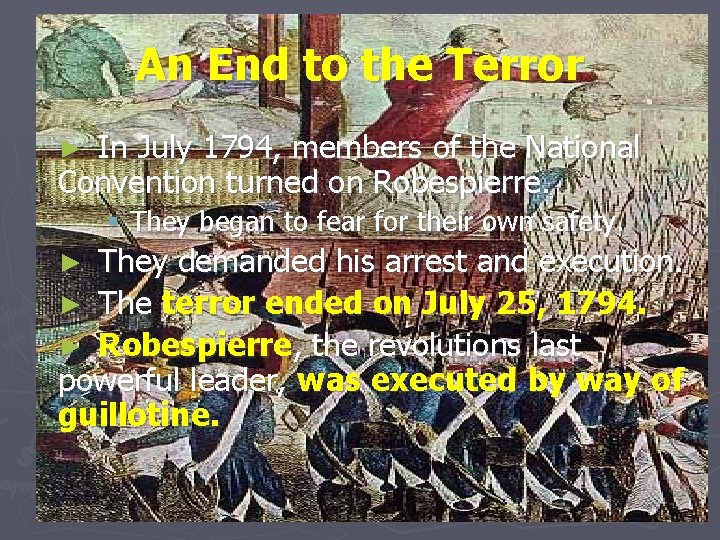
An End to the Terror In July 1794, members of the National Convention turned on Robespierre. ► § They began to fear for their own safety. They demanded his arrest and execution. ► The terror ended on July 25, 1794. ► Robespierre, the revolutions last powerful leader, was executed by way of guillotine. ►
The Aftermath ►After the execution of Robespierre and the end of the terror, public opinion in France shifted dramatically to the right (conservative). ►People were sick of the terror and the sky rocketing prices for bread, salt and other necessities of life.
Introducing the Directory ► In 1795, The National Convention drafted a new constitution. ► The new plan: § Put power in the hands of the upper middle class (bourgeoisie). § Created a two-house legislature § Formed an executive body of five men known as the directory.
Success of the Directory ► Gave France a period of order. ► Directory found a new general to command the army (Napoleon Bonaparte).
Robespierre Justified? ► 1. Was Robespierre justified in killing thousands of people during the Reign of Terror? Why or why not? (Give 2 reasons minimum) ► 2. What would you have done if you were the head of the Committee of Public Safety about the “enemies” of the Revolution?
- Slides: 19