
French Revolution French Revolution Introduced democratic ideas to
- Slides: 23
French Revolution ❧
French Revolution ❧ ❧ Introduced democratic ideas to France but did not make the nation a democracy. ❧ It ended the supreme rule of French kings and strengthened the power of the middle class.
Causes: Class Conflict ❧ ❧ Dissatisfaction among the lower and middle classes. ❧ Legal divisions in France known as Estates, which consisted of three groups. ❧ 1 st Estate: Clergy ❧ 2 nd Estate: Nobles ❧ 3 rd Estate: Everyone else ❧ Including the bourgeoisie (middle class): bankers, merchants, lawyers, doctors, journalists ❧ Peasants formed the largest group within the third estate. Many of them earned so little that they could barely afford to feed their families. ❧ The first 2 estates did not have to pay taxes. Therefore, the 3 rd estate had to provide all of the country’s tax revenue.
Causes: New Ideas ❧ ❧ New ideas about government began to challenge France’s absolute monarchy. ❧ During the 1700 s, French philosophers raised new ideas about freedom. ❧ Thinkers such as, Jean-Jacques Rousseau suggested that the right to govern came from the people.
Causes: Financial Crisis ❧ ❧ The revolution began with a government financial crisis. ❧ France is deeply in debt due to the Seven Years War (1756 -1763) and for funding the American Revolution (1775 -1783). ❧ By 1788, the government was almost bankrupt. ❧ 1789 also brought about a terrible famine to France. The prices of grain increased and in return mass starvation occurred.
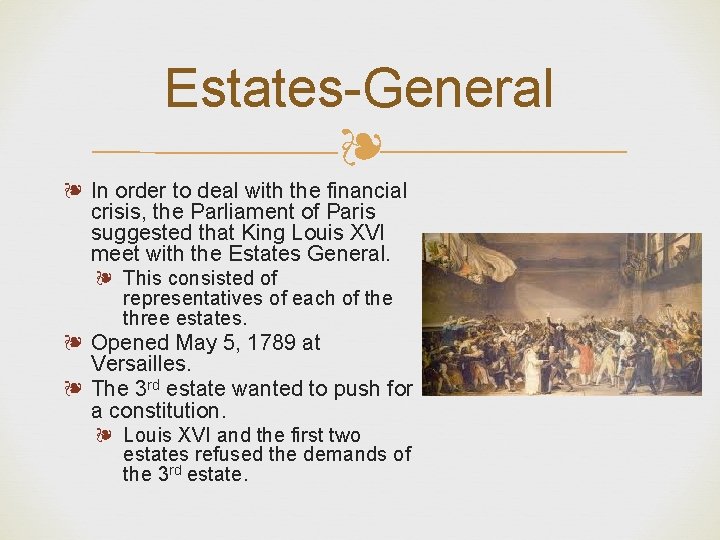
Estates-General ❧ ❧ In order to deal with the financial crisis, the Parliament of Paris suggested that King Louis XVI meet with the Estates General. ❧ This consisted of representatives of each of the three estates. ❧ Opened May 5, 1789 at Versailles. ❧ The 3 rd estate wanted to push for a constitution. ❧ Louis XVI and the first two estates refused the demands of the 3 rd estate.
National Assembly ❧ ❧ June 1789 the 3 rd estate declares themselves the National Assembly of France. ❧ “Oath of the Tennis Court” ❧ National Assembly pledges to not disband until a constitution is written. ❧ Eventually, reform-minded clergy and nobles began to join the Assembly.
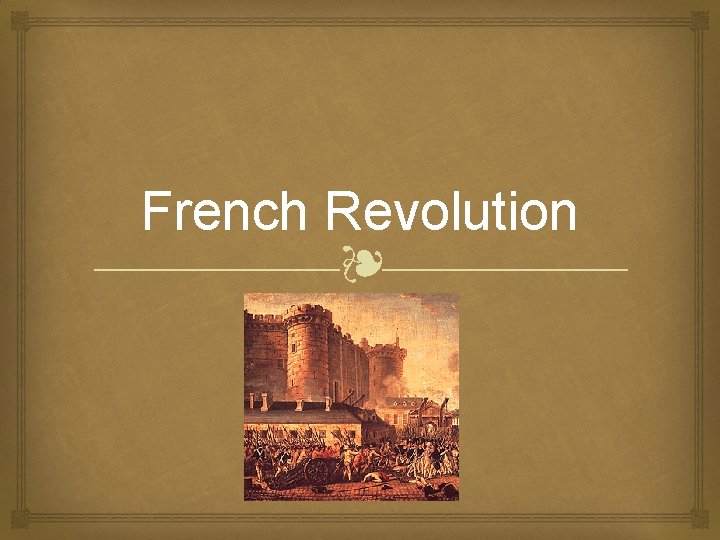
❧ ❧ July 14, 1789 ❧ Parisians storm the Bastille ❧ A medieval fortress used as a prison for political and other prisoners. ❧ Capturing of the Bastille marked the start of the French Revolution. ❧ Since 1880, French have celebrated Bastille Day annually as their national independence day.
❧ ❧ The National Assembly is pressured to end Feudalism. ❧ The idea was to limit some of the nobles’ privileges. However, most historians note that the nobles gave up nothing. ❧ Declaration of the Rights of Man ❧ Modeled after the American Declaration of Independence. ❧ The declaration proclaimed that all male citizens were equal before law. ❧ Freedom of religion. ❧ Taxes to be levied according to ability to pay.
❧ ❧ The National Assembly enacts the Civil Constitution of the Clergy, putting the French Catholic Church under state control ending papal authority over the French church. Many bishops and priests refused the Civil Constitution of the Clergy and the pope condemned it. ❧ The Constitution of 1791 establishes a new government with a limited monarchy in place of the absolute monarchy.
❧ ❧In June 1791, King Louis and Queen Marie Antoinette attempt to escape their humiliating situation. ❧However, the attempt fails.
❧ ❧ A new legislative assembly called the National Convention had the power to make laws, collect taxes, and decide on issues of war and peace. ❧ In April 1792 French revolutionaries and European monarchs such as Austria and Britain went to war.
Radicals take control ❧ ❧ Radical revolutionaries take control and execute King Louis as well as extend the right to vote to all male citizens and not just property owners. This is known as suffrage. ❧ In September 1792 the Monarchy was abolished and replaced by a republic.
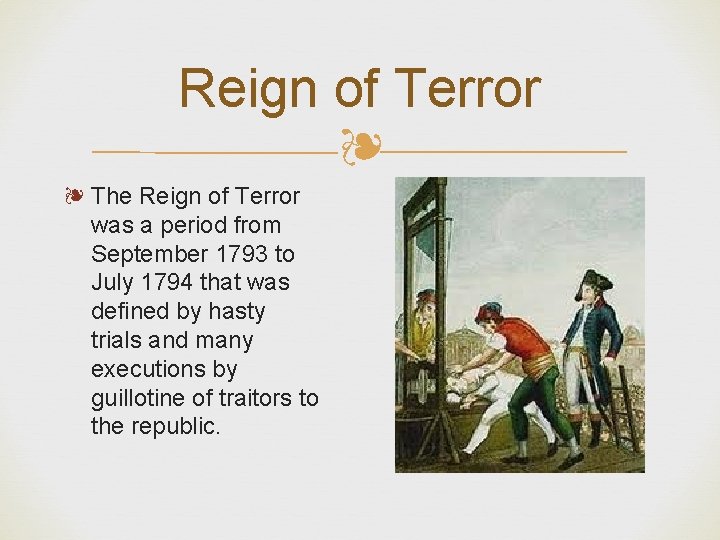
Reign of Terror ❧ ❧ The Reign of Terror was a period from September 1793 to July 1794 that was defined by hasty trials and many executions by guillotine of traitors to the republic.
❧ ❧ Committee of Public Safety ❧ Was created as a way to protect the revolution. ❧ Protecting against foreign attacks and internal rebellion. ❧ Issued a levee en masse, which required all citizens to contribute to the war effort. ❧ Robespierre ❧ Leader of the Committee of Public Safety ❧ He believed that France could achieve a “republic of virtue” only through the use of terror.
❧ ❧ About 300, 000 were arrested during the Reign of Terror. ❧ 17, 000 were executed. ❧ Many were victims of mistaken identity or were falsely accused by their neighbors. ❧ Only 15% of the accused were nobility and clergy. ❧ The engine of the Terror was the guillotine.
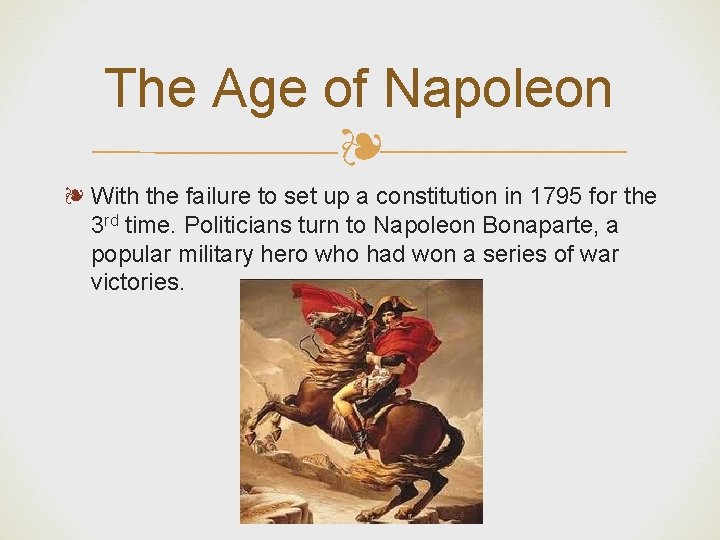
The Age of Napoleon ❧ ❧ With the failure to set up a constitution in 1795 for the 3 rd time. Politicians turn to Napoleon Bonaparte, a popular military hero who had won a series of war victories.
❧ ❧ In 1799 the Revolution begins to change. ❧ Nationalism Spreads ❧ French people are now gaining a strong sense of National identity. ❧ Push for Social Reforms ❧ State schools were set up to replace religious ones and organized systems were created to help the poor, old soldiers and war widows.
❧ ❧ To restore economic prosperity Napoleon controlled prices, encouraged new industry, and built roads and canals. ❧ He also set up a system of strict public schools to ensure well trained officials and military officers. ❧ He made peace with the Catholic Church even inviting the pope to crown him as emperor although he made it clear that he did not owe the Catholic Church for the title.
❧ ❧ Napoleon held support across all classes and although the republic was theoretically in power, Napoleon held absolute power. ❧ The Napoleonic Code ❧ was a reform that embodied Enlightenment principles such as equality of all citizens before the law, religious toleration, and the abolition of feudalism.
❧ ❧ Napoleon continued his pursuit of world domination. ❧ By 1805, Austria, Russia, and Sweden had joined the United Kingdom in a new coalition against France.
Results ❧ ❧The French Revolution brought France into opposition with much of Europe. ❧ The monarchs who ruled the other nations feared the spread of democratic ideals.
❧ ❧ The revolution left the French people in extreme disagreement about the best form of government for their country. ❧ However, the revolution created the long-lasting foundations for a unified state, a strong central government, and a free society dominated by the middle class and the landowners.