
French Immersion Research Myth or Reality JOSEPH DICKS



- Slides: 34
French Immersion Research: Myth or Reality? JOSEPH DICKS, PHD January 2017 TEXT
Some Thoughts on Myths Definition: a widespread but unfounded belief A couple of quotable quotes: • « Que serions-nous sans le secours de ce qui n’existe pas? » • “What would we be without the support of that which does not exist? ” -- Paul Valéry (la Petite lettre sur les mythes) « J'ai toujours préféré la mythologie à l'histoire parce que l'histoire est une vérité qui se déforme de bouche en bouche et devient mensonge, alors que le mythe de bouche en bouche, prends des forces et en arrive à devenir vrai. » “I always preferred myths to history because history is a truth that becomes twisted by word of mouth and becomes a lie, whereas a myth, through word of mouth, becomes more forceful and ends up becoming the truth”. -- Jean Cocteau
PRESENTATION OVERVIEW WE WILL CONFRONT A NUMBER OF MYTHS OR HALFTRUTHS ABOUT FRENCH IMMERSION AND BILINGUALISM IN GENERAL THAT HAVE BEEN MAKING THE ROUNDS FOR SOME TIME YOU WILL INDICATE USING YOUR PERSONAL RESPONSE DEVICES (AKA CLICKERS) THE DEGREE TO WHICH YOU BELIEVE EACH STATEMENT TO BE TRUE OR FALSE. FOR EACH STATEMENT WE WILL STOP TO GIVE YOU SOME TIME TO DISCUSS AND TO EXAMINE WHAT THE RESEARCH TELLS US ABOUT THESE VARIOUS ISSUES
MYTH OR REALITY? 1 IN THE LONG TERM, FRENCH IMMERSION CAN HAVE A NEGATIVE EFFECT ON THE FIRST LANGUAGE DEVELOPMENT OF THE LEARNER. 1. I am confident that this is true. 2. I believe that this might be true. 3. I believe that this might not be true. 4. I am confident that this is not true.
What the research says … French Immersion has no negative long-term effects on first language development. Early French immersion does result in a short-term delay in some aspects of English language writing (spelling, e. g. ), but this is overcome. (Genesee, 2007; Turnbull, Lapkin, & Hart, 2001; Wiss, 1987; Swain & Lapkin, 1982) So, not true! A myth.
MYTH OR REALITY? 2 STUDENTS WHO BEGIN FRENCH IMMERSION IN GRADE 3 HAVE AN ADVANTAGE OVER THOSE WHO BEGIN IN K OR GRADE 1 BECAUSE THEY KNOW HOW TO READ AND WRITE IN THEIR FIRST LANGUAGE 1. I am confident that this is true. 2. I believe that this might be true. 3. I believe that this might not be true. 4. I am confident that this is not true.
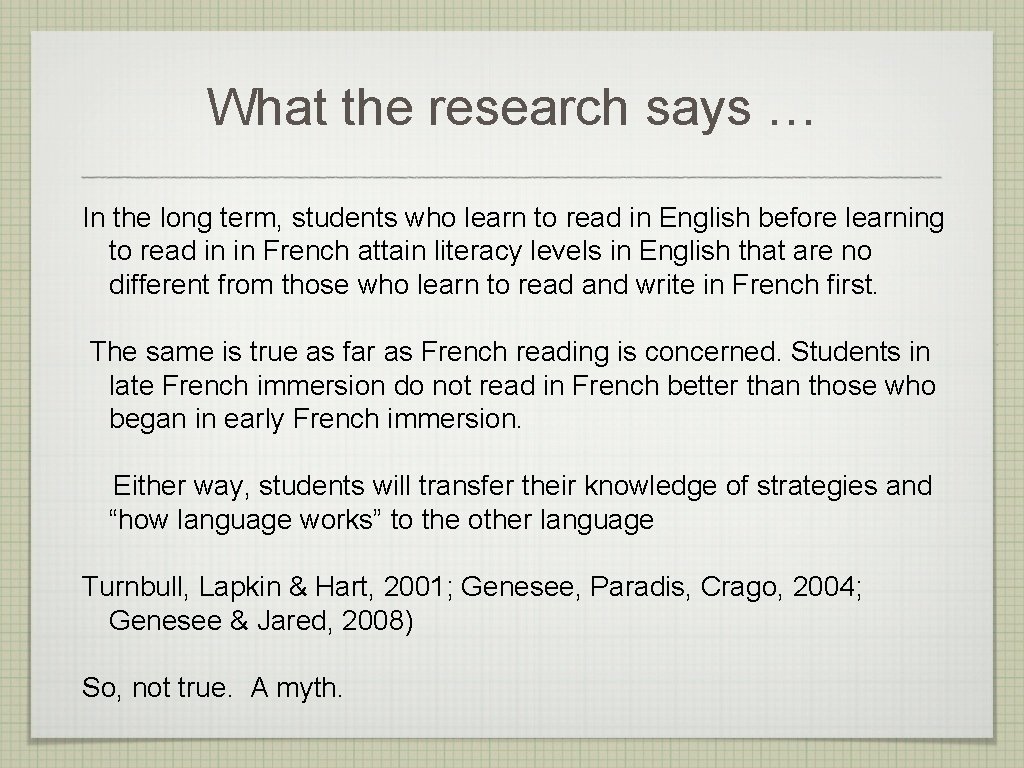
What the research says … In the long term, students who learn to read in English before learning to read in in French attain literacy levels in English that are no different from those who learn to read and write in French first. The same is true as far as French reading is concerned. Students in late French immersion do not read in French better than those who began in early French immersion. Either way, students will transfer their knowledge of strategies and “how language works” to the other language Turnbull, Lapkin & Hart, 2001; Genesee, Paradis, Crago, 2004; Genesee & Jared, 2008) So, not true. A myth.
MYTH OR REALITY? 3 LEARNING A SECOND LANGUAGE OVERTAXES THE BRAIN OF AN ALREADY STRUGGLING LEARNER 1. I am confident that this is true. 2. I believe that this might be true. 3. I believe that this might not be true. 4. I am confident that this is not true.
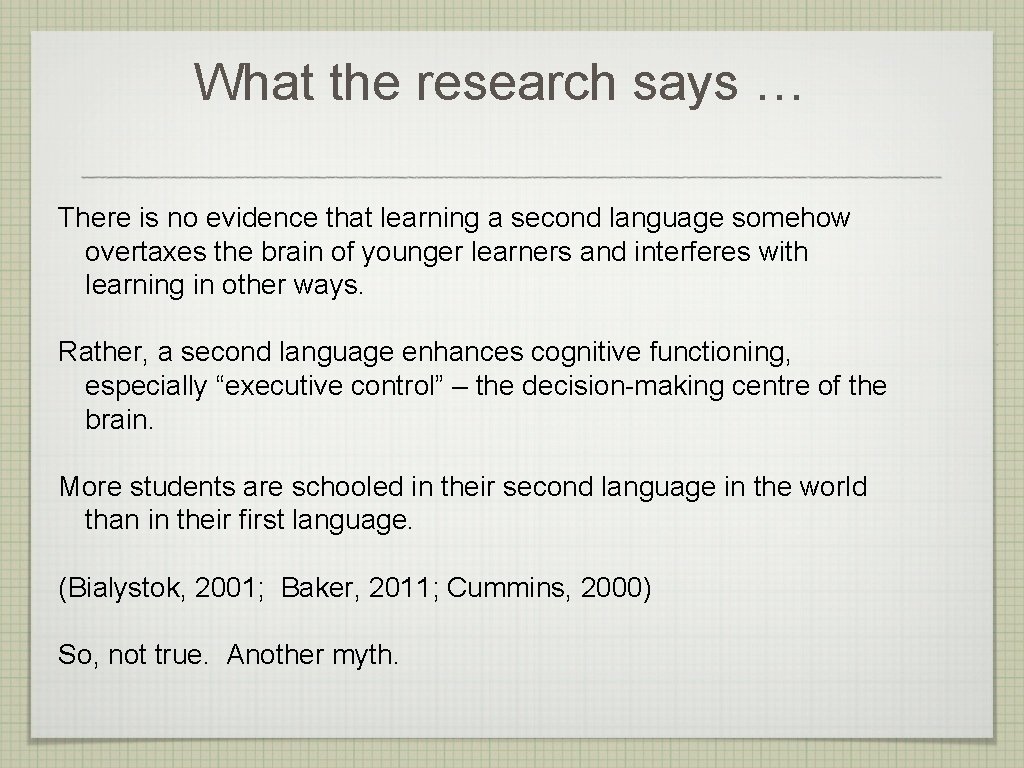
What the research says … There is no evidence that learning a second language somehow overtaxes the brain of younger learners and interferes with learning in other ways. Rather, a second language enhances cognitive functioning, especially “executive control” – the decision-making centre of the brain. More students are schooled in their second language in the world than in their first language. (Bialystok, 2001; Baker, 2011; Cummins, 2000) So, not true. Another myth.
MYTH OR REALITY? 4 A CHILD MUST WHO DOES NOT POSSESS STRONG ORAL ABILITIES IN HIS/HER FIRST LANGUAGE SHOULD NOT ENTER AN IMMERSION PROGRAM. 1. I am confident that this is true. 2. I believe that this might be true. 3. I believe that this might not be true. 4. I am confident that this is not true.
What the research says … Students enrolling in an immersion program should be developing in their first language at a level that is roughly equal to their peers. There is no requirement for advanced oral language development for students to be successful in French immersion. However, severely delayed first language development is a cause for concern. These students should probably avoid a K or Gr 1 entry, and consider a grade 3 entry or a grade 6 entry. (Wiss, 1983; Cummins, 2000) So, mostly not true. A partial myth.
MYTH OR REALITY? 5 A STUDENT WHO IS STRUGGLING ACADEMICALLY SHOULD NOT ENTER FRENCH IMMERSION 1. I am confident that this is true. 2. I believe that this might be true. 3. I believe that this might not be true. 4. I am confident that this is not true.
What the research says … The earlier the better for students who are experiencing academic difficulties because 1) There are lower cognitive demands in earlier starting programs. 2) There is a better fit between the language level of the learner and the complexity of the language of the subject content areas. 3) There are socio-affective variables that help with risk-taking and willingness to communicate. In earlier starting programs students can succeed in French immersion to the same level as in English. However, students entering late entry programs like Late immersion and who are already experiencing academic difficulties in English will likely struggle. At all levels, it is critical to provide scaffolding and other supports to struggling learners. (Bruck, 1979; Wiss, 1987; Genesee, 2007) So, yes for early start. Not so for later start. Partial myth.
MYTH OR REALITY? 6 CHILDREN WHO SPEAK A LANGUAGE OTHER THAN ENGLISH AT HOME SHOULD NOT ENROL IN FRENCH IMMERSION. 1. I am confident that this is true. 2. I believe that this might be true. 3. I believe that this might not be true. 4. I am confident that this is not true.
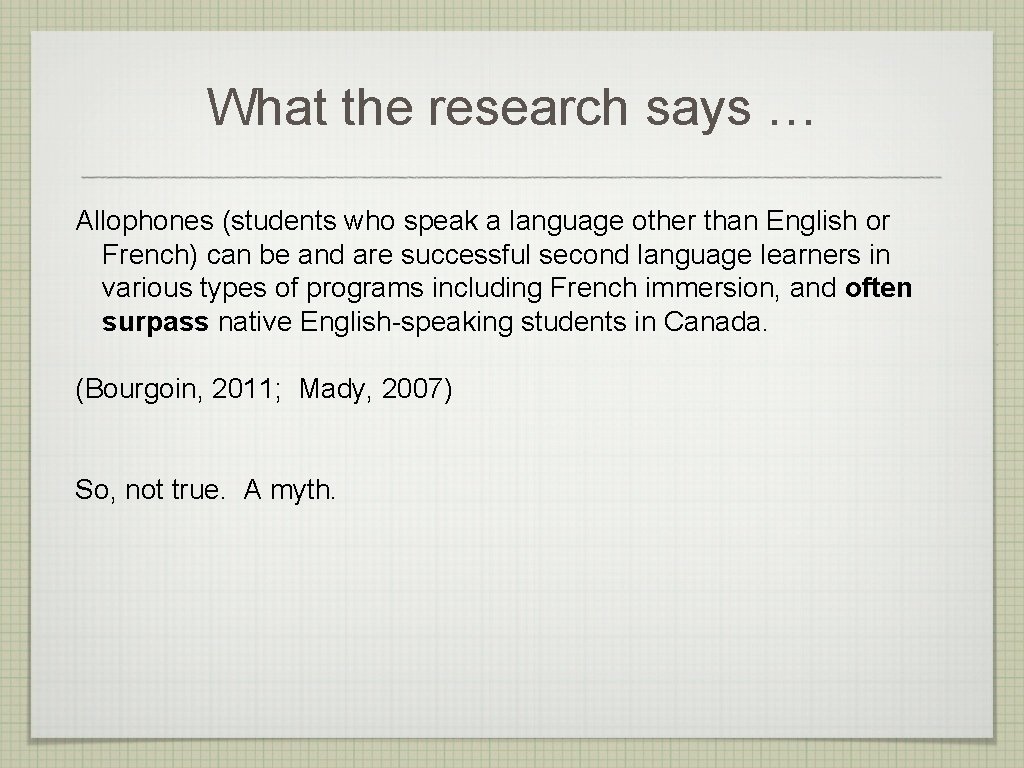
What the research says … Allophones (students who speak a language other than English or French) can be and are successful second language learners in various types of programs including French immersion, and often surpass native English-speaking students in Canada. (Bourgoin, 2011; Mady, 2007) So, not true. A myth.
MYTH OR REALITY? 7 CHILDREN WITH SPECIAL NEEDS CANNOT SUCCEED IN FRENCH IMMERSION. 1. I am confident that this is true. 2. I believe that this might be true. 3. I believe that this might not be true. 4. I am confident that this is not true.
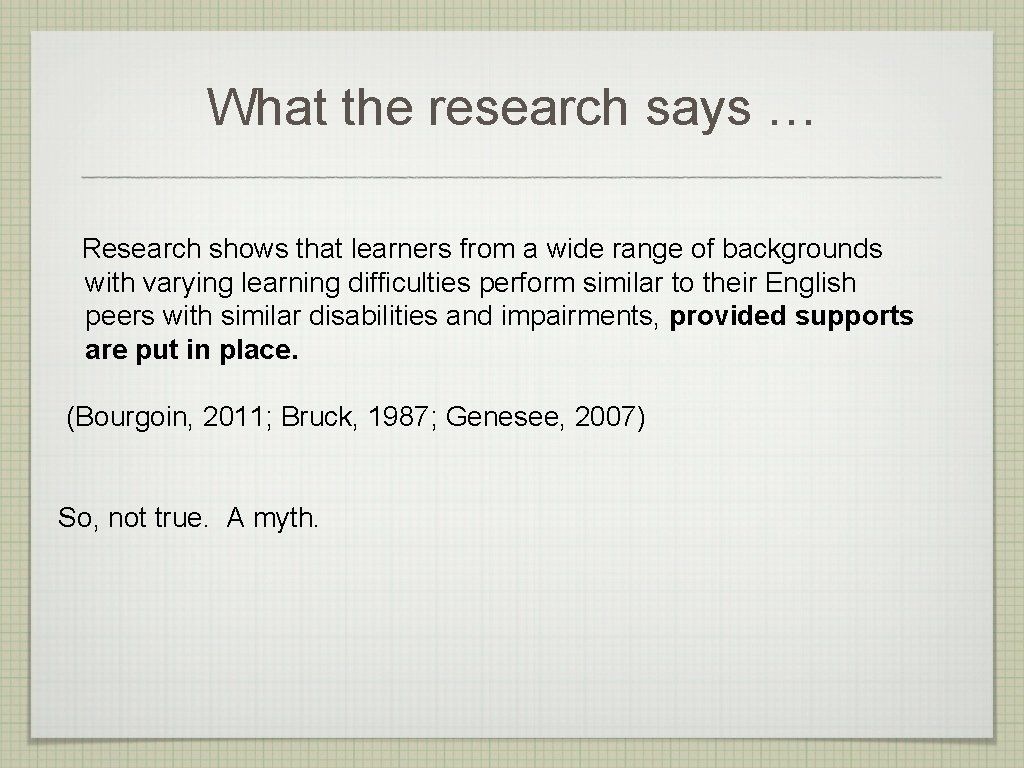
What the research says … Research shows that learners from a wide range of backgrounds with varying learning difficulties perform similar to their English peers with similar disabilities and impairments, provided supports are put in place. (Bourgoin, 2011; Bruck, 1987; Genesee, 2007) So, not true. A myth.
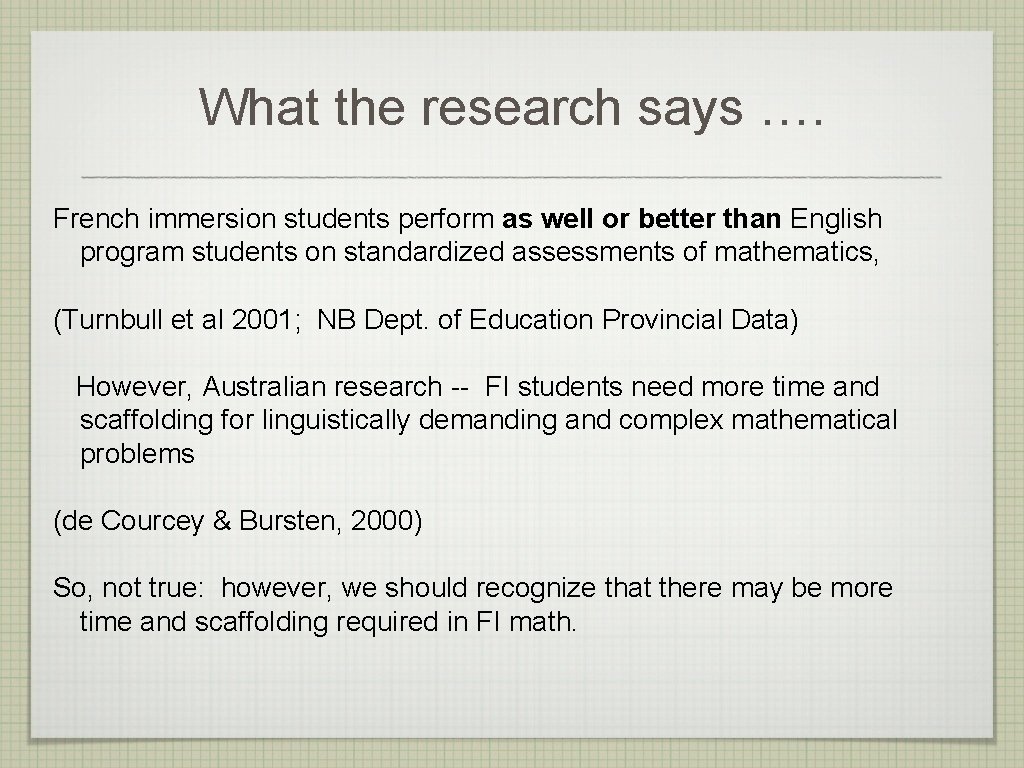
MYTH OR REALITY? 8 MATHEMATICS SHOULD BE TAUGHT IN ENGLISH IN FRENCH IMMERSION. 1. I am confident that this is true. 2. I believe that this might be true. 3. I believe that this might not be true. 4. I am confident that this is not true.
What the research says …. French immersion students perform as well or better than English program students on standardized assessments of mathematics, (Turnbull et al 2001; NB Dept. of Education Provincial Data) However, Australian research -- FI students need more time and scaffolding for linguistically demanding and complex mathematical problems (de Courcey & Bursten, 2000) So, not true: however, we should recognize that there may be more time and scaffolding required in FI math.
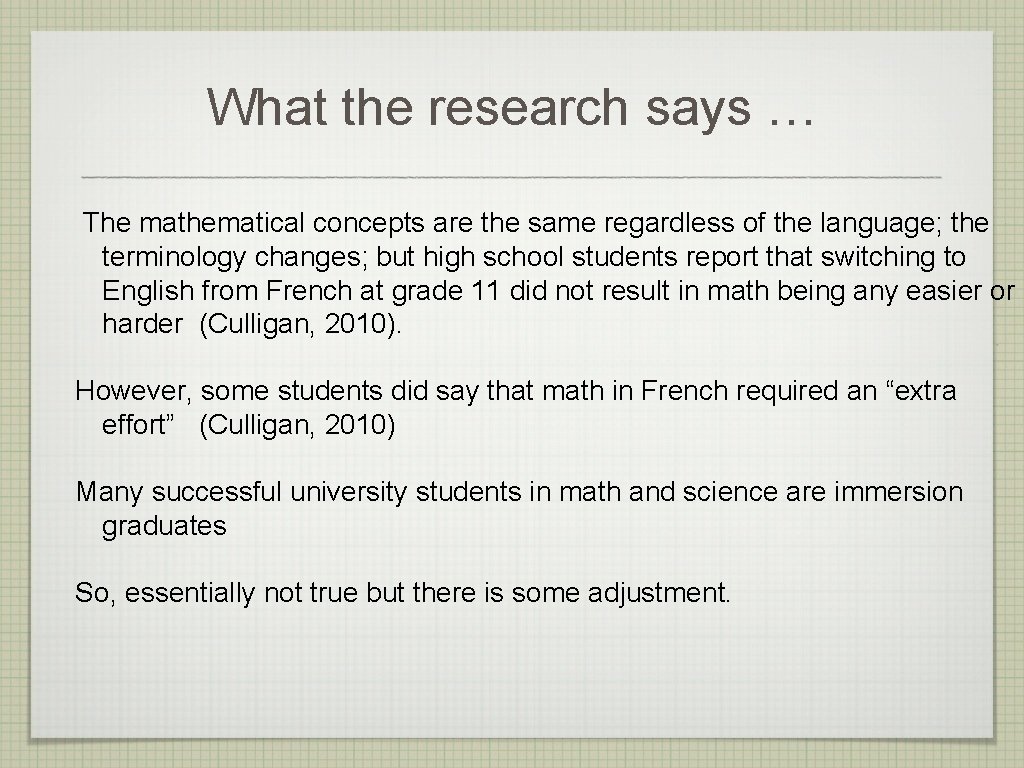
MYTH OR REALITY? 9 HIGH SCHOOL FRENCH IMMERSION STUDENTS WHO HAVE TAKEN MATH AND SCIENCES COURSES IN WILL HAVE DIFFICULTY IF THEY SWITCH TO COURSES IN ENGLISH (LATER IN HIGH SCHOOL OR AT UNIVERSITY, E. G. ) 1. I am confident that this is true. 2. I believe that this might be true. 4. I believe that this might not be true. 5. I am confident that this is not true.
What the research says … The mathematical concepts are the same regardless of the language; the terminology changes; but high school students report that switching to English from French at grade 11 did not result in math being any easier or harder (Culligan, 2010). However, some students did say that math in French required an “extra effort” (Culligan, 2010) Many successful university students in math and science are immersion graduates So, essentially not true but there is some adjustment.
MYTH OR REALITY? 10 GIFTED STUDENTS ARE EXCELLENT CANDIDATES FOR FRENCH IMMERSION BECAUSE THE PROGRAM OFFERS THEM A CHALLENGE. 1. I am confident that this is true. 2. I believe that this might be true. 3. I believe that this might not be true. 4. I am confident that this is not true.
What the research says …. Not much research! However, immersion is not enrichment! We need enrichment within immersion for gifted students; also anecdotal evidence suggests that gifted students can find the early stages of immersion very frustrating. Arnett (2013) argues that differentiation is needed in all French second language learning inclusive environments. Not true. A myth.
MYTH OR REALITY? 11 FRENCH IMMERSION STUDENTS WHO HAVE DIFFICULTIES IN SUBJECTS TAUGHT IN FRENCH CANNOT BENEFIT FROM SUPPORT GIVEN IN ENGLISH 1. I am confident that this is true. 2. I believe that this might be true. 3. I believe that this might not be true. 4. I am confident that this is not true.
What the research says … Students can transfer strategies and skills from one language to another (critical thinking, literacy strategies, eg. ) Ideally extra support should be provided in French; however, support provided in English can help learners with content area learning in French immersion (Bourgoin & Dicks, 2013; Wise & Chen, 2009; Cummins, 2000; Durgunoglu, 2002) So, not true. A myth.
MYTH OR REALITY? 12 AT LEAST ONE PARENT SHOULD SPEAK SOME FRENCH FOR STUDENTS TO DO WELL IN FRENCH IMMERSION. 1. I am confident that this is true. 2. I believe that this might be true. 3. I believe that this might not be true. 4. I am confident that this is not true.
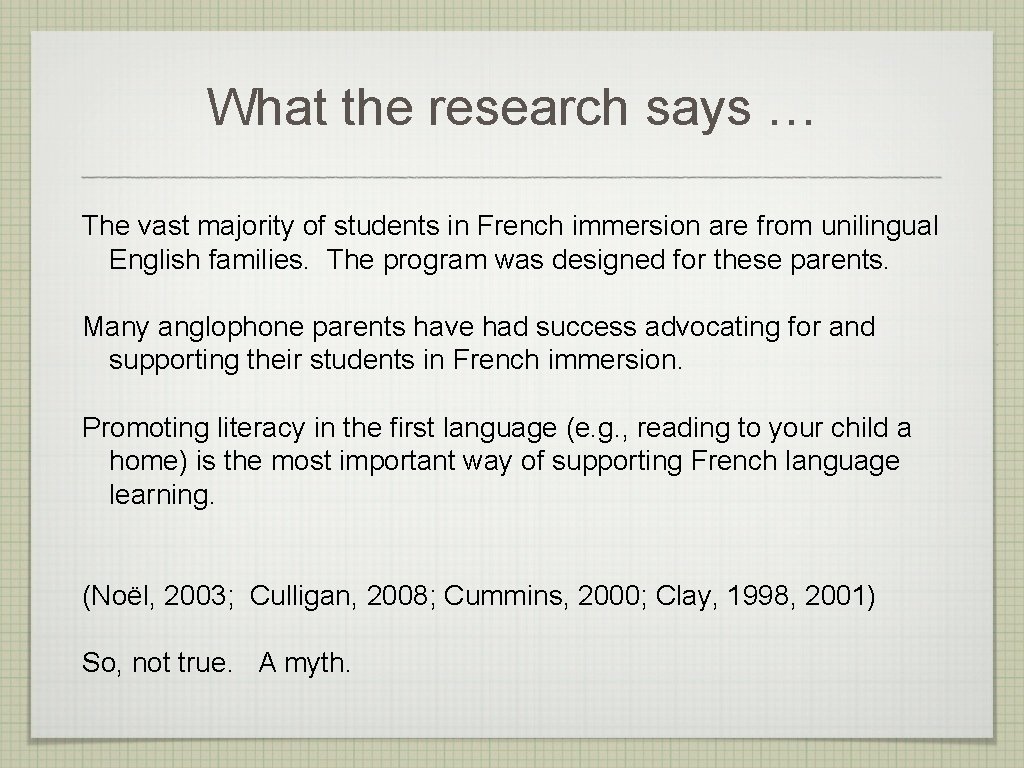
What the research says … The vast majority of students in French immersion are from unilingual English families. The program was designed for these parents. Many anglophone parents have had success advocating for and supporting their students in French immersion. Promoting literacy in the first language (e. g. , reading to your child a home) is the most important way of supporting French language learning. (Noël, 2003; Culligan, 2008; Cummins, 2000; Clay, 1998, 2001) So, not true. A myth.
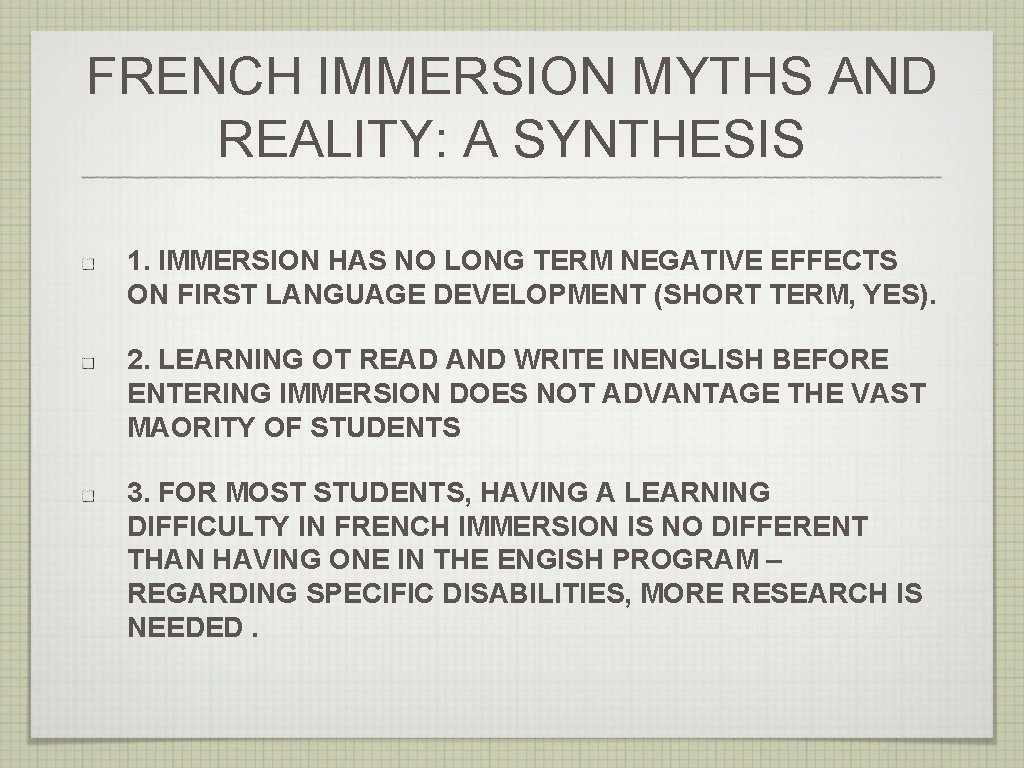
FRENCH IMMERSION MYTHS AND REALITY: A SYNTHESIS 1. IMMERSION HAS NO LONG TERM NEGATIVE EFFECTS ON FIRST LANGUAGE DEVELOPMENT (SHORT TERM, YES). 2. LEARNING OT READ AND WRITE INENGLISH BEFORE ENTERING IMMERSION DOES NOT ADVANTAGE THE VAST MAORITY OF STUDENTS 3. FOR MOST STUDENTS, HAVING A LEARNING DIFFICULTY IN FRENCH IMMERSION IS NO DIFFERENT THAN HAVING ONE IN THE ENGISH PROGRAM – REGARDING SPECIFIC DISABILITIES, MORE RESEARCH IS NEEDED.
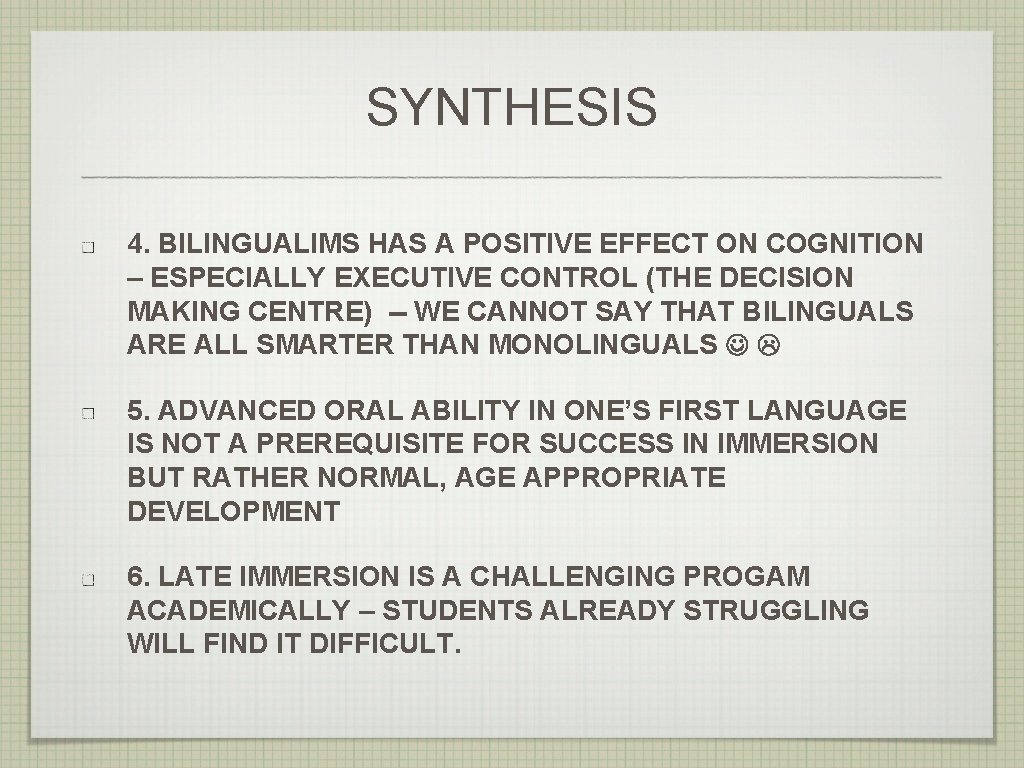
SYNTHESIS 4. BILINGUALIMS HAS A POSITIVE EFFECT ON COGNITION – ESPECIALLY EXECUTIVE CONTROL (THE DECISION MAKING CENTRE) -- WE CANNOT SAY THAT BILINGUALS ARE ALL SMARTER THAN MONOLINGUALS 5. ADVANCED ORAL ABILITY IN ONE’S FIRST LANGUAGE IS NOT A PREREQUISITE FOR SUCCESS IN IMMERSION BUT RATHER NORMAL, AGE APPROPRIATE DEVELOPMENT 6. LATE IMMERSION IS A CHALLENGING PROGAM ACADEMICALLY – STUDENTS ALREADY STRUGGLING WILL FIND IT DIFFICULT.
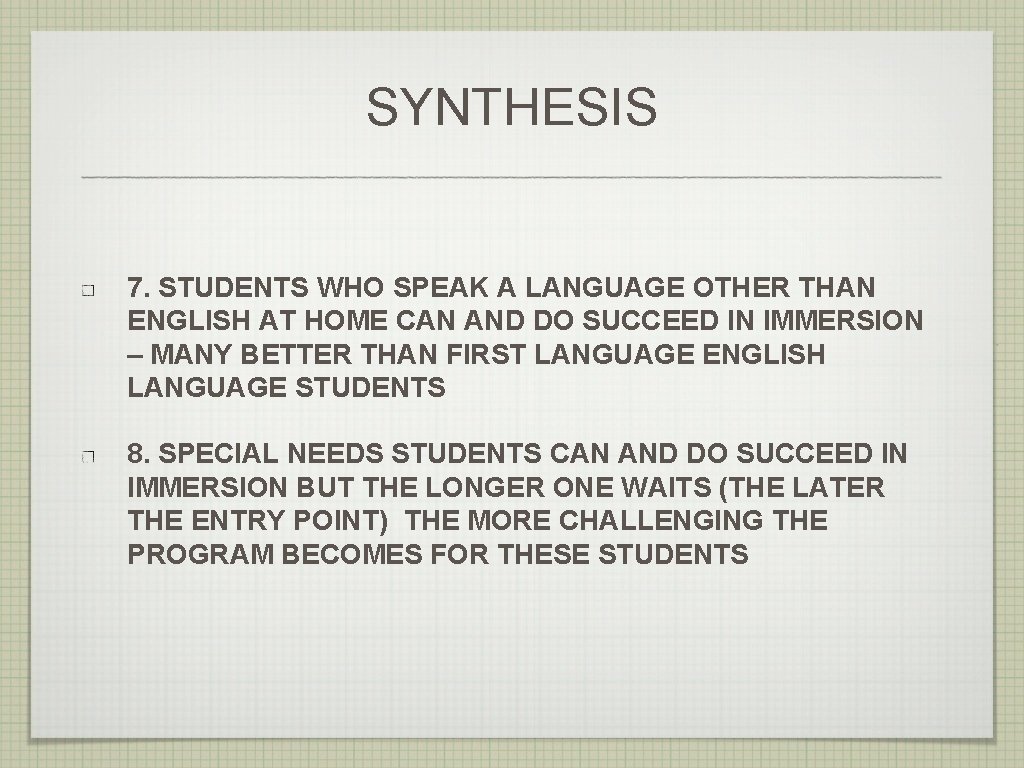
SYNTHESIS 7. STUDENTS WHO SPEAK A LANGUAGE OTHER THAN ENGLISH AT HOME CAN AND DO SUCCEED IN IMMERSION – MANY BETTER THAN FIRST LANGUAGE ENGLISH LANGUAGE STUDENTS 8. SPECIAL NEEDS STUDENTS CAN AND DO SUCCEED IN IMMERSION BUT THE LONGER ONE WAITS (THE LATER THE ENTRY POINT) THE MORE CHALLENGING THE PROGRAM BECOMES FOR THESE STUDENTS
SYNTHESIS 9. FOR MOST STUDENTS, SUCCESS IN FRENCH IMMERSION WILL PARALLEL THAT IN THE ENGLISH PROGRAM – PROVIDED PROPER SUPPORTS ARE AVAILABLE 10. DIFFICULTY READING OR DOING MATHEMATICS IN FRENCH IS NOT A REASON TO TRANSFER STUDENTS TO ENGLISH - IT IS A REASON TO SEEK SUPPORT 11. CHILDREN WITH BEHAVIOURAL DIFFICULTIES CAN SUCCEED TO THE SAME DEGREE IN FRENCH IMMERSION AS IN ENGLISH
SYNTHESIS 12. STUDENTS WHO HAVE TAKEN COURSES LIKE MATH AND SCIENCE IN FRENCH IN IMMERSION WILL NOT HAVE ANY MAJOR DIFFICULTY SWITCHING TO COURSES IN ENGLISH (NOR IS THERE ANY MAJOR ADVANTAGE IN DOING SO). THERE WILL BE SOME WORK TO DO WITH REGARD TO CERTAIN TERMS THAT ARE LESS OBVIOUS 13. FRENCH IMMERSION IS NOT A SUBSTITUE FOR ENRICHMENT PROGRAMS FOR GIFTED STUDENTS. SOME GIFTED STUDENTS MAY FIND IMMERSION TO BE FRUSTRATING AT THE OUTSET DUE TO LIMITED ABILITY TO COMMUNICATE IDEAS.
Références Arnett, K. (2013). Languages for All: How to Support and Challenge Students in a Second Language Classroom. Toronto: Pearson Canada. Arnett, K. & Mady, C. (Eds) (2013). Minority populations in second language education: Broadening the lens from Canada. Multilingual Matters. Baker, C. (2011). Foundations of Bilingual Education and Bilingualism. Toronto: Multilingual Matters. Bialystok, E. (2001). Bilingualism in Development: Language, Literacy, & Cognition. Cambridge: Cambridge University Press Bourgoin, R. (2011). Immersion and at-Risk Leaners: What Does the Research Say. Journal de l’immersion: Les enfants à risque en immersion, 33(3), 27 -30. Bourgoin, R. & Dicks, J. (2013) Reading Without Borders: L 1 and L 2 Students Experiences in English and French Immersion Programs. In Arnett, K. & Mady, C. (Eds) Minority populations in second language education: Broadening the lens from Canada. Multilingual Matters. Bruck, M. (1978/79). Switching out of French immersion. Interchange, 9 (4), 86 -94. Bruck, M. (1985). Predictors of transfer out of early French immersion programs. Applied Psycholinguistics, 6, 39 -61. Clay, M. (1991). Becoming Literate: The Construction of Inner Control. Auckland: Heinemann. Clay. M. (1998). By Different Paths to Common Outcomes. Maine: Stenhouse Publishers. Clay, M. (2001). Change Over Time in Children’s Literacy Development. Auckland: Heinemann. Culligan, K. (2010). Pente or slope? Using student voices to explore program choice and experiences in secondary French immersion mathematics. The Canadian Modern Language Review/La Revue canadienne des langues vivantes, 66(3), 421 -444. doi: 10. 3138/cmlr. 66. 3. 421 Culligan, K. (2013). Intégrer le français dans les mathématiques au niveau secondaire. Le journal de l’immersion, 35(1), 17 -18. Cummins, J. (1983). Language proficiency, biliteracy and French immersion. Canadian Journal of Education. 8 (20), 117 -138. Cummins, J. (1984). Bilingualism and Special Education. Clevedon, Eng. : Multilingual Matters.
Cummins, J. (2000). Language, Power and Pedagogy. Clevedon: Multilingual Matters. de Courcy, M. C, & Burston, M. (2000). Learning Mathematics through French in Australia. Language and Education. 14(2), 75 -95. Durgunoglu, A. (2002) Cross-linguistic Transfer in Literacy Development and Implications for Language Learners. Annals of Dyslexia 52, 189 -204. Genesee, F. (1987). Learning through two languages: Studies of immersion and blingual Education. Rowley, MA: Newbury House. Genesee, F. (1992). Second/foreign language immersion and at-risk English-speaking children. Foreign Language Annals, 25 (3), 199 -213. Genesee, F. (2007 a). French immersion and at-risk students: A review of research evidence. The Canadian Modern Language Review, 63 (5), 655 -687. Genesee, F, (2007 b). Literacy outcomes in French immersion. Encyclopedia of Language and Literacy Development. (pp. 1 -8). London, On: Canadian Languag and Literacy Research network. Retrieved 10/2008 from http: //literacyencyclopedia. ca/index. php? fa=items. show&topic. Id=27 Genesee, F. & Jared, D. (2008). Literacy development in early French immersion programs. Canadian Psychology, 49 (2). 140 -147. Genesee, F. , Paradis, J. & Crago, M. (2004). Dual Language Development and Disorders: A Handbook on Bilingualism and Second Language Learning. Baltimore: Brookes Publishing Co. Mady C. (2007). Les élèves allophones dans les programmes de français seconde langue officielle: Revue de la litterature. Canadian Modern Language Review, 63(5), 761 -79 Swain, M. , & Lapkin, S. (1982). Evaluating Bilingual Education: A Canadian Case Study. Clevedon: Multilingual Matters. Turnbull, M. Lapkin, S. & Hart, D. (2001). Grade 3 immersion students’ performance in literacy and mathematics: Province-wide results from Ontario (1998 -99). The Canadian Modern Language Review, 58 (1), 9 -26. Turnbull, M. , Hart, D. & Lapkin, S. (2003) Grade 6 French Immersion Students' Performance on Large-Scale Reading, Writing, and Mathematics Tests: Building Explanations. The Alberta Journal of Educational Research. Vol. XLIX, No. 1, Spring 2003, 6 -23 Wise, N & Chen, Xi. (2009) Early Identification of At-Risk Reades in French Immersion. Retrieved from: http: //www. edu. gov. on. ca/eng/literacynumeracy/inspire/research/At_Risk_Readers_en. pdf Wiss, C, (1987). Issues in assessment of learning problems in children from French immersion programs; A case study illustration in support of Cummins. The Canadian Modern Language Review, 43, 302 -313.