
French Birth rate in the 1 Nineteenth century

French Birth rate in the 1 Nineteenth century. By Mike Allen 1 Mostly from Wikipedia.
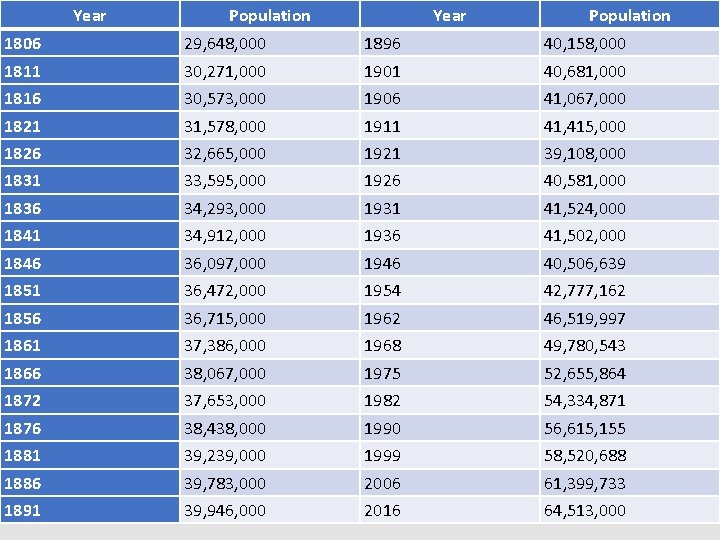
Year Population 1806 29, 648, 000 1896 40, 158, 000 1811 30, 271, 000 1901 40, 681, 000 1816 30, 573, 000 1906 41, 067, 000 1821 31, 578, 000 1911 41, 415, 000 1826 32, 665, 000 1921 39, 108, 000 1831 33, 595, 000 1926 40, 581, 000 1836 34, 293, 000 1931 41, 524, 000 1841 34, 912, 000 1936 41, 502, 000 1846 36, 097, 000 1946 40, 506, 639 1851 36, 472, 000 1954 42, 777, 162 1856 36, 715, 000 1962 46, 519, 997 1861 37, 386, 000 1968 49, 780, 543 1866 38, 067, 000 1975 52, 655, 864 1872 37, 653, 000 1982 54, 334, 871 1876 38, 438, 000 1990 56, 615, 155 1881 39, 239, 000 1999 58, 520, 688 1886 39, 783, 000 2006 61, 399, 733 1891 39, 946, 000 2016 64, 513, 000
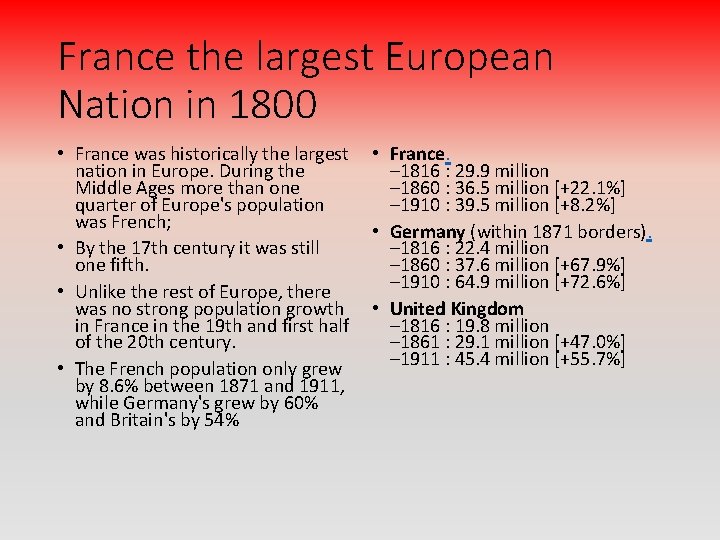
France the largest European Nation in 1800 • France was historically the largest nation in Europe. During the Middle Ages more than one quarter of Europe's population was French; • By the 17 th century it was still one fifth. • Unlike the rest of Europe, there was no strong population growth in France in the 19 th and first half of the 20 th century. • The French population only grew by 8. 6% between 1871 and 1911, while Germany's grew by 60% and Britain's by 54% • France. – 1816 : 29. 9 million – 1860 : 36. 5 million [+22. 1%] – 1910 : 39. 5 million [+8. 2%] • Germany (within 1871 borders). – 1816 : 22. 4 million – 1860 : 37. 6 million [+67. 9%] – 1910 : 64. 9 million [+72. 6%] • United Kingdom – 1816 : 19. 8 million – 1861 : 29. 1 million [+47. 0%] – 1911 : 45. 4 million [+55. 7%]
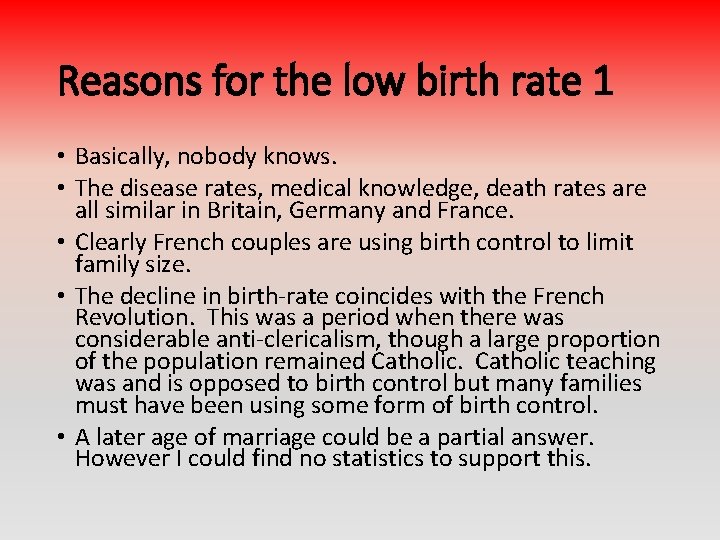
Reasons for the low birth rate 1 • Basically, nobody knows. • The disease rates, medical knowledge, death rates are all similar in Britain, Germany and France. • Clearly French couples are using birth control to limit family size. • The decline in birth-rate coincides with the French Revolution. This was a period when there was considerable anti-clericalism, though a large proportion of the population remained Catholic teaching was and is opposed to birth control but many families must have been using some form of birth control. • A later age of marriage could be a partial answer. However I could find no statistics to support this.
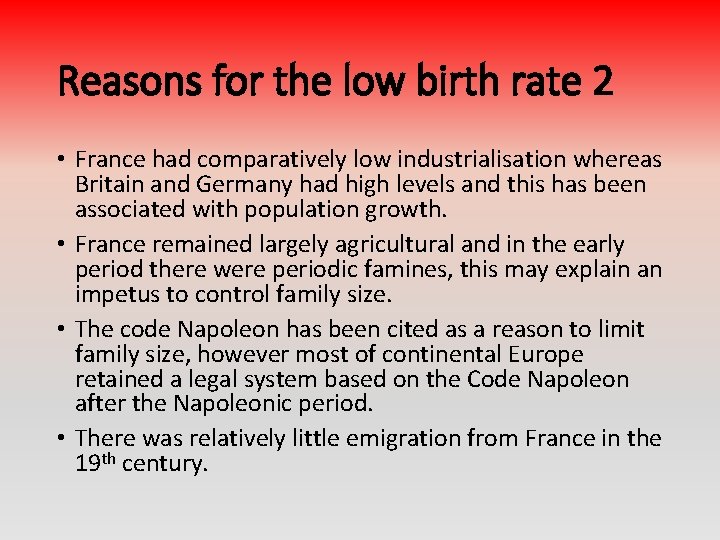
Reasons for the low birth rate 2 • France had comparatively low industrialisation whereas Britain and Germany had high levels and this has been associated with population growth. • France remained largely agricultural and in the early period there were periodic famines, this may explain an impetus to control family size. • The code Napoleon has been cited as a reason to limit family size, however most of continental Europe retained a legal system based on the Code Napoleon after the Napoleonic period. • There was relatively little emigration from France in the 19 th century.
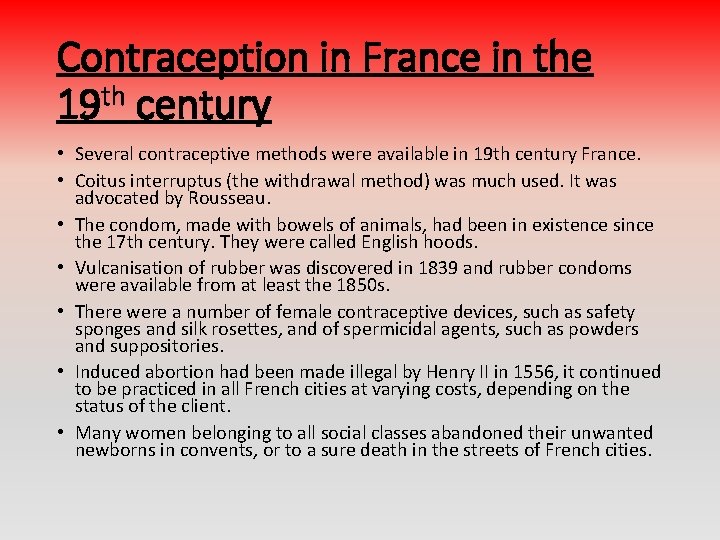
Contraception in France in the 19 th century • Several contraceptive methods were available in 19 th century France. • Coitus interruptus (the withdrawal method) was much used. It was advocated by Rousseau. • The condom, made with bowels of animals, had been in existence since the 17 th century. They were called English hoods. • Vulcanisation of rubber was discovered in 1839 and rubber condoms were available from at least the 1850 s. • There were a number of female contraceptive devices, such as safety sponges and silk rosettes, and of spermicidal agents, such as powders and suppositories. • Induced abortion had been made illegal by Henry II in 1556, it continued to be practiced in all French cities at varying costs, depending on the status of the client. • Many women belonging to all social classes abandoned their unwanted newborns in convents, or to a sure death in the streets of French cities.
- Slides: 6