
French Absolutism The Rise of LOUIS XIV Introduction
French Absolutism The Rise of LOUIS XIV

Introduction The 17 th century was a period of great transition European climate cooled providing less food Governments spent more mostly on armies and raised taxes on the poor to pay for it France and Spain gained control over the papacy England Germany establish national churches
Absolute Monarchs a) controlled the church b) controlled the law courts c) abolished freedoms and liberties d) maintained permanent armies e) used secret police and spies f) established huge bureaucracies focused on the king g) secured the cooperation of the nobility
Limits of Absolutism Not total rule because they lacked the resources But it did foreshadow totalitarianism in 2 respects: i) glorification of the state over all else ii) use of war and expansionism to divert attention from domestic problems

Foundations of French Absolutism Henry IV (1553 -1610) and his adviser the Duke of Sully laid the foundations for absolutism in France Sully: a) revived the paulette tax - a tax on hereditary positions b) started a highway system c) and dreamed of an international organization to keep the peace d) also indirect tax on salt and sales But the number of taxes actually declined – and revenues increased
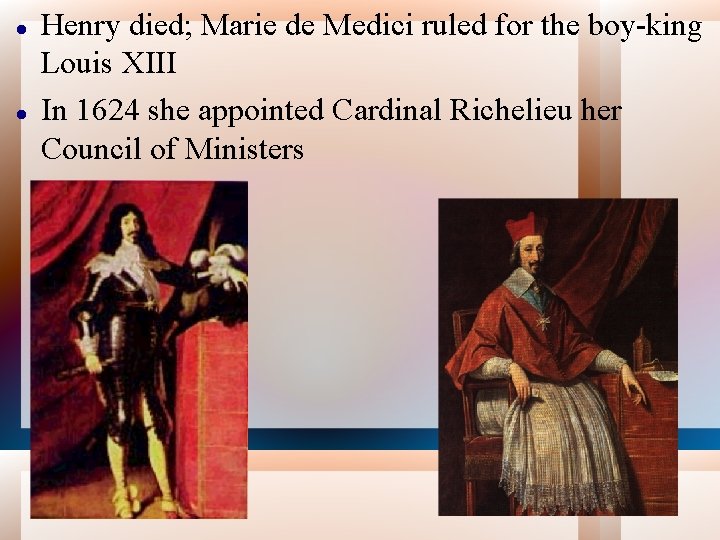
Henry died; Marie de Medici ruled for the boy-king Louis XIII In 1624 she appointed Cardinal Richelieu her Council of Ministers
Louis XIII and Cardinal Richelieu: a) subordinated all offices to the monarchy b) weakened the power of the nobles c) recruited for the army d) supervised tax collection doubling what was collected e) checked on nobility f) regulated economic activity Richelieu’s policy was to weaken the Hapsburgs who surrounded France
Louis XIII Continued 1631 France joins Sweden in the Thirty Years’ War against the Catholics Richelieu wrote Political Testament which said power is based on revenue French monarchs couldn’t tax at will so they would never have complete control “raison d’etat” - what is done for the state is done for God

Richelieu persuaded the king to appoint Jules Mazarin Richelieu's as his successor Richelieu and Louis both died Queen Anne of Austria governs for her son Louis XIV
Mazarin and Louis XIV Mazarin continues Richelieu’s policies of war with Spain, selling offices, and restricting the nobles. This leads to a civil war - The Fronde (1648 -53) The war was between the king and the sword nobility known as the frondeurs
The Fronde Immediate Cause: The Parliament of Paris refused to loan the State money, in response Mazarin orders the leaders arrested Louis XIV was forced to flee Paris, Mazarin was forced to flee France Violence continued for 12 years and had three significant results: a) government would have to compromise with the nobility, but comes out much strengthened b) the economy was ruined and would take years to rebuild c) Louis XIV would never forget the trauma

Louis XIV Under Louis (Sun King) absolutism reached its height 1661 Mazarin died and Louis took control of the economy Never relied on one councilor Reigned for 72 years
Louis XIV Continued Married Maria Theresa because of a diplomatic arrangement with Spain Had complete control over all classes of society Ruled from Versailles where he required the nobility to reside for several months each year 60% of revenue was spent on the maintaining of Versailles Never called the Estates General Other monarchs imitated Louis and French replaced Latin as the language of the educated But his weakness was always finances He appointed Jean-Baptiste Colbert Controller of Finances
Louis Weakens the Nobles and Towns Nobles were immune from Royal Taxes Louis wanted to make sure nobles did not become “overmighty” He forces nobles to come to Versailles to keep an eye on them, but sold offices to capable people to help his bureaucracy Stationed troops in towns to “keep order” they were also good for business Makes local authorities like mayors royal officials Censured the press
Colbert He appointed Jean-Baptiste Colbert Controller of Finances Colbert believed the wealth of the country should serve the state He applied theory of mercantilism to France Mercantilism - government policies for the regulation of economic activities by and for the state Colbert sent 4, 000 people to Canada Commercial class prospered while agriculture declined Because of war, bad harvests, deflation of currency, and emigration Colbert’s goals were never attained

Louis XIV and Religion 1685 Louis revoked the Edict of Nantes Closed schools, destroyed Protestant churches, and exiled those who would not renounce their faith “one king, one law, one faith” “un roi, une loi, une foi” The revocation won Louis enormous praise
Louis XIV’s Wars Kept France at war for most of his reign Appointed Marquis de Louvois secretary of State for War Louvois created a professional army A) feed the troops b) an ambulance corps c) standard weapons and uniforms d) rationalized training for an 18 th century army e) regulated promotion
Louis Expands his Empire 1667 Louis invaded Flanders with no success 1672 he invaded Holland but the Dutch saved themselves by flooding their land 1681 he seized Strasbourg and parts of Lorraine 1689 William of Orange becomes king of England William joined the League of Augsburg, but neither side won Claude Le Peletier, Colbert’s successor devalued the currency and sold offices and titles to the nobility
More Money Issues Between 1688 -94 bad harvests sent the price of wheat skyrocketing 1694 Lord Pontchartrain imposed the capitation (personal tax) to raise money 1701 -1713 The War of Spanish Succession a) old territorial disputes b) dynastic question of Spanish throne
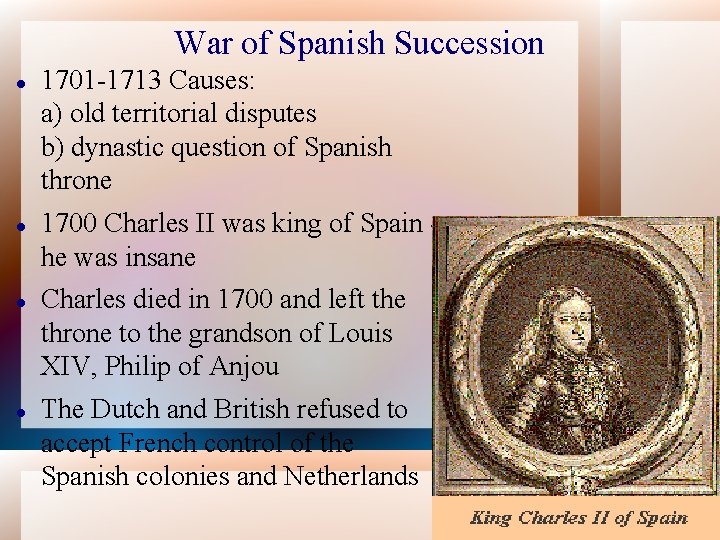
War of Spanish Succession 1701 -1713 Causes: a) old territorial disputes b) dynastic question of Spanish throne 1700 Charles II was king of Spain he was insane Charles died in 1700 and left the throne to the grandson of Louis XIV, Philip of Anjou The Dutch and British refused to accept French control of the Spanish colonies and Netherlands
War of Spanish Succession Continued English, Dutch, Austrian and Prussians formed the Grand Alliance Even though they were all fighting the French internal conflicts developed among the alliance Two soldiers dominated: Eugene, prince of Savoy representing the HRE John Churchill representing England
PEACE OF UTRECHT Philip of Anjou remains king of Spain and France must never unite France gave Austria Spanish Netherlands France gave England Nova Scotia, Hudson Bay, Newfoundland France recognizes the Hohenzollern rulers of Prussia Spain gave England Gibraltar Spain gave England -asiento- the rights to the slave trade
The Treaty Represented the balance of power principle Saw the decline of Spain Saw the rise of the British Empire Marked the end of French expansionism
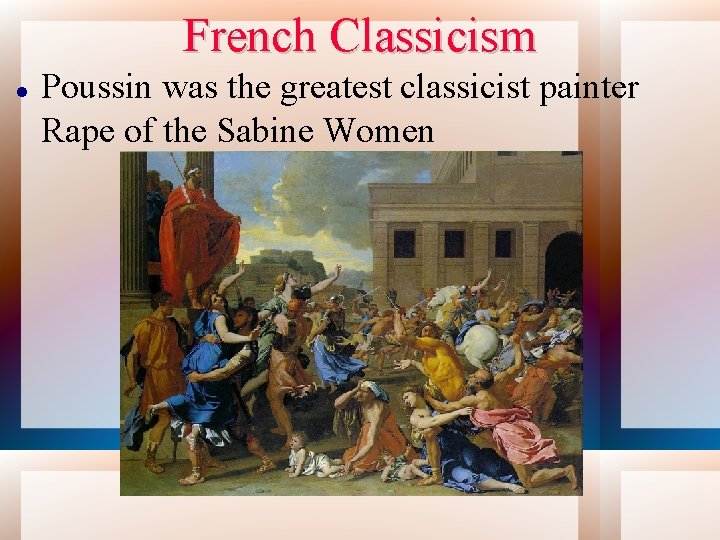
French Classicism Poussin was the greatest classicist painter Rape of the Sabine Women

Absolutism and Classicism Absolutism and Classicism melded Art glorified the king Lully, Couperin, and Charpentier created great orchestral works Moliere and Racine wrote powerful plays on controversial issues Les Femmes Savantes - Tartuffe, mocked intelligent women
- Slides: 25