
Freight Management DEFINITION OF FREIGHT According to Business
Freight Management

DEFINITION OF FREIGHT According to Business Dictionary. com, “Freights are charges paid for carriage or transportation of goods (cargo) by air, land, or sea”. Goods may be transported (shipped) on freight-prepaid or freight-collect basis: If the freight is paid by the consignor (as under C&F and CIF terms) the goods remain the consignor’s property until their delivery is taken by the consignee upon their arrival at the destination, and payment of the consignor’s invoice. If freight is paid by the consignee (as under FOB terms) the goods become the consignee’s property when handed-over to the carrier against a bill of lading. 2

Description Freight management system is to optimize the efficiency of commercial freight operations. It help in improving company’s communication and productivity.
Description The various features of a freight management include freight tracking system, • vehicle maintenance and repairs, • pallet tracking, • Proof of Delivery (POD) scanning, • drivers and subcontractors rating and payments, • Electronic Data Interchange (EDI) interfacing, • consignment entry, • consistent auto consignment pricing and • comprehensive operational reporting.
Scope Improve their delivery capabilities. Rapid increase in the demand of on-time delivery of products and raw materials Ensures warehouse efficiencies by decreasing time Another factor that is contributing to the growth of this market is rise in global trade.
PRINCIPLES OF FREIGHT RATES • Freight rates should cover the costs incurred in the general operation of the transport company and those particular costs, which are incurred in connection with a particular consignment, like certain special handling charges. • Freight rates for any mode of transport are based on the following principles: • 1) Total Cost. • a) Fixed Cost • b) Semi-Fixed Cost • c) Variable Cost • d) Variable Utilization • 2. Affordable • 3. Government Policy • 4. Reasonable Profit 6
• CONTRACT OF AFFREIGHTMENT • FREIGHT RATES OR TARIFF RATES • International Air Transport Association (IATA) 7
FREIGHT RATES TERMINOLOGY USED IN INTERNATIONAL SHIPMENTS • • • 1. General Cargo Rates The general cargo rate applies to a shipment of mixed products. 2. Specific Commodity Rates The specific commodity rate is applicable to the shipment of a specific product between specified ports. It is lower than the general cargo rate. In practice, most export goods are transported under this rate. • • 3. NES Rates • The NES (Not Elsewhere Specified) rate or the NOS (Not Otherwise Specified) rate, sometimes referred to innocently as the FAK rate (Freight All Kinds) rate, applies to a product that is not specifically listed in the tariff for a given route, i. e. , a product not found under the specific commodity or the general cargo classifications. This rate is higher than the specific commodity and the general cargo 8 rates.
• 4. Box Rates • Most ocean height in modern shipping is containerized. Hence, there is a trend towards the flat rate per container for FCL shipments, known as box rate, at times also referred to as FAK rate, instead of the weight or measure that is commonly applied in the LCL shipments. • The box rate is convenient in simplifying the freight cost calculation in consignments consisting of wide range of products. This rate is commonly used between the ocean carrier and the Non-Vessel Operating Common Carrier (NVOCC), large shipper (e. g. , the giant trading company), or large importer (e. g. , the chain store). 9
• 5. Through Freight Rates • The through freight rate is used in multi-modal transport and transshipment. It covers the specified route and mode(s) of transportation to the final destination. • • 6. Charter Rates • The charter rate used in the charter industry varies greatly among the charter operators. it is the lowest rate per weight or measure. The operator may offer a very low rate on a return trip in order to secure the cargo, e. g. , in the return trip from it voyage charter. 10
Types of Sea rates 1. Advance Freight - Payable in advance, before delivery of goods. 2. Lump sum Freight - Payable for use of whole or portion of a ship, calculated on actual cubic capacity of the ship offered. 3. Dead Freight - It is a damage claim for breach of contract by the charterer to furnish a full cargo to a ship. The ship owner is entitled to claim dead freight for unoccupied space. 4. Back Freight - Return of the goods constitutes back freight. 5. Prorate Freight - It arises when the cargo has been carried only part of the way and circumstances make it impossible to continue the voyage further – delivery made at the nearest port. 6. Ad Valorem Freight - It arises when cargo is assessed for rate purposes on a percentage of its value. 11
DETERMINATION OF FREIGHT RATES • • Nature and volume of cargo, Relationship of weight to the measurement, Competition from other carriers/conferences, Possibility of damage, pilferage, lighterage, Operational cost, Port charges and dues, Possibility of securing return cargo. 12
INCOTERMS ®
What are Incoterms? Incoterms are standard international “trade terms” (such as FCA, FOB and CIF), which enable exporters to quote prices that clearly allocate the costs and risks of international transport between seller and buyer.
Insurance responsibilities (under CIF and CIP) and responsibility for customs duties and formalities are also covered by Incoterms.
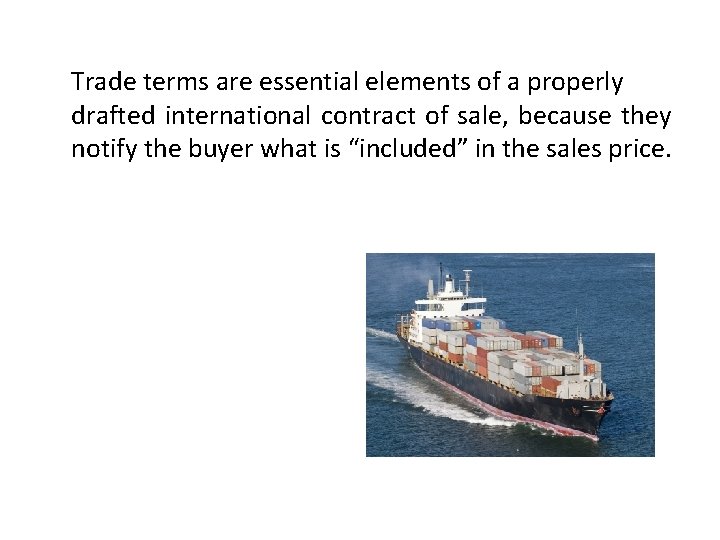
Trade terms are essential elements of a properly drafted international contract of sale, because they notify the buyer what is “included” in the sales price.
• In essence, Incoterms allocate the following key contract elements between seller and buyer: 1. Transport costs 2. Risk of loss or damage to the goods 3. Export and import customs clearance and payment of duties ( if any) 4. Insurance responsibilities
There actually 11 Incoterms® Rules for any mode of transport EXW (Ex Works) FCA (Free Carrier) CPT (Carriage Paid To) CIP (Carriage and Insurance Paid To) DAT (Delivered at Terminal) DAP (Delivered at Place) DDP (Delivered Duty Paid)
There actually 11 Incoterms® Rules appropriate when the point of delivery and the place to which the goods are carried are both port FAS (Free Alongside Ship) FOB (Free On Board) CFR (Cost and Freight) CIF (Cost Insurance and Freight
Ex Work • Ex Works” means that the seller delivers when it places the goods at the disposal of the buyer at the seller’s premises or at another named place (i. e. , works, factory, warehouse, etc. ). • The seller does not need to load the goods on any collecting vehicle, nor does it need to clear the goods for export, where such clearance is applicable. • The parties should precisely specify the point within the named place of delivery, as all costs and risks up that point are for the seller’s account. • The buyer thereafter bears all cost and risks of transport
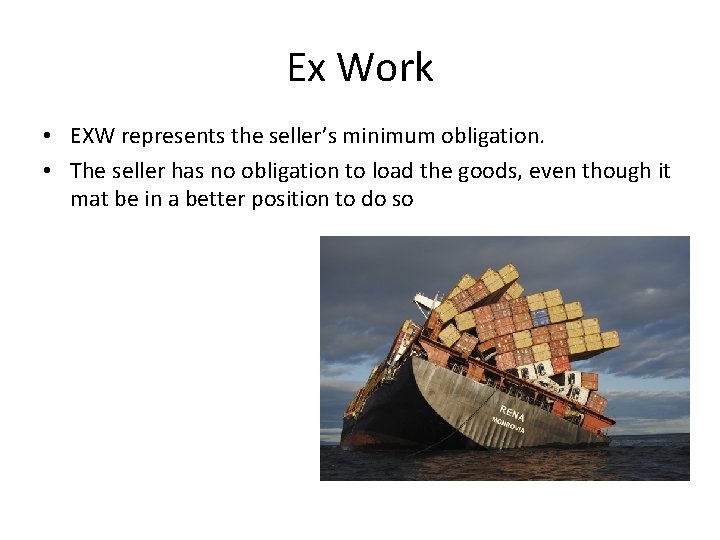
Ex Work • EXW represents the seller’s minimum obligation. • The seller has no obligation to load the goods, even though it mat be in a better position to do so
FCA – Free Carrier • “Free Carrier” means that the seller delivers the goods to the carrier or another person nominated by the buyer at the seller’s premises or another named place. • The parties are well advised to specify as clearly as possible the point within the named place of delivery, as the risk passes to the buyer at that point. • FCA requires the seller to clear the goods for export, where applicable.
CPT – Carriage Paid To • “Carriage Paid To” means that the seller delivers the goods to the carrier or another person nominated by the seller at an agreed place (if any such place is agreed between parties) and that the seller must contract for and pay the costs of carriage necessary to bring the goods to the named place of destination. • CPT requires the seller to clear the goods for export if necessary. However, the seller has no import clearance or duty obligation.
CIP – Carriege and Insurance Paid To • “Carriage and Insurance Paid to” means that the seller delivers the goods to the carrier or another person nominated by the seller at an agreed place (if any such place is agreed between parties) and that the seller must contract for and pay the costs of carriage necessary to bring the goods to the named place of destination.
CIP – Carriege and Insurance Paid To • The seller also contracts for insurance cover against the buyer’s risk of loss of or damage to the goods during the carriage. The buyer should note that under CIP the seller is required to obtain insurance only on minimum cover. • Should the buyer wish to have more insurance protection, it will need either to agree as much expressly with the seller or to make its own extra insurance arrangements. ”
DAT – Delivered At Terminal • “Delivered at Terminal” means that the seller delivers when the goods, once unloaded from the arriving means of transport, are placed at the disposal of the buyer at a named terminal at the named port or place of destination. • “Terminal” includes a place, whether covered or not, such as a quay, warehouse, container yard or road, rail or air cargo terminal. • The seller bears all risks involved in bringing the goods to and unloading them at the terminal at the named port or place of destination.
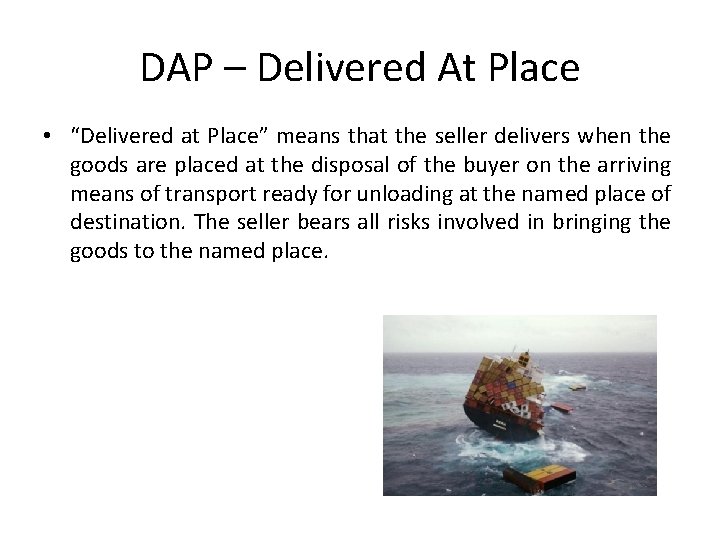
DAP – Delivered At Place • “Delivered at Place” means that the seller delivers when the goods are placed at the disposal of the buyer on the arriving means of transport ready for unloading at the named place of destination. The seller bears all risks involved in bringing the goods to the named place.
DDP – Delivered Duty Paid • “Delivered Duty Paid” means that the seller delivers the goods when the goods are placed at the disposal of the buyer, cleared for import on the arriving means of transport ready for unloading at the named place of destination. • The seller bears all the costs and risks involved in bringing the goods to the place of destination and has an obligation to clear the goods not only for export but also for import, to pay any duty for both export and import and to carry out all customs formalities.
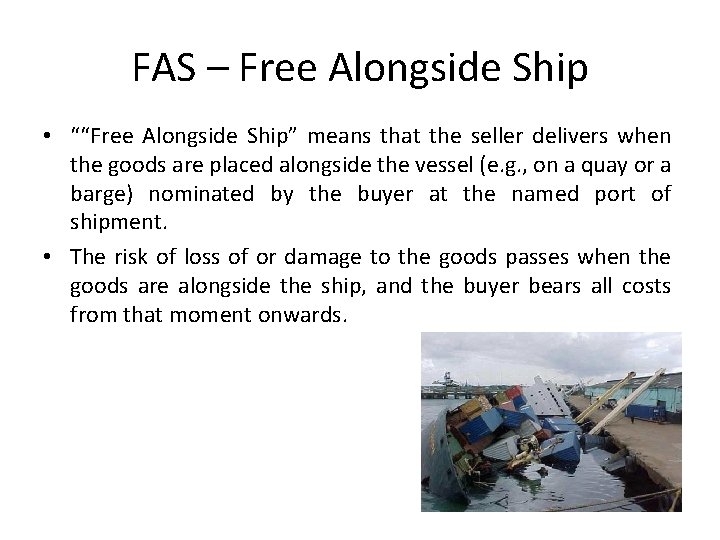
FAS – Free Alongside Ship • ““Free Alongside Ship” means that the seller delivers when the goods are placed alongside the vessel (e. g. , on a quay or a barge) nominated by the buyer at the named port of shipment. • The risk of loss of or damage to the goods passes when the goods are alongside the ship, and the buyer bears all costs from that moment onwards.
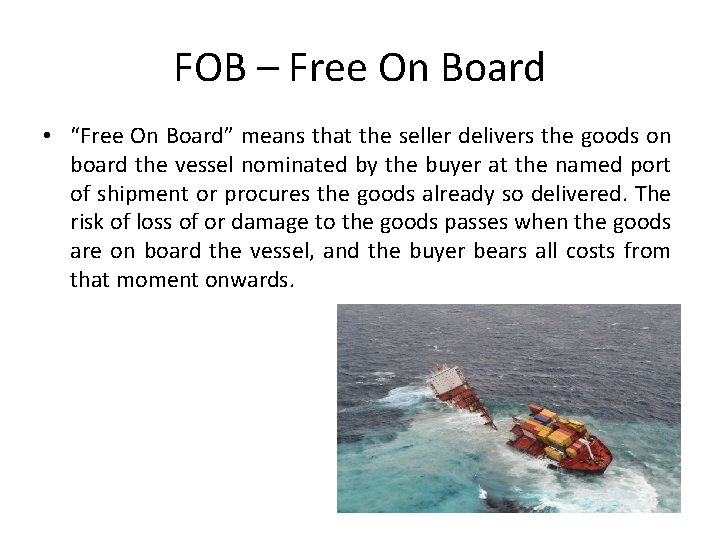
FOB – Free On Board • “Free On Board” means that the seller delivers the goods on board the vessel nominated by the buyer at the named port of shipment or procures the goods already so delivered. The risk of loss of or damage to the goods passes when the goods are on board the vessel, and the buyer bears all costs from that moment onwards.
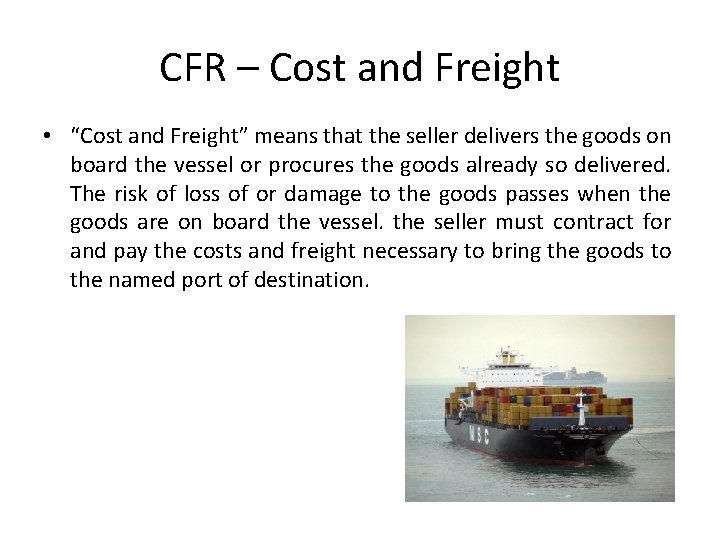
CFR – Cost and Freight • “Cost and Freight” means that the seller delivers the goods on board the vessel or procures the goods already so delivered. The risk of loss of or damage to the goods passes when the goods are on board the vessel. the seller must contract for and pay the costs and freight necessary to bring the goods to the named port of destination.
CIF – Cost insurance and Freight • “Cost, Insurance and Freight” means that the seller delivers the goods on board the vessel or procures the goods already so delivered. The risk of loss of or damage to the goods passes when the goods are on board the vessel. The seller must contract for and pay the costs and freight necessary to bring the goods to the named port of destination. •
CIF – Cost insurance and Freight • “Cost, Insurance and Freight” means that the seller delivers the goods on board the vessel or procures the goods already so delivered. The risk of loss of or damage to the goods passes when the goods are on board the vessel. The seller must contract for and pay the costs and freight necessary to bring the goods to the named port of destination. •
CIF – Cost insurance and Freight • The seller also contracts for insurance cover against the buyer’s risk of loss of or damage to the goods during the carriage. The buyer should note that under CIF the seller is required to obtain insurance only on minimum cover. Should the buyer wish to have more insurance protection, it will need either to agree as much expressly with the seller or to make its own extra insurance arrangements. ”
FLEET MANAGEMENT 35
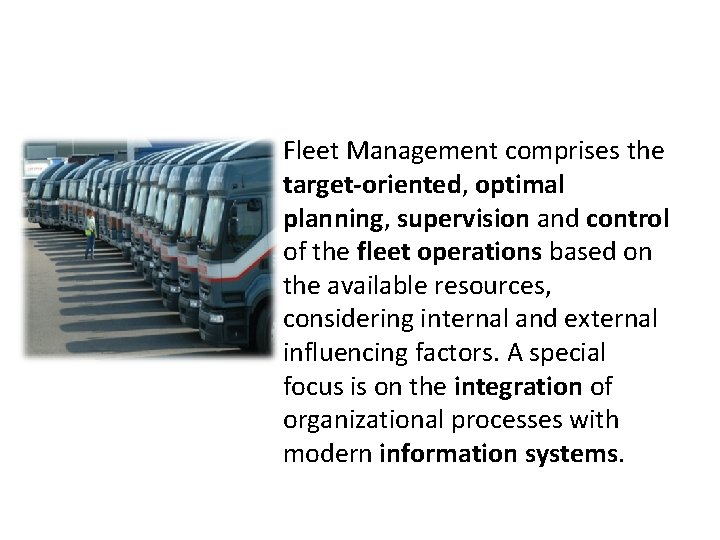
Fleet Management comprises the target-oriented, optimal planning, supervision and control of the fleet operations based on the available resources, considering internal and external influencing factors. A special focus is on the integration of organizational processes with modern information systems.
Fields of application Object tracking (vehicle tracking) Health and safety tracking Fuel and speed management Sales order transmission Route planning Driver Management Vehicle diagnostics
Routing and scheduling of vehicles. Issues: 1. How should deliveries be grouped to form routes. 2. What is the best delivery sequence for serving the customers. 3. Which route should be assigned to which customer. 38
Route Planning - Definition • Route Planning serves to arrange different transport orders to tours of a vehicle fleet. • The most known Route Planning problems are: – The Travelling Salesman Problem (TSP) (only one vehicle!) – the Vehicle Routing Problem (VRP) – the Pickup and Delivery Problem (PDP)
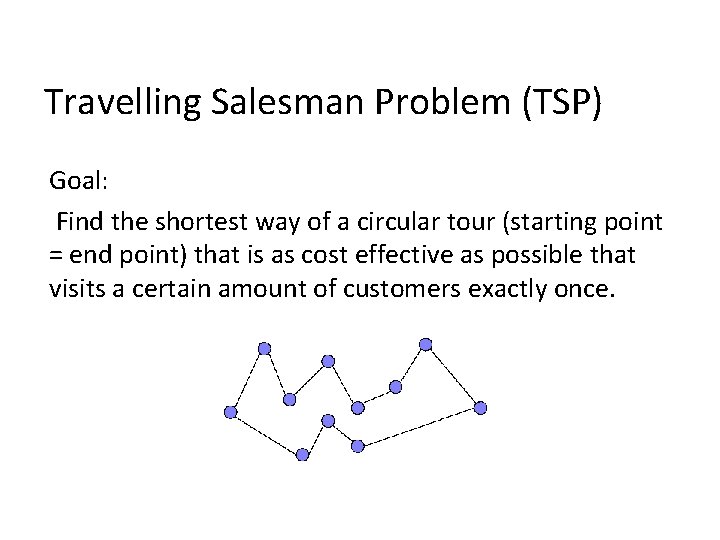
Travelling Salesman Problem (TSP) Goal: Find the shortest way of a circular tour (starting point = end point) that is as cost effective as possible that visits a certain amount of customers exactly once.
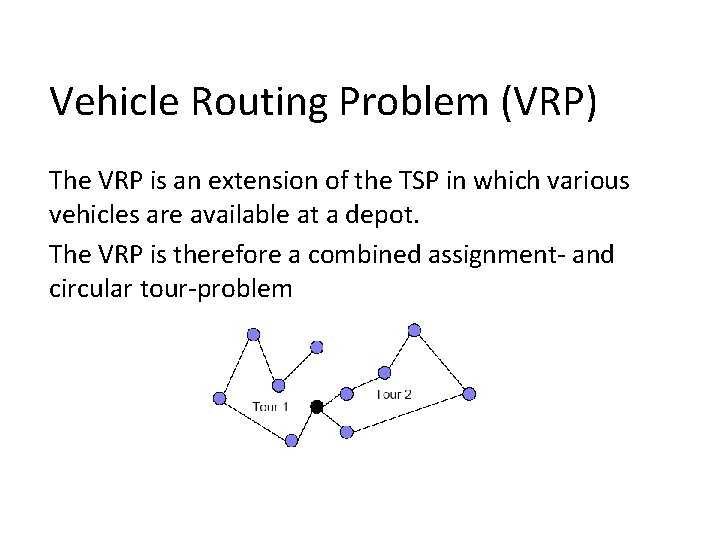
Vehicle Routing Problem (VRP) The VRP is an extension of the TSP in which various vehicles are available at a depot. The VRP is therefore a combined assignment- and circular tour-problem
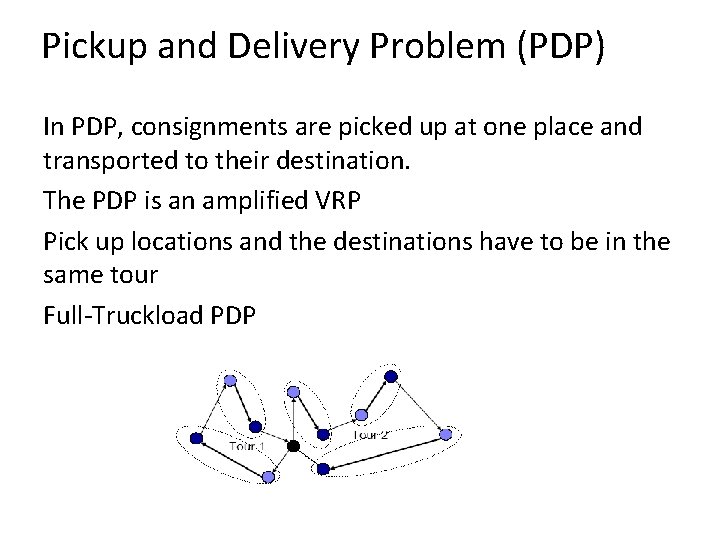
Pickup and Delivery Problem (PDP) In PDP, consignments are picked up at one place and transported to their destination. The PDP is an amplified VRP Pick up locations and the destinations have to be in the same tour Full-Truckload PDP
Transportation Administration 1. Operations Management 2. Freight Consolidation 3. Rate negotiation 4. Freight Control 43
1. Operations Management • Vehicle Scheduling • Load planning • Routing • Carrier Management. 44
2. Freight Consolidation • Economies of scale • Economies of Distance Consolidation happens… • Consolidating Orders • Scheduled delivery • Pooled delivery 45
3. Rate negotiation Win win situation. Different strategies are used. Long term association is important. 4. Freight Control Tracking and expending the carriers. Use of IT. . 46
Location-Tracking Location-tracking helps companies to § § § streamline and control supply chains move products to the market faster monitor assets prevent inventory loss track vehicle fleets Companies must consider how to track inventory § in a smaller area § across a wide area
Tracking Technologies Location tracking is not one, single technology. Local Area & Indoor Tracking – RFID: Small, battery-less microchips is attached to consumer goods, vehicles, objects to track movements. Wide Area Tracking – GPS: Signals received from Satellites to track movements of objects moving great distances.
- Slides: 48