
FreezeTCP a true endtoend TCP enhancement mechanism for
- Slides: 28
Freeze-TCP: a true end-to-end TCP enhancement mechanism for mobile environments Goff, T. ; Moronski, J. ; Phatak, D. S. ; Gupta, V. INFOCOM 2000 Lee Hyo Jin 2001 Fall Mobile Networks 발표자료 Nov/28/2001 Prof. Young-Joo Suh Postech DP&NM Lab
Reference • Tom Goff et el, "Freeze-TCP: A True End-to-End TCP Enhancement Mechanism for Mobile Environments, " INFOCOM'00. • K. Brown and S. Singh, “M-TCP: TCP for Mobile Cellular Networks, ” ACM Computer Communications Review (CCR), vol. 27, no. 5, 1997. • Ajay Bakre and B. R. Badrinath, “I-TCP: Indirect TCP for mobile hosts, ” Tech. Rep. , Rutgers University, May 1995, Freeze-TCP (2) Postech DP&NM Lab
Contents • • Introduction. Requirement Key concepts. TCP window management. Introduce to existing solutions. Details of Freeze-TCP. Experimental result. Conclusion and Discussion. Freeze-TCP (3) Postech DP&NM Lab
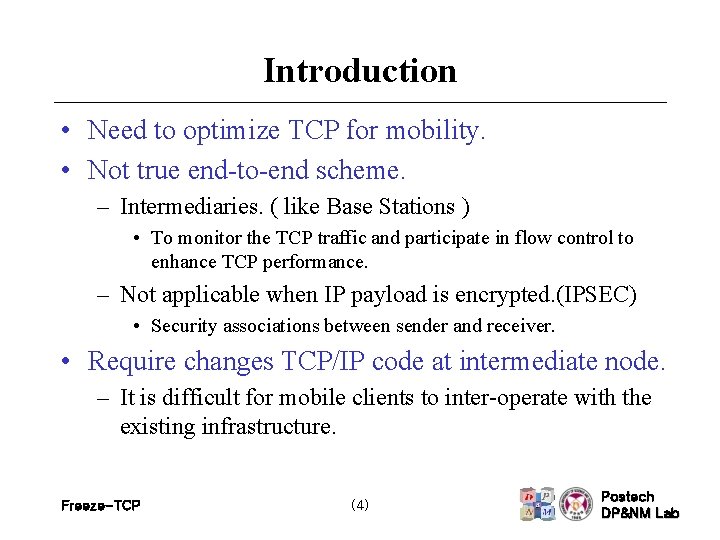
Introduction • Need to optimize TCP for mobility. • Not true end-to-end scheme. – Intermediaries. ( like Base Stations ) • To monitor the TCP traffic and participate in flow control to enhance TCP performance. – Not applicable when IP payload is encrypted. (IPSEC) • Security associations between sender and receiver. • Require changes TCP/IP code at intermediate node. – It is difficult for mobile clients to inter-operate with the existing infrastructure. Freeze-TCP (4) Postech DP&NM Lab
Requirements • True end to end scheme. • Interoperate existing infrastructure. – TCP code must change in mobile client (MH) • Need to performance enhancement. We need a new scheme. Freeze-TCP (5) Postech DP&NM Lab
Key Concepts • • • No help with base stations in hand-off. To detect an impending handoff at client. ( MH ) ZWA(MH): zero window advertisement. ZWP (FH) : zero window probes. TR-ACKs : Triplicate acks. • True end to end semantics. • Performance enhancement. Freeze-TCP (6) Postech DP&NM Lab
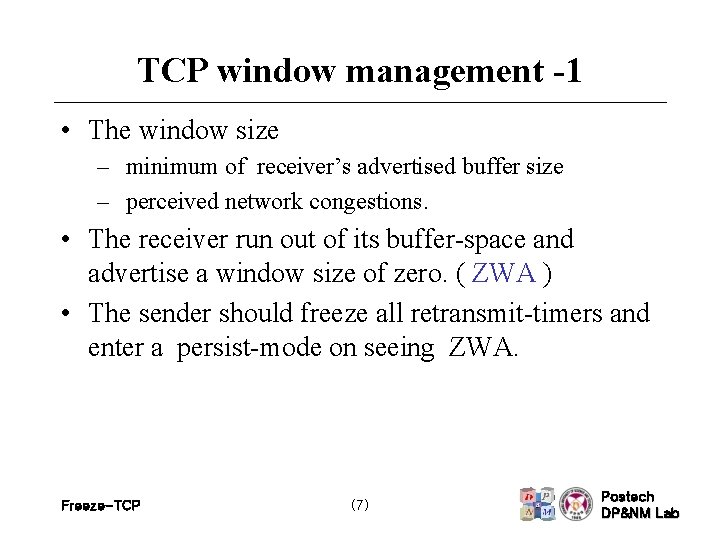
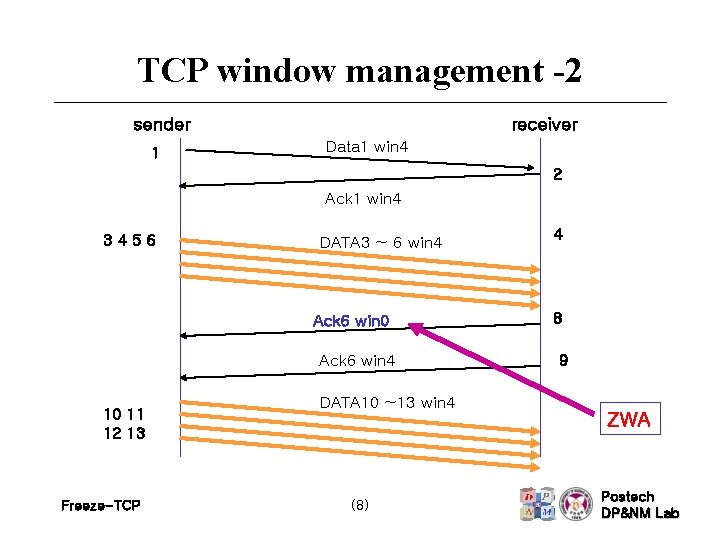
TCP window management -1 • The window size – minimum of receiver’s advertised buffer size – perceived network congestions. • The receiver run out of its buffer-space and advertise a window size of zero. ( ZWA ) • The sender should freeze all retransmit-timers and enter a persist-mode on seeing ZWA. Freeze-TCP (7) Postech DP&NM Lab
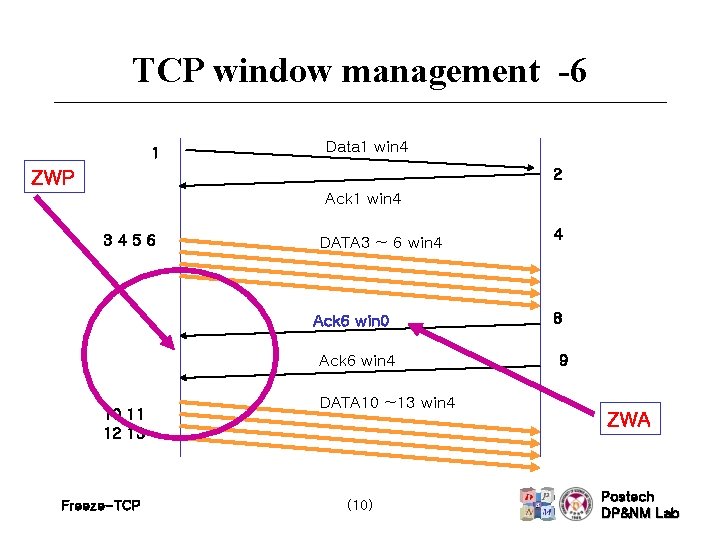
TCP window management -2 sender 1 receiver Data 1 win 4 2 Ack 1 win 4 3456 DATA 3 ~ 6 win 4 Ack 6 win 0 Ack 6 win 4 10 11 12 13 Freeze-TCP DATA 10 ~13 win 4 (8) 4 8 9 ZWA Postech DP&NM Lab
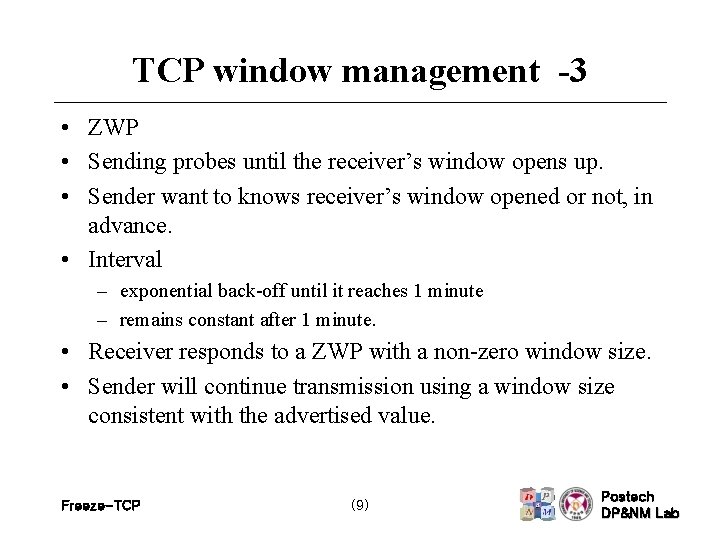
TCP window management -3 • ZWP • Sending probes until the receiver’s window opens up. • Sender want to knows receiver’s window opened or not, in advance. • Interval – exponential back-off until it reaches 1 minute – remains constant after 1 minute. • Receiver responds to a ZWP with a non-zero window size. • Sender will continue transmission using a window size consistent with the advertised value. Freeze-TCP (9) Postech DP&NM Lab
TCP window management -6 1 Data 1 win 4 2 ZWP Ack 1 win 4 3456 DATA 3 ~ 6 win 4 Ack 6 win 0 Ack 6 win 4 10 11 12 13 Freeze-TCP DATA 10 ~13 win 4 (10) 4 8 9 ZWA Postech DP&NM Lab
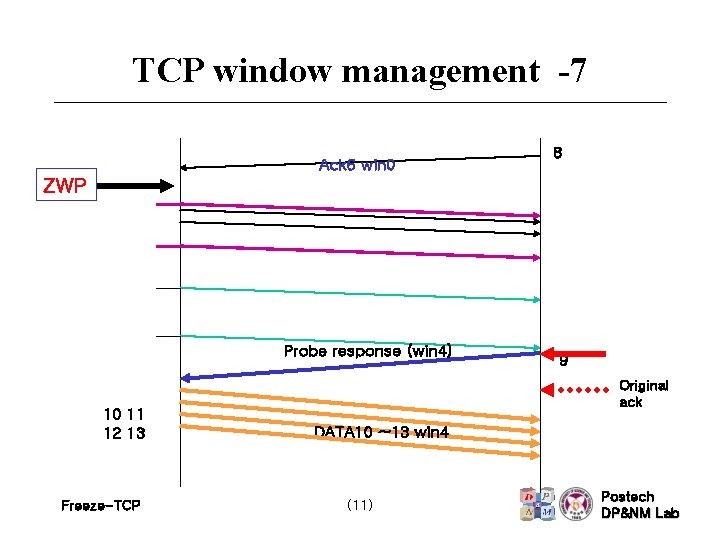
TCP window management -7 Ack 6 win 0 8 ZWP Probe response (win 4) 10 11 12 13 Freeze-TCP 9 Original ack DATA 10 ~13 win 4 (11) Postech DP&NM Lab
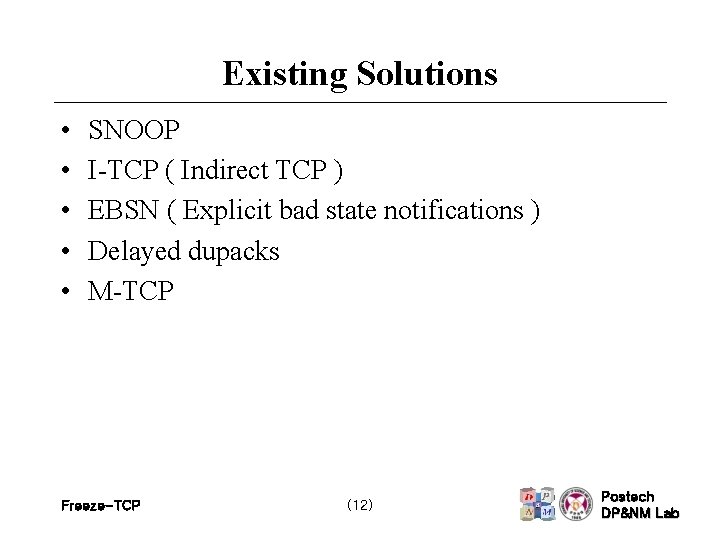
Existing Solutions • • • SNOOP I-TCP ( Indirect TCP ) EBSN ( Explicit bad state notifications ) Delayed dupacks M-TCP Freeze-TCP (12) Postech DP&NM Lab
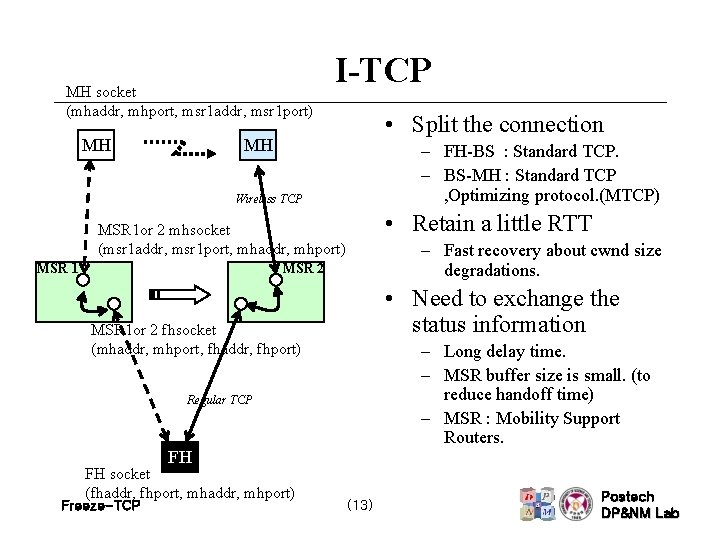
MH socket (mhaddr, mhport, msr 1 addr, msr 1 port) MH I-TCP • Split the connection MH – FH-BS : Standard TCP. – BS-MH : Standard TCP , Optimizing protocol. (MTCP) Wireless TCP • Retain a little RTT MSR 1 or 2 mhsocket (msr 1 addr, msr 1 port, mhaddr, mhport) MSR 1 – Fast recovery about cwnd size degradations. MSR 2 • Need to exchange the status information MSR 1 or 2 fhsocket (mhaddr, mhport, fhaddr, fhport) – Long delay time. – MSR buffer size is small. (to reduce handoff time) – MSR : Mobility Support Routers. Regular TCP FH FH socket (fhaddr, fhport, mhaddr, mhport) Freeze-TCP (13) Postech DP&NM Lab
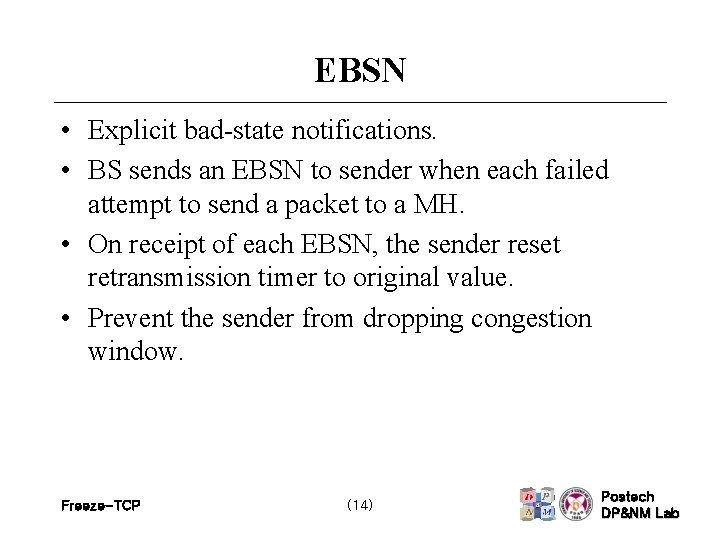
EBSN • Explicit bad-state notifications. • BS sends an EBSN to sender when each failed attempt to send a packet to a MH. • On receipt of each EBSN, the sender reset retransmission timer to original value. • Prevent the sender from dropping congestion window. Freeze-TCP (14) Postech DP&NM Lab
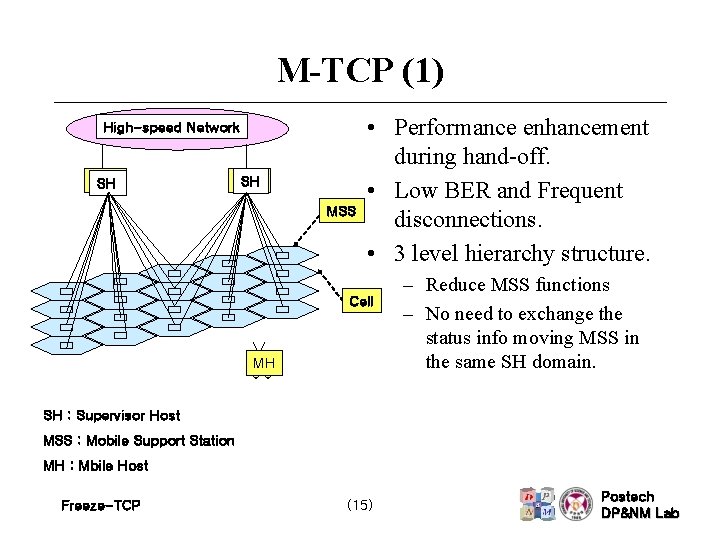
M-TCP (1) High-speed Network SH SH MSS • Performance enhancement during hand-off. • Low BER and Frequent disconnections. • 3 level hierarchy structure. Cell MH – Reduce MSS functions – No need to exchange the status info moving MSS in the same SH domain. SH : Supervisor Host MSS : Mobile Support Station MH : Mbile Host Freeze-TCP (15) Postech DP&NM Lab
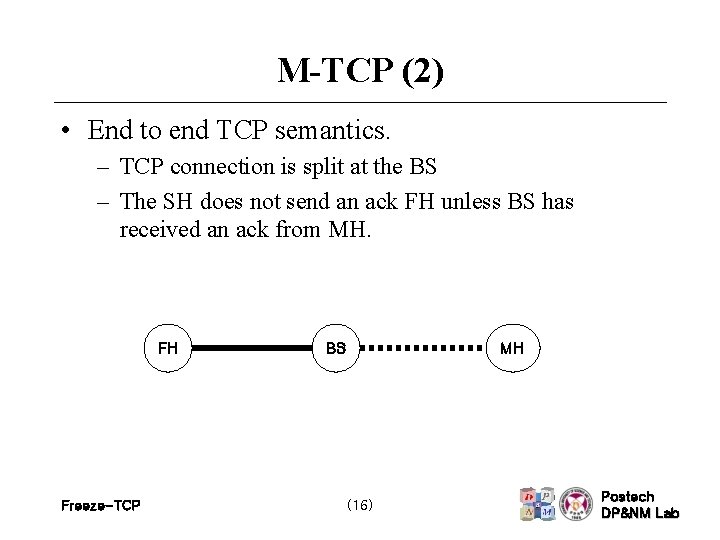
M-TCP (2) • End to end TCP semantics. – TCP connection is split at the BS – The SH does not send an ack FH unless BS has received an ack from MH. FH Freeze-TCP BS MH (16) Postech DP&NM Lab
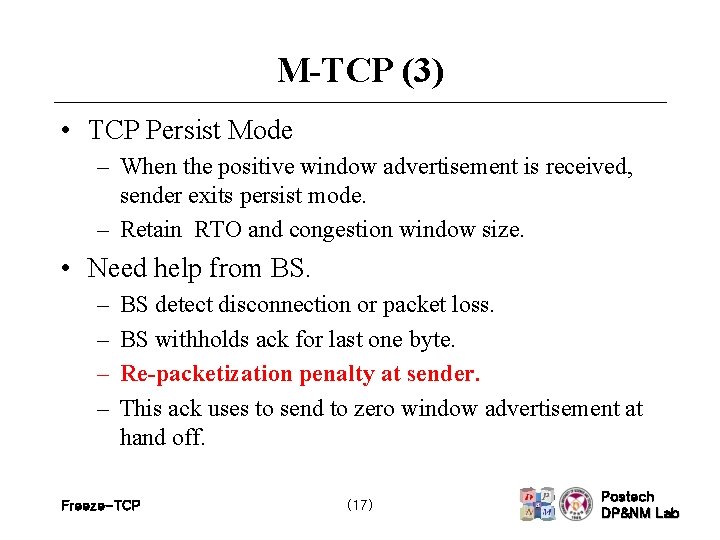
M-TCP (3) • TCP Persist Mode – When the positive window advertisement is received, sender exits persist mode. – Retain RTO and congestion window size. • Need help from BS. – – BS detect disconnection or packet loss. BS withholds ack for last one byte. Re-packetization penalty at sender. This ack uses to send to zero window advertisement at hand off. Freeze-TCP (17) Postech DP&NM Lab
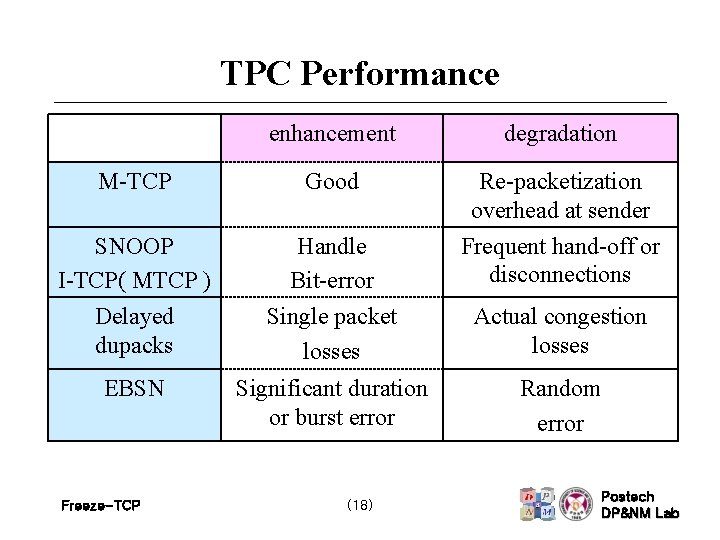
TPC Performance enhancement degradation M-TCP Good Re-packetization overhead at sender SNOOP I-TCP( MTCP ) Handle Bit-error Frequent hand-off or disconnections Delayed dupacks Single packet losses Actual congestion losses EBSN Significant duration or burst error Random error Freeze-TCP (18) Postech DP&NM Lab
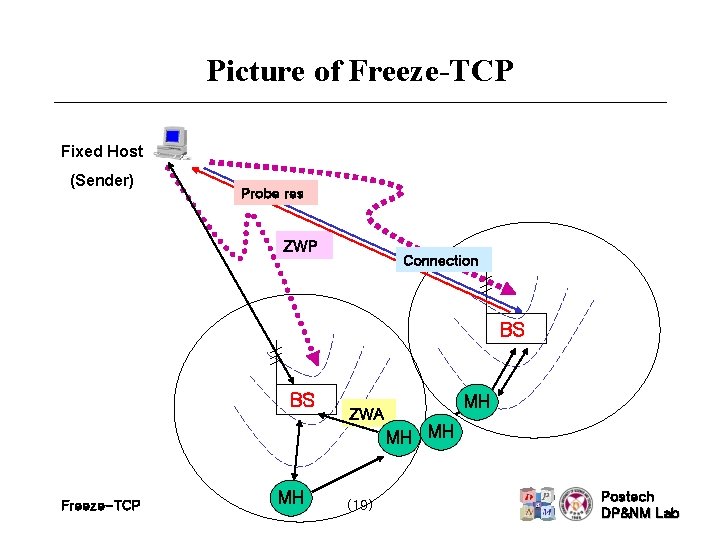
Picture of Freeze-TCP Fixed Host (Sender) Probe res ZWP Connection BS BS Freeze-TCP MH ZWA (19) MH MH MH Postech DP&NM Lab
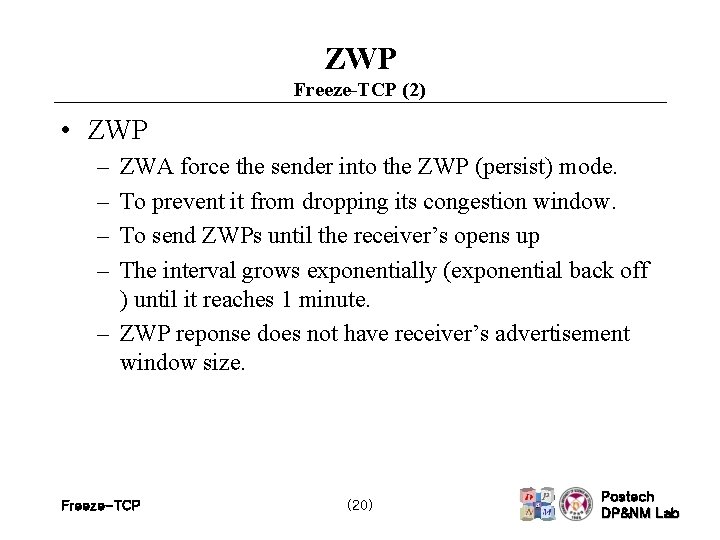
ZWP Freeze-TCP (2) • ZWP – – ZWA force the sender into the ZWP (persist) mode. To prevent it from dropping its congestion window. To send ZWPs until the receiver’s opens up The interval grows exponentially (exponential back off ) until it reaches 1 minute. – ZWP reponse does not have receiver’s advertisement window size. Freeze-TCP (20) Postech DP&NM Lab
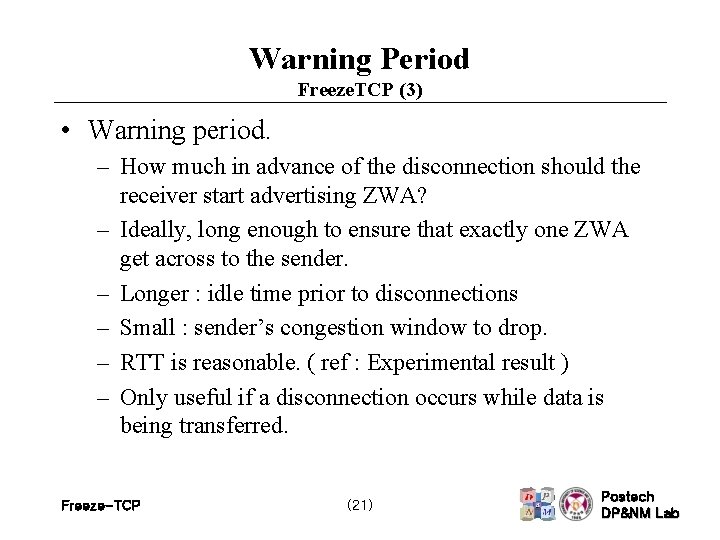
Warning Period Freeze. TCP (3) • Warning period. – How much in advance of the disconnection should the receiver start advertising ZWA? – Ideally, long enough to ensure that exactly one ZWA get across to the sender. – Longer : idle time prior to disconnections – Small : sender’s congestion window to drop. – RTT is reasonable. ( ref : Experimental result ) – Only useful if a disconnection occurs while data is being transferred. Freeze-TCP (21) Postech DP&NM Lab
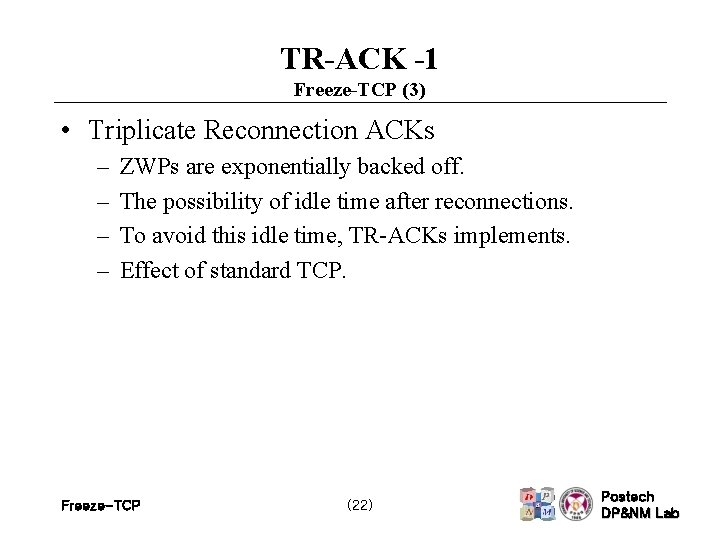
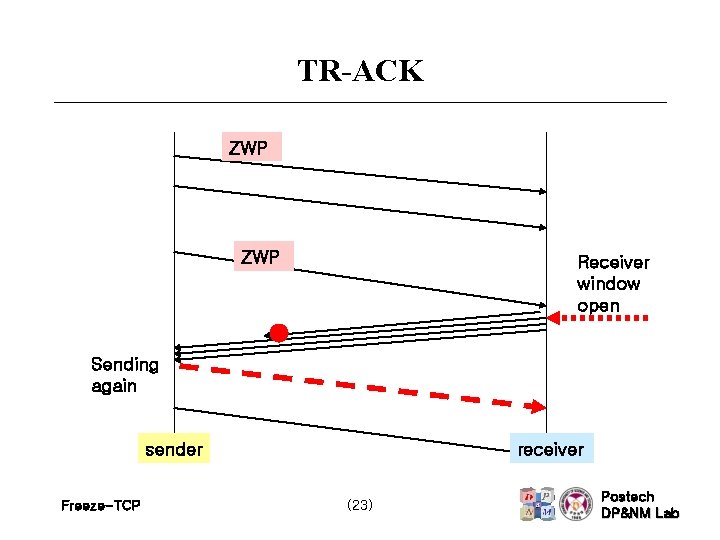
TR-ACK -1 Freeze-TCP (3) • Triplicate Reconnection ACKs – – ZWPs are exponentially backed off. The possibility of idle time after reconnections. To avoid this idle time, TR-ACKs implements. Effect of standard TCP. Freeze-TCP (22) Postech DP&NM Lab
TR-ACK ZWP Receiver window open Sending again sender Freeze-TCP receiver (23) Postech DP&NM Lab
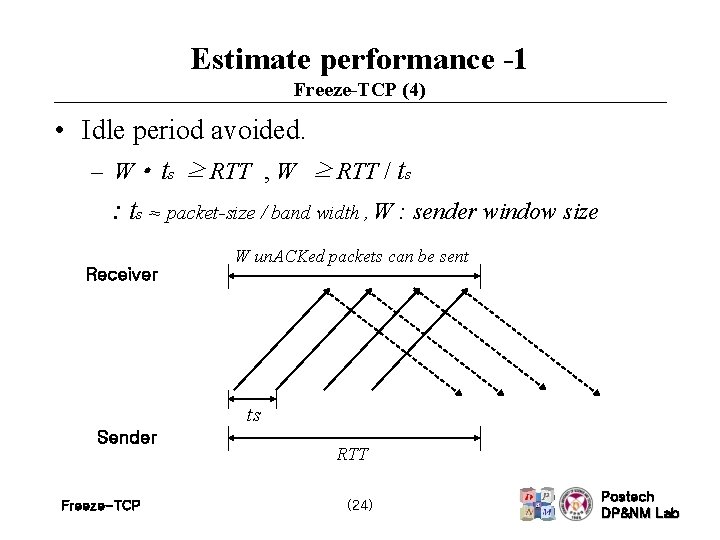
Estimate performance -1 Freeze-TCP (4) • Idle period avoided. – W • ts ≥ RTT , W ≥ RTT / ts : ts ≈ packet-size / band width , W : sender window size Receiver W un. ACKed packets can be sent ts Sender Freeze-TCP RTT (24) Postech DP&NM Lab
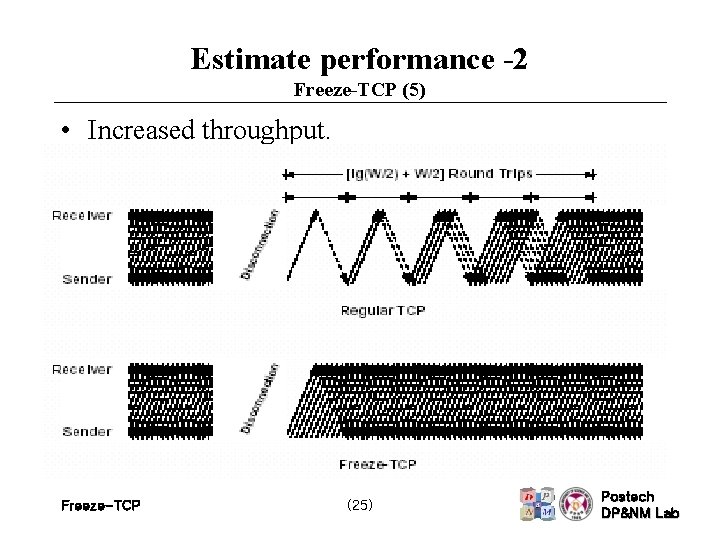
Estimate performance -2 Freeze-TCP (5) • Increased throughput. Freeze-TCP (25) Postech DP&NM Lab
Experimental result • Modifying the Linux 2. 1. 101 TCP source code. • Emulate the mobile host in a PC. • Freeze-TCP is not worsen performance by a noticeable amount. Freeze-TCP (26) Postech DP&NM Lab
Conclusion and Discussion -1 • To enhance TCP performance in the present of disconnections and reconnections. • True end-to-end signaling scheme. • Unnecessary intermediaries’s help. • Easy changing TCP code at receiver side • Easy to implement. • Almost no overheads and tradeoffs. • Complete inter-operability with existing infrastructure is guaranteed. Freeze-TCP (27) Postech DP&NM Lab
Conclusion and Discussion -2 • Full rate with old window size on entering new unknown environment or not. • Needs at receiver to predict impending disconnections. ( pro-active action/simulations ) Freeze-TCP (28) Postech DP&NM Lab