
Freehand Sketching Introduction to Mechanical Engineering Fall 2004
- Slides: 19
Freehand Sketching Introduction to Mechanical Engineering Fall 2004 Created by: P. M. Larochelle & J. S. Ketchel
Freehand Sketching l Ideation – Integral to the design process – l l l Generation of design concepts to solve a design problem Usually freehand sketching is used to explore, study and communicate these design concepts Even today, and for the foreseeable future, many great design ideas are communicated via freehand sketching The “BEST” design engineers can immediately communicate an idea via a freehand sketch
Freehand Sketching l Required – l Pencil, Paper and Eraser Do not use – Straight edges, templates, compasses etc. They slow down the process and defeat the purpose of fast communication of ideas!
Freehand Sketching l l Sketches are planned Visualize the sketch – – Size of paper & scale Orientation of the object Minimum detail to communicate the idea Type of sketch l l l Oblique Isometric Orthographic
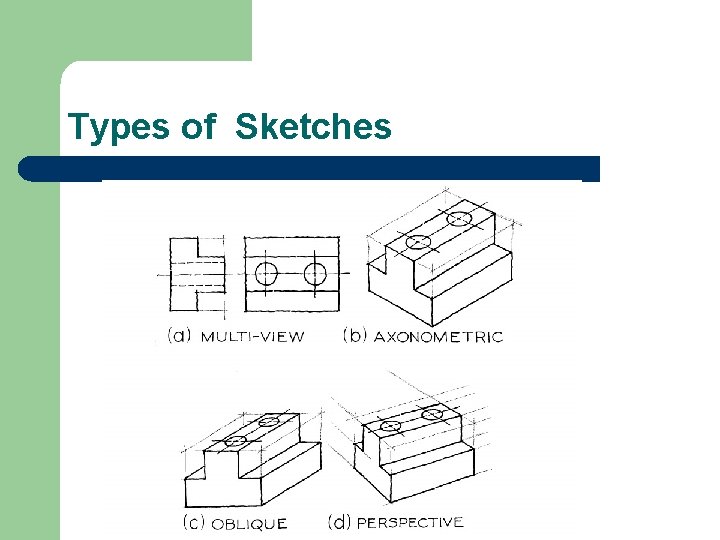
Types of Sketches
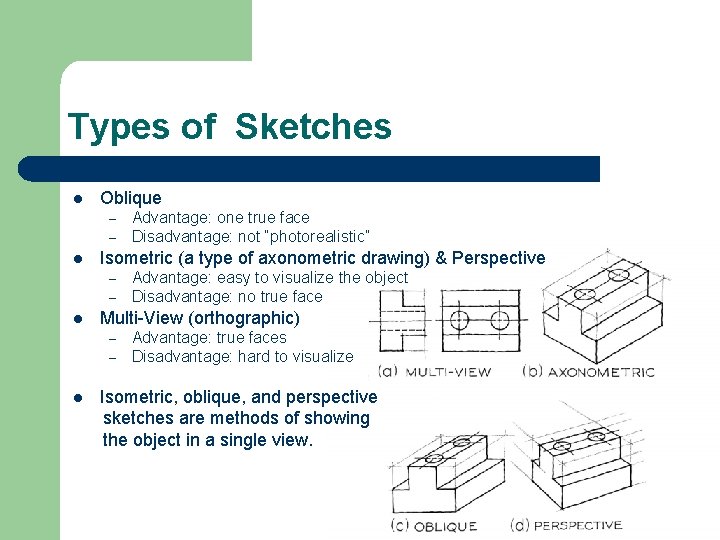
Types of Sketches l Oblique – – l Isometric (a type of axonometric drawing) & Perspective – – l Advantage: easy to visualize the object Disadvantage: no true face Multi-View (orthographic) – – l Advantage: one true face Disadvantage: not “photorealistic” Advantage: true faces Disadvantage: hard to visualize Isometric, oblique, and perspective sketches are methods of showing the object in a single view.
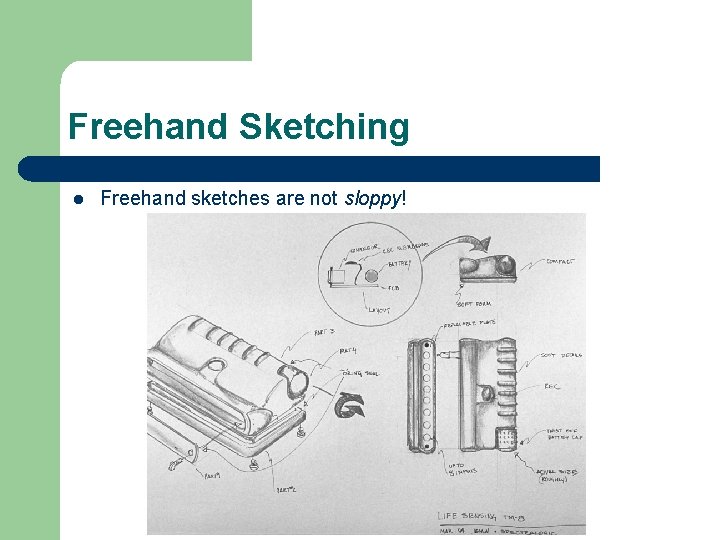
Freehand Sketching l Freehand sketches are not sloppy!
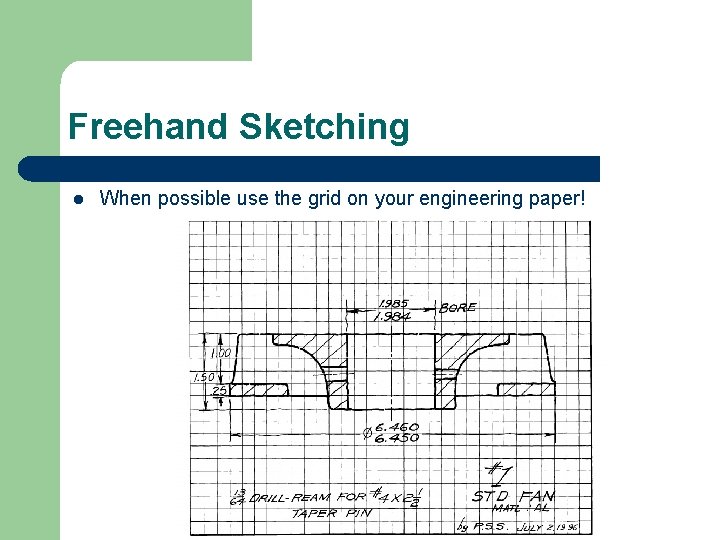
Freehand Sketching l When possible use the grid on your engineering paper!
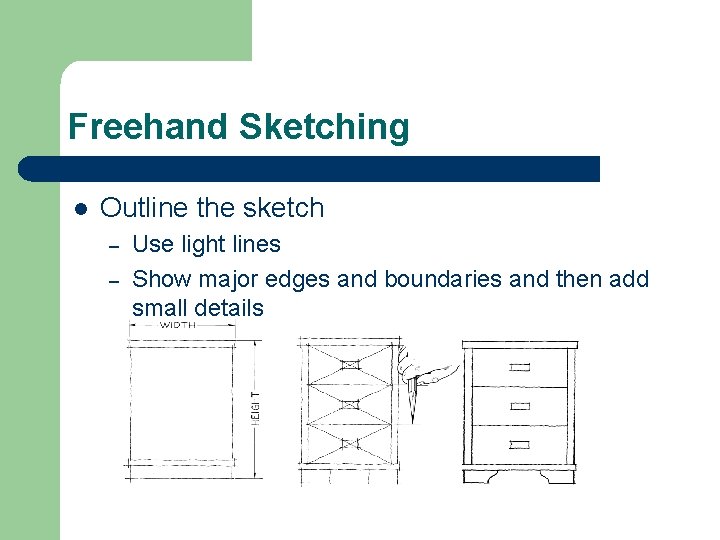
Freehand Sketching l Outline the sketch – – Use light lines Show major edges and boundaries and then add small details
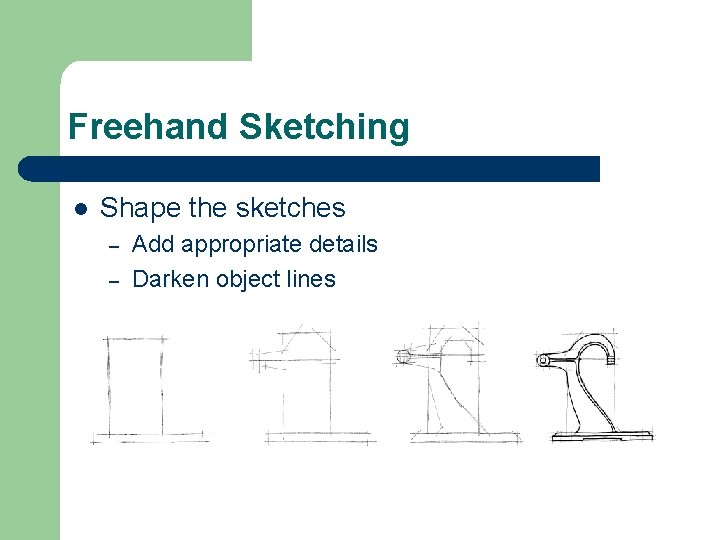
Freehand Sketching l Shape the sketches – – Add appropriate details Darken object lines
Freehand Sketching l Fundamental Rule of Sketching – l l Maintain Proportion Hints: use standard techniques to draw lines and arcs Lines – – – Locate a start “dot” Locate an end “dot” Put pencil on start dot, look at the end dot and smoothly move pencil toward the end dot
Freehand Sketching l Circles (arcs) – – Draw light horizontal and vertical lines that intersect at the center Lightly mark the radius on the lines Connect the radius marks with arcs to complete the circle See Step-by-Step 3. 1& 3. 3 on pages 60 & 62.
Construction Lines l l l Light and thin lines Serve as path for final straight lines Intersection of construction lines specify the length of the final lines Points marked by the intersection of construction lines serve as guides for sketching of arcs and circles Guide the proportion of the sketch
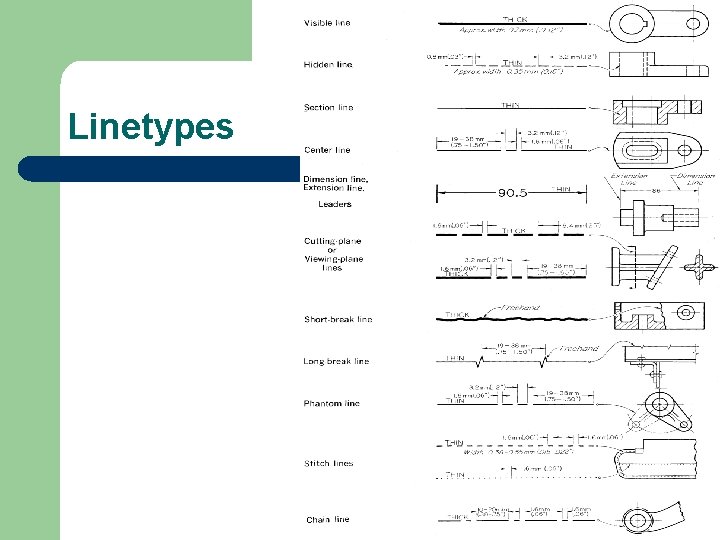
Linetypes
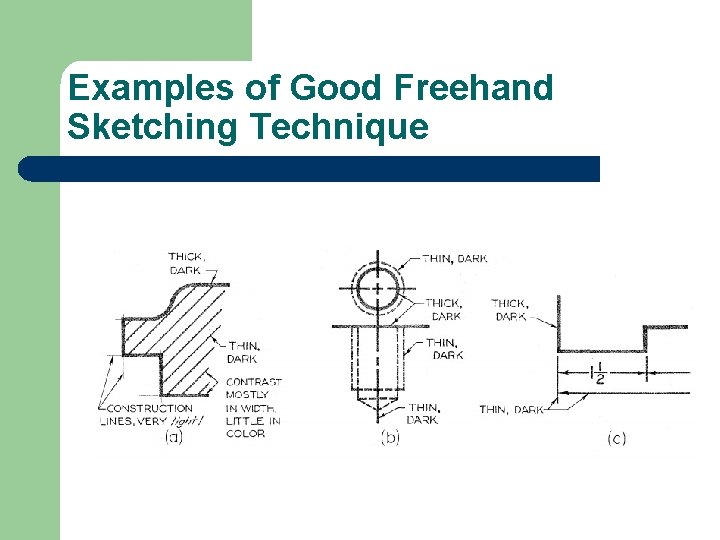
Examples of Good Freehand Sketching Technique
Oblique Sketching l l Step 1 – Draw the horizontal and vertical construction lines which outline the basic shape of the main face - “Blocking in” Step 2 – Sketch the face of the part Step 3 – Sketch receding construction lines at 30 or 45 degrees Step 4 – Sketch- in and darken the lines outlining the part – Done!
Isometric Sketching l Step 1 – Construct a horizontal line, two lines at 30 degrees above the horizontal and a vertical line through their intersection – This defines the isometric axes used to draw the sketch
Isometric Sketching l l Step 2 – Sketch in a box to “block-in” the front face and the other faces follow Step 3 – Sketch the outline of the front face in it’s “block” and the other faces follow – Work parallel to the isometric axes
References l l Chapter 3 of Modern Graphics Communication by Giesecke, Mitchell, Spencer, Hill, Dygdon, Novak, and Lockhard, 3 rd edition. Prentice-Hall, 2004. Technical Drawing by Giesecke, Mitchell, Spencer, Hill, Dygdon, and Novak, 9 th edition. Macmillan, 1991.