
Freedom of Information Act Exemptions Overview 1 As
- Slides: 42
Freedom of Information Act Exemptions Overview 1
As the Supreme Court has held, “disclosure not secrecy, is the dominant objective” of the FOIA. 2
At the same time, not all records can be released under the FOIA. Congress established nine categories of information that are not required to be released because release would be harmful to governmental or private interests. 3
In creating these exemptions, Congress sought to create a “workable balance” between the public’s right to know and the government’s need to protect certain information. 4
An agency can withhold information under an exemption only if the agency “reasonably foresees that disclosure would harm an interest protected by [that] exemption” or if disclosure is prohibited by law. 5
Exemption 1 Protects properly classified information 6
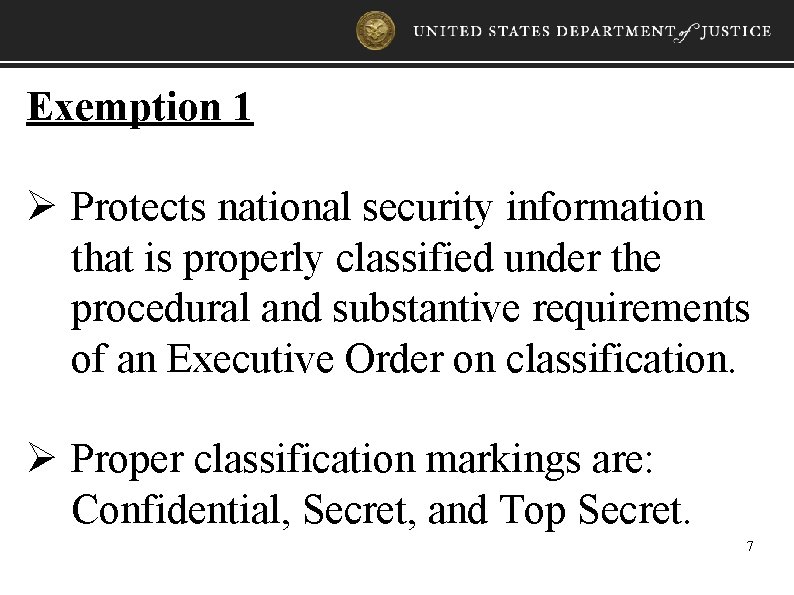
Exemption 1 Ø Protects national security information that is properly classified under the procedural and substantive requirements of an Executive Order on classification. Ø Proper classification markings are: Confidential, Secret, and Top Secret. 7
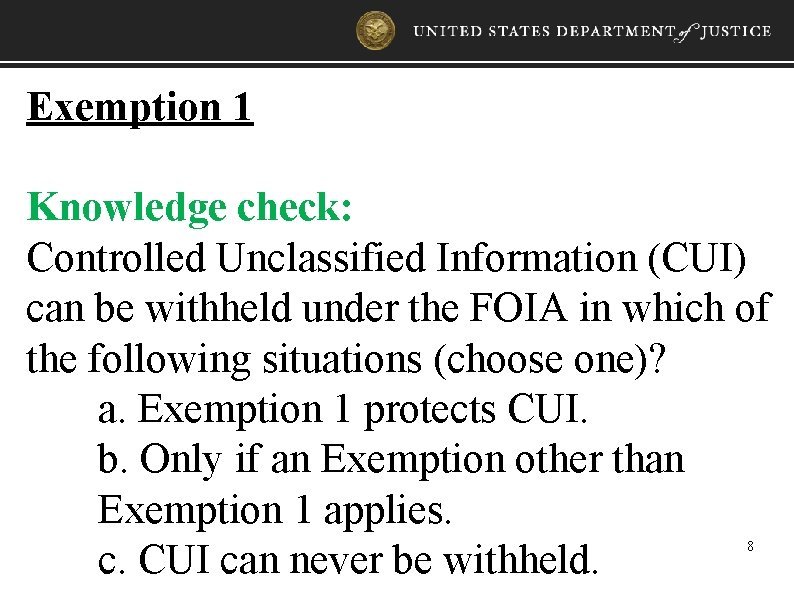
Exemption 1 Knowledge check: Controlled Unclassified Information (CUI) can be withheld under the FOIA in which of the following situations (choose one)? a. Exemption 1 protects CUI. b. Only if an Exemption other than Exemption 1 applies. c. CUI can never be withheld. 8
Exemption 2 Protects records that are “related solely to the internal personnel rules and practices of an agency” 9
Exemption 2 1) Information must be related to “personnel” rules/practices; 2) Information must relate “solely” to those rules; and, 3) Information must be “internal. ” 10
Exemption 3 Protects information that has been “specifically exempted from disclosure by statute” 11
Exemption 3 What can qualify as a “statute” under Exemption 3? ØCertain Federal Statutes ØFederal Rules of Procedure enacted into law by Congress ØCertain Self-Executing Treaties 12
Exemption 3 Ø Subpart A(i) – Absolute prohibition on disclosure – no agency discretion. Ø Subpart A(ii) – Limited prohibition on disclosure a) statute defines particular matters to be withheld; or b) statute provides specific criteria for withholding 13
Exemption 3 OPEN FOIA Act of 2009 Ø Any statute enacted after the effective date of the OPEN FOIA Act of 2009 (October 28, 2009) must also specifically reference Exemption 3 of the FOIA. 14
Exemption 3 Two-Part Analysis 1. Whether the withholding statute qualifies as an Exemption 3 statute; and 2. Whether the records fall within the statute’s scope. 15
Exemption 3 Resources ØExemption 3 Chapter of the Department of Justice Guide to FOIA https: //www. justice. gov/oip/foiaguide/exemption_3/download ØStatutes Found to Qualify Under Exemption 3 https: //www. justice. gov/oip/foia-resources#s 4 ØList of Exemption 3 Statutes cited by Federal 16 Agencies in Fiscal Year 2017 https: //www. justice. gov/oip/foiaresources/fy 17 statutes/ download#FY%202017
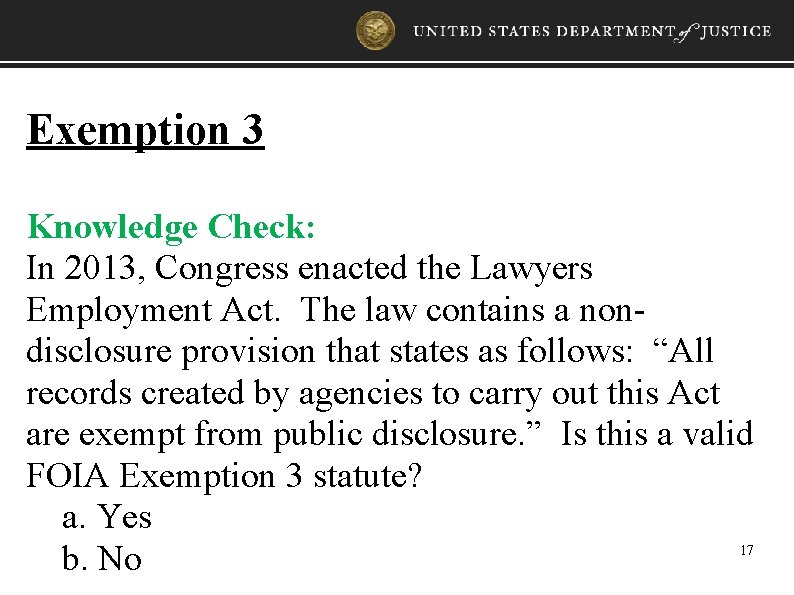
Exemption 3 Knowledge Check: In 2013, Congress enacted the Lawyers Employment Act. The law contains a nondisclosure provision that states as follows: “All records created by agencies to carry out this Act are exempt from public disclosure. ” Is this a valid FOIA Exemption 3 statute? a. Yes b. No 17
Exemption 4 Protects trade secrets or commercial or financial information obtained from a person that is privileged or confidential 18
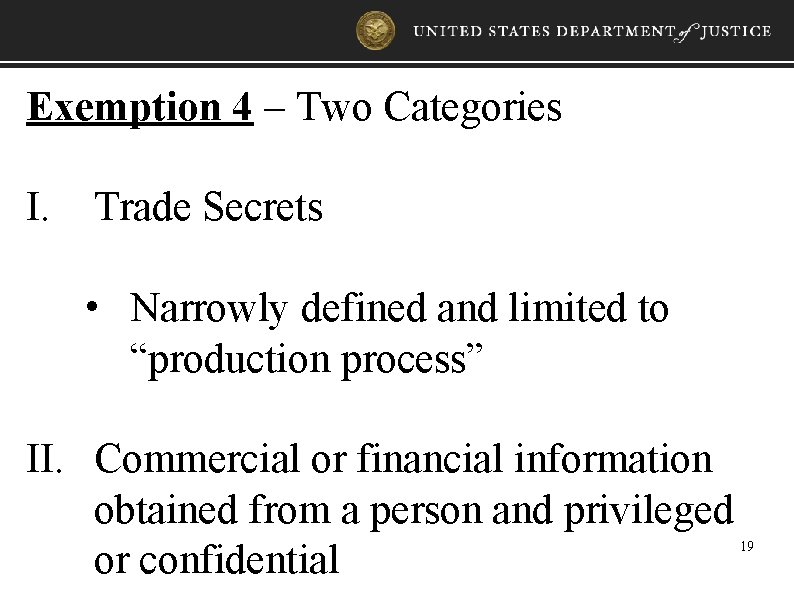
Exemption 4 – Two Categories I. Trade Secrets • Narrowly defined and limited to “production process” II. Commercial or financial information obtained from a person and privileged or confidential 19
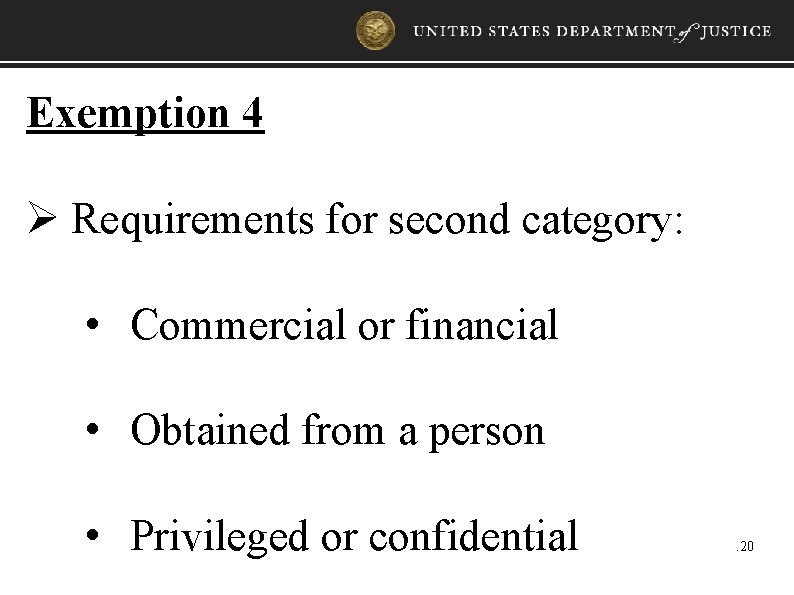
Exemption 4 Ø Requirements for second category: • Commercial or financial • Obtained from a person • Privileged or confidential . 20
Exemption 4 - Confidential Information • Information private or closely-held? • Government provided an express or implied assurance of confidentiality? • Express or implied indications at the time the information was submitted that the government would publicly disclose the information? 21
Exemption 4 Resources • OIP Guidance: Ø https: //www. justice. gov/oip/exemption-4 -aftersupreme-courts-ruling-food-marketing-institute -v-argus-leader-media • Checklist Ø https: //www. justice. gov/oip/step-guidedetermining-if-commercial-or-financialinformation-obtained-person-confidential 22
Exemption 5 Protects “inter-agency or intra-agency memorandums or letters which would not be available by law to a party other than an agency in litigation with the agency” 23
Exemption 5 Threshold Ø Created and exchanged within or between agencies Ø Consultant Corollary 24
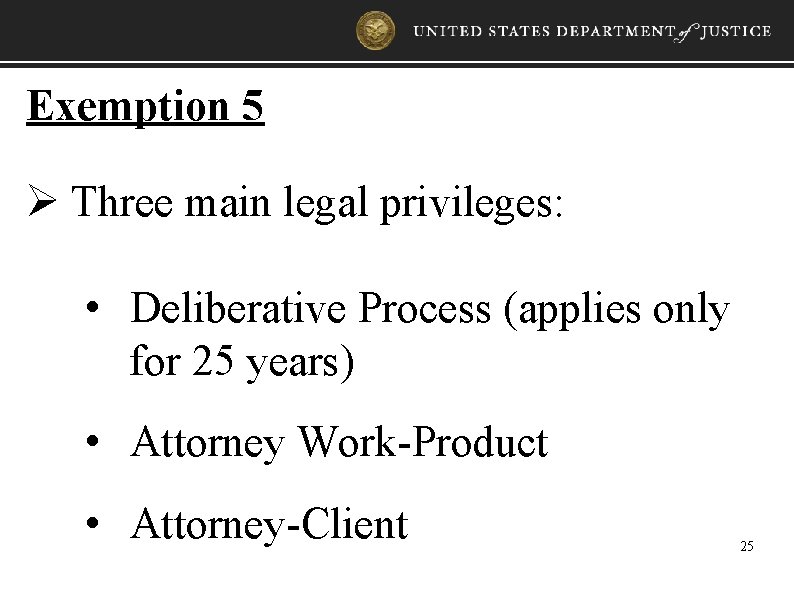
Exemption 5 Ø Three main legal privileges: • Deliberative Process (applies only for 25 years) • Attorney Work-Product • Attorney-Client 25
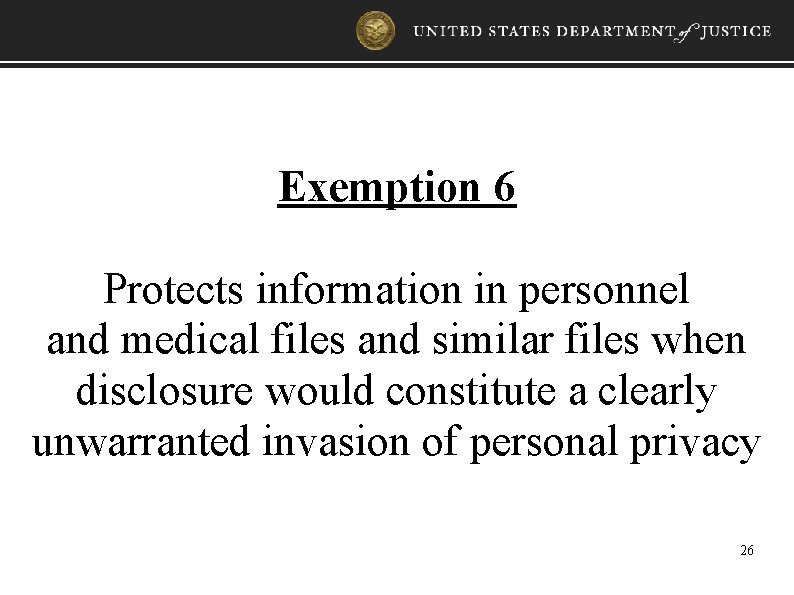
Exemption 6 Protects information in personnel and medical files and similar files when disclosure would constitute a clearly unwarranted invasion of personal privacy 26
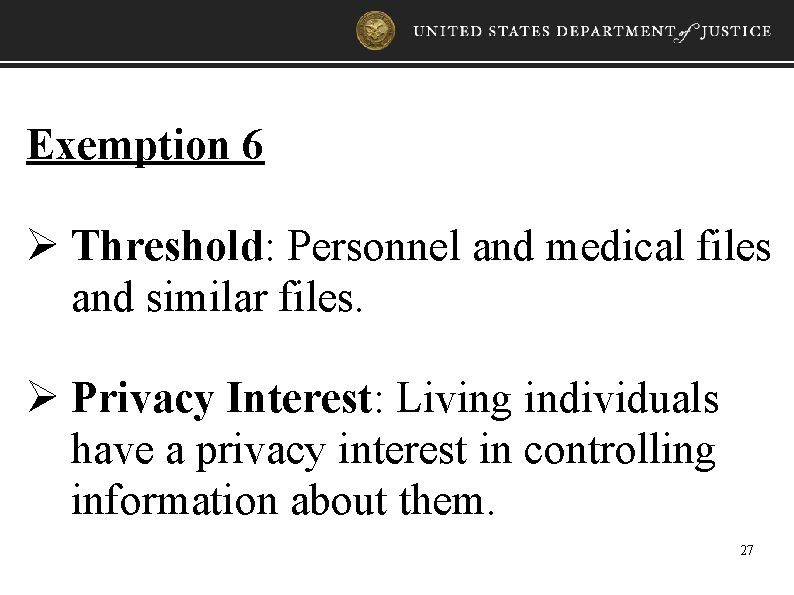
Exemption 6 Ø Threshold: Personnel and medical files and similar files. Ø Privacy Interest: Living individuals have a privacy interest in controlling information about them. 27
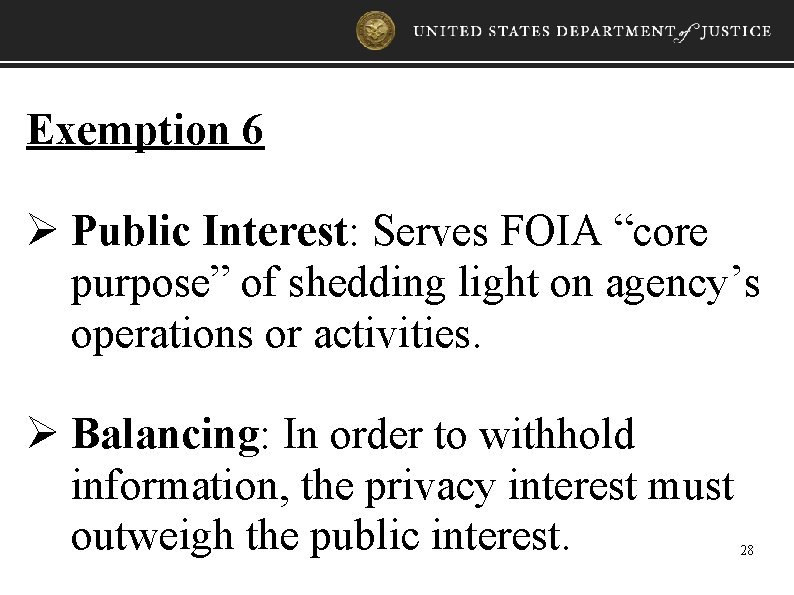
Exemption 6 Ø Public Interest: Serves FOIA “core purpose” of shedding light on agency’s operations or activities. Ø Balancing: In order to withhold information, the privacy interest must outweigh the public interest. 28
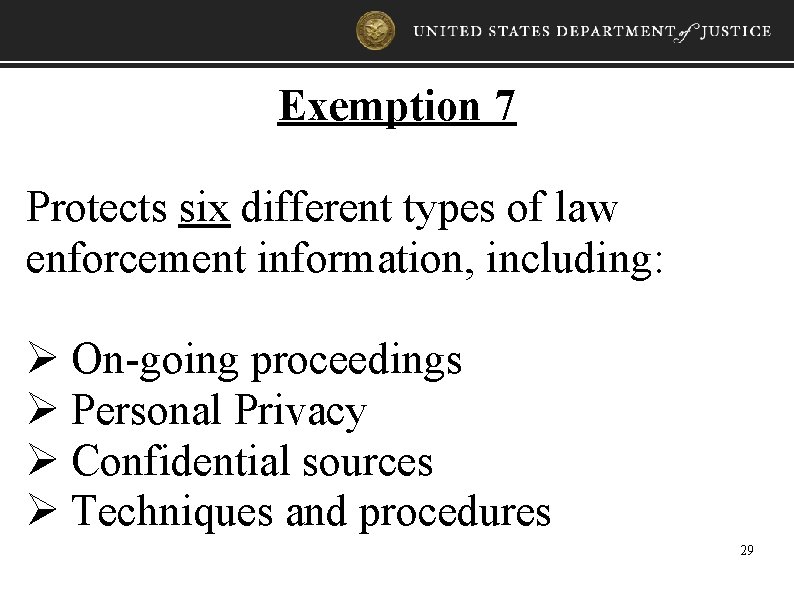
Exemption 7 Protects six different types of law enforcement information, including: Ø On-going proceedings Ø Personal Privacy Ø Confidential sources Ø Techniques and procedures 29
Exemption 7 Ø Threshold: Records or information compiled for law enforcement purposes. 30
Exemption 7 Ø 7(A) -- information that could reasonably be expected to interfere with a pending law enforcement matter. 31
Exemption 7 Ø 7(B) -- disclosure of information would deprive a person of the right to a fair trial or an impartial adjudication. 32
Exemption 7 Ø 7(C) -- disclosure could reasonably be expected to cause an unwarranted invasion of personal privacy. • • Privacy interest Public interest Balancing test “Glomar” response 33
Exemption 7 Ø 7(D) -- disclosure could reasonably be expected to reveal identity of confidential source or, in certain circumstances, information provided by source. a) express confidentiality b) implied confidentiality • nature of crime or wrongdoing • source’s relation to crime or wrongdoing 34
Exemption 7 Ø 7(E) -- disclosure would reveal one of the following: 1) techniques and procedures for investigations or prosecutions; or 2) guidelines for investigations or prosecutions if disclosure could risk circumvention of the law. 35
Exemption 7 Ø 7(F) -- disclosure could reasonably be expected to endanger the life or physical safety of individuals. • undercover agents • witnesses subject to violent reprisal 36
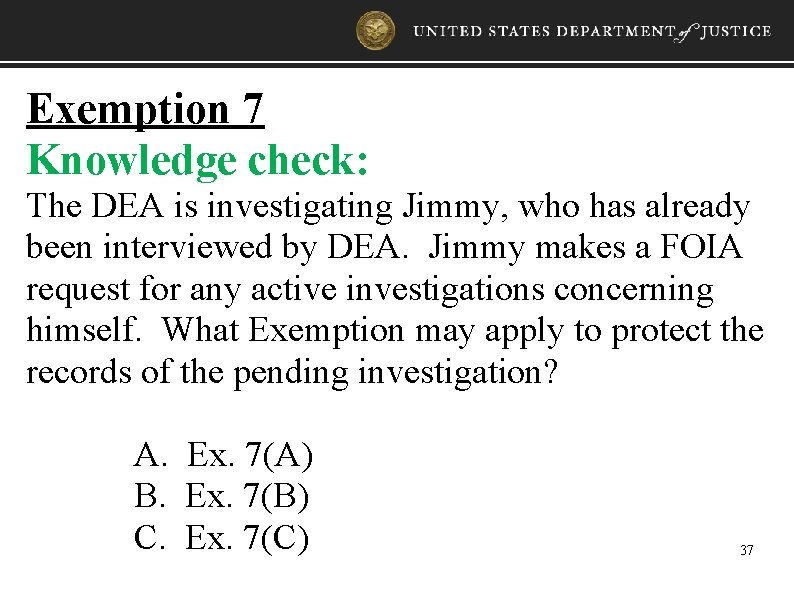
Exemption 7 Knowledge check: The DEA is investigating Jimmy, who has already been interviewed by DEA. Jimmy makes a FOIA request for any active investigations concerning himself. What Exemption may apply to protect the records of the pending investigation? A. Ex. 7(A) B. Ex. 7(B) C. Ex. 7(C) 37
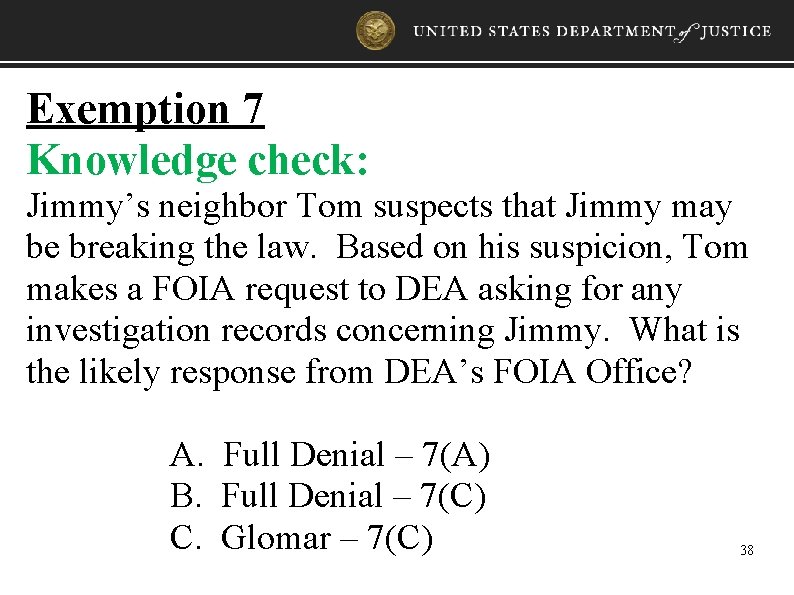
Exemption 7 Knowledge check: Jimmy’s neighbor Tom suspects that Jimmy may be breaking the law. Based on his suspicion, Tom makes a FOIA request to DEA asking for any investigation records concerning Jimmy. What is the likely response from DEA’s FOIA Office? A. Full Denial – 7(A) B. Full Denial – 7(C) C. Glomar – 7(C) 38
Exemption 8 Protects matters contained in or related to examination, operating, or condition reports prepared by or for regulators or supervisors of financial institutions 39
Exemption 9 Protects geological information and data, including maps, concerning wells 40
Statutory Exclusions In certain extraordinary criminal law enforcement or national security contexts, Congress excluded certain categories of records from the requirements of the FOIA. Agencies should review OIP’s guidance on this topic and consult with OIP prior to the use of a statutory exclusion. http: //www. justice. gov/oip/blog/foia-guidance-6 41
Questions?