
FreeBody Diagrams NANSLO Physics Core Units and Laboratory

Free-Body Diagrams NANSLO Physics Core Units and Laboratory Experiments by the North American Network of Science Labs Online, a collaboration between WICHE, CCCS, and BCcampus is licensed under a Creative Commons Attribution 3. 0 Unported License; based on a work at rwsl. nic. bc. ca. Funded by a grant from EDUCAUSE through the Next Generation Learning Challenges. PHYSICS SEMESTER ONE
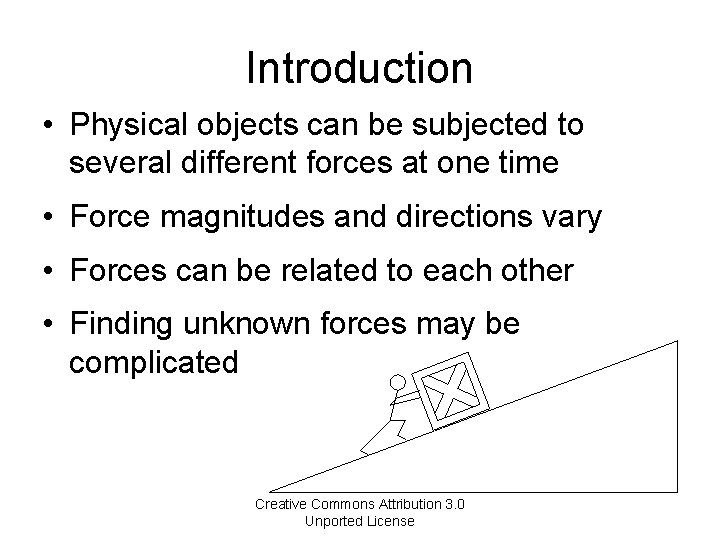
Introduction • Physical objects can be subjected to several different forces at one time • Force magnitudes and directions vary • Forces can be related to each other • Finding unknown forces may be complicated Creative Commons Attribution 3. 0 Unported License
Free-Body Diagrams • Free-body diagrams (FBDs) are sketches showing the relative magnitude and direction of all forces acting on an object • They help us see the relationships between the forces • They assist in organizing our solutions. Creative Commons Attribution 3. 0 Unported License
Creating a FBD Case: Find the net force on a 1. 0 kg object (rock, animal, crate, computer …) on a horizontal surface with an applied force of 5. 0 N to the right, and a coefficient of kinetic friction of 0. 20. Creative Commons Attribution 3. 0 Unported License
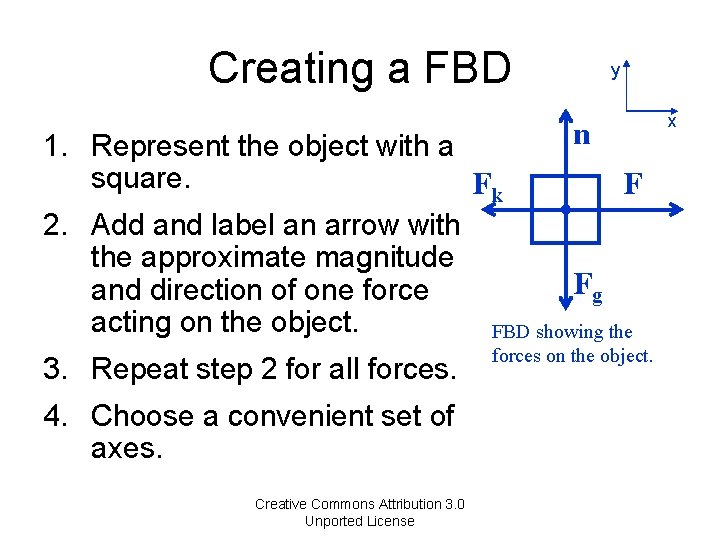
Creating a FBD y n 1. Represent the object with a square. Fk F 2. Add and label an arrow with the approximate magnitude Fg and direction of one force acting on the object. FBD showing the 3. Repeat step 2 for all forces. 4. Choose a convenient set of axes. Creative Commons Attribution 3. 0 Unported License forces on the object. x
Other Notes on FBDs • It is usually easiest to set one axis in the expected direction of motion. • FBDs only show all forces on a single object. If you need to consider forces on two objects, draw two FBDs. • Assume that all forces apply to the same point. Otherwise, the question is a torque and rotational equilibrium problem. Creative Commons Attribution 3. 0 Unported License
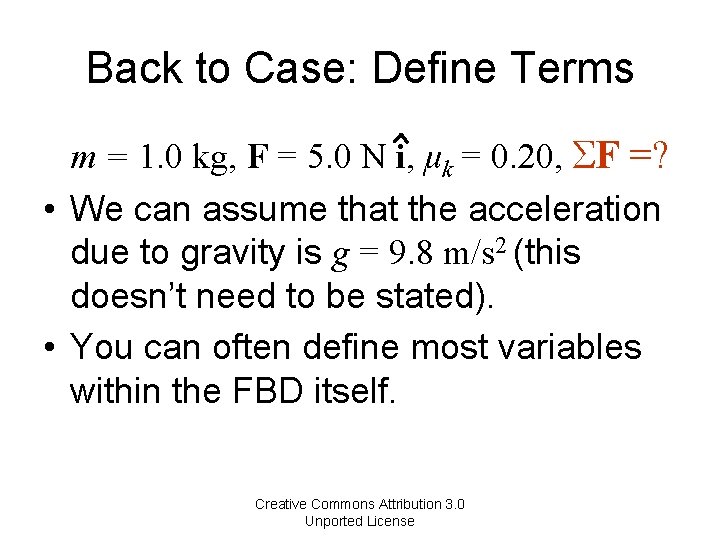
Back to Case: Define Terms m = 1. 0 kg, F = 5. 0 N i, μk = 0. 20, ΣF =? • We can assume that the acceleration due to gravity is g = 9. 8 m/s 2 (this doesn’t need to be stated). • You can often define most variables within the FBD itself. Creative Commons Attribution 3. 0 Unported License
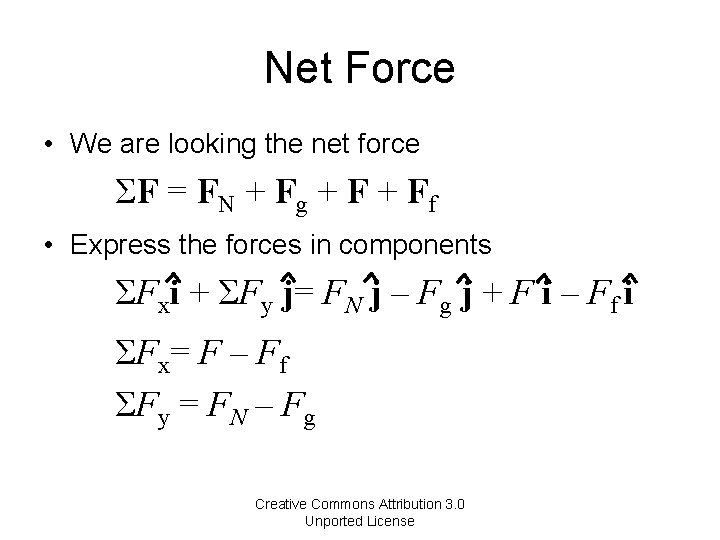
Net Force • We are looking the net force ΣF = FN + Fg + Ff • Express the forces in components ΣFxi + ΣFy j= FN j – Fg j + F i – Ff i ΣFx= F – Ff ΣFy = FN – Fg Creative Commons Attribution 3. 0 Unported License
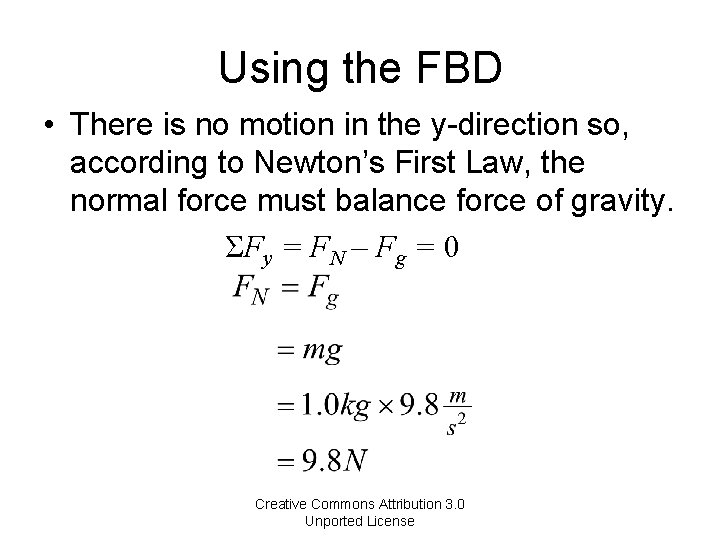
Using the FBD • There is no motion in the y-direction so, according to Newton’s First Law, the normal force must balance force of gravity. ΣFy = FN – Fg = 0 Creative Commons Attribution 3. 0 Unported License
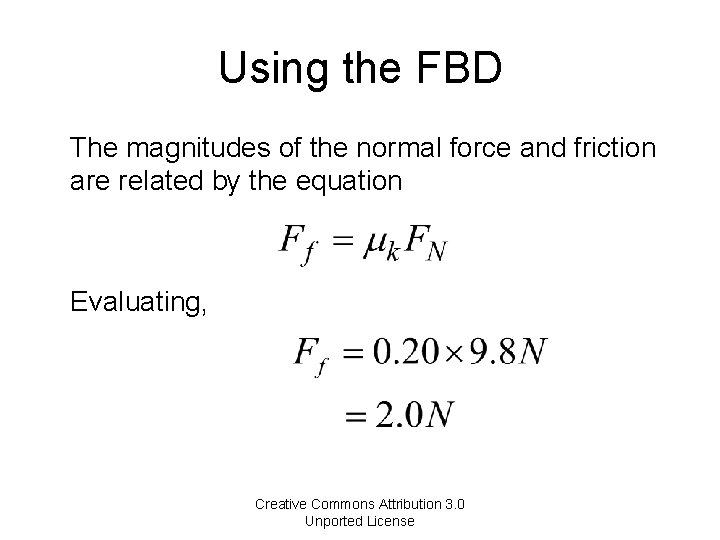
Using the FBD The magnitudes of the normal force and friction are related by the equation Evaluating, Creative Commons Attribution 3. 0 Unported License
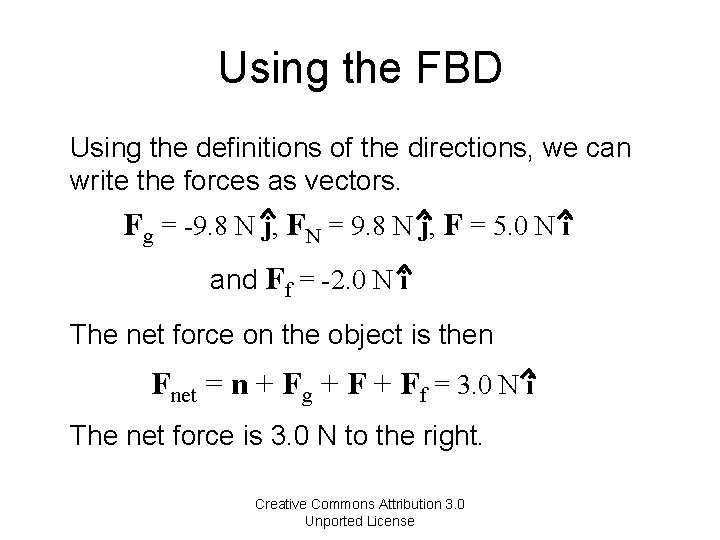
Using the FBD Using the definitions of the directions, we can write the forces as vectors. Fg = -9. 8 N j, FN = 9. 8 N j, F = 5. 0 N i and Ff = -2. 0 N i The net force on the object is then Fnet = n + Fg + Ff = 3. 0 N i The net force is 3. 0 N to the right. Creative Commons Attribution 3. 0 Unported License
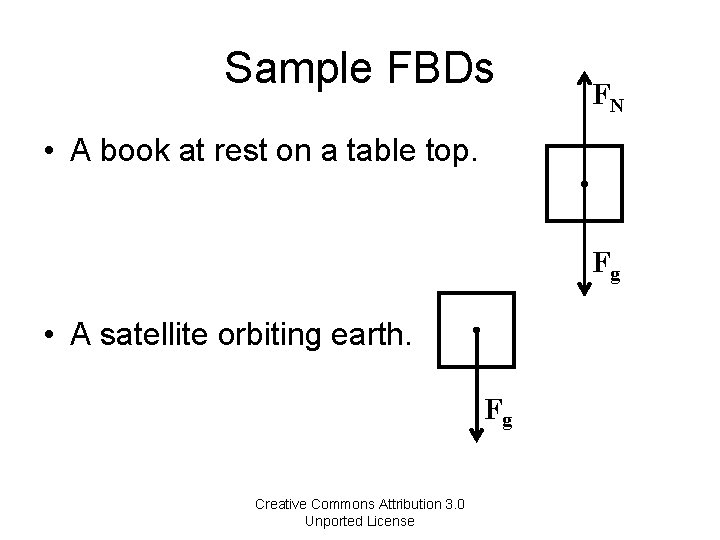
Sample FBDs FN • A book at rest on a table top. Fg • A satellite orbiting earth. Fg Creative Commons Attribution 3. 0 Unported License
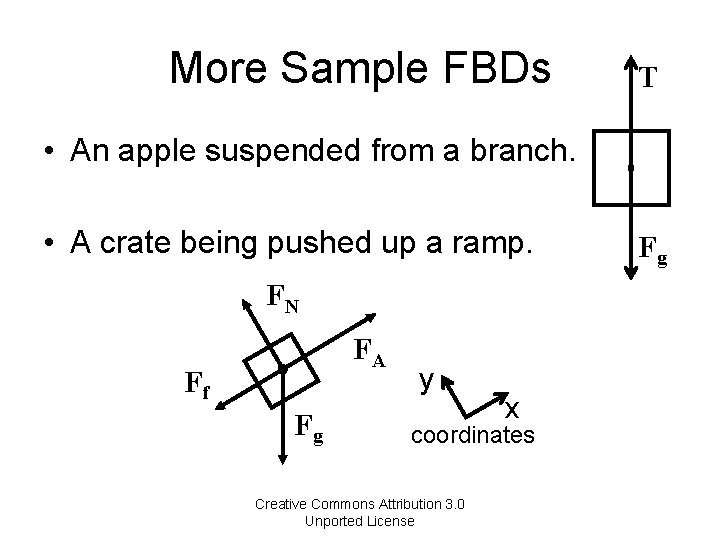
More Sample FBDs T • An apple suspended from a branch. • A crate being pushed up a ramp. FN FA Ff Fg y x coordinates Creative Commons Attribution 3. 0 Unported License Fg
Summary • Free-Body Diagrams are useful tools in organizing the relationships between the forces on a single object. – The object in a FBD is represented by a box. – The forces are represented by arrows with appropriate directions and relative magnitudes. • A suitable coordinate system can be selected to simplify calculations. • Unknown forces can be found using Newton’s Laws of Motion and other physics relationships. Creative Commons Attribution 3. 0 Unported License
- Slides: 14