
Free will vs Determinism Starter On BWBS What
Free will vs Determinism
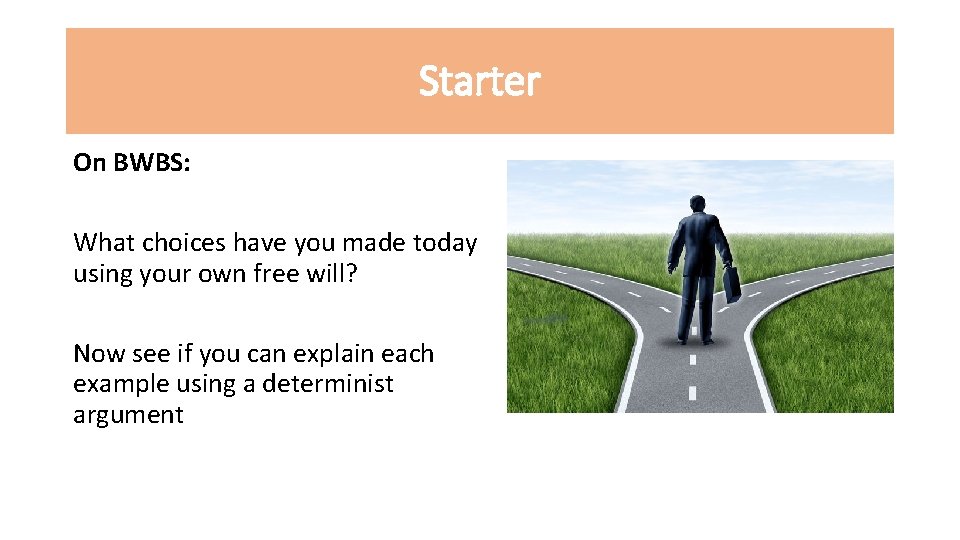
Starter On BWBS: What choices have you made today using your own free will? Now see if you can explain each example using a determinist argument
Free will vs determinism: What you need to know On MWBs, write a definition of the following: • Hard determinism • Soft determinism • Free will Why do think that determinist theories may be considered more scientific than free will theories? • They enable us to establish causal relationships • This in turn means that we are able to make predictions Now give an example of the following: • Biological determinism • Environmental determinism • Psychic determinism Can you come up with any examples from other areas of Psychology where a determinist viewpoint has meant that we are able to make predictions about behaviour?

Kahoot Quiz
Real-life application Down the pub, a lively discussion breaks out about criminals Dave: “we all know what’s right and wrong, we all make our choices. If someone’s gonna nick some other geezer’s stuff, he deserves to be thrown in prison” Jemima: “come on Dave, I bet most people in prison have had a really traumatic childhood, or something bad happened to them. ” Lee: “that’s rubbish Jemima, I had a really bad childhood. My mum ran away when I was 4 and my dad got with this horrible person who hated me, but I don’t break the law. Options were limited when I left school, and I chose the armed forces. ” Jemima: “you didn’t chose the armed forces. There wasn’t any other opportunities, you didn’t end up with any qualifications, what else could you have done? ” Dave: “I still say, we all make our own beds, so we have to lie in them. Criminals know what they are doing, they should take the consequences” Out of Dave, Lee and Jemima, which is arguing from a position of free will, which is most arguing from a position of soft-determinism and which is most arguing from a hard-determinism perspective. Justify your answer.
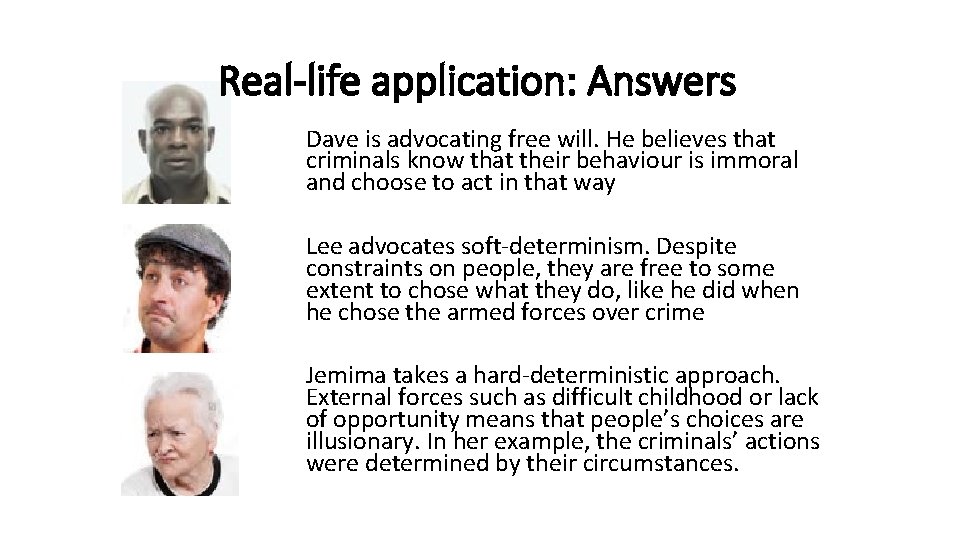
Real-life application: Answers Dave is advocating free will. He believes that criminals know that their behaviour is immoral and choose to act in that way Lee advocates soft-determinism. Despite constraints on people, they are free to some extent to chose what they do, like he did when he chose the armed forces over crime Jemima takes a hard-deterministic approach. External forces such as difficult childhood or lack of opportunity means that people’s choices are illusionary. In her example, the criminals’ actions were determined by their circumstances.

Biological, environmental or psychic determinism? In pairs, on MWBs, decide whether the following are examples of biological, environmental or psychic determinism. .

Biological, environmental or psychic determinism? Hans is scared of horses. He has displaced his fear of castration by his father onto a more acceptable fear of horses. The fact that Hans is really scared of blinkered horses adds weight to theory as his father wears spectacles Hans’ behaviour is determined by psychic determinism
Biological, environmental or psychic determinism? Martha won’t go swimming. When she was younger, her brother pushed her into a river as a joke, but the strong current took her under and she nearly drowned. Ever since that day, she has been too scared to go into water, even in the shallow end of a kids pool: Martha’s fear has been environmentally determined (classical conditioning)
Biological, environmental or psychic determinism? Terry is prone to violent episodes and is currently serving 3 years in prison for ABH. A sample of cerebrospinal fluid has confirmed what prison doctors had thought. Terry has very low levels of serotonin Terry’s violence is caused by very low levels of serotonin, which is a neurochemical linked to mood – biological determinism
Determinism or free will? Linking to the approaches On BWB, Do the following approaches demonstrate determinism (if so, what type), soft determinism, or free will? The Biological approach Hard Determinism/ Biological determinism Learning theories Behaviourism- Hard Determinism /Environmental SLT- Soft determinism Cognitive Soft Determinism and argues for an element of free will Psychodynamic Hard Determinism/ Psychic determinism Humanism Free will
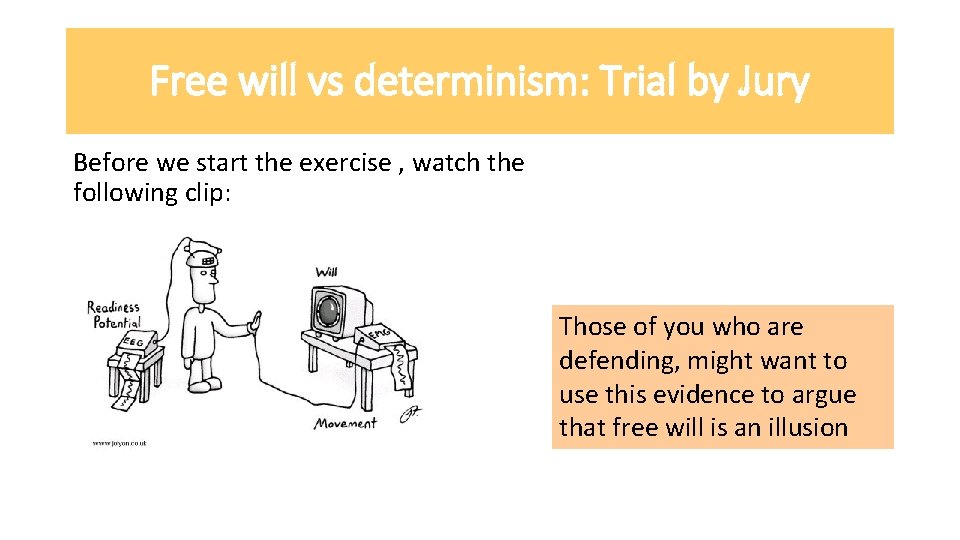
Free will vs determinism: Trial by Jury Before we start the exercise , watch the following clip: Those of you who are defending, might want to use this evidence to argue that free will is an illusion

Free will vs determinism: Trial by Jury • Each group will be given a case to work on. You will split into two. One half is going to be making a case for the prosecution, the other half is going to be making a case for the defence, using the information in the packs • The defence will concentrate on evidence that would suggest the defendant should not be held accountable for their behaviour as it has been determined by factors outside of their control (determinism) • The prosecution will argue that the defendant should be held responsible for their behaviour and, therefore, found guilty as they had free will. The prosecution will need to think about the evidence the defence is likely to put forward • You have 10 minutes to put your case together, using Psychological evidence. You will then present it to the jury (the rest of the class), who will vote on whether the person should be found guilty or innocent If you need some guidance, come and consult the judge

Now each case will be put forward to the jury You will see details of each case on the following slides The defence will present their case first The prosecution will then present their case Then you will vote for which side you believe had the stronger case (you will need your devices for this)
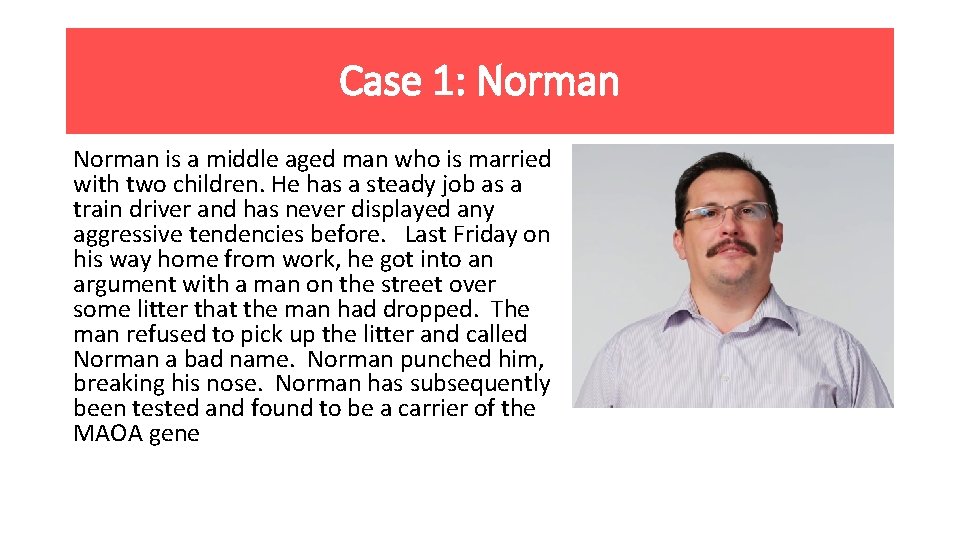
Case 1: Norman is a middle aged man who is married with two children. He has a steady job as a train driver and has never displayed any aggressive tendencies before. Last Friday on his way home from work, he got into an argument with a man on the street over some litter that the man had dropped. The man refused to pick up the litter and called Norman a bad name. Norman punched him, breaking his nose. Norman has subsequently been tested and found to be a carrier of the MAOA gene
Now vote. Guilty or not guilty?
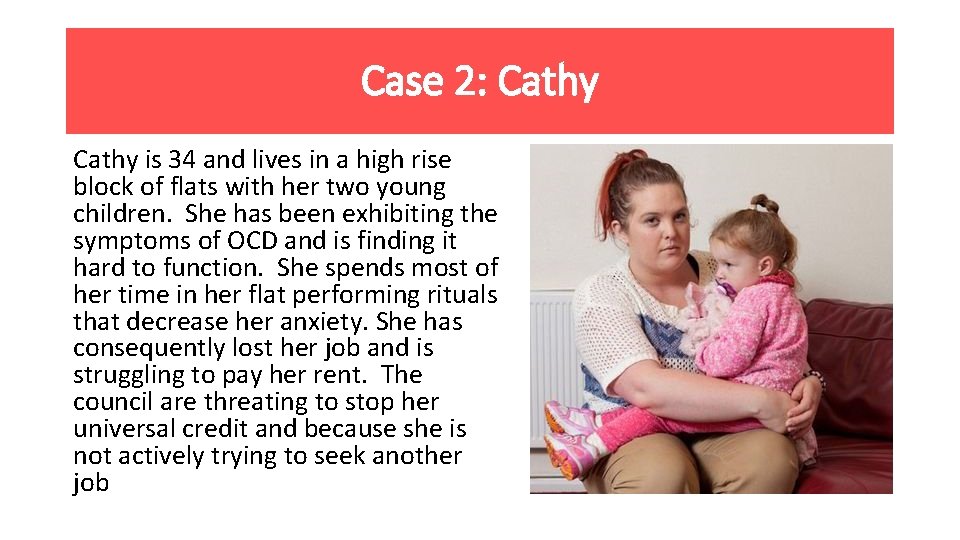
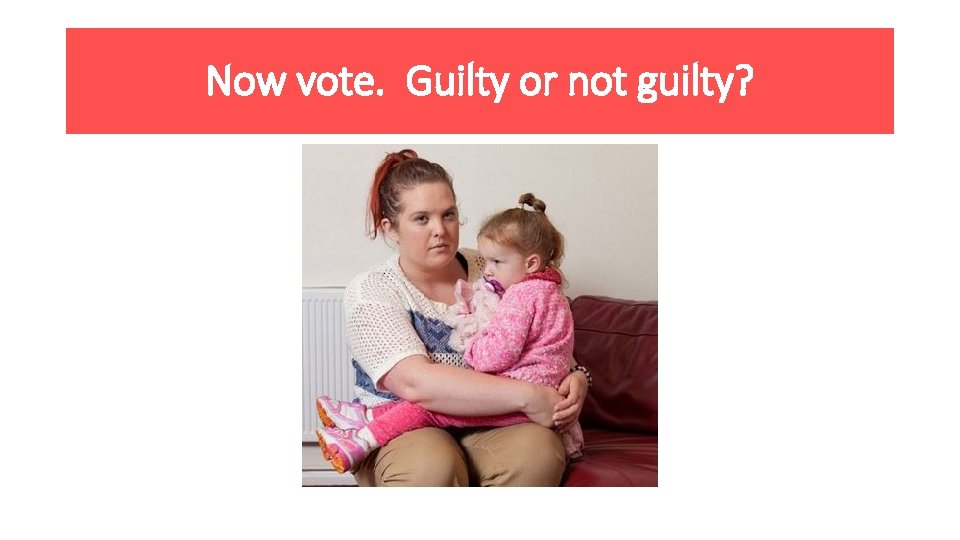
Case 2: Cathy is 34 and lives in a high rise block of flats with her two young children. She has been exhibiting the symptoms of OCD and is finding it hard to function. She spends most of her time in her flat performing rituals that decrease her anxiety. She has consequently lost her job and is struggling to pay her rent. The council are threating to stop her universal credit and because she is not actively trying to seek another job
Now vote. Guilty or not guilty?
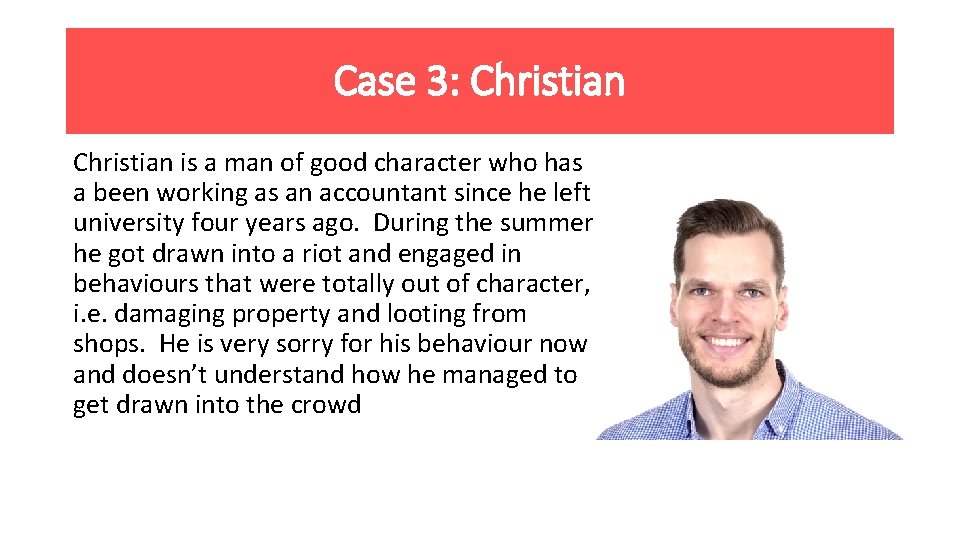
Case 3: Christian is a man of good character who has a been working as an accountant since he left university four years ago. During the summer he got drawn into a riot and engaged in behaviours that were totally out of character, i. e. damaging property and looting from shops. He is very sorry for his behaviour now and doesn’t understand how he managed to get drawn into the crowd
Now vote. Guilty or not guilty?
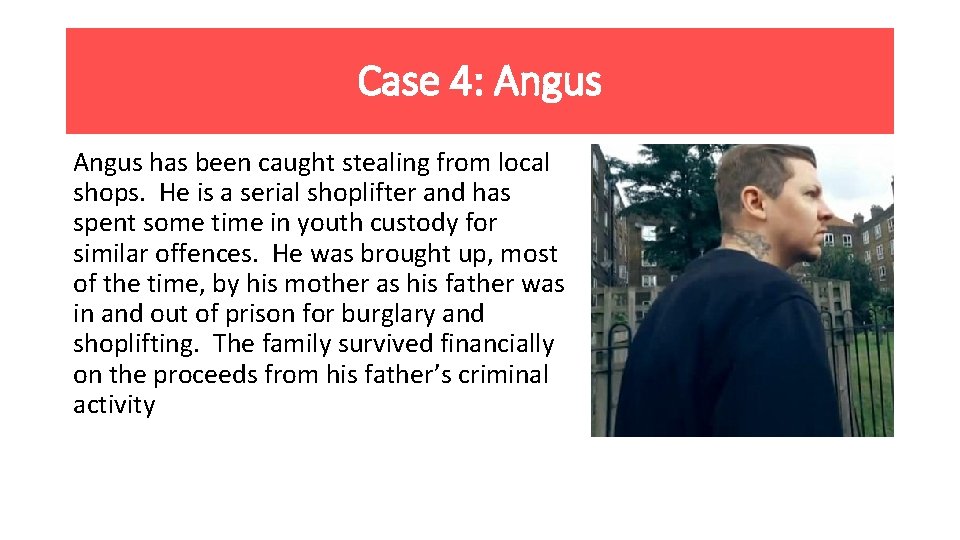
Case 4: Angus has been caught stealing from local shops. He is a serial shoplifter and has spent some time in youth custody for similar offences. He was brought up, most of the time, by his mother as his father was in and out of prison for burglary and shoplifting. The family survived financially on the proceeds from his father’s criminal activity
Now vote. Prison or not?
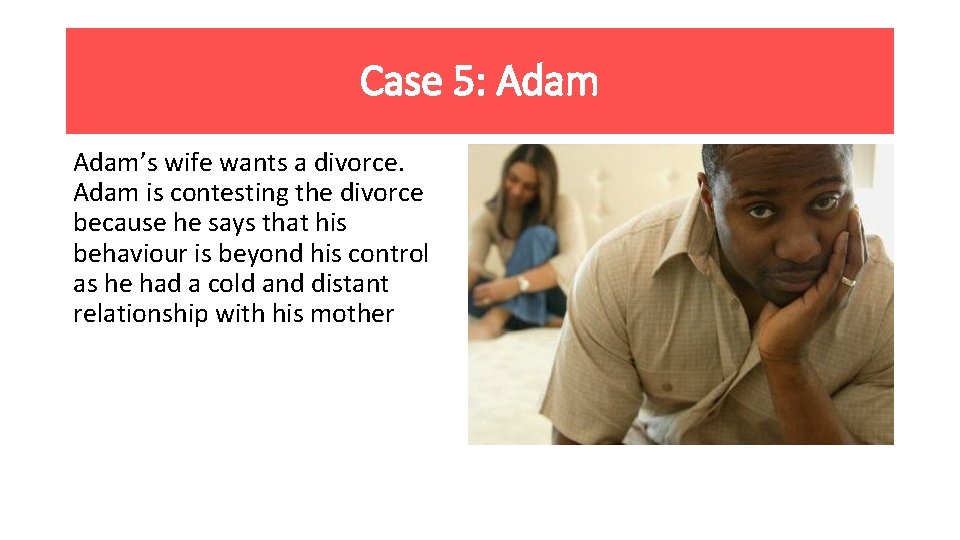
Case 5: Adam’s wife wants a divorce. Adam is contesting the divorce because he says that his behaviour is beyond his control as he had a cold and distant relationship with his mother
Now vote. Divorce or stay married?
Exam Practice Write a snap plan for the following essay title: Dancho is a talented and famous musician. He was taught to play the piano by his father who was a concert pianist. From the age of four years Dancho attended a specialist music school where he spent many hours each day practising the piano. In a recent TV interview Dancho said, ‘My earliest memories are of notes and melodies, so music is a part of me. To hear the applause in the concert hall is what I live for. Even if I wanted to stop playing, I could not. ’ Discuss two or more types of determinism. Refer to the case of Dancho as part of your discussion. [16 marks] Your plan should consist of: AO 1: (6 marks) outlining two types of determinism AO 2: (4 marks) identifying how each of the types of determinism are demonstrated in the stem AO 3: (6 marks) 2 PEEL points on the strengths and weakness of a determinist argument (this could include supporting research, or they could be general points about the pros and cons of determinism)
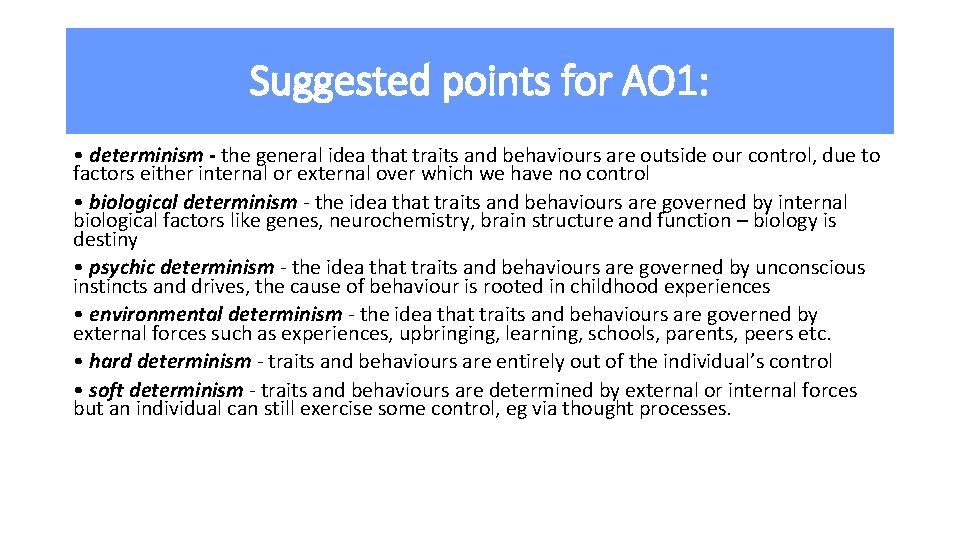
Suggested points for AO 1: • determinism - the general idea that traits and behaviours are outside our control, due to factors either internal or external over which we have no control • biological determinism - the idea that traits and behaviours are governed by internal biological factors like genes, neurochemistry, brain structure and function – biology is destiny • psychic determinism - the idea that traits and behaviours are governed by unconscious instincts and drives, the cause of behaviour is rooted in childhood experiences • environmental determinism - the idea that traits and behaviours are governed by external forces such as experiences, upbringing, learning, schools, parents, peers etc. • hard determinism - traits and behaviours are entirely out of the individual’s control • soft determinism - traits and behaviours are determined by external or internal forces but an individual can still exercise some control, eg via thought processes.
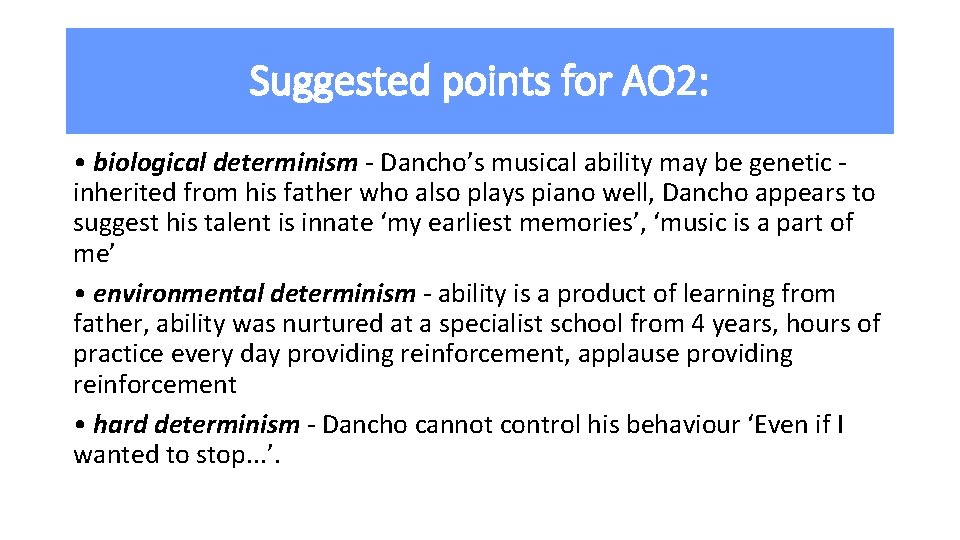
Suggested points for AO 2: • biological determinism - Dancho’s musical ability may be genetic inherited from his father who also plays piano well, Dancho appears to suggest his talent is innate ‘my earliest memories’, ‘music is a part of me’ • environmental determinism - ability is a product of learning from father, ability was nurtured at a specialist school from 4 years, hours of practice every day providing reinforcement, applause providing reinforcement • hard determinism - Dancho cannot control his behaviour ‘Even if I wanted to stop. . . ’.
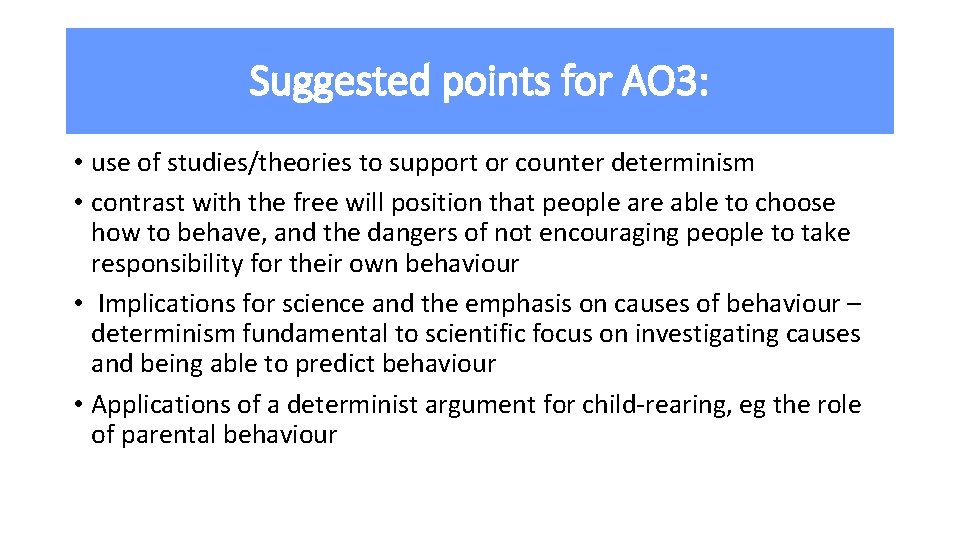
Suggested points for AO 3: • use of studies/theories to support or counter determinism • contrast with the free will position that people are able to choose how to behave, and the dangers of not encouraging people to take responsibility for their own behaviour • Implications for science and the emphasis on causes of behaviour – determinism fundamental to scientific focus on investigating causes and being able to predict behaviour • Applications of a determinist argument for child-rearing, eg the role of parental behaviour
- Slides: 28