
Free Water Surface Wetlands Patrick Brice 12042012 Types
Free Water Surface Wetlands Patrick Brice 12/04/2012
Types of Free Water Surface (FWS) Wetlands �Surface Flow �Open Water Zone �Floating Aquatic Plant System
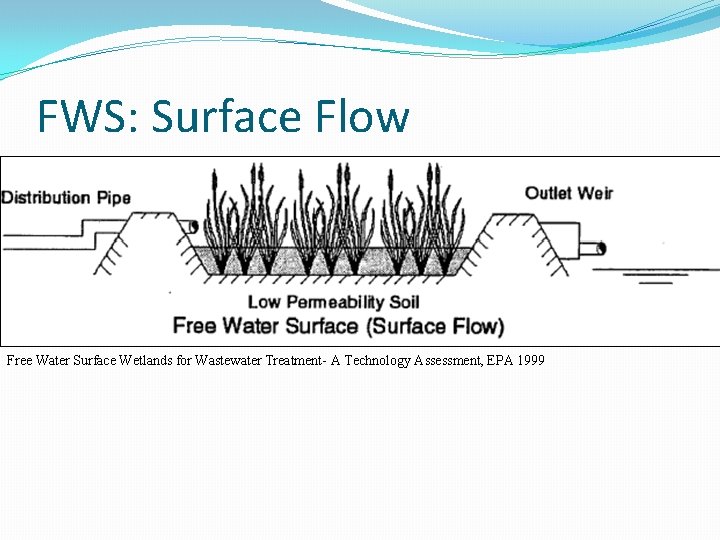
FWS: Surface Flow Free Water Surface Wetlands for Wastewater Treatment- A Technology Assessment, EPA 1999

FWS: Open Water Zone Free Water Surface Wetlands for Wastewater Treatment- A Technology Assessment, EPA 1999
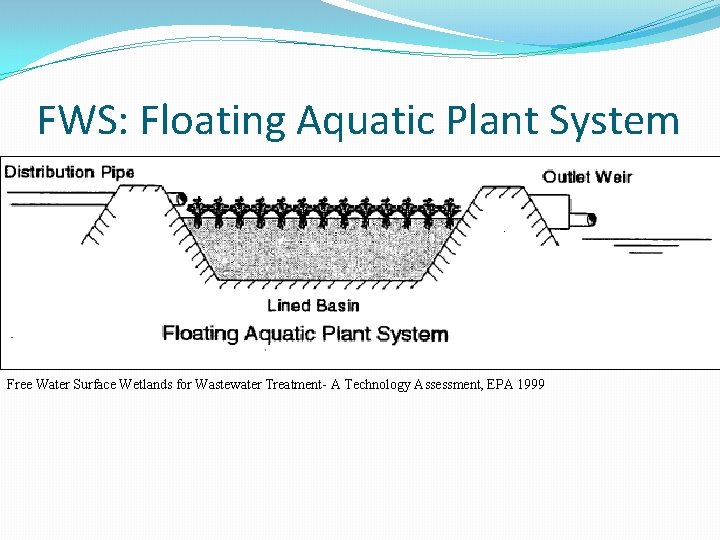
FWS: Floating Aquatic Plant System Free Water Surface Wetlands for Wastewater Treatment- A Technology Assessment, EPA 1999
Question #1 �Name 2 types of Free Water Surface Wetlands.
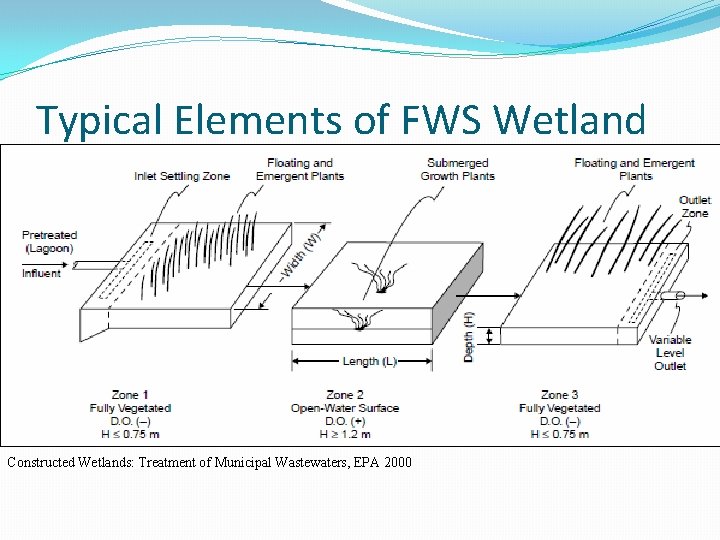
Typical Elements of FWS Wetland Constructed Wetlands: Treatment of Municipal Wastewaters, EPA 2000
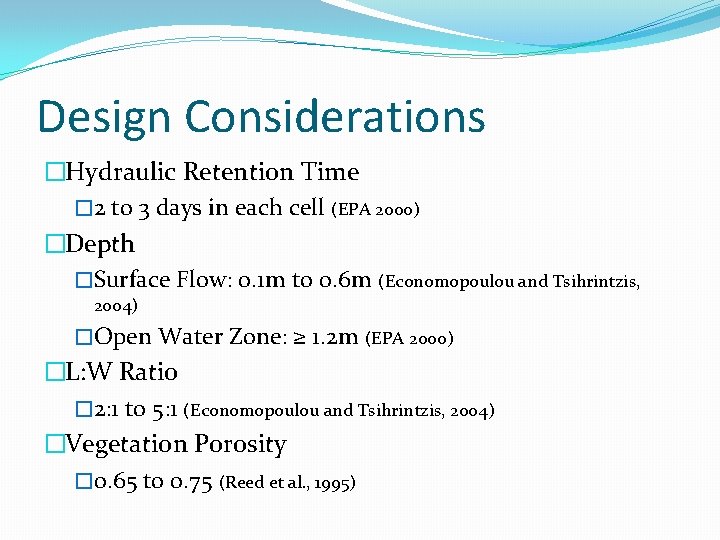
Design Considerations �Hydraulic Retention Time � 2 to 3 days in each cell (EPA 2000) �Depth �Surface Flow: 0. 1 m to 0. 6 m (Economopoulou and Tsihrintzis, 2004) �Open Water Zone: ≥ 1. 2 m (EPA 2000) �L: W Ratio � 2: 1 to 5: 1 (Economopoulou and Tsihrintzis, 2004) �Vegetation Porosity � 0. 65 to 0. 75 (Reed et al. , 1995)
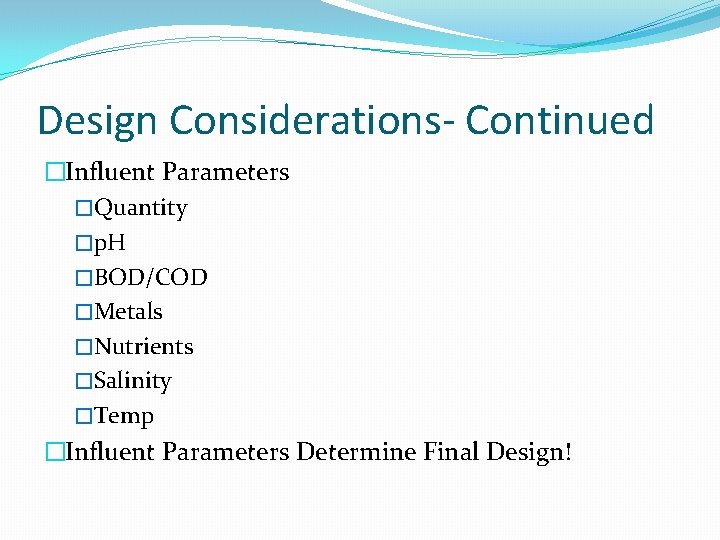
Design Considerations- Continued �Influent Parameters �Quantity �p. H �BOD/COD �Metals �Nutrients �Salinity �Temp �Influent Parameters Determine Final Design!
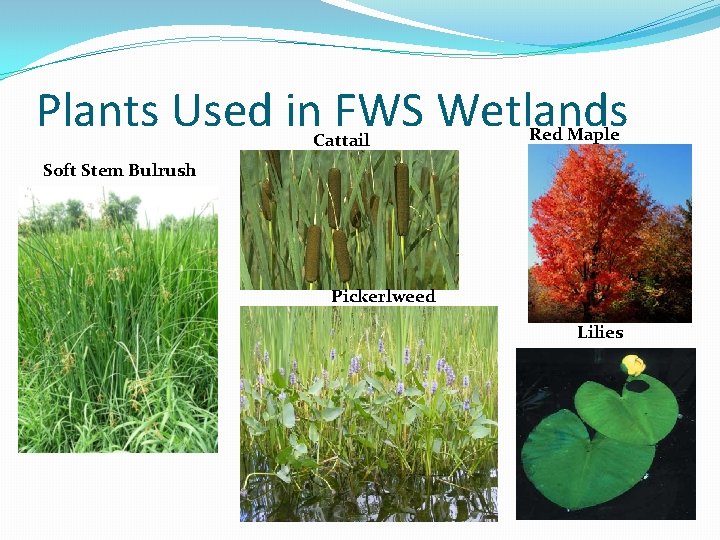
Plants Used in FWS Wetlands Cattail Red Maple Soft Stem Bulrush Pickerlweed Lilies
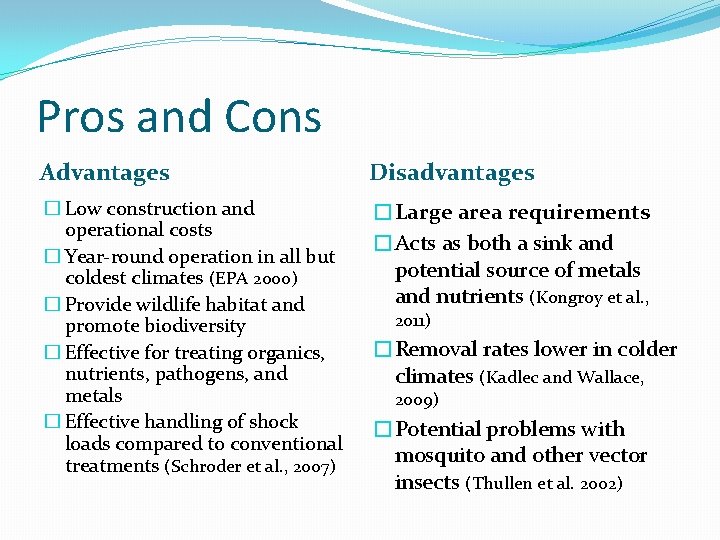
Pros and Cons Advantages Disadvantages � Low construction and operational costs � Year-round operation in all but coldest climates (EPA 2000) � Provide wildlife habitat and promote biodiversity � Effective for treating organics, nutrients, pathogens, and metals � Effective handling of shock loads compared to conventional treatments (Schroder et al. , 2007) �Large area requirements �Acts as both a sink and potential source of metals and nutrients (Kongroy et al. , 2011) �Removal rates lower in colder climates (Kadlec and Wallace, 2009) �Potential problems with mosquito and other vector insects (Thullen et al. 2002)
Question #2 �What is the biggest disadvantage of a FWS?
References � � � � Cameron, Kimberley, Madramootoo, Chandra, Crolla, Anna and Kinsley, Christopher. “Pollutant removal from municipal sewage lagoon effluents with a free-surface wetland. ” Water Research, Volume 37, Issue 12, , July 2003, Pages 2803 -2812. Davis, Luise. United States. Department of Agriculture. Constructed Wetlands Handbook. Web. <http: //water. epa. gov/type/wetlands/restore/upload/constructed-wetlands-handbook. pdf>. Economopoulou, Maria, and Vassilios Tsihrintzis. Design Methodology of Free Water Surface Constructed Wetlands. Water Resources Management 18. (2004): 541 -565. Print. Ibekwe, A. M. , S. R. Lyon, M. Leddy, and M. Jacobson-Meyers. Impact of Plant Density and Microbial Composition on Water Quality from a Free Water Surface Constructed Wetland. Journal of Applied Microbiology. 102 (2007): 921 -936. Print. Kadlec, Robert H. , Wallace, Scott D. , Treatment Wetlands. 2 nd ed. Boca Raton: Taylor & Francis Group, LLC, 2009. e. Book. Porntawee Kongroy, Netnapid Tantemsapya, Ying-Feng Lin, Shuh Ren Jing & Wanpen Wirojanagud (2012): Spatial Distribution of Metals in the Constructed Wetlands , International Journal of Phytoremediation, 14: 2, 128 -141 Schroder, Peter, Juan Navarro-Avino, et al. "Phytoremediation Technologies. " Phytoremediation Technologies. 14. 7 (2007): 490 -497. Reed, S. C. , Crites, R. W. , and Middlebrooks, E. J. , Natural Systems for Waste Management and Treatment, 2 nd ed. New York: Mc. Graw-Hill, Inc, 1995. e. Book. Rittman, Bruce, Mc. Carty, Perry. “Environmental Biotechnology: Principles and Applications. ” Mc. Graw Hill. New York, NY. 2001. Rogozinski, Lynn, and Janis Farmer. "Groundwater Treatment Via Constructed Wetland. " National Groundwater Association. BP Oil Company. Web. 1 Dec 2012. <http: //info. ngwa. org/GWOL/pdf/920157405. PDF>. Thullen, Joan S. , Sartoris, James J. , and Walton, William E. “Effects of vegetation management in constructed wetland treatment cells on water quality and mosquito production. ” Ecological Engineering, Volume 18, Issue 4, , 1 March 2002, Pages 441 -457. United States. Environmental Protection Agency. Free Water Surface Wetlands for Wastewater Treatment. Washington D. C. : USEPA Office of Water, 1999. Web. 29 Nov 2012. <http: //water. epa. gov/type/wetlands/restore/upload/2004_12_20_wetlands_pdf_FW_Surface_Wetlands. pdf > United States. Environmental Protection Agency. Orlando, FL-Wetland Treatment Systems: A Case History- The Orlando Easterly Wetland Reclamation Project. Washington D. C. : USEPA Office of Water, 1993. Web. 29 Nov 2012. <http: //www. epa. gov/owow/wetlands/pdf/Orlando. pdf> United States. Environmental Protection Agency. Wastewater Technology Fact Sheet: Free Water Surface Wetlands. Washington D. C. : USEPA Office of Water, 2000. Web. 29 Nov 2012. <http: //www. epa. gov/owow/wetlands/pdf/Orlando. pdf>
- Slides: 13