
Free Trade Theory Why Nations Trade Basics of
Free Trade Theory Why Nations Trade
Basics of Trade • Exports: goods/services sold to other countries • Imports: goods/services bought from other countries • Trade Surplus: Exports greater than imports • Trade Deficit: Imports greater than export
Ways to Limit Trade • Tariffs– taxes on imports • Quotas- limits on quantity imported • Protectionism: Gov’t policy which seeks to limit trade • Globalization: the “global” movement away from protectionism and towards free trade – Trade without Tariffs & Quotas – Worldwide movement towards free market capitalism
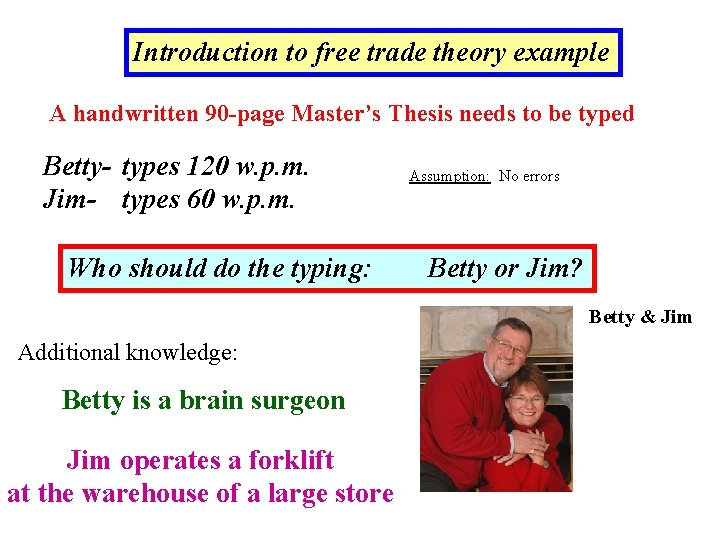
Introduction to free trade theory example A handwritten 90 -page Master’s Thesis needs to be typed Betty- types 120 w. p. m. Jim- types 60 w. p. m. Who should do the typing: Assumption: No errors Betty or Jim? Betty & Jim Additional knowledge: Betty is a brain surgeon Jim operates a forklift at the warehouse of a large store
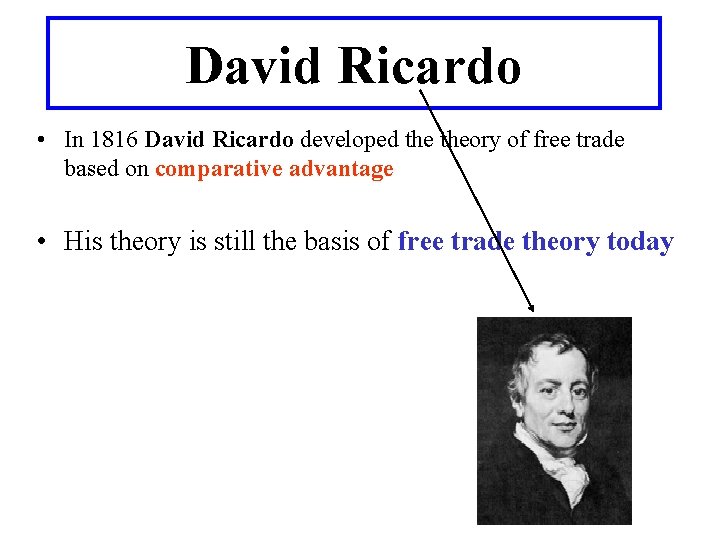
David Ricardo • In 1816 David Ricardo developed theory of free trade based on comparative advantage • His theory is still the basis of free trade theory today
Ricardo Trade Terms • Absolute Advantage: when a country can outright produce more of a good than another country • Comparative Advantage: when a country can produce a good at a lower opportunity cost
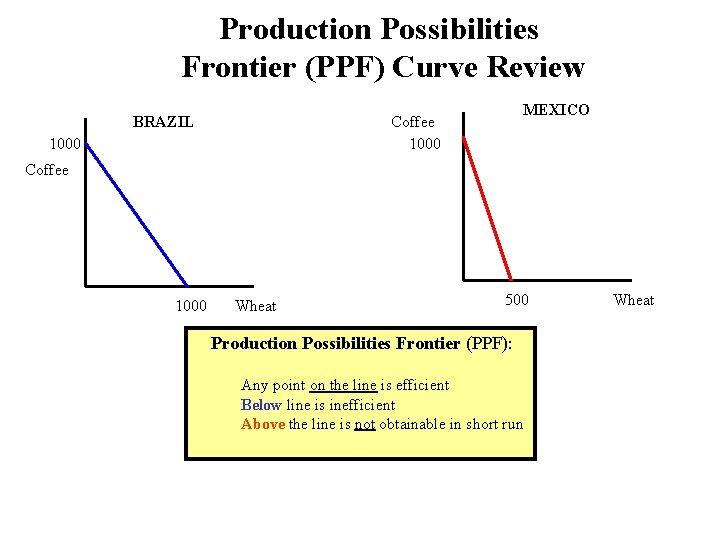
Production Possibilities Frontier (PPF) Curve Review BRAZIL MEXICO Coffee 1000 Wheat 500 Production Possibilities Frontier (PPF): Any point on the line is efficient Below line is inefficient Above the line is not obtainable in short run Wheat
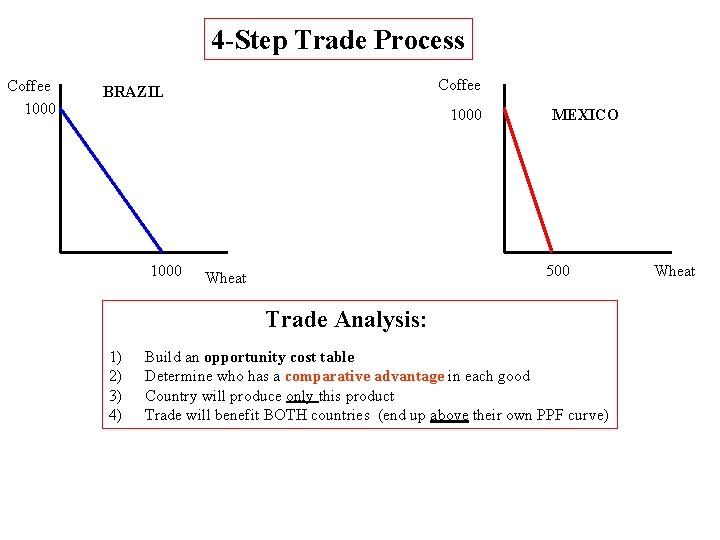
4 -Step Trade Process Coffee 1000 Coffee BRAZIL 1000 MEXICO 500 Wheat Trade Analysis: 1) 2) 3) 4) Build an opportunity cost table Determine who has a comparative advantage in each good Country will produce only this product Trade will benefit BOTH countries (end up above their own PPF curve) Wheat
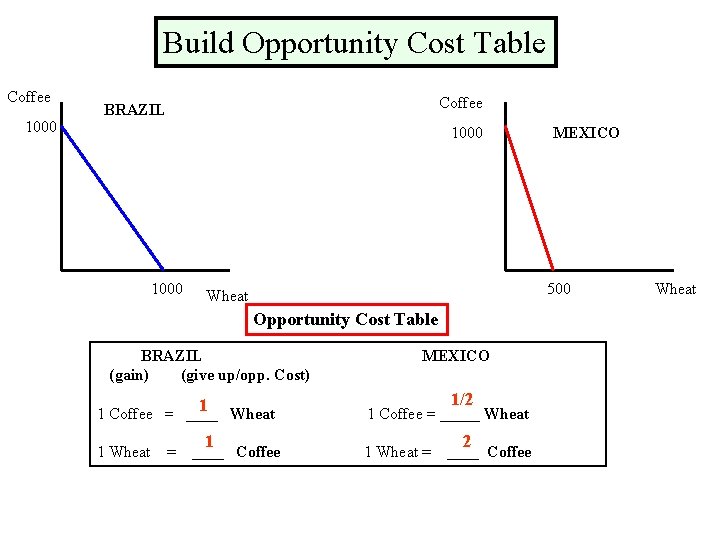
Build Opportunity Cost Table Coffee 1000 Coffee BRAZIL 1000 500 Wheat Opportunity Cost Table BRAZIL (gain) (give up/opp. Cost) 1 Wheat 1 Coffee = ____ 1 Wheat = 1 MEXICO ____ Coffee MEXICO 1/2 1 Coffee = _____ Wheat 1 Wheat = 2 ____ Coffee Wheat
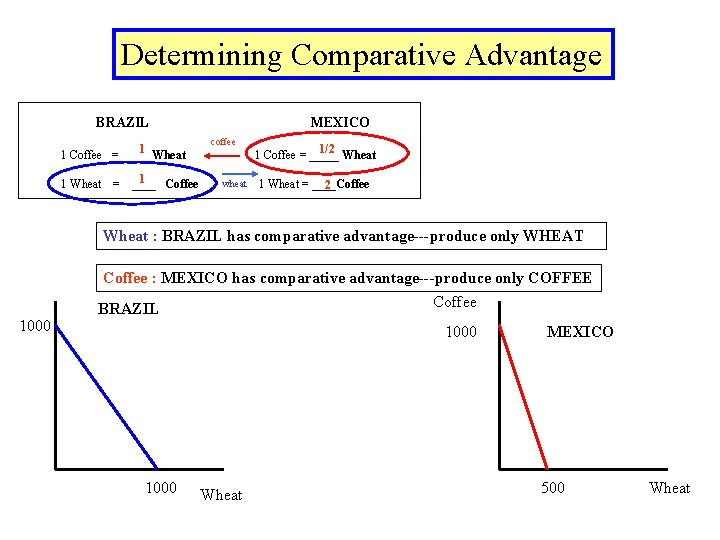
Determining Comparative Advantage BRAZIL 1 1 Coffee = ____Wheat 1 Wheat = 1 ____ Coffee MEXICO coffee wheat 1/2 Wheat 1 Coffee = _____ 1 Wheat = ____Coffee 2 Wheat : BRAZIL has comparative advantage---produce only WHEAT 1000 Coffee : MEXICO has comparative advantage---produce only COFFEE Coffee BRAZIL 1000 Wheat MEXICO 500 Wheat
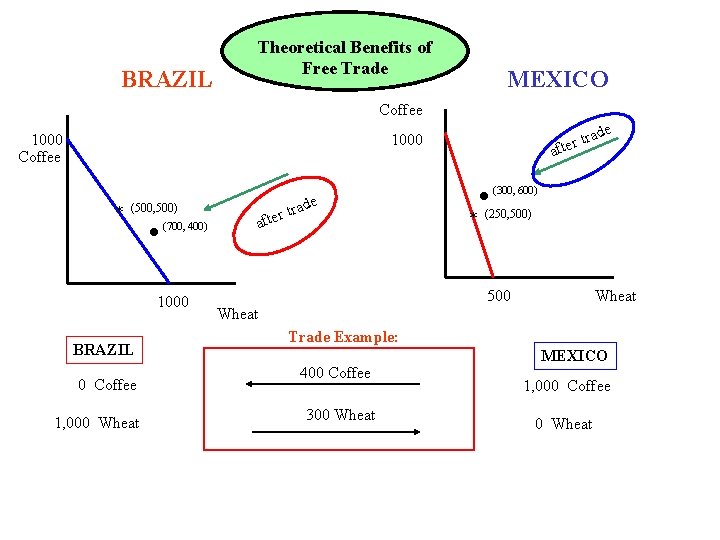
BRAZIL Theoretical Benefits of Free Trade MEXICO Coffee 1000 * . (500, 500) (700, 400) 1000 BRAZIL 0 Coffee 1, 000 Wheat af ade r te . de tra fter a (300, 600) * (250, 500) 500 Wheat Trade Example: 400 Coffee 300 Wheat MEXICO 1, 000 Coffee 0 Wheat
Summary: In Theory • Countries produce goods where they have a comparative advantage • Trade is mutually beneficial – End up at a point above their own PPF curve
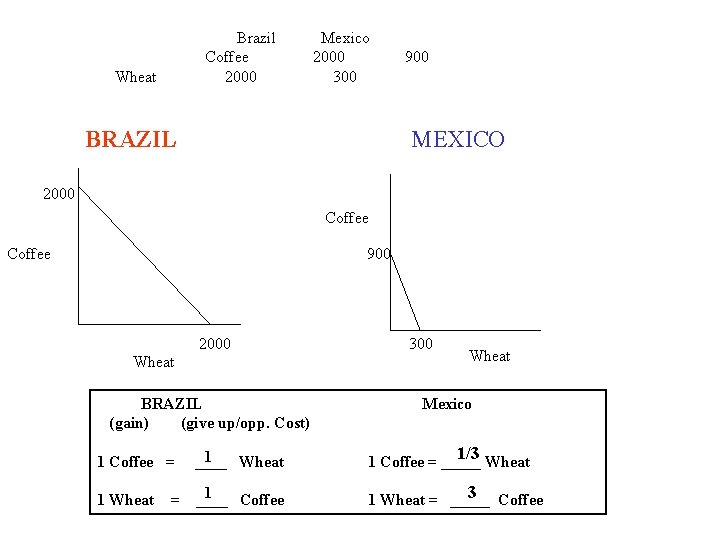
Brazil Coffee 2000 Wheat Mexico 2000 300 BRAZIL 900 MEXICO 2000 Coffee 900 2000 Wheat BRAZIL (gain) (give up/opp. Cost) 1 Coffee = 1 Wheat 1 ____ Wheat 1 = ____ Coffee 300 Wheat Mexico 1/3 Wheat 1 Coffee = _____ 3 Coffee 1 Wheat = _____
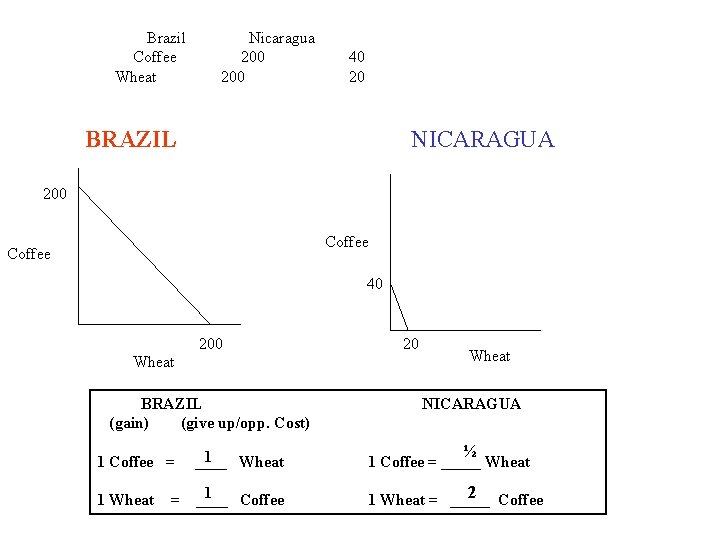
Brazil Coffee Wheat Nicaragua 200 40 20 BRAZIL NICARAGUA 200 Coffee 40 200 Wheat BRAZIL (gain) (give up/opp. Cost) 1 Coffee = 1 Wheat 1 ____ Wheat 1 = ____ Coffee 20 Wheat NICARAGUA ½ 1 Coffee = _____ Wheat 2 Coffee 1 Wheat = _____
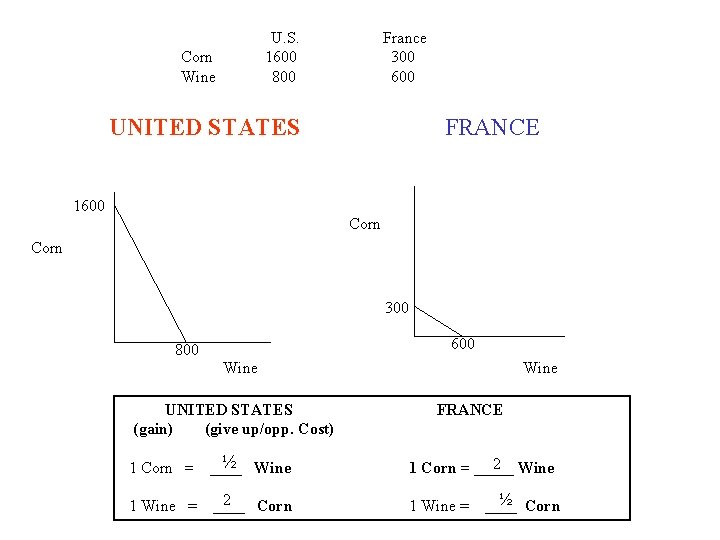
U. S. 1600 800 Corn Wine France 300 600 UNITED STATES FRANCE 1600 Corn 300 600 800 Wine UNITED STATES (gain) (give up/opp. Cost) ½ Wine 1 Corn = ____ 1 Wine = 2 ____ Corn Wine FRANCE 2 Wine 1 Corn = _____ 1 Wine = ½ Corn ____
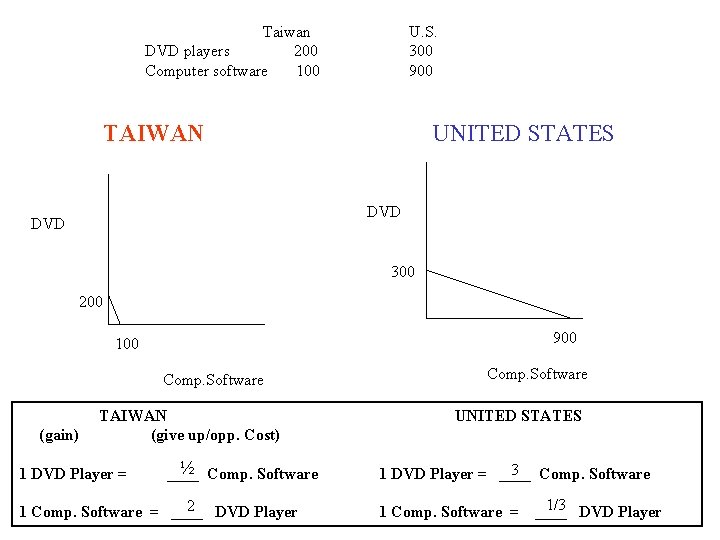
Taiwan DVD players 200 Computer software 100 U. S. 300 900 TAIWAN UNITED STATES DVD 300 200 900 100 Comp. Software (gain) TAIWAN (give up/opp. Cost) 1 DVD Player = ½ Comp. Software ____ 2 DVD Player 1 Comp. Software = ____ Comp. Software UNITED STATES 3 Comp. Software 1 DVD Player = ____ 1 Comp. Software = 1/3 DVD Player ____

Senior Cut Day
- Slides: 17