
Free State Agriculture Vrystaat Landbou Presentation to NERSA
Free State Agriculture / Vrystaat Landbou Presentation to NERSA: ESKOM tariff increase impacts on Agriculture in the Free State Louw Steytler President: Free State Agriculture www. vslandbou. co. za 1
Free State Agriculture / Vrystaat Landbou Presentation Outline: • Introduction to Free State Agriculture • Some Agricultural Statistics • Main issues RE ESKOM tariff increases: – Contrary to Government programmes • Land Reform - Impact on emerging farmers • Comprehensive Rural Development Programme – Use of environmental levy? – Effect on commercial agriculture • Irrigation industry • Intensive agriculture and – Conclusions – Suggestions 2
Free State Agriculture / Vrystaat Landbou VISION A dynamic, modern and directive organisation for agriculture in the Free State. MISSION To promote a safe and sustainable agricultural environment in the interest of sustainable food production in the Free State. 3
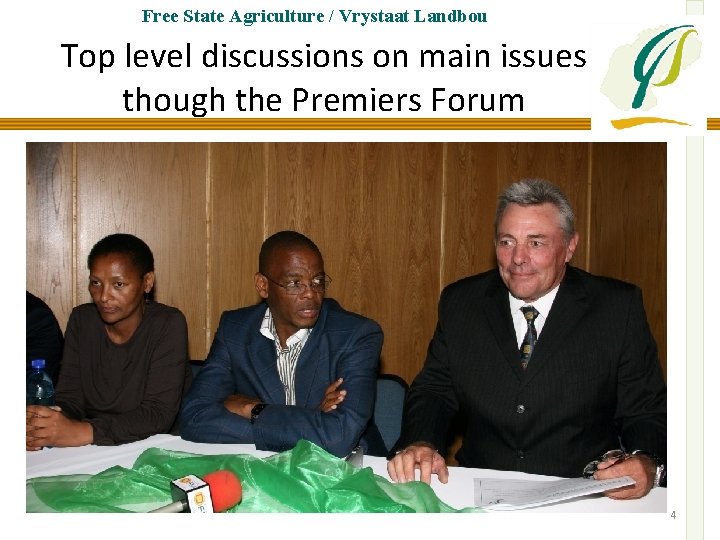
Free State Agriculture / Vrystaat Landbou Top level discussions on main issues though the Premiers Forum 4
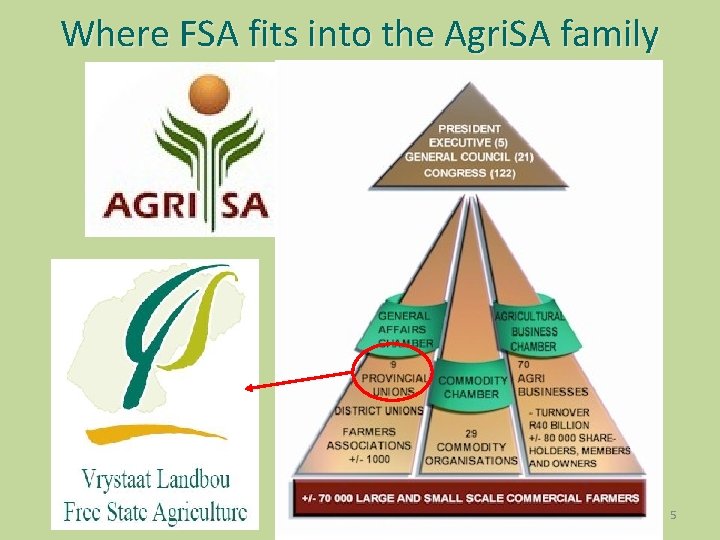
Where FSA fits into the Agri. SA family 5
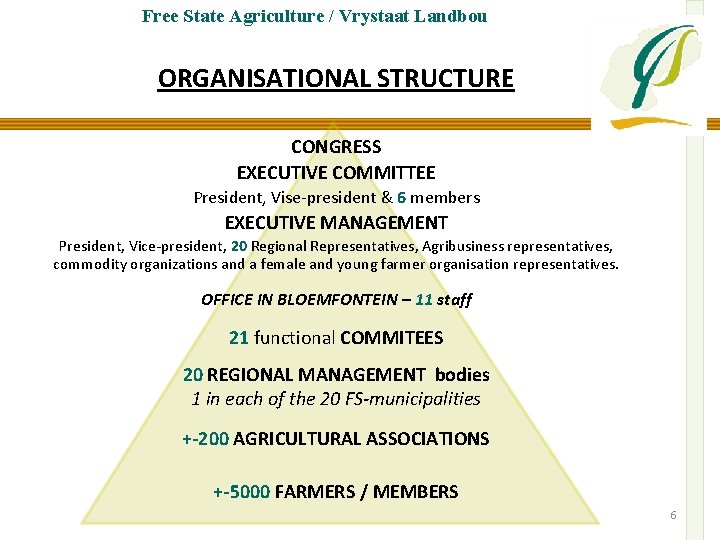
Free State Agriculture / Vrystaat Landbou ORGANISATIONAL STRUCTURE CONGRESS EXECUTIVE COMMITTEE President, Vise-president & 6 members EXECUTIVE MANAGEMENT President, Vice-president, 20 Regional Representatives, Agribusiness representatives, commodity organizations and a female and young farmer organisation representatives. OFFICE IN BLOEMFONTEIN – 11 staff 21 functional COMMITEES 20 REGIONAL MANAGEMENT bodies 1 in each of the 20 FS-municipalities +-200 AGRICULTURAL ASSOCIATIONS +-5000 FARMERS / MEMBERS 6
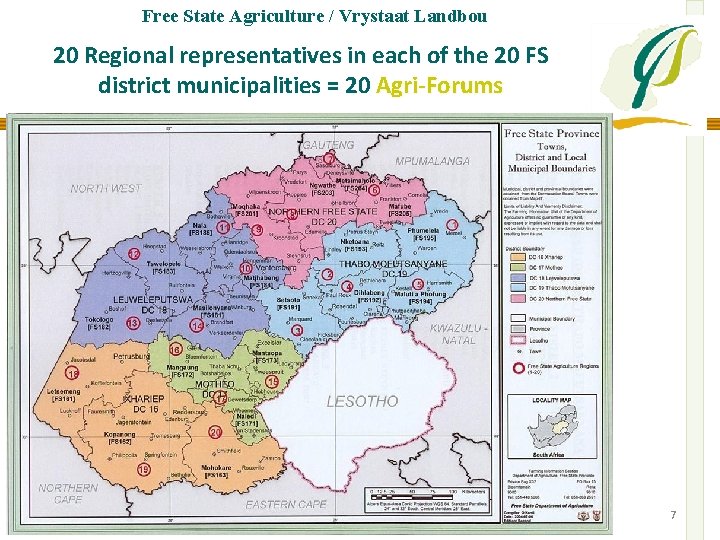
Free State Agriculture / Vrystaat Landbou 20 Regional representatives in each of the 20 FS district municipalities = 20 Agri-Forums 7
Free State Agriculture / Vrystaat Landbou Also speaking on behalf of our Commodity Organisation affiliates • Red Meat Producers Org. • Milk Producers Org. • Grain SA • National Wool Growers Ass. • Dry Bean Producers Org. • potatoes SA 8
Free State Agriculture / Vrystaat Landbou Also speaking on behalf of our Agri-Business affiliates SENWES OVK VKB GWK Suid. Wes 9
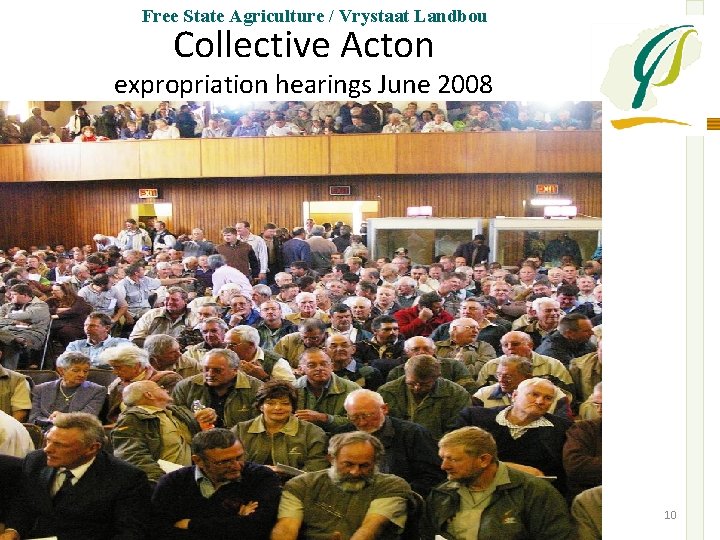
Free State Agriculture / Vrystaat Landbou Collective Acton expropriation hearings June 2008 10
Free State Agriculture / Vrystaat Landbou STATISTICS Source: www. statsonline. gov. za
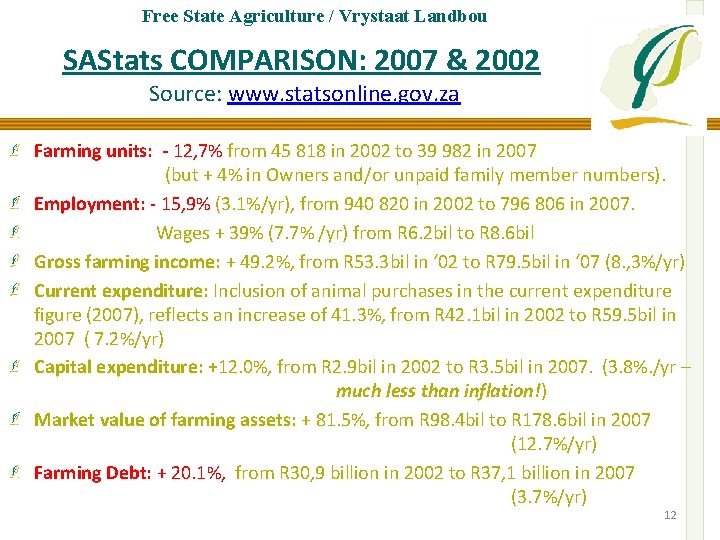
Free State Agriculture / Vrystaat Landbou SAStats COMPARISON: 2007 & 2002 Source: www. statsonline. gov. za Farming units: - 12, 7% from 45 818 in 2002 to 39 982 in 2007 (but + 4% in Owners and/or unpaid family member numbers). Employment: - 15, 9% (3. 1%/yr), from 940 820 in 2002 to 796 806 in 2007. Wages + 39% (7. 7% /yr) from R 6. 2 bil to R 8. 6 bil Gross farming income: + 49. 2%, from R 53. 3 bil in ‘ 02 to R 79. 5 bil in ‘ 07 (8. , 3%/yr) Current expenditure: Inclusion of animal purchases in the current expenditure figure (2007), reflects an increase of 41. 3%, from R 42. 1 bil in 2002 to R 59. 5 bil in 2007 ( 7. 2%/yr) Capital expenditure: +12. 0%, from R 2. 9 bil in 2002 to R 3. 5 bil in 2007. (3. 8%. /yr – much less than inflation!) Market value of farming assets: + 81. 5%, from R 98. 4 bil to R 178. 6 bil in 2007 (12. 7%/yr) Farming Debt: + 20. 1%, from R 30, 9 billion in 2002 to R 37, 1 billion in 2007 (3. 7%/yr) 12
Free State Agriculture / Vrystaat Landbou Free State Provincial Ag. STATS: Source: www. statsonline. gov. za The FS has the most farming units in the country (7 515 - 19% of total; FSA membership = 4556) The FS produces 26. 4% of nations field crops & 15, 9 % of nations animals on 10. 6% of the land area of South Africa FS Gross Farming income (R 11. 9 Bil – 15% of nat. ) FS Market value of assets (R 25. 1 Bil – 14% of nat. ) FS Farming Debt (R 6. 2 Bil – 16. 8% of nat. ) CRIME: FS has greatest loss to theft of tools (28%) & livestock (19%) & 2 nd greatest loss (Mpumulanga) to losses from burglaries (16%) DISASTER: FS has greatest loss of pastures (23%) & products from livestock / crops (17%) & 4 th greatest loss from veld fires (11%) EMPLOYMENT: 3. 4% of the total FS population receives employment on farms The ave. FS farmer employs 7. 2 full time & 6 part-time workers 13
Free State Agriculture / Vrystaat Landbou NERSA presentation 30 Nov 2009 • Speaking on behalf of +-5000 farmer members, who together with their spouses and dependants number over 25 000+ and an additional 100 000 affected farm workers; • As well as on behalf of the industry that makes the largest contribution to the GGP of most municipalities in the Free State; • Free State Agriculture hereby makes this submission out of concern of the ramifications of the proposed ESKOM tariff increases on the following: – Farm profitability and the resulting impact on employment in the agricultural sector – National food security and affordability of food – The already high cost of electricity to agriculture due to the high Service and Network charges, in addition to Energy charge, and – The fact that farm workers currently do not receive free basic electricity and that farmers in many instances are providing this to their workers. • Furthermore we would like to reiterate that farmers are price takers and thus have very little impact on the final retail price of food. If it becomes unprofitable to grow a crop, farmers will not plant it (& financiers may not finance such an enterprise according to the Banking Act) thus resulting in scarcity. Scarcity in turn pushes up prices to levels where it is profitable once again for farmers. This fluctuation in market prices results in instability in the sector resulting in disincentive for investment and growth.
Free State Agriculture / Vrystaat Landbou NERSA presentation 30 Nov 2009 • • Of particular concern are the following highly energy dependant agricultural enterprises: – The irrigation sector, – Intensive agricultural enterprises such as dairies, piggeries, poultry units, tunnels & green houses. These high energy primary enterprises produce in excess of 35% of the food we eat in South Africa (Irrigation 25% - Water Resource Commission Report, & Intensive industries >10%). Lack of international trade protection inter alia in the wheat industry for example has already exerted huge pressure on this winter crop for which there are limited alternatives. When farmers’ alternatives for production are constrained due to factors such as increasing energy costs, smaller & family farms are often the ones forced out of production and off their farms; to be bought out by industrial type farms that can still profit from economies of scale. This depopulates the countryside further degrading our struggling rural towns. The resulting impacts of proposed electricity tariff increases on rural towns are also totally contradictory to the current Government programs of the new Department of Rural Development and Land Reform aimed at rural revitalization through inter alia the formation of (energy dependant) agricultural value adding & processing industries
Free State Agriculture / Vrystaat Landbou Response to NERSA questions: • In short the following points: – A suggestion to the method of financing is an option to charge half a percentage more on the VAT rate (makes basic foods exempt) – RE the bad debt question: why must ESKOM carry bad debt of municipalities? Free State Agriculture requests enforcement of the political will / “teeth” to address this sustainably – Why does ESKOM (/the State as only shareholder) need to make a profit on the investments in ESKOM? What will be the effect if profit is kept at 0% profit for at least next 3 -4 years? – RE the Roads vs. freight rail debate for transporting coal – Free Sate Agriculture fully supports the proposal to transport as much coal as possible via rail due to the shocking state of roads in our rural areas
Free State Agriculture / Vrystaat Landbou Special appeal to exclude agriculture • The special appeal to exclude agriculture (Landrate / Ruraflex clients) in the price increases is due to the following facts: – Use <5% of National Electricity (<2. 5% of national energy) – 5 -20% reduction in Net Farm Income (BFAP model results) – this will put many marginal farmers out of business – If it’s going to hurt commercial agriculture how much more new emerging farmers? – Increased energy costs will also be totally counterproductive to the Governments Comprehensive Rural Development Strategy • To value adding co-operatives which will have large electricity costs components • Also a disincentive to live in rural areas where electricity is more expensive for paying customers due to high service and network charges. – Regarding the already high cost of electricity to agriculture due to the Service and Network charges, in addition to Energy charge: On an average farm with a R 2000/month account, this consist about 35%, making it a lot more expensive than a business in town. This percentage of the total Eskom bill however differs from farm to farm, and the amount of energy used in the enterprise composition of the farm. – It also reduces the incentives for large commercial farmers to sell land for land reform and intensify their operations into energy intensive value adding or intensive farming systems such as tunnels, chickens, pigs, dairies, etc.
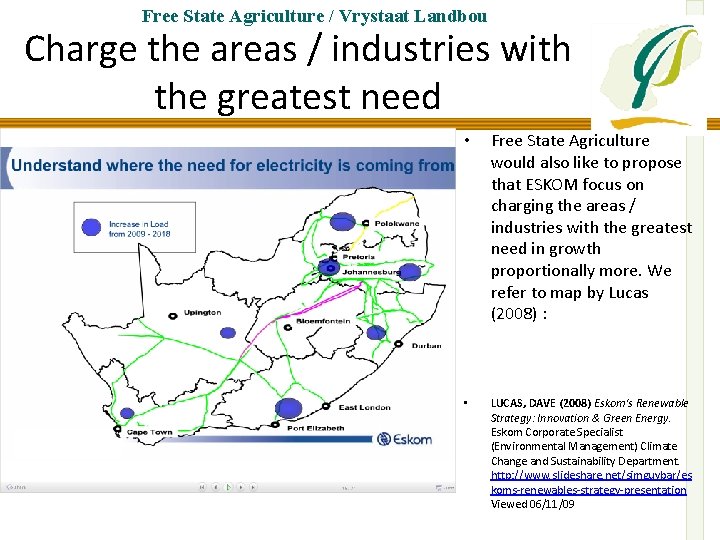
Free State Agriculture / Vrystaat Landbou Charge the areas / industries with the greatest need • Free State Agriculture would also like to propose that ESKOM focus on charging the areas / industries with the greatest need in growth proportionally more. We refer to map by Lucas (2008) : • LUCAS, DAVE (2008) Eskom's Renewable Strategy: Innovation & Green Energy. Eskom Corporate Specialist (Environmental Management) Climate Change and Sustainability Department. http: //www. slideshare. net/simguybar/es koms-renewables-strategy-presentation Viewed 06/11/09
Free State Agriculture / Vrystaat Landbou MAIN ISSUES: 35% ESKOM tariff increases will: - Reduce farm profitability & job losses - Lead to food insecurity & Increase food prices - Place a heavier burden on emerging irrigation and intensive farmers to ever become profitable
Free State Agriculture / Vrystaat Landbou Impact of 300% ESKOM increase on Irrigation profitability The BFAP / GSA / GWK model demonstrates the impact of the initial 300% ESKOM increase on Irrigation profitability in the GWK co-op service area of the Orange River, The following is evident: – The Eskom cost component of the irrigation maize production enterprise budget increases from 8% to 25% of total variable input costs (R/ha) – Irrigation maize profitability decreases by 468% – Breakeven yield at a price of R 1 418 / ton is 12. 61 tons – Breakeven price at 13 ton / ha yield is R 1 375 / ton – To make a profit at a yield of greater than 10 tons the Maize price must be greater than R 1 718 – At a Maize price of R 1 216 a yield in excess of 14 tons per ha will have to be achieved The impact on the currently barely profitable irrigation wheat enterprise budget is far more dramatic, so bearing in mind that most irrigation farmers in this area rely on a 1 & ½ crop per year rotation between wheat and maize, as well as the high fixed costs component of irrigation, these effects are substantial!
Free State Agriculture / Vrystaat Landbou Request Env. Levy for Agric. • Agriculture welcomes/insists on more renewable energy sources • Ag. potentially a major source of renewable energy production (bio-fuels) • Ag. has the land for renewable (solar / wind) • Ag insists that portion of Env. Levy be used for research into Alt. Ag. energy production • That Government allocate 10 x more that current R 15 mil to the Energy Subsidy Finance Office to move away from a Coal base
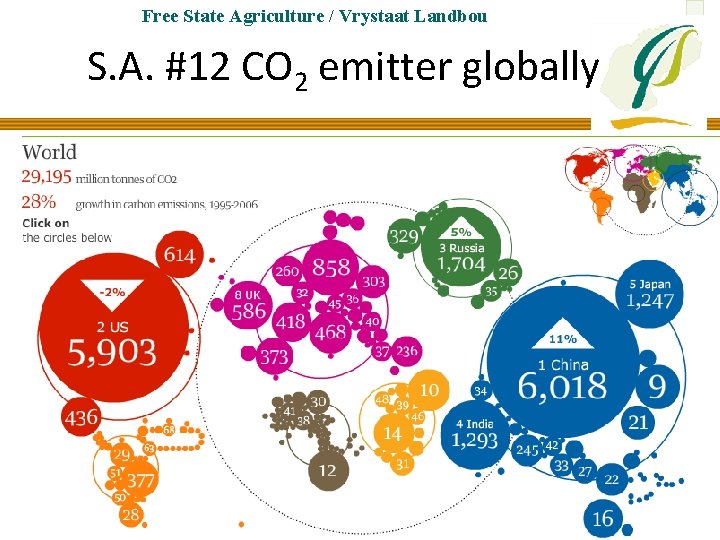
Free State Agriculture / Vrystaat Landbou S. A. #12 CO 2 emitter globally
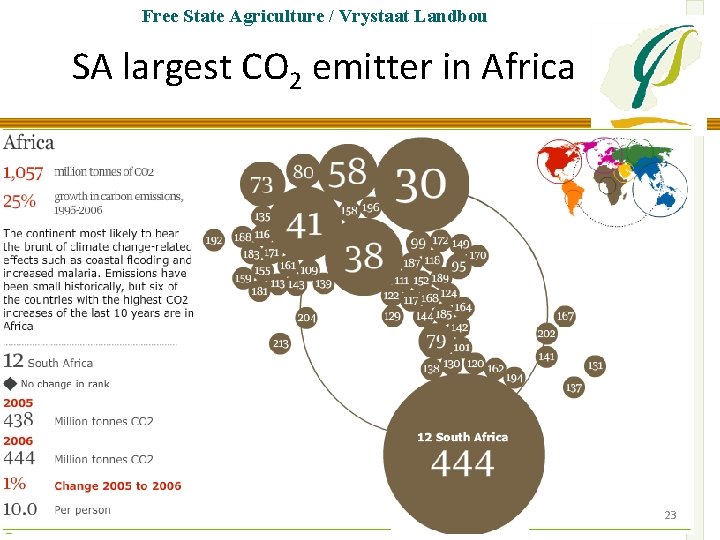
Free State Agriculture / Vrystaat Landbou SA largest CO 2 emitter in Africa 23
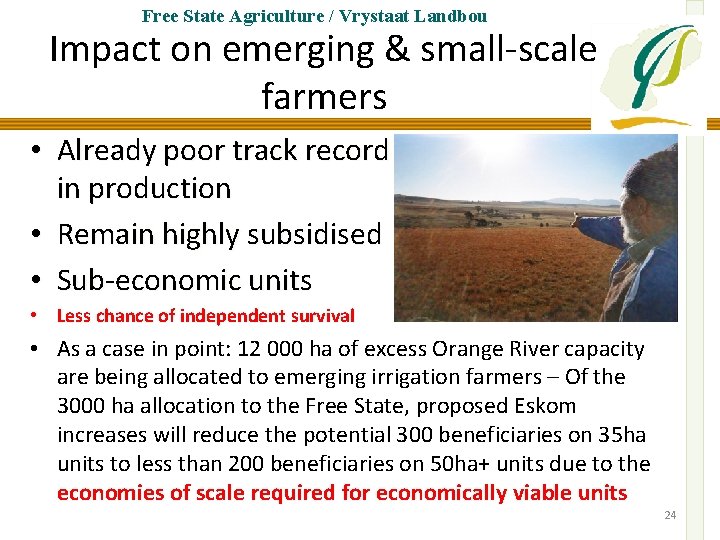
Free State Agriculture / Vrystaat Landbou Impact on emerging & small-scale farmers • Already poor track record in production • Remain highly subsidised • Sub-economic units • Less chance of independent survival • As a case in point: 12 000 ha of excess Orange River capacity are being allocated to emerging irrigation farmers – Of the 3000 ha allocation to the Free State, proposed Eskom increases will reduce the potential 300 beneficiaries on 35 ha units to less than 200 beneficiaries on 50 ha+ units due to the economies of scale required for economically viable units 24
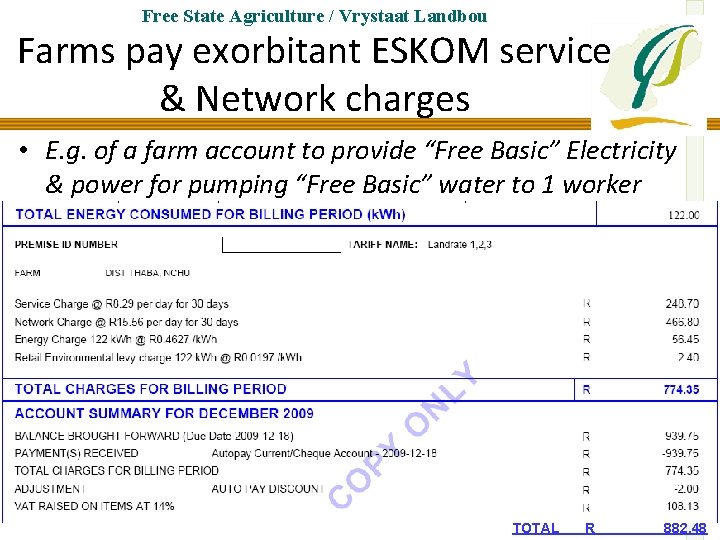
Free State Agriculture / Vrystaat Landbou Farms pay exorbitant ESKOM service & Network charges • E. g. of a farm account to provide “Free Basic” Electricity & power for pumping “Free Basic” water to 1 worker TOTAL R 882. 48
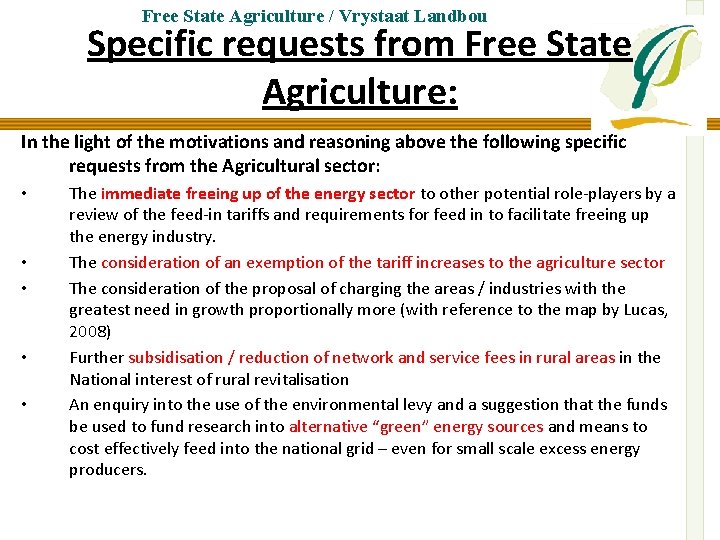
Free State Agriculture / Vrystaat Landbou Specific requests from Free State Agriculture: In the light of the motivations and reasoning above the following specific requests from the Agricultural sector: • • • The immediate freeing up of the energy sector to other potential role-players by a review of the feed-in tariffs and requirements for feed in to facilitate freeing up the energy industry. The consideration of an exemption of the tariff increases to the agriculture sector The consideration of the proposal of charging the areas / industries with the greatest need in growth proportionally more (with reference to the map by Lucas, 2008) Further subsidisation / reduction of network and service fees in rural areas in the National interest of rural revitalisation An enquiry into the use of the environmental levy and a suggestion that the funds be used to fund research into alternative “green” energy sources and means to cost effectively feed into the national grid – even for small scale excess energy producers.
Free State Agriculture / Vrystaat Landbou SUGGESTIONS TO NERSA: • Free up the energy sector • Make Agricultural ESKOM use exempt from increases (or at lease limit the allowed increase to 5 -10% per year) • Use Env. Levy for Alt. Ag. energy research • Make it easier for feeding into the grid
Free State Agriculture / Vrystaat Landbou CONCLUSIONS: Increases in ESKOM tariffs will: • further jeopardise Food Security in the Sub-Saharan Africa region and Increase Food Prices • Most affected industry: Irrigation (25% of the countries food from irrigation – stable production) • Will cause Severe Job Losses • Be contrary to Gov. s Land Reform & Rural Dev. Policy • Farmer are price takers not price makers so can’t adjust accordingly in a short time. • WE CANNOT AFFORD THE INCREASE!
Free State Agriculture / Vrystaat Landbou Life is not about waiting for the storm to pass, it’s about learning to dance in the rain. (Alan Knott-Craig) 29
Thank you! info@vslandbou. co. za 30
- Slides: 30