
Free Fall Motion Vertical Kinematics Galileo Galilei Did
- Slides: 14
Free Fall Motion Vertical Kinematics
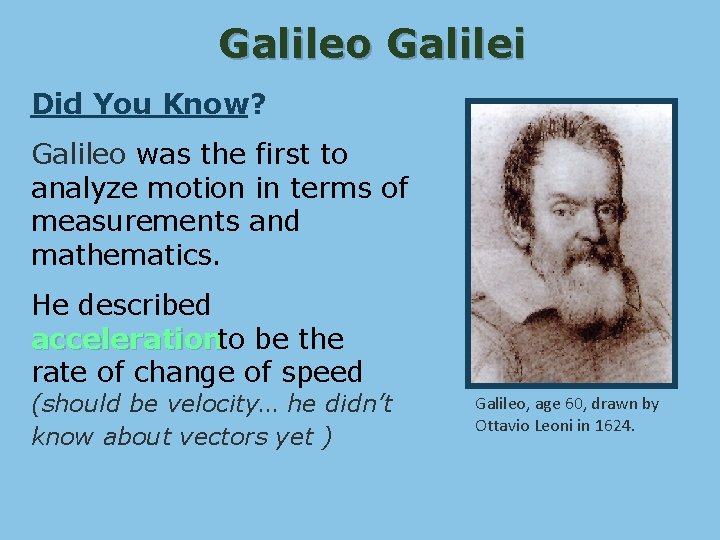
Galileo Galilei Did You Know? Galileo was the first to analyze motion in terms of measurements and mathematics. He described accelerationto be the rate of change of speed (should be velocity… he didn’t know about vectors yet ) Galileo, age 60, drawn by Ottavio Leoni in 1624.
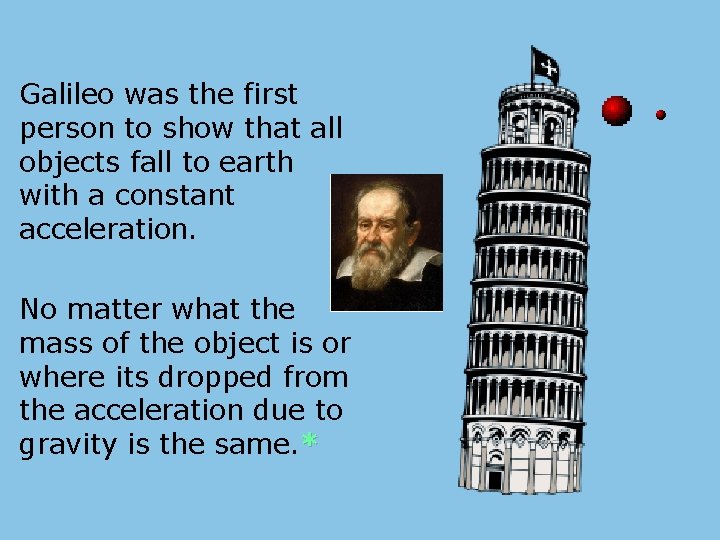
Galileo was the first person to show that all objects fall to earth with a constant acceleration. No matter what the mass of the object is or where its dropped from the acceleration due to gravity is the same. *
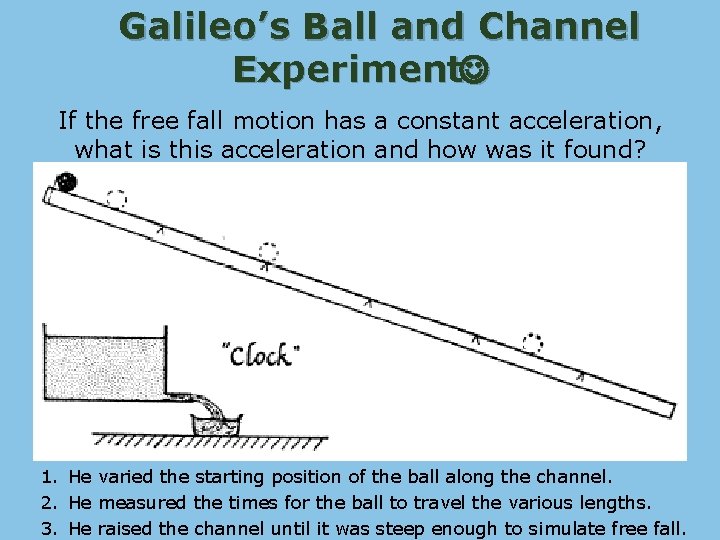
Galileo’s Ball and Channel Experiment If the free fall motion has a constant acceleration, what is this acceleration and how was it found? 1. He varied the starting position of the ball along the channel. 2. He measured the times for the ball to travel the various lengths. 3. He raised the channel until it was steep enough to simulate free fall.
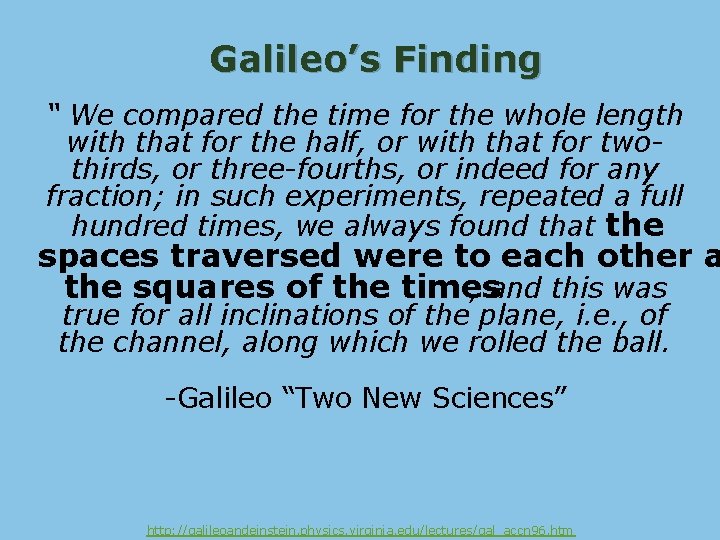
Galileo’s Finding “ We compared the time for the whole length with that for the half, or with that for twothirds, or three-fourths, or indeed for any fraction; in such experiments, repeated a full hundred times, we always found that the spaces traversed were to each other a the squares of the times , and this was true for all inclinations of the plane, i. e. , of the channel, along which we rolled the ball. -Galileo “Two New Sciences” http: //galileoandeinstein. physics. virginia. edu/lectures/gal_accn 96. htm
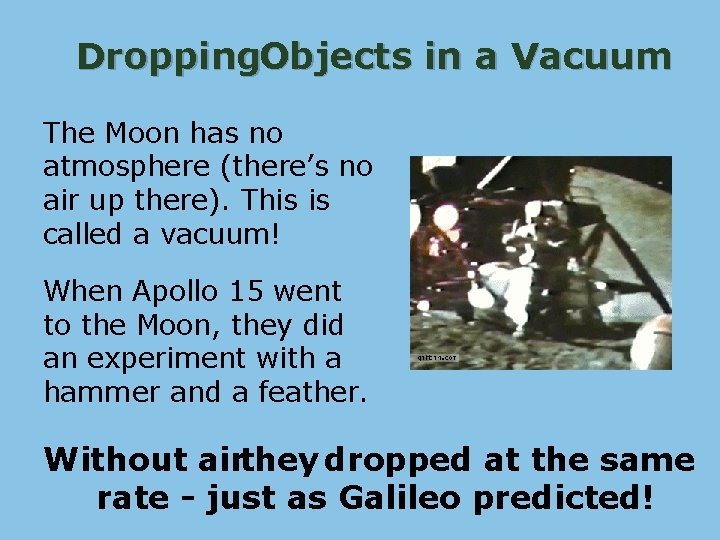
Dropping. Objects in a Vacuum The Moon has no atmosphere (there’s no air up there). This is called a vacuum! When Apollo 15 went to the Moon, they did an experiment with a hammer and a feather. Without airthey dropped at the same rate - just as Galileo predicted!
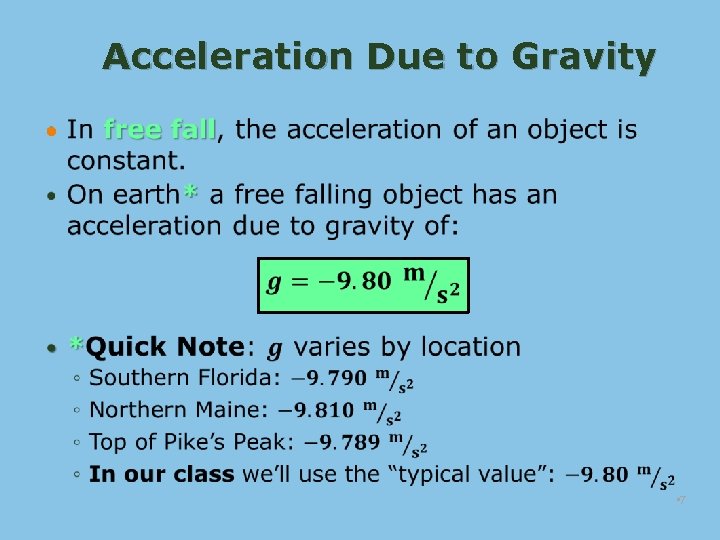
Acceleration Due to Gravity • 7
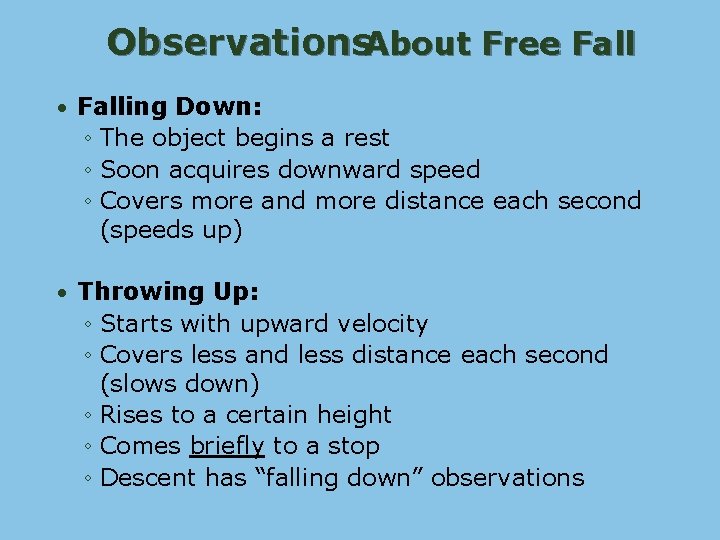
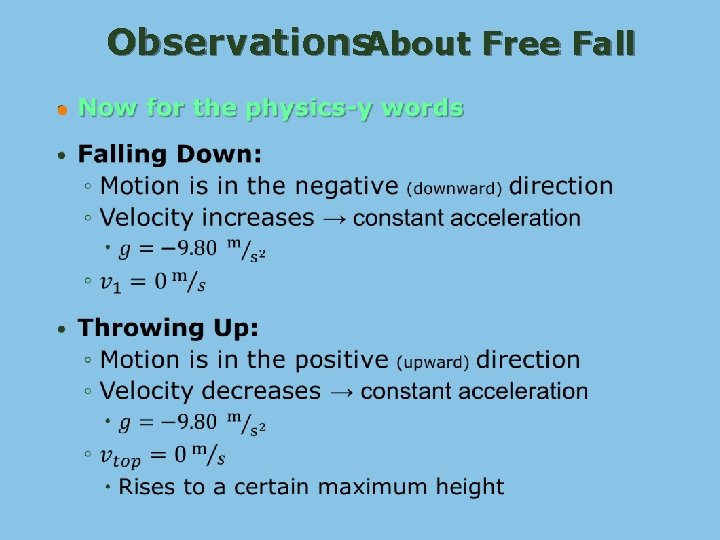
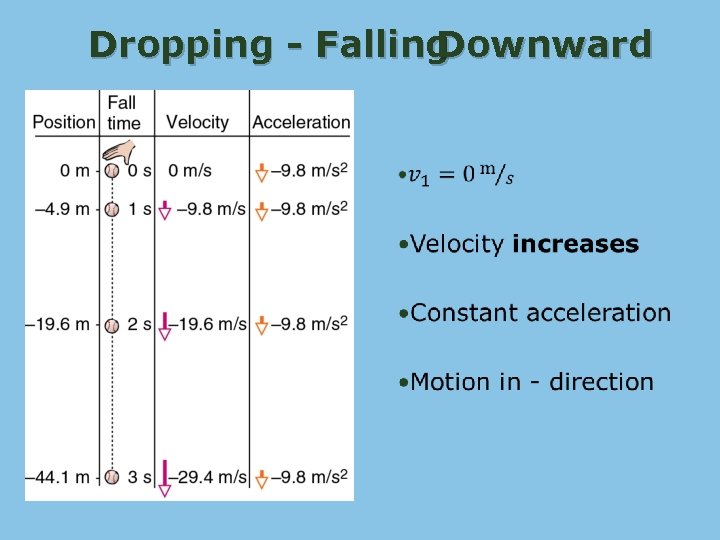
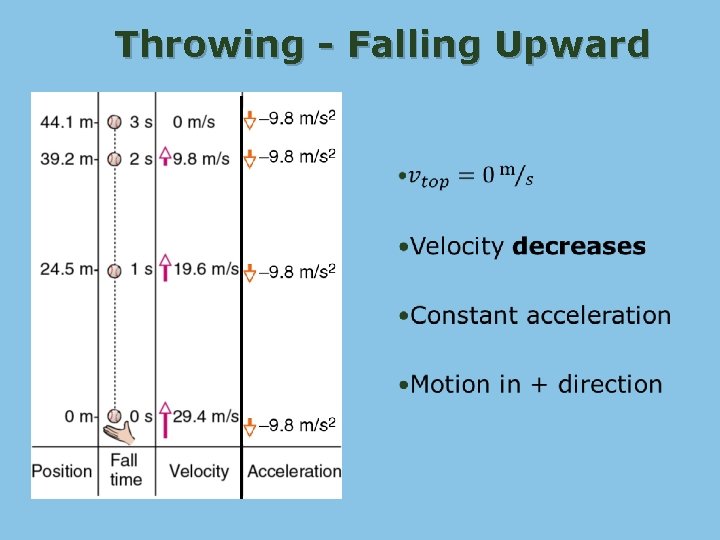
Observations. About Free Falling Down: ◦ The object begins a rest ◦ Soon acquires downward speed ◦ Covers more and more distance each second (speeds up) Throwing Up: ◦ Starts with upward velocity ◦ Covers less and less distance each second (slows down) ◦ Rises to a certain height ◦ Comes briefly to a stop ◦ Descent has “falling down” observations
Observations. About Free Fall
Dropping - Falling. Downward •
Throwing - Falling Upward •
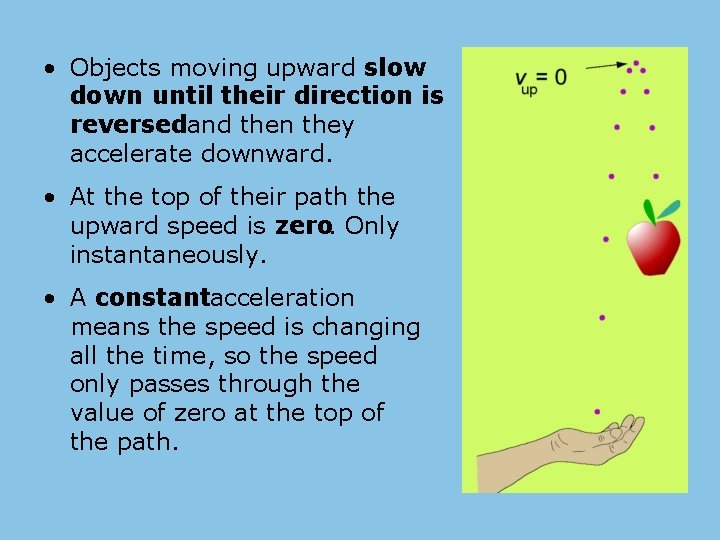
• Objects moving upward slow down until their direction is reversedand then they accelerate downward. • At the top of their path the upward speed is zero. Only instantaneously. • A constantacceleration means the speed is changing all the time, so the speed only passes through the value of zero at the top of the path.
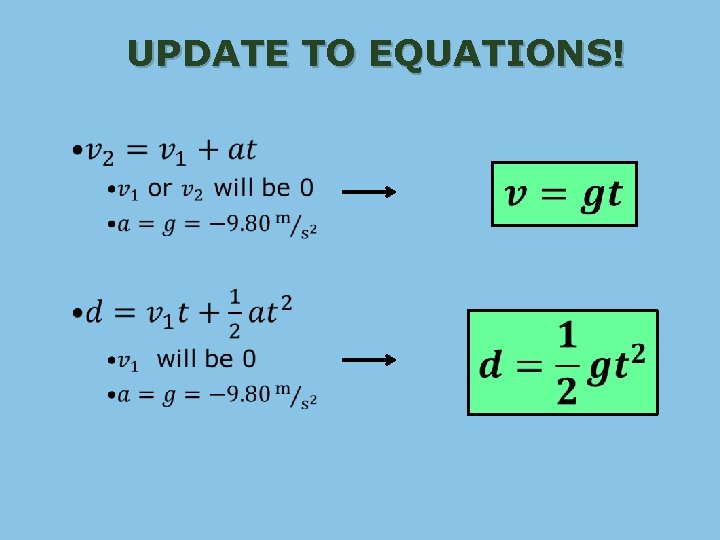
UPDATE TO EQUATIONS! • • •
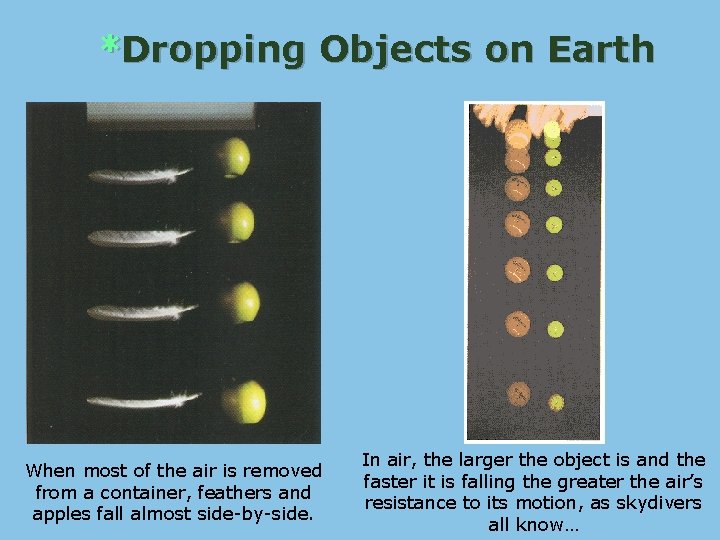
*Dropping Objects on Earth When most of the air is removed from a container, feathers and apples fall almost side-by-side. In air, the larger the object is and the faster it is falling the greater the air’s resistance to its motion, as skydivers all know…