
Free Fall Lecture 4 Law of Falling Bodies
Free Fall Lecture 4

Law of Falling Bodies • In a vacuum, all objects fall at the same rate regardless of its mass. – Always true in a vacuum (no air resistance) – Free fall is when gravity is only force acting on an object as it falls – True also if objects do not reach terminal velocity during fall. • A body falling from rest near the Earth – Falls increasing distances each second – Increases speed each second – Has an acceleration of 9. 81 m/s/s~10 m/s/s

Free Fall-How Fast and How Far? For object starting from rest; g = 9. 81 m/s/s ~10 m/s/s Time Instant (seconds) Instantaneous Speed (m/s) Instantaneous Position (m) 0 0 0 1 -10 -5 2 -20 3 -30 -45 4 -40 -80 5 -50 -125 t -gt -1/2 gt 2

Up and Down Upward shot object Downward shot object • Will go higher than object dropped from rest • Velocity is positive and the acceleration of gravity is negative • Dx=v 0 Dt -1/2 g. Dt 2 • Vf=V 0 -g. Dt • Vf 2 = V 02 -2 g. Dx • Dx=((Vf – V 0) /2) Dt • Will go lower than object dropped from rest • Velocity and acceleration of gravity are negative. • Dx=-v 0 Dt -1/2 g. Dt 2 • Vf=-V 0 -g. Dt • Vf 2 = -V 02 -2 g. Dx • Dx=((-Vf – V 0) /2) Dt
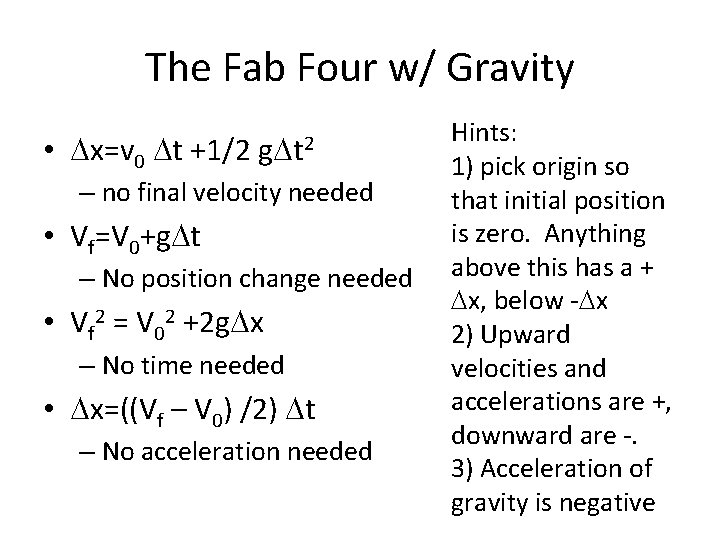
The Fab Four w/ Gravity • Dx=v 0 Dt +1/2 g. Dt 2 – no final velocity needed • Vf=V 0+g. Dt – No position change needed • Vf 2 = V 02 +2 g. Dx – No time needed • Dx=((Vf – V 0) /2) Dt – No acceleration needed Hints: 1) pick origin so that initial position is zero. Anything above this has a + Dx, below -Dx 2) Upward velocities and accelerations are +, downward are -. 3) Acceleration of gravity is negative
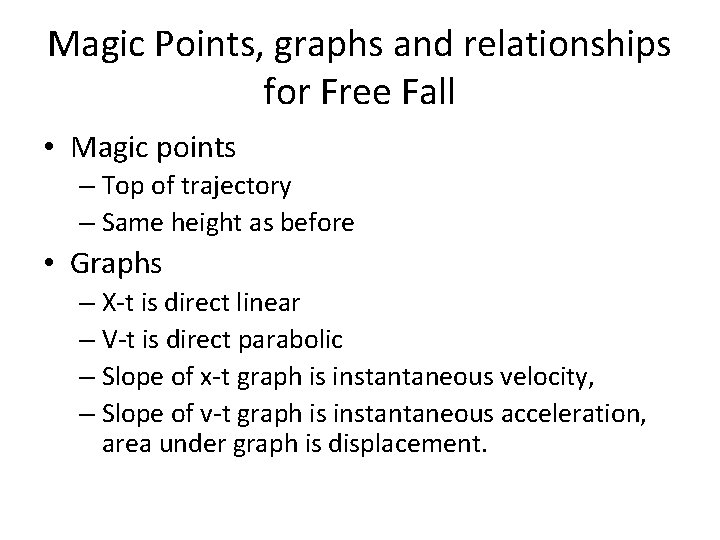
Magic Points, graphs and relationships for Free Fall • Magic points – Top of trajectory – Same height as before • Graphs – X-t is direct linear – V-t is direct parabolic – Slope of x-t graph is instantaneous velocity, – Slope of v-t graph is instantaneous acceleration, area under graph is displacement.
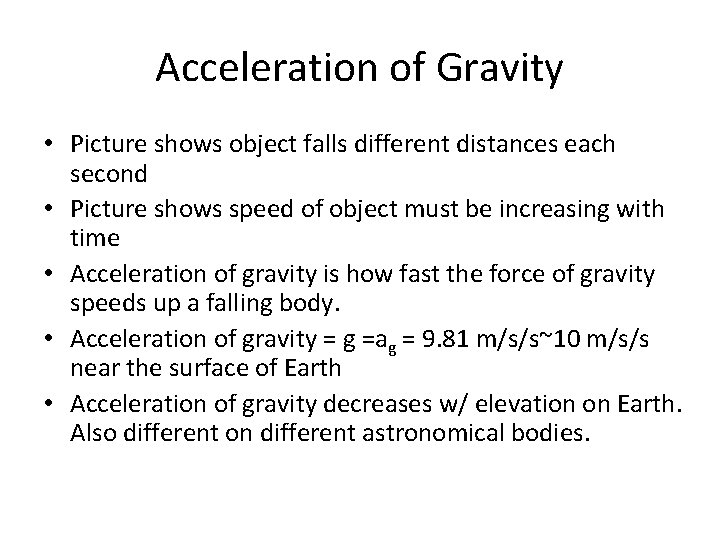
Acceleration of Gravity • Picture shows object falls different distances each second • Picture shows speed of object must be increasing with time • Acceleration of gravity is how fast the force of gravity speeds up a falling body. • Acceleration of gravity = g =ag = 9. 81 m/s/s~10 m/s/s near the surface of Earth • Acceleration of gravity decreases w/ elevation on Earth. Also different on different astronomical bodies.
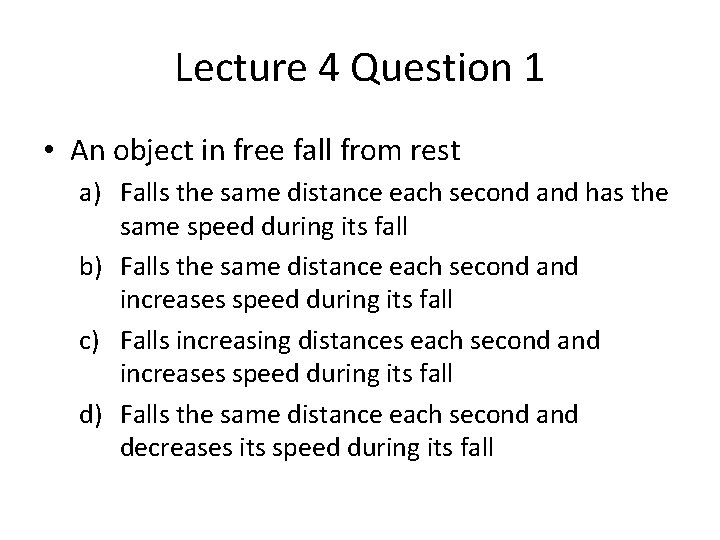
Lecture 4 Question 1 • An object in free fall from rest a) Falls the same distance each second and has the same speed during its fall b) Falls the same distance each second and increases speed during its fall c) Falls increasing distances each second and increases speed during its fall d) Falls the same distance each second and decreases its speed during its fall
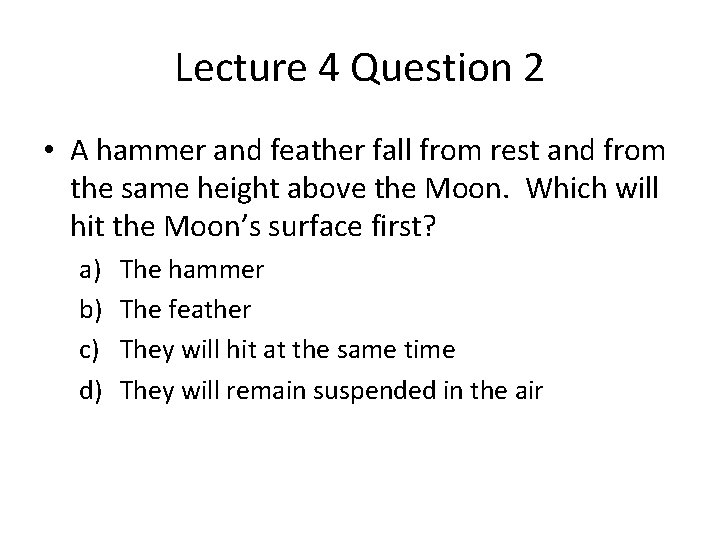
Lecture 4 Question 2 • A hammer and feather fall from rest and from the same height above the Moon. Which will hit the Moon’s surface first? a) b) c) d) The hammer The feather They will hit at the same time They will remain suspended in the air
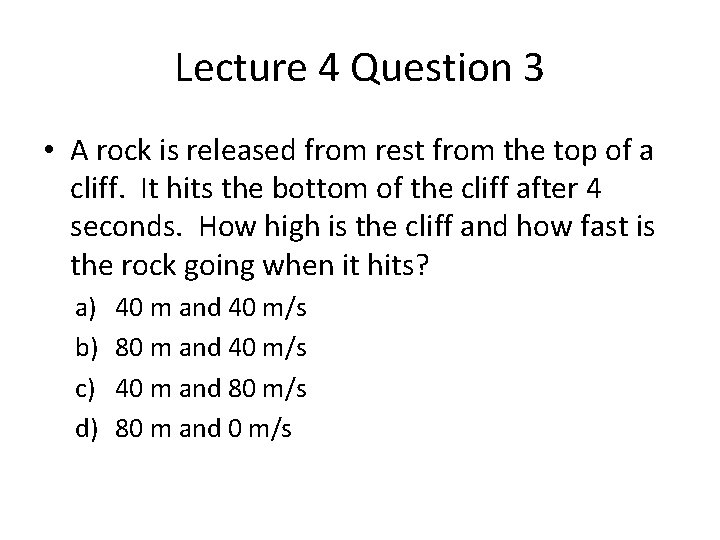
Lecture 4 Question 3 • A rock is released from rest from the top of a cliff. It hits the bottom of the cliff after 4 seconds. How high is the cliff and how fast is the rock going when it hits? a) b) c) d) 40 m and 40 m/s 80 m and 40 m/s 40 m and 80 m/s 80 m and 0 m/s
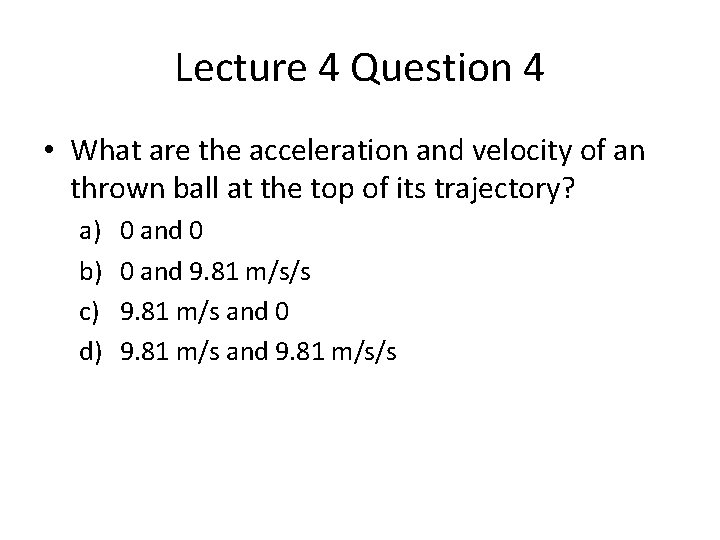
Lecture 4 Question 4 • What are the acceleration and velocity of an thrown ball at the top of its trajectory? a) b) c) d) 0 and 0 0 and 9. 81 m/s/s 9. 81 m/s and 0 9. 81 m/s and 9. 81 m/s/s
Lecture 4 Question 5 • The slope and area under a v-t graph correspond to what? a) b) c) d) Speed and displacement Acceleration and displacement Distance and displacement Speed and acceleration
- Slides: 12