
Frederick Sanger Niket Yadav Early Life Born August
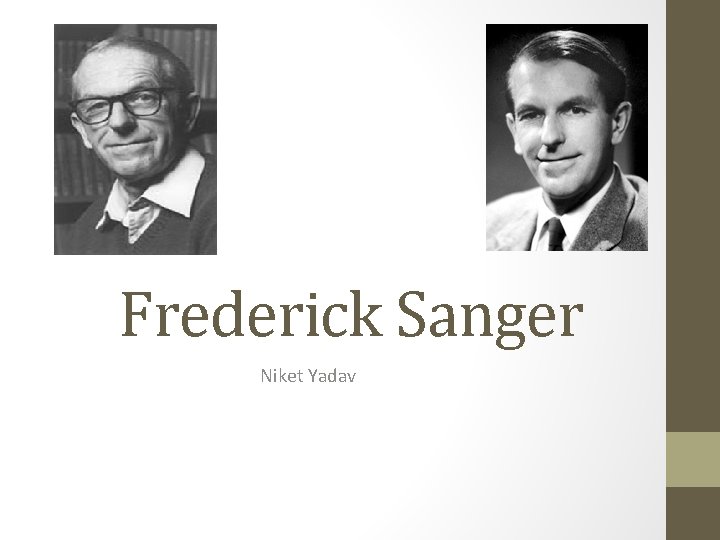
Frederick Sanger Niket Yadav
Early Life • • Born August 13, 1918 in England Son of a physician Studied Natural Sciences at St. John’s College, Cambridge Got his Ph. D in 1943 • Thesis: The metabolism of the amino acid lysine in the animal body
Notable Awards • Nobel Prize in Chemistry (1958) • Royal Medal (1969)-for his work on protein and RNA sequencing • Gairdner Foundation International Award (1971)-for his scientific discoveries • William Bate Hardy Prize (1976)-Cambridge award for biomedical research • Copley Medal (1977)-outstanding achievements in science • Louisa Gross Horwitz Prize (1979)-exceptional contributions in biochemistry and biology • Nobel Prize in Chemistry (1980)
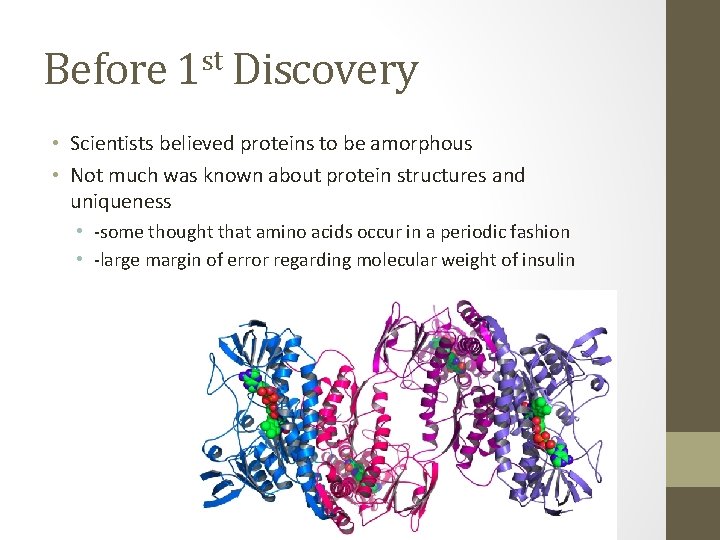
Before 1 st Discovery • Scientists believed proteins to be amorphous • Not much was known about protein structures and uniqueness • -some thought that amino acids occur in a periodic fashion • -large margin of error regarding molecular weight of insulin
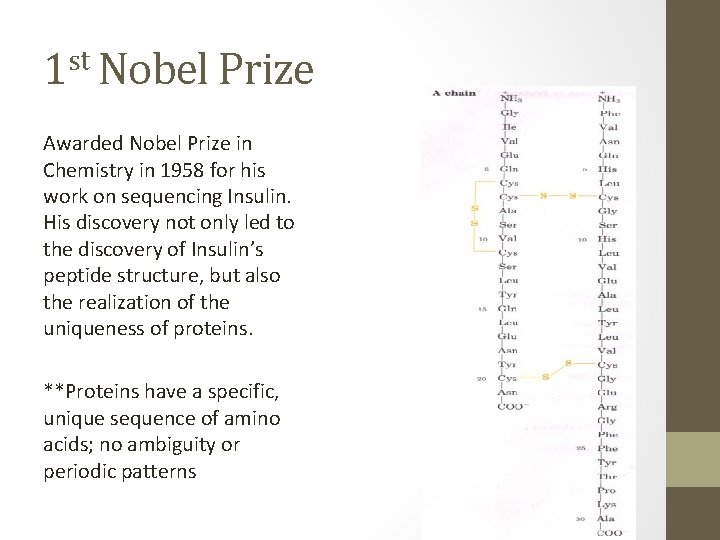
1 st Nobel Prize Awarded Nobel Prize in Chemistry in 1958 for his work on sequencing Insulin. His discovery not only led to the discovery of Insulin’s peptide structure, but also the realization of the uniqueness of proteins. **Proteins have a specific, unique sequence of amino acids; no ambiguity or periodic patterns
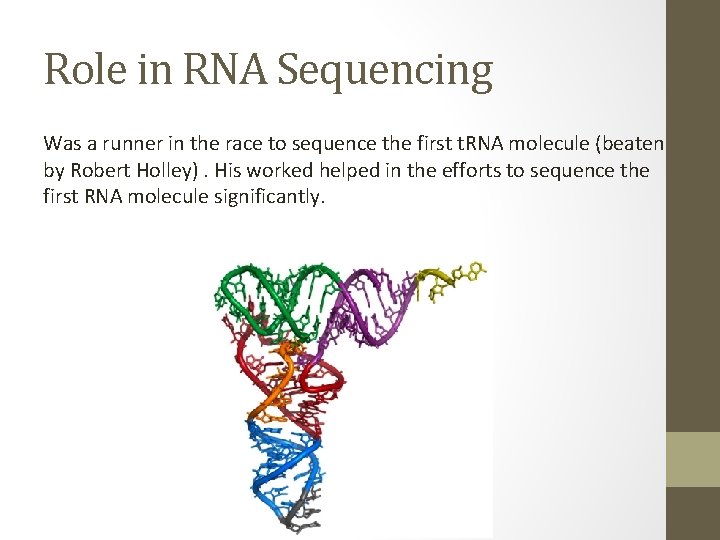
Role in RNA Sequencing Was a runner in the race to sequence the first t. RNA molecule (beaten by Robert Holley). His worked helped in the efforts to sequence the first RNA molecule significantly.
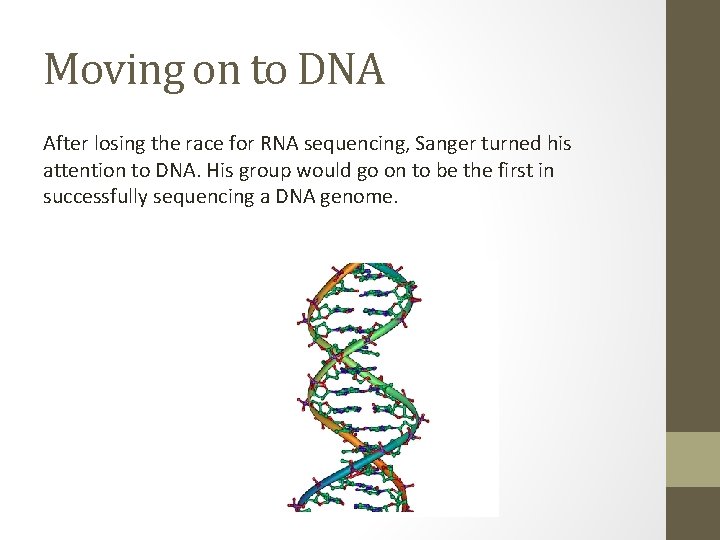
Moving on to DNA After losing the race for RNA sequencing, Sanger turned his attention to DNA. His group would go on to be the first in successfully sequencing a DNA genome.
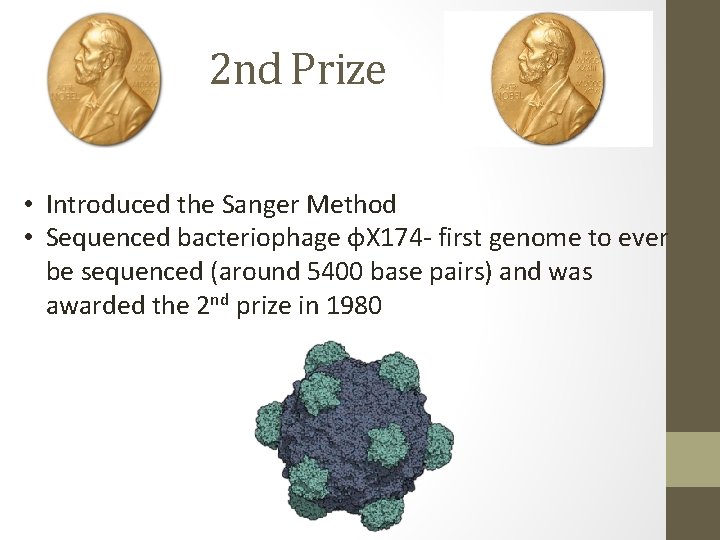
2 nd Nobe 2 nd Prize • Introduced the Sanger Method • Sequenced bacteriophage φX 174 - first genome to ever be sequenced (around 5400 base pairs) and was awarded the 2 nd prize in 1980
The Sanger Method • In his work, Sanger discovered that some coding regions of DNA overlapped. • Dideoxy termination-allowed large DNA sections to be sequenced accurately and quickly. • Using this method, Sanger and his colleagues went on to sequence mitochondrial DNA, which had around 16, 000 bp. • Eventually, this method allowed us to sequence the entire human genome!
Later Life • Retired in 1983 and devoted himself to his family and gardening. • Died on November 19, 2013
Other Facts • Torn between science and religion—based on his understanding of science, he found it hard to believe religious ideas. • Did most of his experiments himself, on the bench, rather than having others do it for him • A genomic research center was named after him---the Sanger Institute. • Declined a knighthood because he didn’t want to be called ‘Sir’; “A knighthood makes you different and I don’t want to be different. ”
Sources • http: //www. nytimes. com/2013/11/21/science/fredericksanger-two-time-nobel-winning-scientist-dies-at 95. html? pagewanted=all&_r=0 • http: //www. nature. com/scitable/topicpage/frederick-sangermethod-man-problem-solver-6537485 • https: //unlockinglifescode. org/timeline/11 • http: //www. nobelprize. org/nobel_prizes/chemistry/laureates /1958/sanger-lecture. pdf • http: //www. nobelprize. org/nobel_prizes/chemistry/laureates /1980/sanger-lecture. pdf • http: //en. wikipedia. org/wiki/Frederick_Sanger
- Slides: 12