
FREDERICK E BERRY LIBRARY AND LEARNING COMMONS INTEGRATED
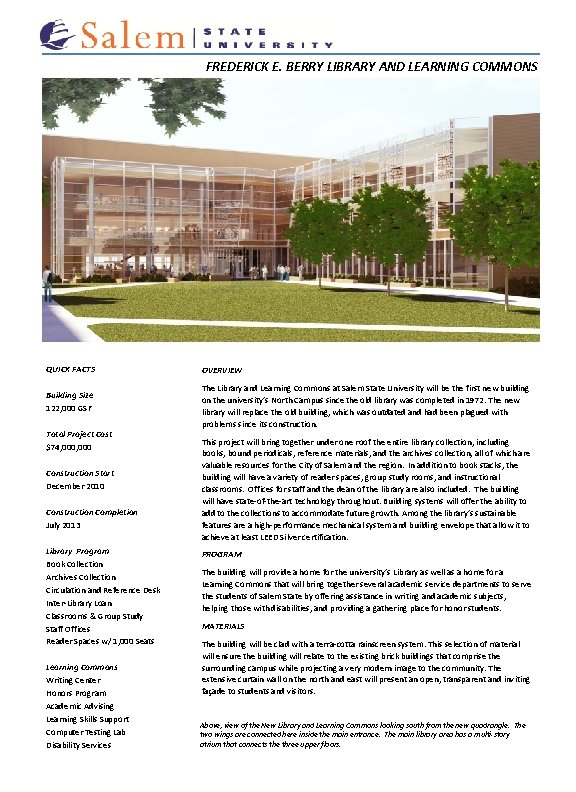
FREDERICK E. BERRY LIBRARY AND LEARNING COMMONS INTEGRATED SCIENCES COMPLEX UNIVERSITY OF MASSACHUSETTS BOSTON QUICK FACTS OVERVIEW Building Size 122, 000 GSF The Library and Learning Commons at Salem State University will be the first new building on the university’s North Campus since the old library was completed in 1972. The new library will replace the old building, which was outdated and had been plagued with problems since its construction. Total Project Cost $74, 000 Construction Start December 2010 Construction Completion July 2013 Library Program Book Collection Archives Collection Circulation and Reference Desk Inter-Library Loan Classrooms & Group Study Staff Offices Reader Spaces w/ 1, 000 Seats Learning Commons Writing Center Honors Program Academic Advising Learning Skills Support Computer Testing Lab Disability Services This project will bring together under one roof the entire library collection, including books, bound periodicals, reference materials, and the archives collection, all of which are valuable resources for the City of Salem and the region. In addition to book stacks, the building will have a variety of reader spaces, group study rooms, and instructional classrooms. Offices for staff and the dean of the library are also included. The building will have state-of-the-art technology throughout. Building systems will offer the ability to add to the collections to accommodate future growth. Among the library’s sustainable features are a high-performance mechanical system and building envelope that allow it to achieve at least LEED Silver certification. PROGRAM The building will provide a home for the university’s Library as well as a home for a Learning Commons that will bring together several academic service departments to serve the students of Salem State by offering assistance in writing and academic subjects, helping those with disabilities, and providing a gathering place for honor students. MATERIALS The building will be clad with a terra-cotta rainscreen system. This selection of material will ensure the building will relate to the existing brick buildings that comprise the surrounding campus while projecting a very modern image to the community. The extensive curtain wall on the north and east will present an open, transparent and inviting façade to students and visitors. Above, view of the New Library and Learning Commons looking south from the new quadrangle. The two wings are connected here inside the main entrance. The main library area has a multi-story atrium that connects the three upper floors.

Left, a view looking northeast from College Drive at the Library and Learning Commons entry. At right, a view of the main entry from the new quadrangle. PROJECT TEAM Architect Shepley Bulfinch Mechanical, Plumbing, & Fire Protection Engineer RDK Engineers Electrical Engineer ART Engineering SITE AND BUILDING DESIGN The building was designed with the intent of transforming the North Campus by creating an internal quadrangle that will provide a sense of place for the community. This will strengthen the role of the North Campus as the academic heart of the university. The addition of this large green space within the campus will provide opportunities for play, learning and gatherings. A large bio-retention area will mitigate stormwater and provide a natural landscape to the west of the building. Site and landscape design are integral to the library’s success. The sloped site allows for two primary entrances to the building on two different levels, providing an inviting connection between the commuter parking lot and dorm to the south and the new quadrangle to the north. Structural Engineer Simpson, Gumpertz & Heger The building’s transparency is an important gesture to the larger community that the activities inside the new building, as well as those throughout the campus, are open to all. Civil Engineer Nitsch Engineering SUSTAINABLE FEATURES Landscape Architect Mik. Young Kim Design Code Consultant RW Sullivan Cost Consultant Keville Enterprises, Inc. • Improved stormwater quality control • Construction waste management, diverting waste materials from disposal • Use of regional materials • Low-emitting construction materials • High-performance glazing to reduce heat gain and maximize daylight transmission • Daylight sensors and light fixture dimming (daylight harvesting) to reduce power use • Reduced water use with low-water-usage plumbing fixtures • Mechanical system ready for addition of ground-source heat pumps (geothermal wells) • Roof structure designed for the addition of PV panels for on-site electricity generation Commissioning Agent WSP Flack & Kurtz Construction Manager Lee Kennedy Company
- Slides: 2