
FRCS General Surgery exam tips for breast trainees
FRCS General Surgery exam: tips for breast trainees in line with the new examination format Mr Baek Kim FRCS MD MA ST 7 General Surgery Yorkshire deanery Mammary Fold education and training rep 2016
Application process • Outcome 1 at ST 6 ARCP is required for eligibility with use of the ST 6 checklist • Send up to date CV, logbook, and three references including from the training programme director • Part 1: MCQ and EMI questions • Part 2: Viva and clinicals
Part I • Two papers: MCQ paper in the morning and EMI in the afternoon. • Tests breath of knowledge in General surgery • Few questions on breast surgery • Greater emphasis on emergency general surgery • Exams conducted in driving centres
Recommended books and websites for part I • www. efrcs. com • www. onexamination. com • FRCS general surgery: 500 SBAs and EMIs by Wilson et al (green book) • Rush university medical center review of surgery: expert consult- online and print (quite detailed but the online version is useful for question practise)

• Practise attempting questions in a timed setting • In the actual exam there is little time to spare and there will be ambiguous questions with more than one potential right answer • Pass mark around 70% at the last sitting in 2015. The marks from the two papers are combined for a final mark.
Part two • Viva: whole day comprising of 4 sections • Emergency/trauma/critical care (30 minutes): x 6 questions with about 5 minute per question • General surgery (30 minutes): as above • Academic viva and principle of surgery/basic science (30 minutes): 30 minutes to read a breast paper. 15 minutes to critique paper followed by 15 minutes testing knowledge in breast surgery (including basic science).
• Breast specialty viva (30 minutes): x 6 questions with about 5 minute per question • Clinicals: half day comprising of one long case (20 minutes) and two short cases (10 minutes each) • Therefore, 40 minute general surgery clinical and a further 40 minute breast clinical
Tips for part two • Revise with other registrars and practice answering viva questions (ideally a GI trainee and breast trainee also) • Ask consultants for viva practice. Some deaneries have mock viva sessions. • Utilise clinics to fine tune history taking and examination skillssignificant amount of the clinicals are spent taking detailed history and examination just like in day-to-day clinics. • Practice presenting in journal clubs with focus on how to critique breast papers • Get used to interpreting CT scans (very common to be shown radiological images during the exam)/ questions on consenting for common procedures • Courses are of high value (e. g. Manchester alpine course and Whipps cross course etc. )
Reading list for part two • Cracking the intercollegiate general surgery FRCS viva by Ball, Walsh, and Tang • FRCS: companion cases for the intercollegiate exam in general surgery by Kumar and Phillips • NICE guidelines: can be downloaded as an app onto i. Pad • ATLS manual • Companion series • Surgical critical care vivas by Kanani (used for MRCS- also useful for FRCS)
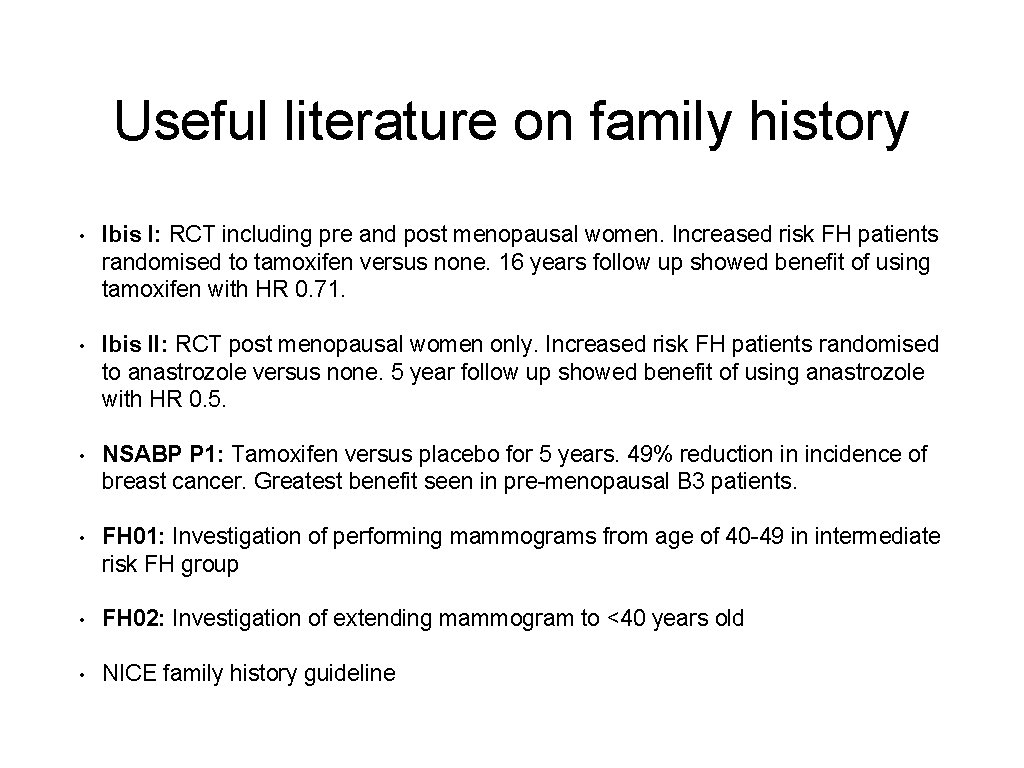
Useful literature on family history • Ibis I: RCT including pre and post menopausal women. Increased risk FH patients randomised to tamoxifen versus none. 16 years follow up showed benefit of using tamoxifen with HR 0. 71. • Ibis II: RCT post menopausal women only. Increased risk FH patients randomised to anastrozole versus none. 5 year follow up showed benefit of using anastrozole with HR 0. 5. • NSABP P 1: Tamoxifen versus placebo for 5 years. 49% reduction in incidence of breast cancer. Greatest benefit seen in pre-menopausal B 3 patients. • FH 01: Investigation of performing mammograms from age of 40 -49 in intermediate risk FH group • FH 02: Investigation of extending mammogram to <40 years old • NICE family history guideline
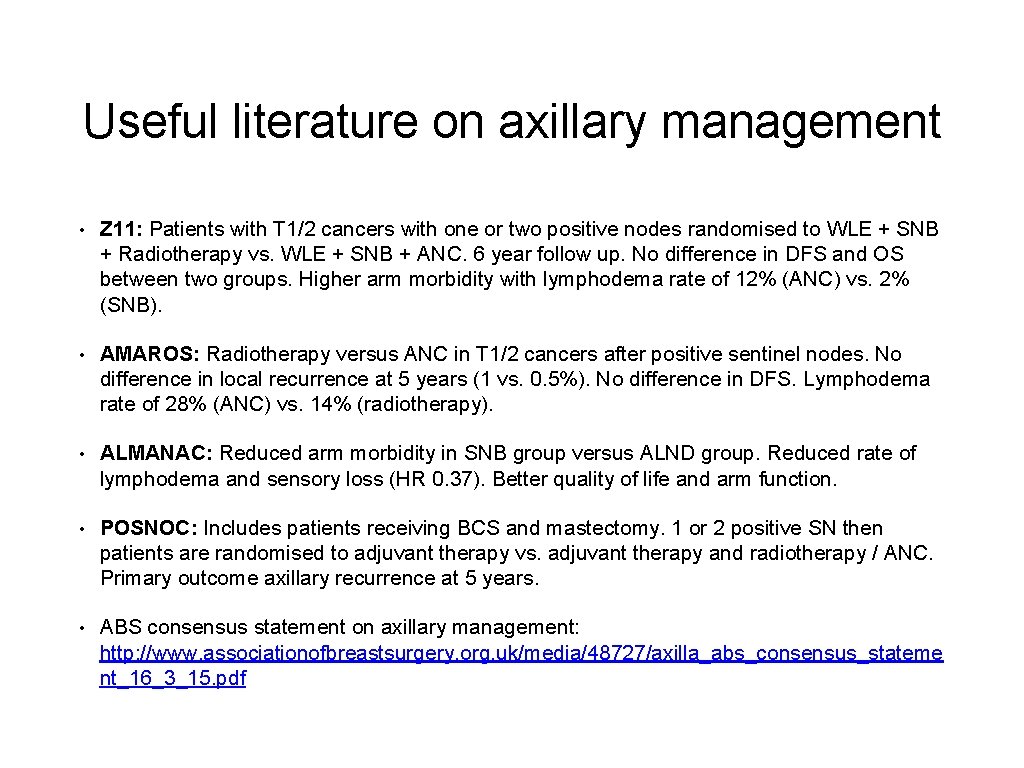
Useful literature on axillary management • Z 11: Patients with T 1/2 cancers with one or two positive nodes randomised to WLE + SNB + Radiotherapy vs. WLE + SNB + ANC. 6 year follow up. No difference in DFS and OS between two groups. Higher arm morbidity with lymphodema rate of 12% (ANC) vs. 2% (SNB). • AMAROS: Radiotherapy versus ANC in T 1/2 cancers after positive sentinel nodes. No difference in local recurrence at 5 years (1 vs. 0. 5%). No difference in DFS. Lymphodema rate of 28% (ANC) vs. 14% (radiotherapy). • ALMANAC: Reduced arm morbidity in SNB group versus ALND group. Reduced rate of lymphodema and sensory loss (HR 0. 37). Better quality of life and arm function. • POSNOC: Includes patients receiving BCS and mastectomy. 1 or 2 positive SN then patients are randomised to adjuvant therapy vs. adjuvant therapy and radiotherapy / ANC. Primary outcome axillary recurrence at 5 years. • ABS consensus statement on axillary management: http: //www. associationofbreastsurgery. org. uk/media/48727/axilla_abs_consensus_stateme nt_16_3_15. pdf
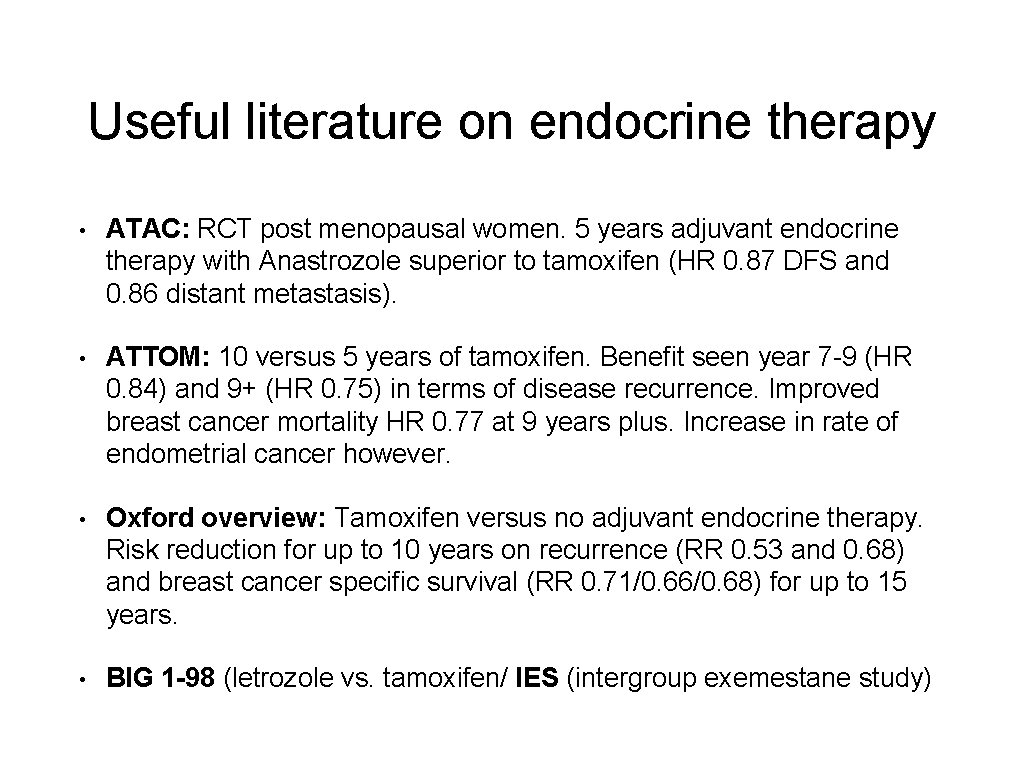
Useful literature on endocrine therapy • ATAC: RCT post menopausal women. 5 years adjuvant endocrine therapy with Anastrozole superior to tamoxifen (HR 0. 87 DFS and 0. 86 distant metastasis). • ATTOM: 10 versus 5 years of tamoxifen. Benefit seen year 7 -9 (HR 0. 84) and 9+ (HR 0. 75) in terms of disease recurrence. Improved breast cancer mortality HR 0. 77 at 9 years plus. Increase in rate of endometrial cancer however. • Oxford overview: Tamoxifen versus no adjuvant endocrine therapy. Risk reduction for up to 10 years on recurrence (RR 0. 53 and 0. 68) and breast cancer specific survival (RR 0. 71/0. 66/0. 68) for up to 15 years. • BIG 1 -98 (letrozole vs. tamoxifen/ IES (intergroup exemestane study)
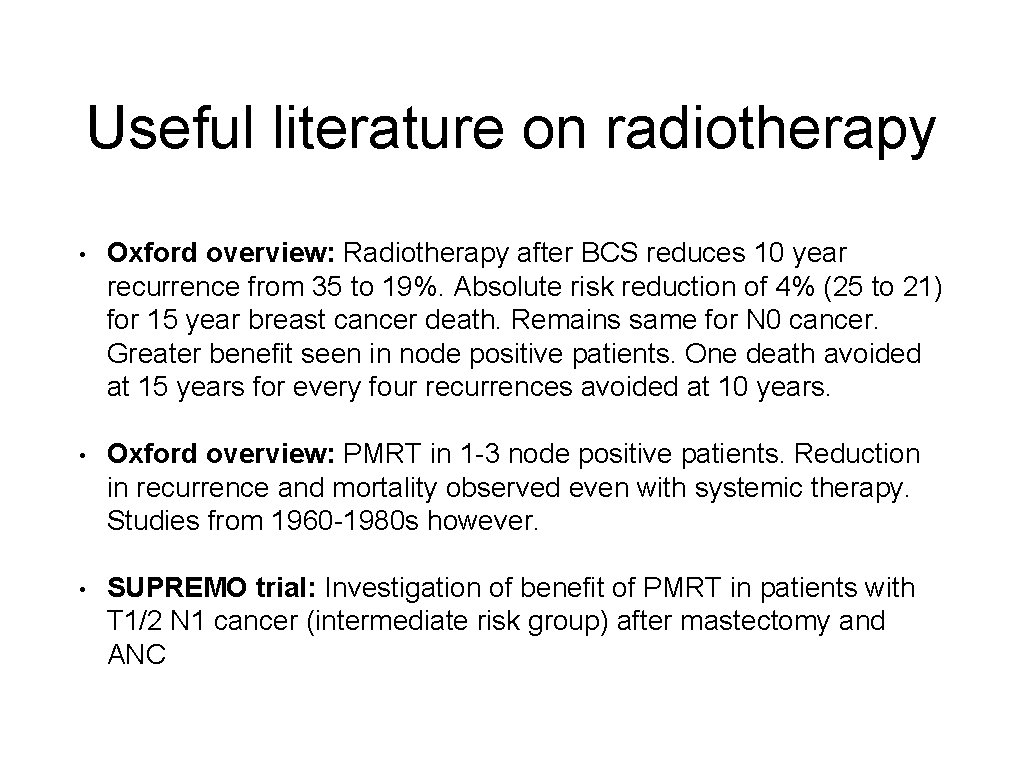
Useful literature on radiotherapy • Oxford overview: Radiotherapy after BCS reduces 10 year recurrence from 35 to 19%. Absolute risk reduction of 4% (25 to 21) for 15 year breast cancer death. Remains same for N 0 cancer. Greater benefit seen in node positive patients. One death avoided at 15 years for every four recurrences avoided at 10 years. • Oxford overview: PMRT in 1 -3 node positive patients. Reduction in recurrence and mortality observed even with systemic therapy. Studies from 1960 -1980 s however. • SUPREMO trial: Investigation of benefit of PMRT in patients with T 1/2 N 1 cancer (intermediate risk group) after mastectomy and ANC
Useful literature on chemotherapy • Oxford overview: AC equivalent to CMF but with AC higher dosage achievable. Taxanes added to AC confer benefit- RR 0. 86 • NICE guideline on adjuvant chemotherapy regime: early and locally advanced breast cancer/ advanced breast cancer (http: //pathways. nice. org. uk/pathways/advancedbreast-cancer/advanced-breast-cancer-chemotherapy-and -biological-therapy. pdf)/ indications for Oncotype Dx.
Further tips • Don't forget about benign breast disease (e. g. management of nipple discharge and gynaecomastia) • Questions based on management of patients with family history of breast cancer and BRCA mutation common in recent examinations • Clinicals have greater emphasis on oncoplastic management of breast reconstructions patients (e. g. strategies to improve symmetry) • Pair of examiners ('hawks and doves')- keep composure as the examiners swap after 15 minutes of vivas with contrasting style of questioning. • 50% of marks are allocated to breast topics so potentially more advantageous for breast trainees? Previously lesser emphasis on breast surgery.
• Marks are averaged so you cannot fail on a bad station. You will have bad stations but marks can be made up in other stations. You have to score average of 6/8 overall. • Useful further guidelines on the ABS website: http: //www. associationofbreastsurgery. org. uk/publications/guideline s/? page=1 • The questions asked in the exams are common conditions you encounter in your normal clinical practice. • Passing both parts of the FRCS at ST 7 level is likely to stand you in good position for those applying for the Ti. G oncoplastic fellowship. • Good luck!
- Slides: 16