
FRCR Ultrasound Lectures Dr Sarah Bohndiek seb 53cam
FRCR Ultrasound Lectures Dr Sarah Bohndiek seb 53@cam. ac. uk Reader in Biomedical Physics & CRUK Group Leader University of Cambridge
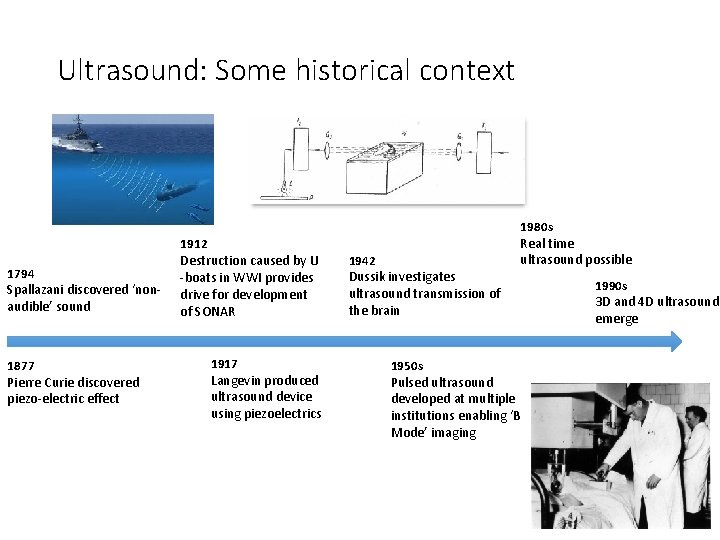
Ultrasound: Some historical context 1794 Spallazani discovered ‘nonaudible’ sound 1877 Pierre Curie discovered piezo-electric effect 1912 Destruction caused by U -boats in WWI provides drive for development of SONAR 1917 Langevin produced ultrasound device using piezoelectrics 1942 Dussik investigates ultrasound transmission of the brain 1980 s Real time ultrasound possible 1950 s Pulsed ultrasound developed at multiple institutions enabling ‘B Mode’ imaging 1990 s 3 D and 4 D ultrasound emerge
Learning outcomes • After these lectures, you should be able to: Explain how ultrasound interacts with tissue Understand where ultrasound imaging contrast comes from Describe how ultrasound signals are generated and detected Explain how anatomical ultrasound images are formed Compare the different clinical approaches to performing ultrasound imaging and discuss emerging new applications of ultrasound • Describe the origin of the hazards that arise from ultrasound imaging and how they can be mitigated • Explain the key governing legislation around ultrasound safety • Describe common approaches to quality assurance / control • • •
Recommended reading • Physics of Diagnostic Radiology, 3 rd edition, Dendy & Heaton • (978 -1 -4200 -8315 -6) • Introduction to Medical Imaging, Smith & Webb • (978 -0 -521 -19065 -7) • Diagnostic Ultrasound, Matthew Hussey • (0. 216. 90029. 8) • The Safe Use of Ultrasound in Medical Diagnosis, 3 rd Edition, ter Haar & Duck • (978 -0 -905749 -78 -5) • IPEM Report 102 – Quality Assurance of Ultrasound Imaging Systems Note: Some material in this course has been taken from previous lecturer Richard Axell
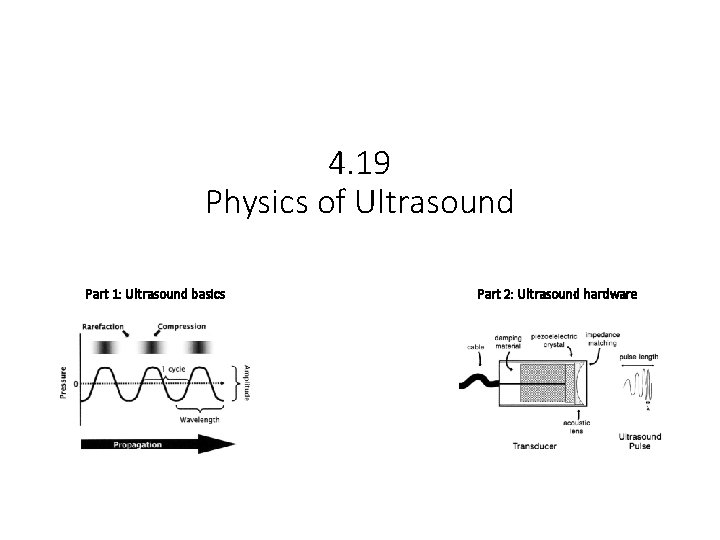
4. 19 Physics of Ultrasound Part 1: Ultrasound basics Part 2: Ultrasound hardware
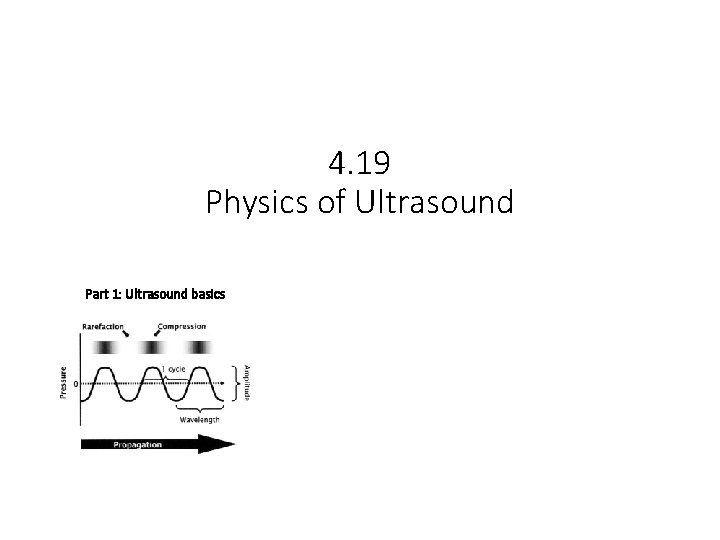
4. 19 Physics of Ultrasound Part 1: Ultrasound basics
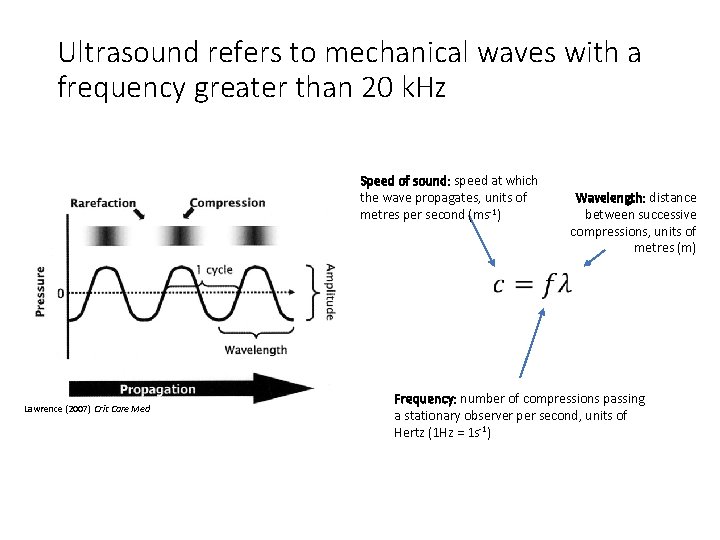
Ultrasound refers to mechanical waves with a frequency greater than 20 k. Hz Speed of sound: speed at which the wave propagates, units of metres per second (ms-1) Wavelength: distance between successive compressions, units of metres (m) Lawrence (2007) Crit Care Med Frequency: number of compressions passing a stationary observer per second, units of Hertz (1 Hz = 1 s-1)
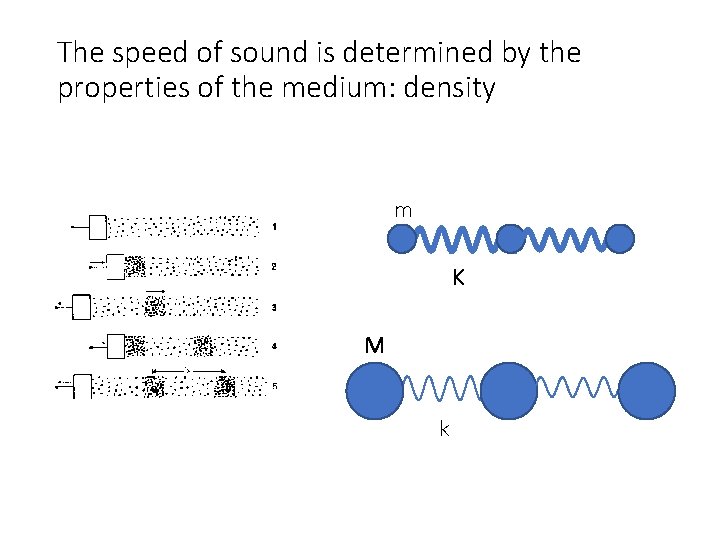
The speed of sound is determined by the properties of the medium: density m K M k
The speed of sound is determined by the properties of the medium: adiabatic bulk modulus • Adiabatic: A process that occurs without transfer of heat or matter to the surroundings • Bulk Modulus: The “spring constant” (k) for the tissue • Describes how resistant a substance is to compressibility; the pressure required to produce a fractional change in volume
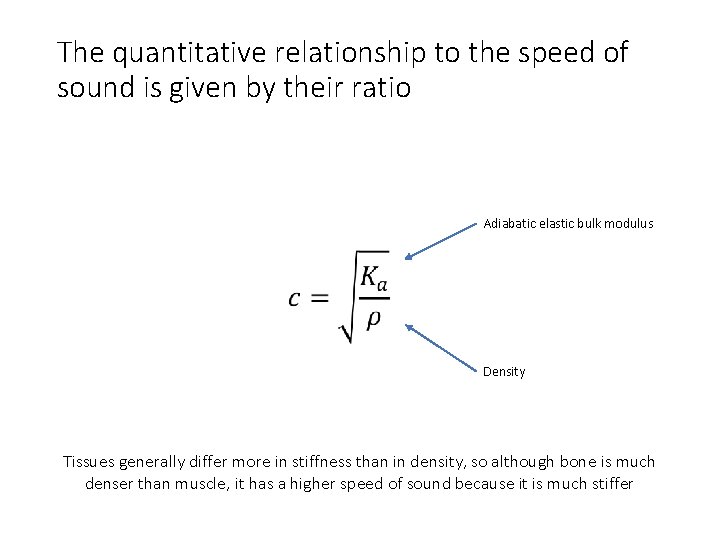
The quantitative relationship to the speed of sound is given by their ratio Adiabatic elastic bulk modulus Density Tissues generally differ more in stiffness than in density, so although bone is much denser than muscle, it has a higher speed of sound because it is much stiffer
Speed of sound through tissue depends on fat, collagen and water content • An increase in water and fat content leads to a decrease in wave speed. • An increase in collagen content leads to an increase in wave speed. • Resolution is related to the wavelength. • A wavelength of 0. 8 mm and wave speed of 1540 ms-1 corresponds to a frequency of 2 MHz.
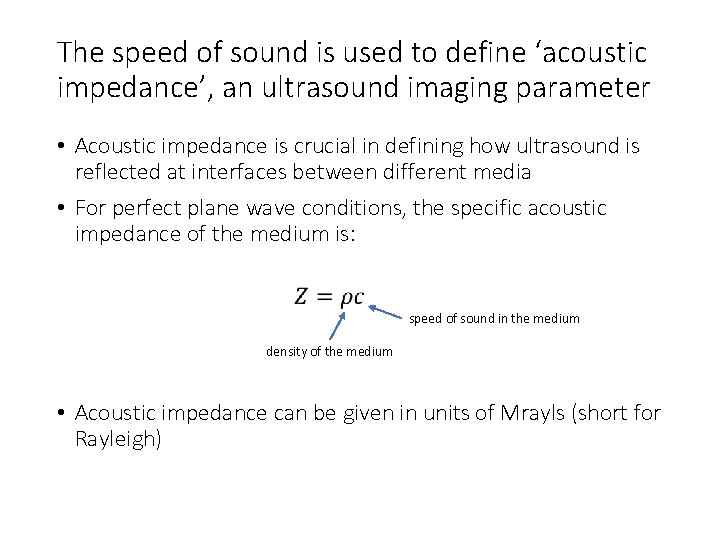
The speed of sound is used to define ‘acoustic impedance’, an ultrasound imaging parameter • Acoustic impedance is crucial in defining how ultrasound is reflected at interfaces between different media • For perfect plane wave conditions, the specific acoustic impedance of the medium is: speed of sound in the medium density of the medium • Acoustic impedance can be given in units of Mrayls (short for Rayleigh)
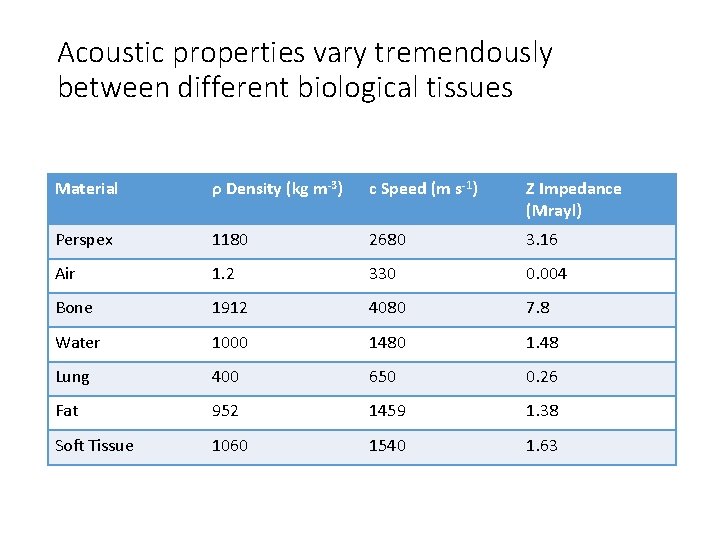
Acoustic properties vary tremendously between different biological tissues Material ρ Density (kg m-3) c Speed (m s-1) Z Impedance (Mrayl) Perspex 1180 2680 3. 16 Air 1. 2 330 0. 004 Bone 1912 4080 7. 8 Water 1000 1480 1. 48 Lung 400 650 0. 26 Fat 952 1459 1. 38 Soft Tissue 1060 1540 1. 63
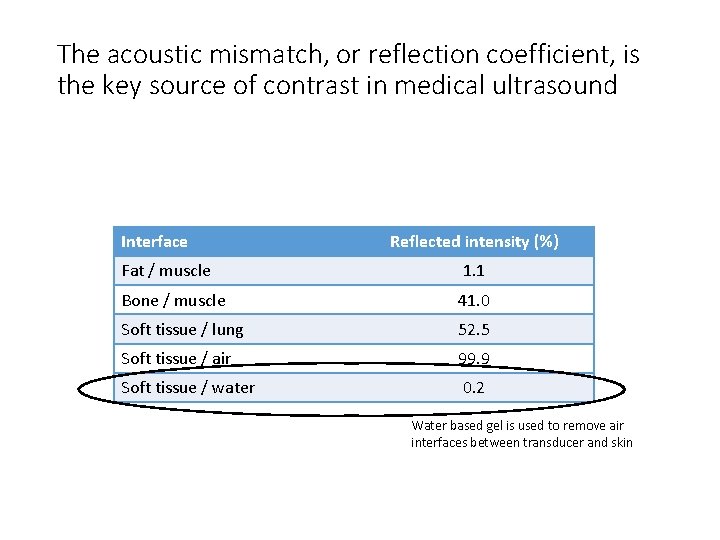
The acoustic mismatch, or reflection coefficient, is the key source of contrast in medical ultrasound Interface Reflected intensity (%) Fat / muscle 1. 1 Bone / muscle 41. 0 Soft tissue / lung 52. 5 Soft tissue / air 99. 9 Soft tissue / water 0. 2 Water based gel is used to remove air interfaces between transducer and skin
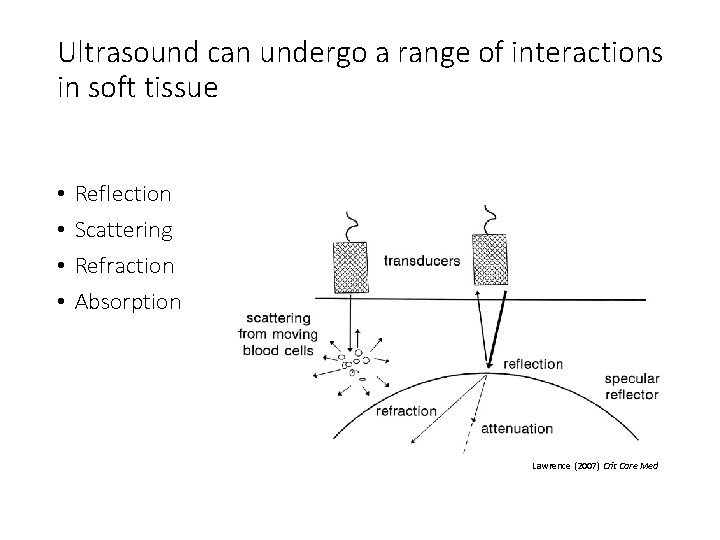
Ultrasound can undergo a range of interactions in soft tissue • • Reflection Scattering Refraction Absorption Lawrence (2007) Crit Care Med
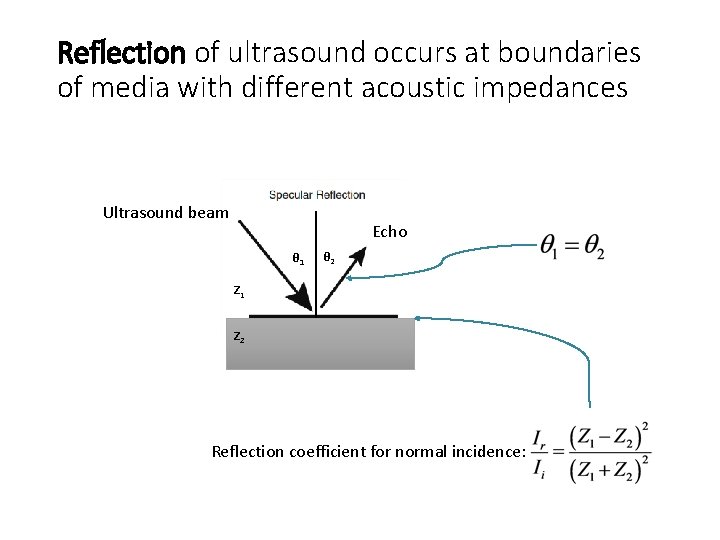
Reflection of ultrasound occurs at boundaries of media with different acoustic impedances Ultrasound beam Echo θ 1 θ 2 Z 1 Z 2 Reflection coefficient for normal incidence:
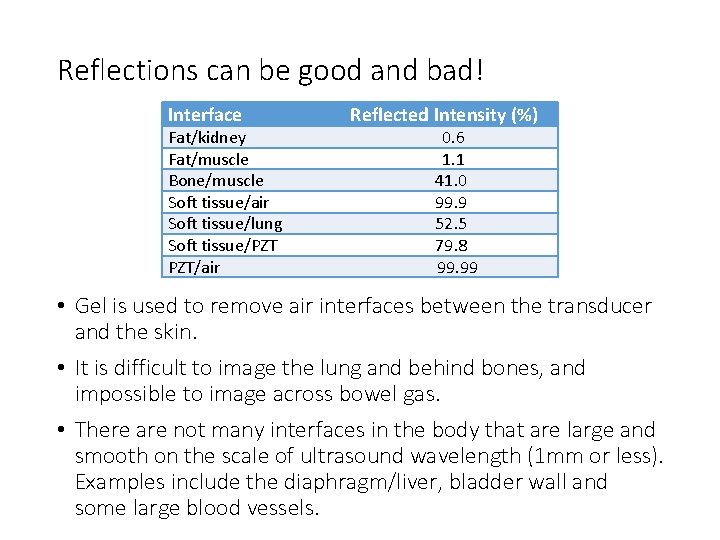
Reflections can be good and bad! Interface Fat/kidney Fat/muscle Bone/muscle Soft tissue/air Soft tissue/lung Soft tissue/PZT PZT/air Reflected Intensity (%) 0. 6 1. 1 41. 0 99. 9 52. 5 79. 8 99. 99 • Gel is used to remove air interfaces between the transducer and the skin. • It is difficult to image the lung and behind bones, and impossible to image across bowel gas. • There are not many interfaces in the body that are large and smooth on the scale of ultrasound wavelength (1 mm or less). Examples include the diaphragm/liver, bladder wall and some large blood vessels.
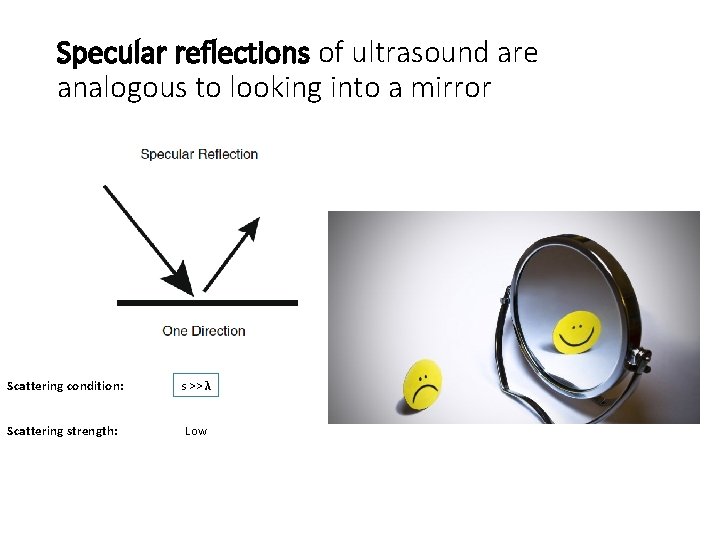
Specular reflections of ultrasound are analogous to looking into a mirror Scattering condition: s >> λ Scattering strength: Low
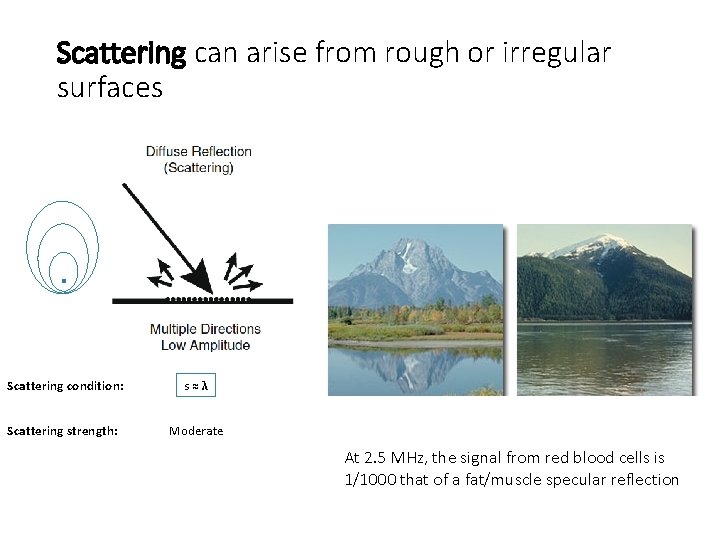
Scattering can arise from rough or irregular surfaces Scattering condition: s ≈ λ Scattering strength: Moderate At 2. 5 MHz, the signal from red blood cells is 1/1000 that of a fat/muscle specular reflection
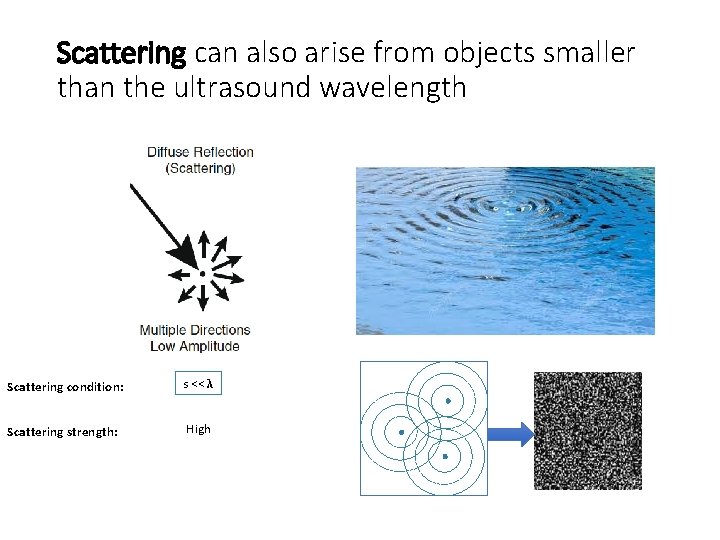
Scattering can also arise from objects smaller than the ultrasound wavelength Scattering condition: s << λ Scattering strength: High
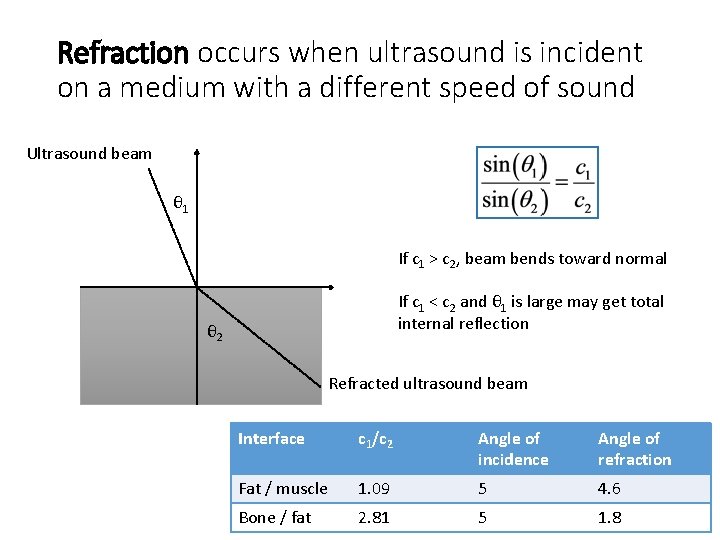
Refraction occurs when ultrasound is incident on a medium with a different speed of sound Ultrasound beam θ 1 If c 1 > c 2, beam bends toward normal If c 1 < c 2 and θ 1 is large may get total internal reflection θ 2 Refracted ultrasound beam Interface c 1/c 2 Angle of incidence Angle of refraction Fat / muscle 1. 09 5 4. 6 Bone / fat 2. 81 5 1. 8
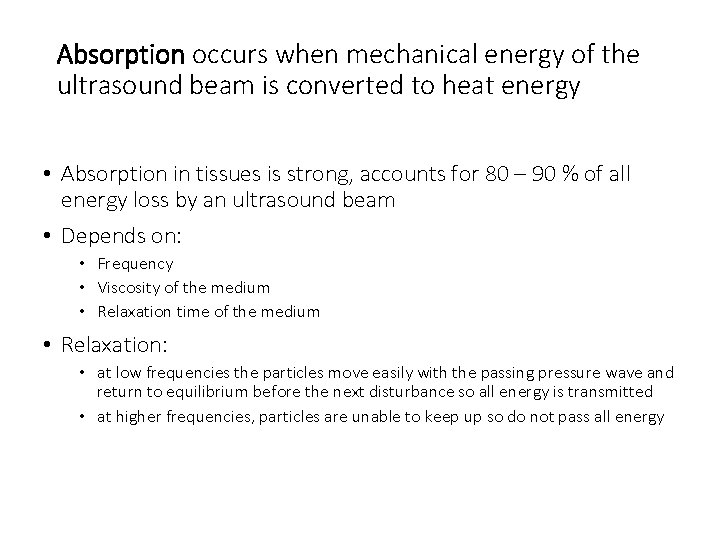
Absorption occurs when mechanical energy of the ultrasound beam is converted to heat energy • Absorption in tissues is strong, accounts for 80 – 90 % of all energy loss by an ultrasound beam • Depends on: • Frequency • Viscosity of the medium • Relaxation time of the medium • Relaxation: • at low frequencies the particles move easily with the passing pressure wave and return to equilibrium before the next disturbance so all energy is transmitted • at higher frequencies, particles are unable to keep up so do not pass all energy
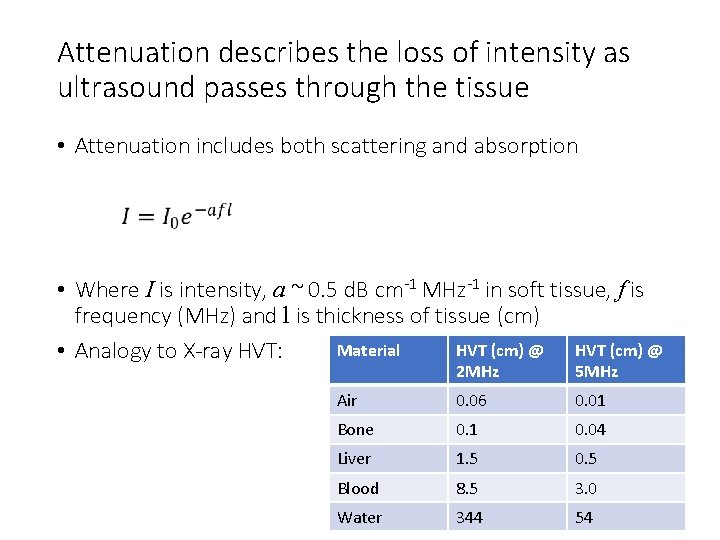
Attenuation describes the loss of intensity as ultrasound passes through the tissue • Attenuation includes both scattering and absorption • Where I is intensity, a ~ 0. 5 d. B cm-1 MHz-1 in soft tissue, f is frequency (MHz) and l is thickness of tissue (cm) Material HVT (cm) @ • Analogy to X-ray HVT: 2 MHz 5 MHz Air 0. 06 0. 01 Bone 0. 1 0. 04 Liver 1. 5 0. 5 Blood 8. 5 3. 0 Water 344 54

To avoid the exponential in attenuation calculations, the decibel scale is used Echo pressure amplitudes vary by a factor of 105 or greater, so a logarithmic scale helps: I/I 0 d. B 1, 000 60 100 20 10 10 2 3 1 0 0. 01 -20 Intensity ratio (d. B) Amplitude ratio (d. B) (Factor of 2, since intensity is proportional to square of amplitude)
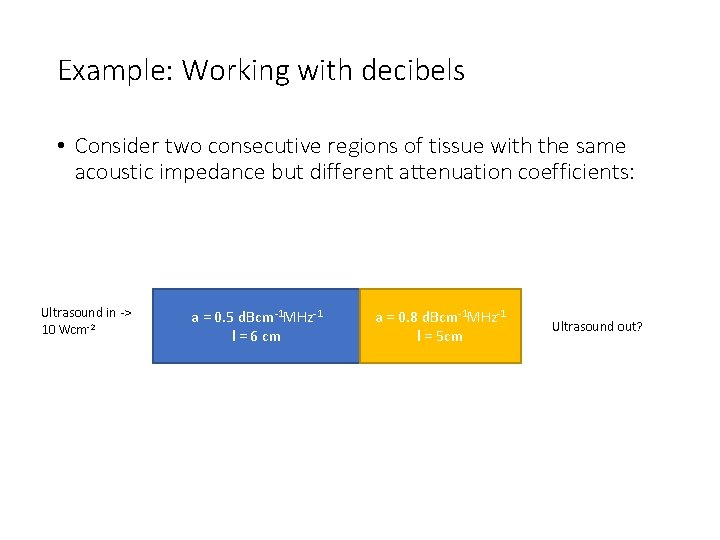
Example: Working with decibels • Consider two consecutive regions of tissue with the same acoustic impedance but different attenuation coefficients: Ultrasound in -> 10 Wcm-2 a = 0. 5 d. Bcm-1 MHz-1 l = 6 cm a = 0. 8 d. Bcm-1 MHz-1 l = 5 cm Ultrasound out?
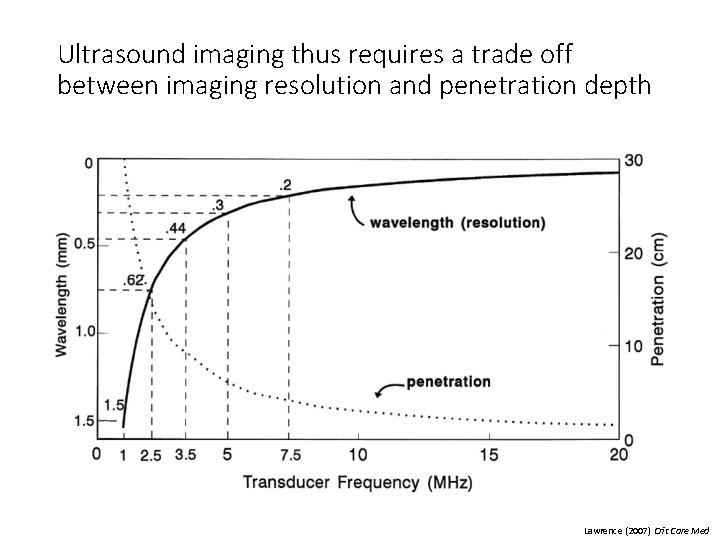
Ultrasound imaging thus requires a trade off between imaging resolution and penetration depth Lawrence (2007) Crit Care Med
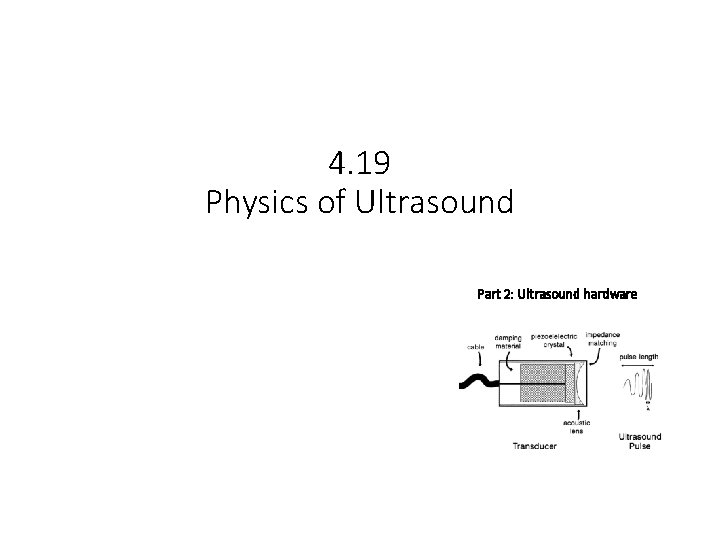
4. 19 Physics of Ultrasound Part 2: Ultrasound hardware
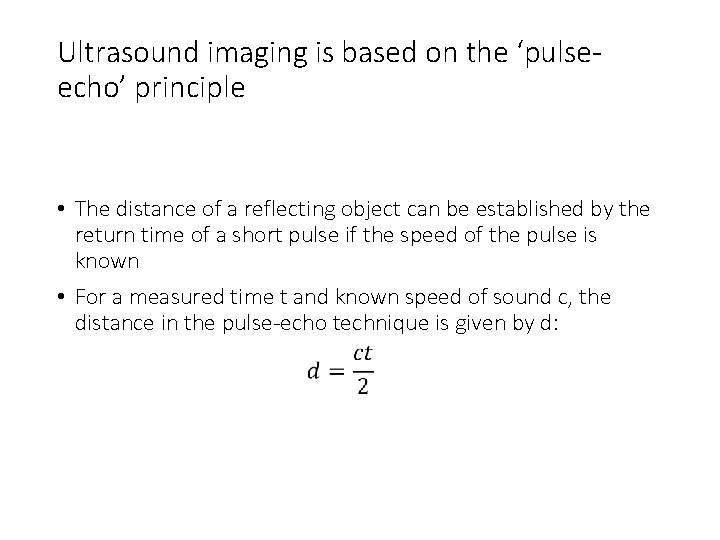
Ultrasound imaging is based on the ‘pulseecho’ principle • The distance of a reflecting object can be established by the return time of a short pulse if the speed of the pulse is known • For a measured time t and known speed of sound c, the distance in the pulse-echo technique is given by d:
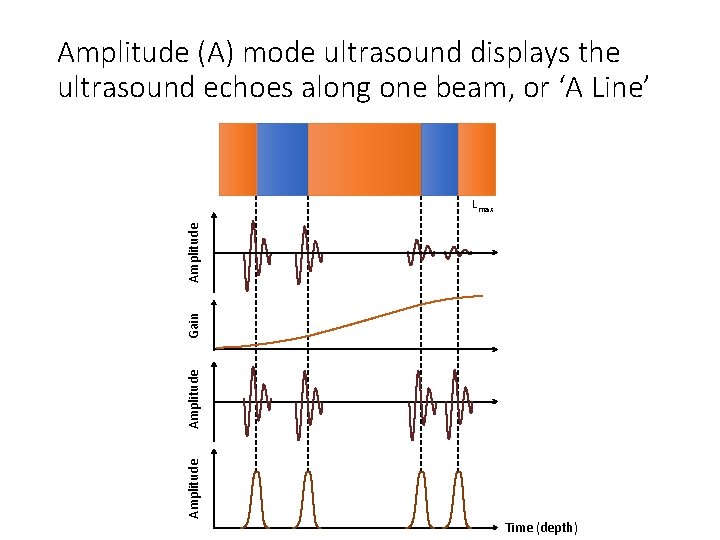
Amplitude (A) mode ultrasound displays the ultrasound echoes along one beam, or ‘A Line’ Amplitude Gain Amplitude Lmax Time (depth)
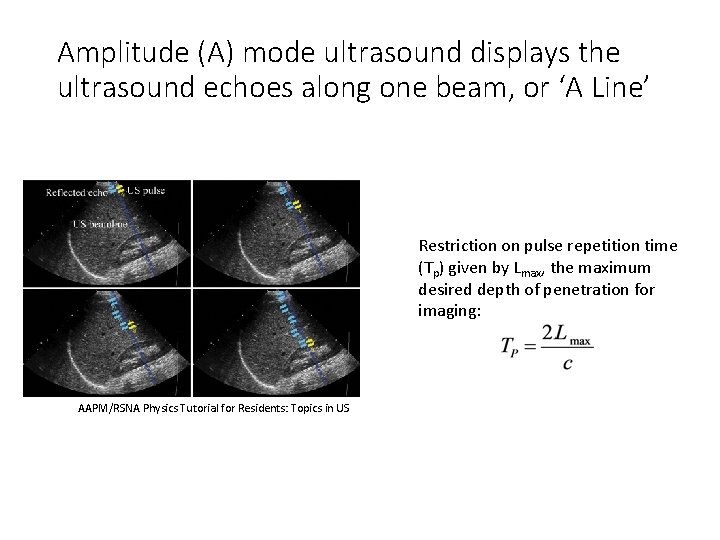
Amplitude (A) mode ultrasound displays the ultrasound echoes along one beam, or ‘A Line’ Restriction on pulse repetition time (Tp) given by Lmax, the maximum desired depth of penetration for imaging: AAPM/RSNA Physics Tutorial for Residents: Topics in US
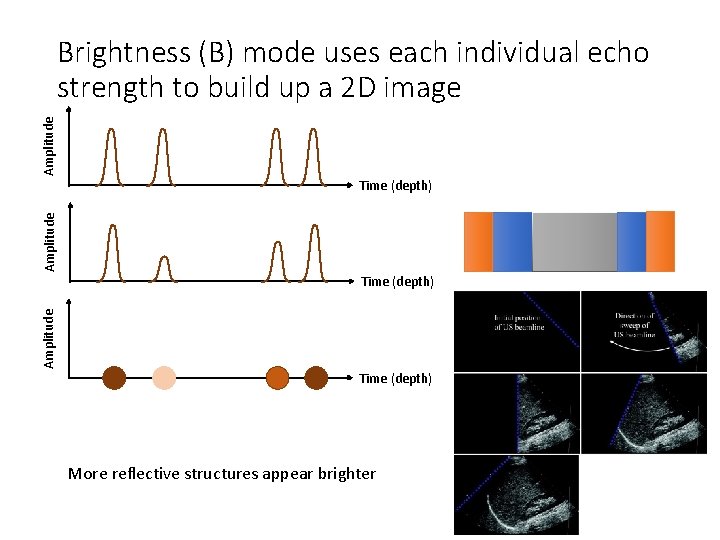
Amplitude Brightness (B) mode uses each individual echo strength to build up a 2 D image Amplitude Time (depth) More reflective structures appear brighter
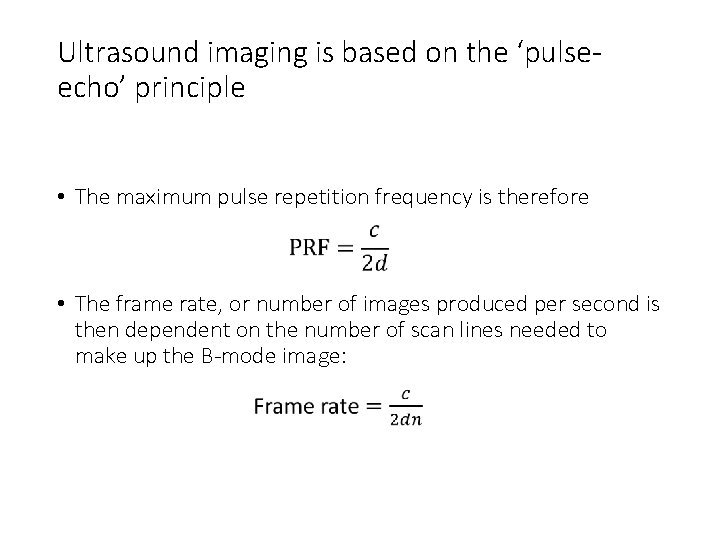
Ultrasound imaging is based on the ‘pulseecho’ principle • The maximum pulse repetition frequency is therefore • The frame rate, or number of images produced per second is then dependent on the number of scan lines needed to make up the B-mode image:
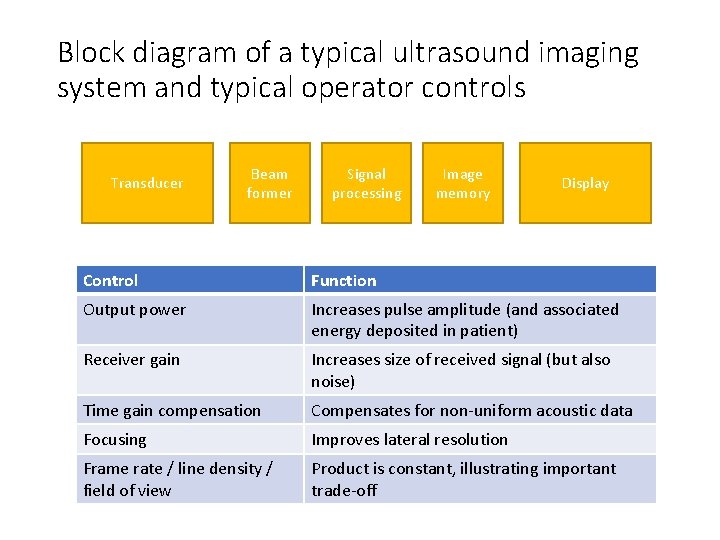
Block diagram of a typical ultrasound imaging system and typical operator controls Transducer Beam former Signal processing Image memory Display Control Function Output power Increases pulse amplitude (and associated energy deposited in patient) Receiver gain Increases size of received signal (but also noise) Time gain compensation Compensates for non-uniform acoustic data Focusing Improves lateral resolution Frame rate / line density / field of view Product is constant, illustrating important trade-off

The transducer
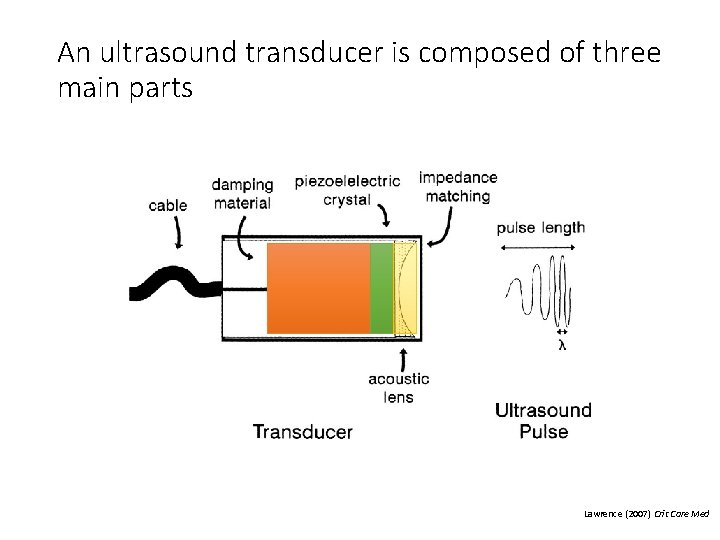
An ultrasound transducer is composed of three main parts Lawrence (2007) Crit Care Med
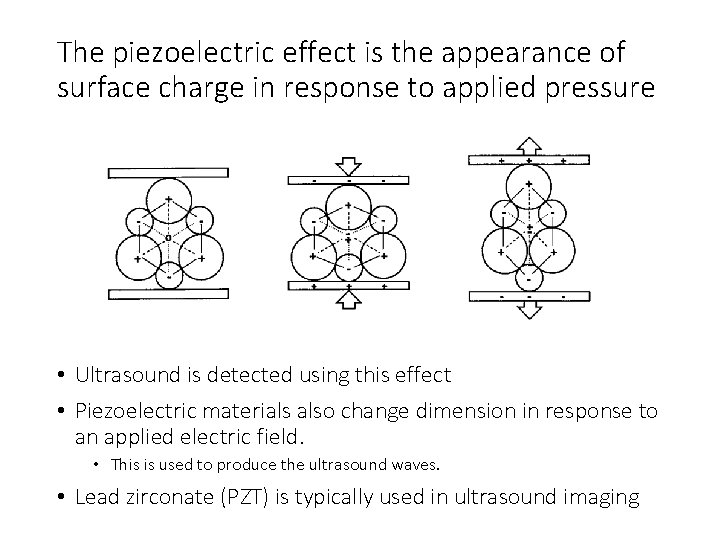
The piezoelectric effect is the appearance of surface charge in response to applied pressure • Ultrasound is detected using this effect • Piezoelectric materials also change dimension in response to an applied electric field. • This is used to produce the ultrasound waves. • Lead zirconate (PZT) is typically used in ultrasound imaging
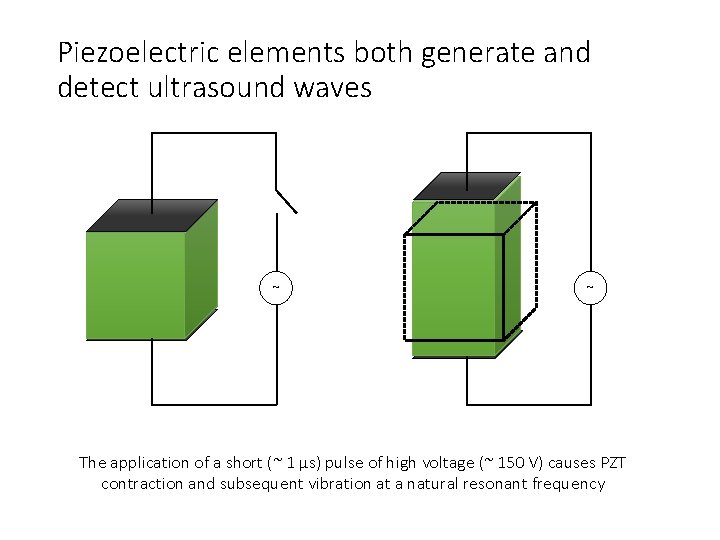
Piezoelectric elements both generate and detect ultrasound waves ~ ~ The application of a short (~ 1 μs) pulse of high voltage (~ 150 V) causes PZT contraction and subsequent vibration at a natural resonant frequency
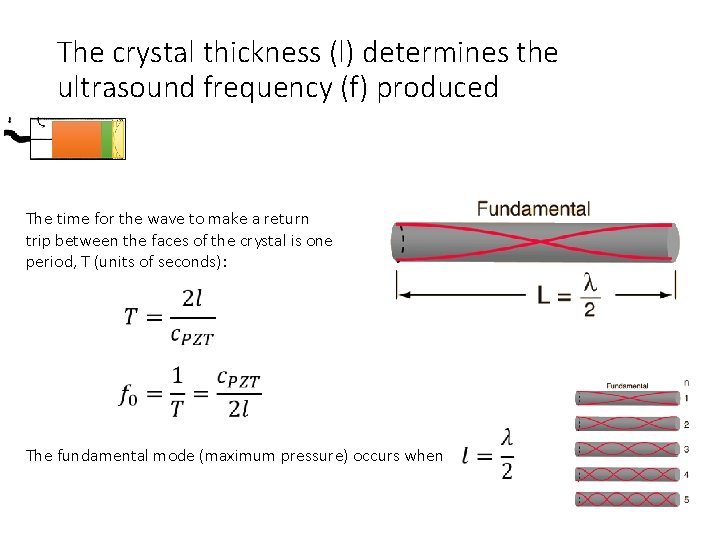
The crystal thickness (l) determines the ultrasound frequency (f) produced The time for the wave to make a return trip between the faces of the crystal is one period, T (units of seconds): The fundamental mode (maximum pressure) occurs when
Example: Calculating required PZT thickness • What thickness of PZT is required to produce an ultrasound wave of 5 MHz for imaging soft tissue? • Speed of sound in PZT c. PZT = 3791 ms-1
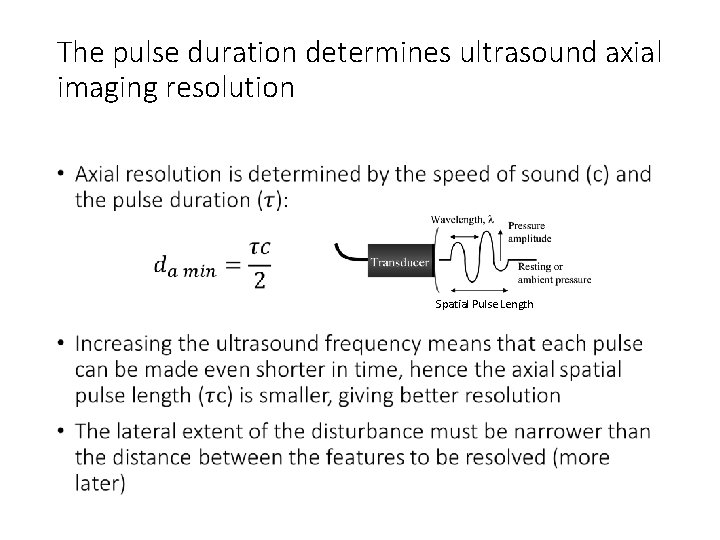
The pulse duration determines ultrasound axial imaging resolution • Spatial Pulse Length
Example: Axial resolution • What is the axial resolution in soft tissue of a 5 MHz transducer producing a pulse of 3 cycles duration? • How much better would this be at 10 MHz?

The pulse frequency bandwidth is an important consideration in transducer design Long spatial pulse length Poor axial resolution Narrow frequency bandwidth Short spatial pulse length Good axial resolution Wide frequency bandwidth Energy 0. 8 1 “Ringing” 1. 2 f/f 0 0. 8 1 1. 2 Damped High sensitivity Optimal axial resolution f/f 0
Example: Bandwidth • What is the bandwidth of a 5 MHz transducer with a pulse duration of 2 cycles?
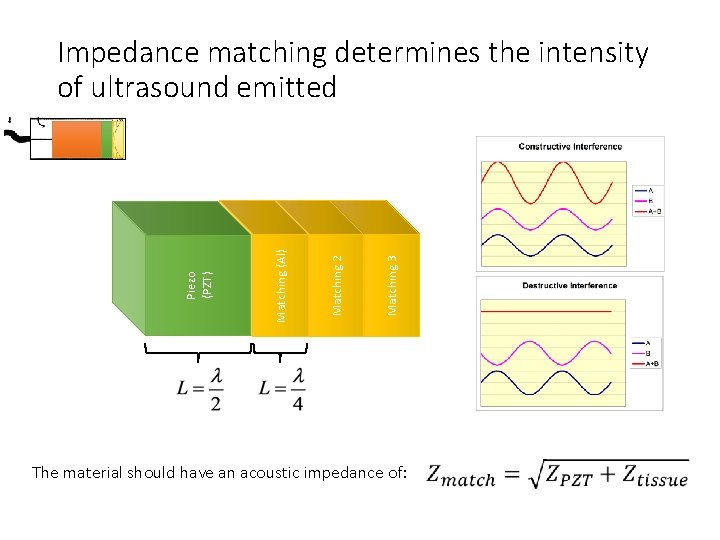
Matching 3 Matching 2 Matching (Al) Piezo (PZT) Impedance matching determines the intensity of ultrasound emitted The material should have an acoustic impedance of:
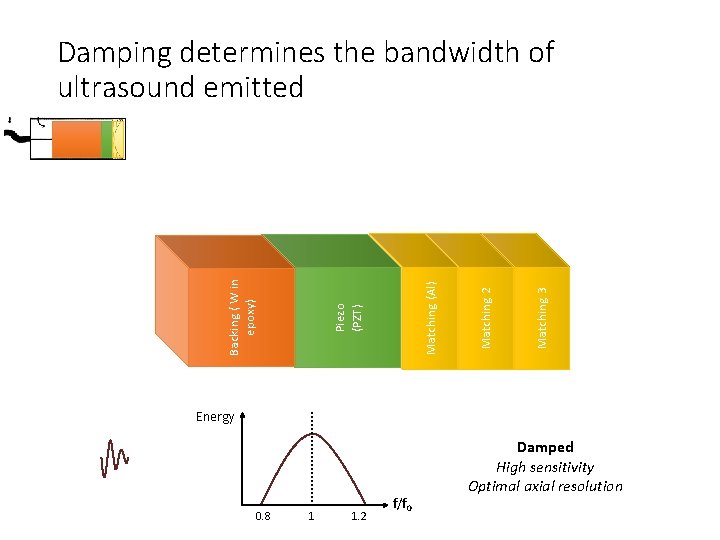
Matching 3 Matching 2 Matching (Al) Piezo (PZT) Backing ( W in epoxy) Damping determines the bandwidth of ultrasound emitted Energy 0. 8 1 1. 2 f/f 0 Damped High sensitivity Optimal axial resolution
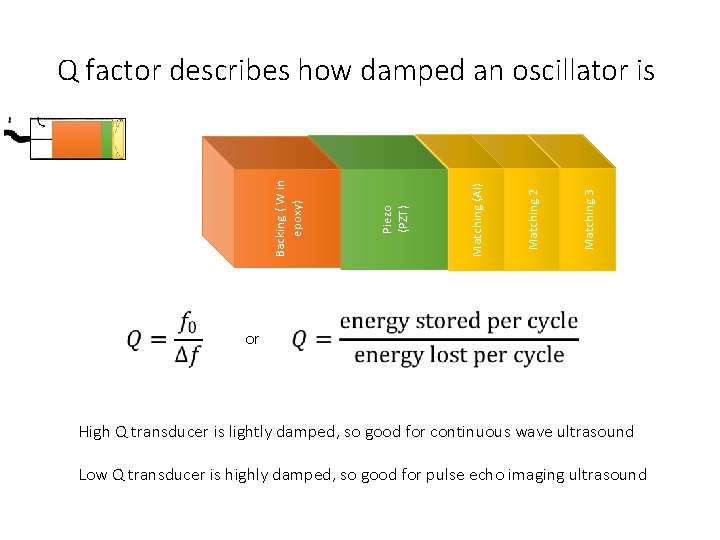
or Matching 3 Matching 2 Matching (Al) Piezo (PZT) Backing ( W in epoxy) Q factor describes how damped an oscillator is High Q transducer is lightly damped, so good for continuous wave ultrasound Low Q transducer is highly damped, so good for pulse echo imaging ultrasound
The ultrasound beam
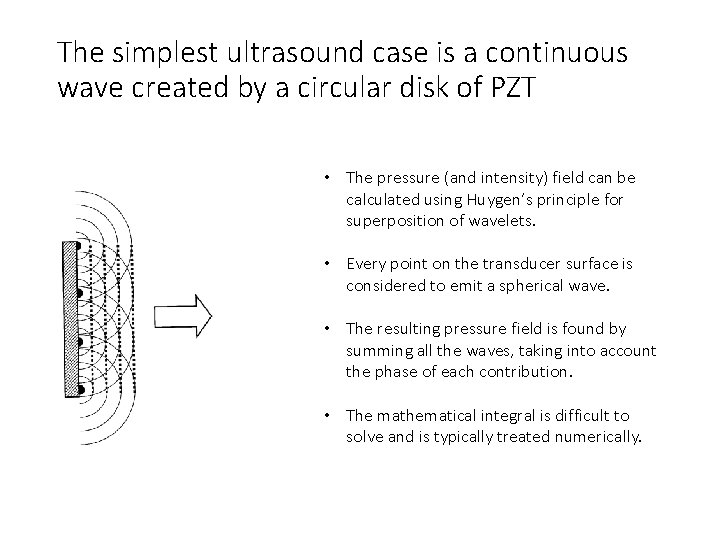
The simplest ultrasound case is a continuous wave created by a circular disk of PZT • The pressure (and intensity) field can be calculated using Huygen’s principle for superposition of wavelets. • Every point on the transducer surface is considered to emit a spherical wave. • The resulting pressure field is found by summing all the waves, taking into account the phase of each contribution. • The mathematical integral is difficult to solve and is typically treated numerically.
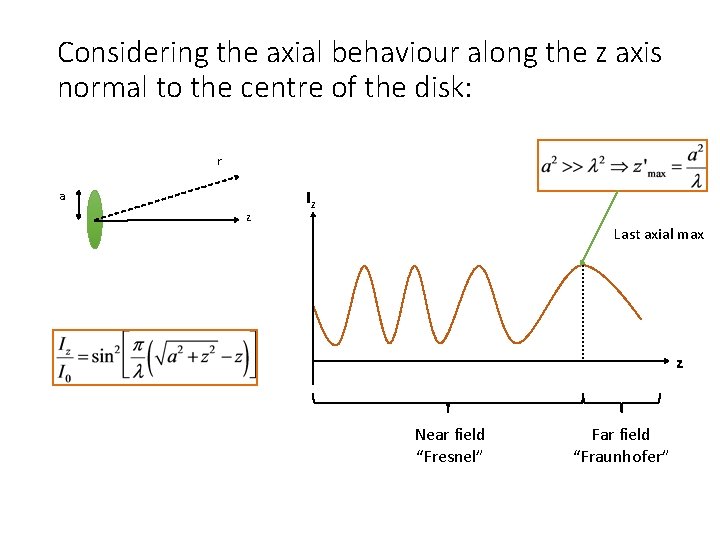
Considering the axial behaviour along the z axis normal to the centre of the disk: r a z Iz Last axial max z Near field “Fresnel” Far field “Fraunhofer”
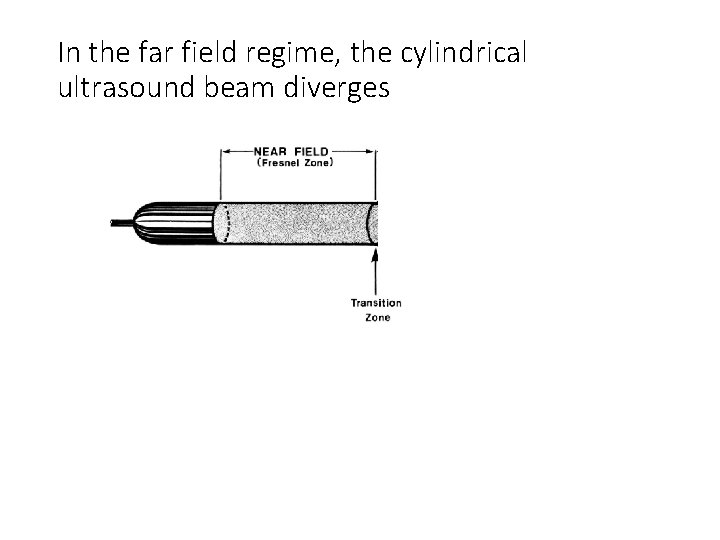
In the far field regime, the cylindrical ultrasound beam diverges θ θ
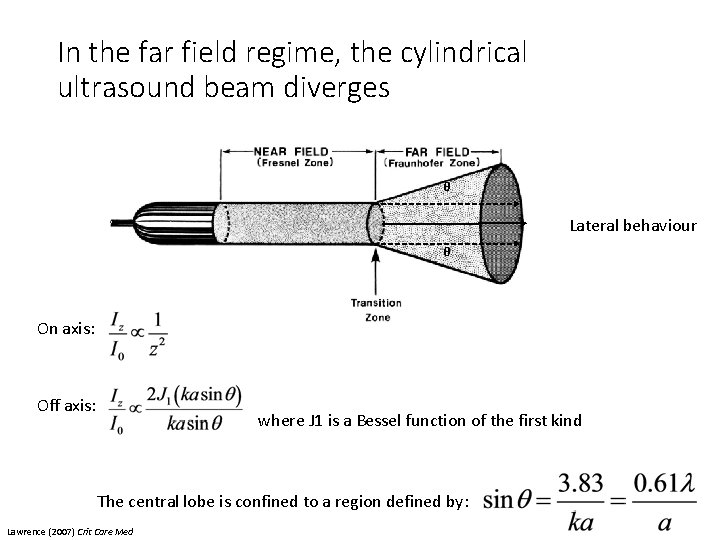
In the far field regime, the cylindrical ultrasound beam diverges θ Lateral behaviour θ On axis: Off axis: where J 1 is a Bessel function of the first kind The central lobe is confined to a region defined by: Lawrence (2007) Crit Care Med
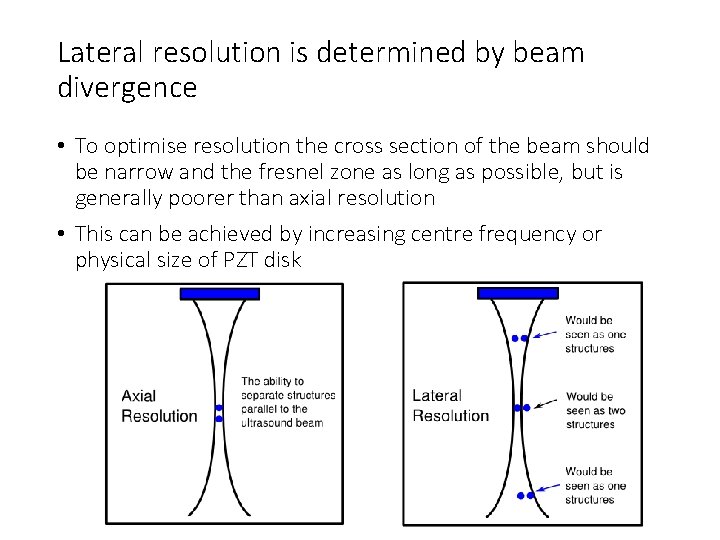
Lateral resolution is determined by beam divergence • To optimise resolution the cross section of the beam should be narrow and the fresnel zone as long as possible, but is generally poorer than axial resolution • This can be achieved by increasing centre frequency or physical size of PZT disk
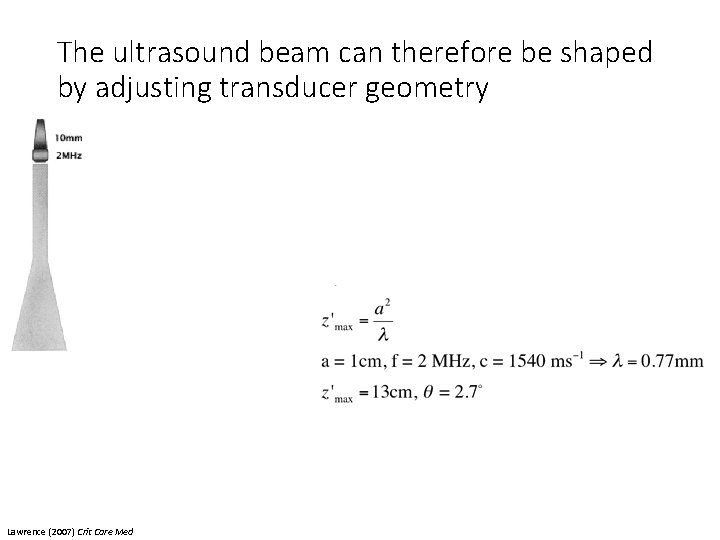
The ultrasound beam can therefore be shaped by adjusting transducer geometry Lawrence (2007) Crit Care Med

The ultrasound beam can therefore be shaped by adjusting transducer geometry Lawrence (2007) Crit Care Med
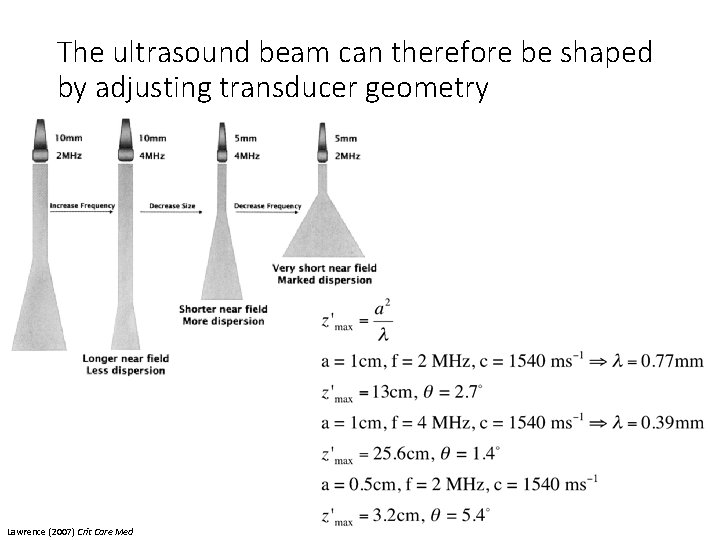
The ultrasound beam can therefore be shaped by adjusting transducer geometry Lawrence (2007) Crit Care Med
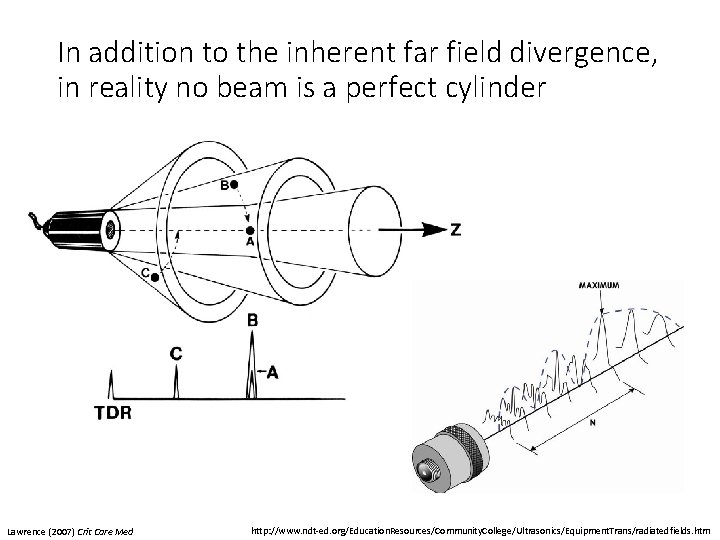
In addition to the inherent far field divergence, in reality no beam is a perfect cylinder Lawrence (2007) Crit Care Med http: //www. ndt-ed. org/Education. Resources/Community. College/Ultrasonics/Equipment. Trans/radiatedfields. htm
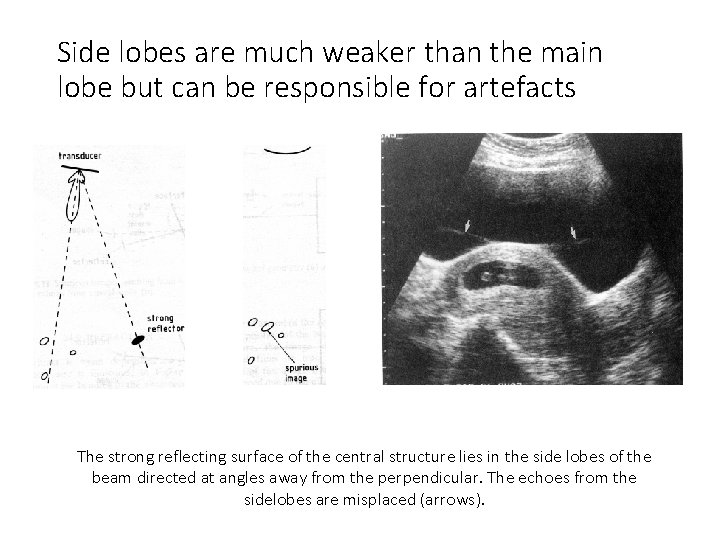
Side lobes are much weaker than the main lobe but can be responsible for artefacts The strong reflecting surface of the central structure lies in the side lobes of the beam directed at angles away from the perpendicular. The echoes from the sidelobes are misplaced (arrows).
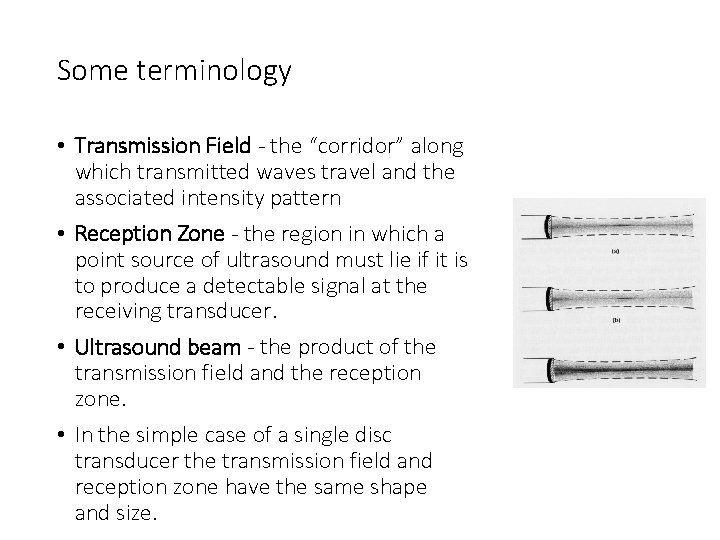
Some terminology • Transmission Field - the “corridor” along which transmitted waves travel and the associated intensity pattern • Reception Zone - the region in which a point source of ultrasound must lie if it is to produce a detectable signal at the receiving transducer. • Ultrasound beam - the product of the transmission field and the reception zone. • In the simple case of a single disc transducer the transmission field and reception zone have the same shape and size.
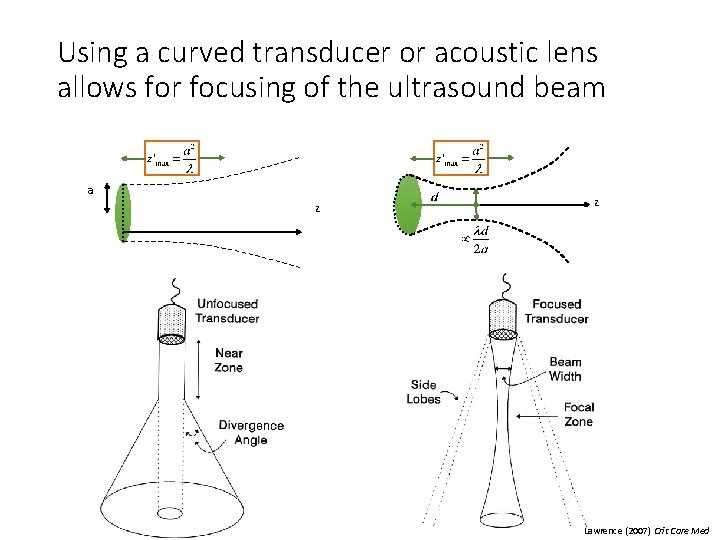
Using a curved transducer or acoustic lens allows for focusing of the ultrasound beam a z z Lawrence (2007) Crit Care Med
The beam former (and array designs)
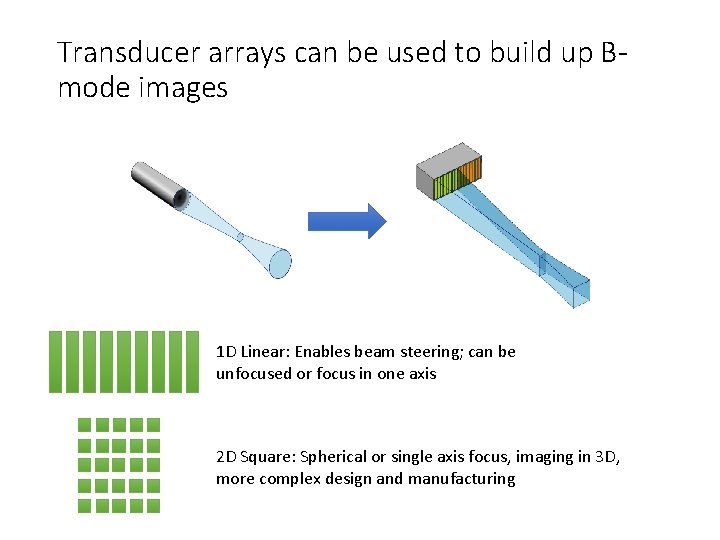
Transducer arrays can be used to build up Bmode images 1 D Linear: Enables beam steering; can be unfocused or focus in one axis 2 D Square: Spherical or single axis focus, imaging in 3 D, more complex design and manufacturing
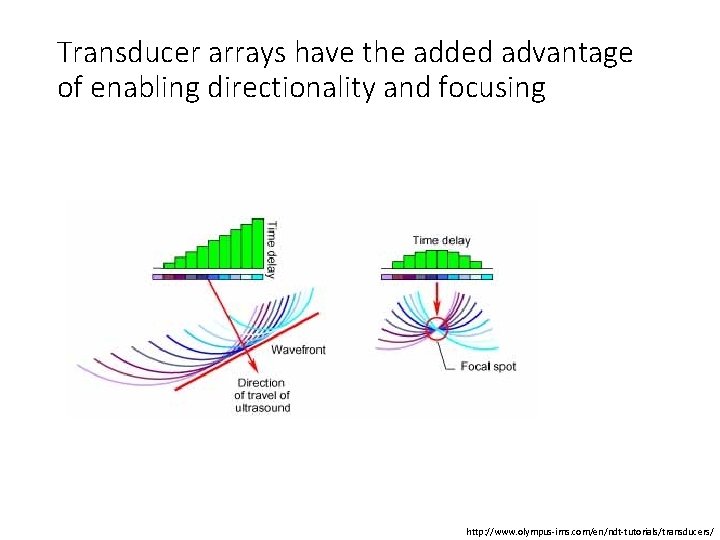
Transducer arrays have the added advantage of enabling directionality and focusing http: //www. olympus-ims. com/en/ndt-tutorials/transducers/

Phased arrays enable electronic beam steering, removing mechanical complexity http: //www. olympus-ims. com/en/ndt-tutorials/transducers/
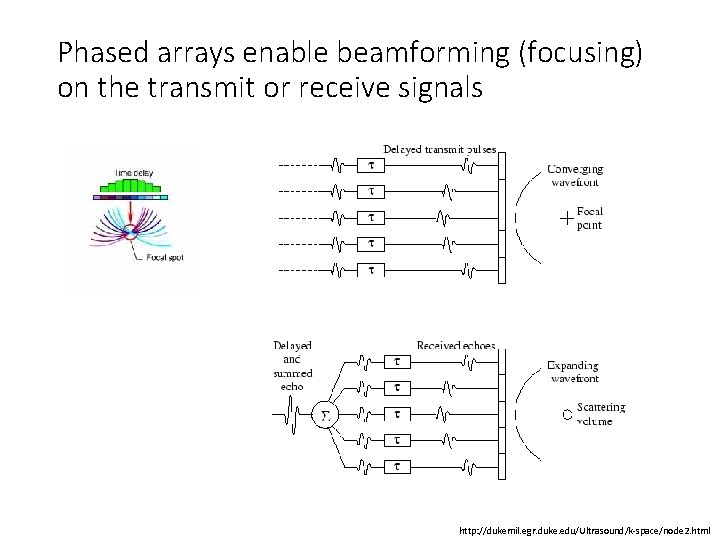
Phased arrays enable beamforming (focusing) on the transmit or receive signals http: //dukemil. egr. duke. edu/Ultrasound/k-space/node 2. html
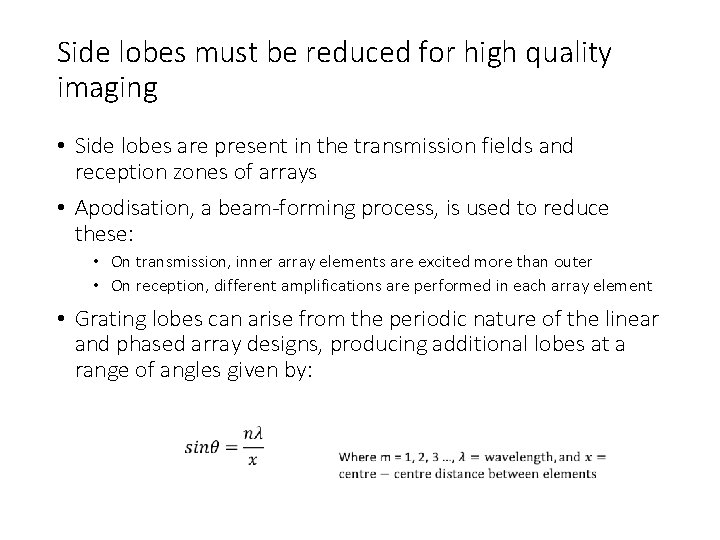
Side lobes must be reduced for high quality imaging • Side lobes are present in the transmission fields and reception zones of arrays • Apodisation, a beam-forming process, is used to reduce these: • On transmission, inner array elements are excited more than outer • On reception, different amplifications are performed in each array element • Grating lobes can arise from the periodic nature of the linear and phased array designs, producing additional lobes at a range of angles given by:
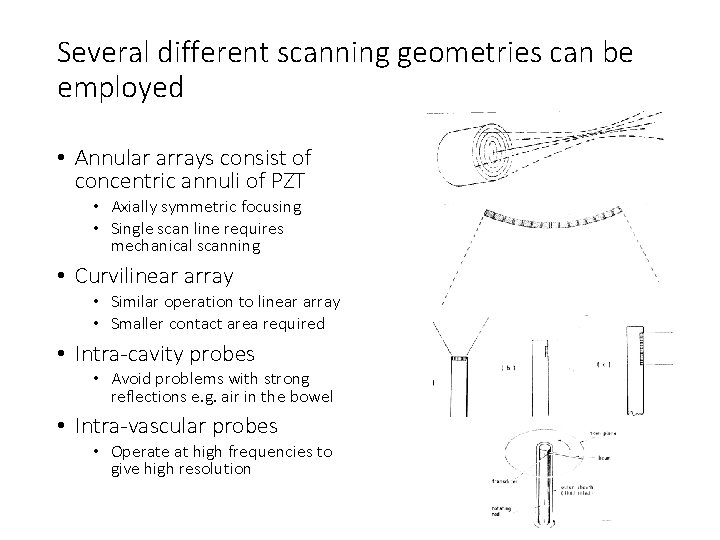
Several different scanning geometries can be employed • Annular arrays consist of concentric annuli of PZT • Axially symmetric focusing • Single scan line requires mechanical scanning • Curvilinear array • Similar operation to linear array • Smaller contact area required • Intra-cavity probes • Avoid problems with strong reflections e. g. air in the bowel • Intra-vascular probes • Operate at high frequencies to give high resolution
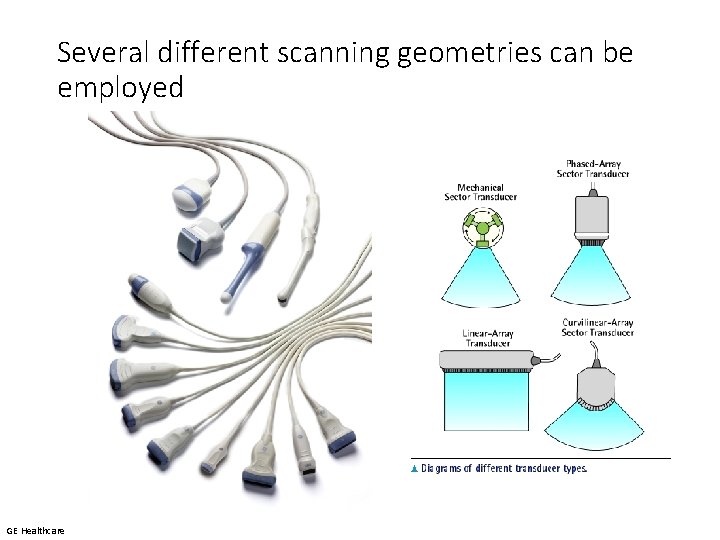
Several different scanning geometries can be employed GE Healthcare
The signal processor
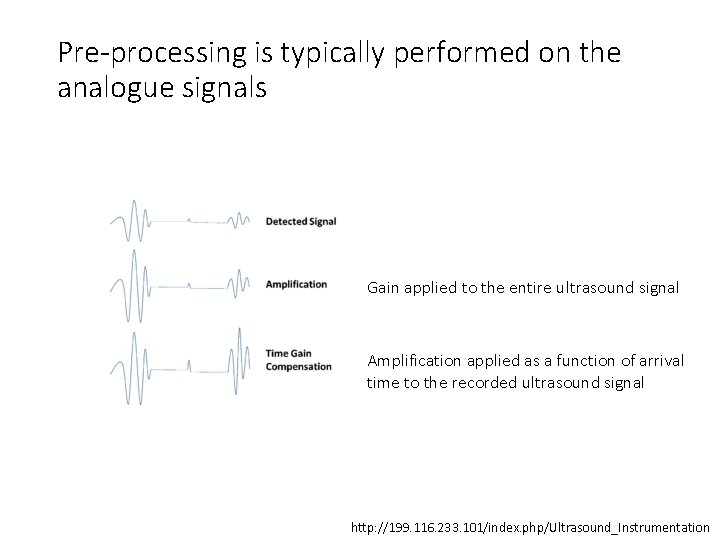
Pre-processing is typically performed on the analogue signals Gain applied to the entire ultrasound signal Amplification applied as a function of arrival time to the recorded ultrasound signal http: //199. 116. 233. 101/index. php/Ultrasound_Instrumentation
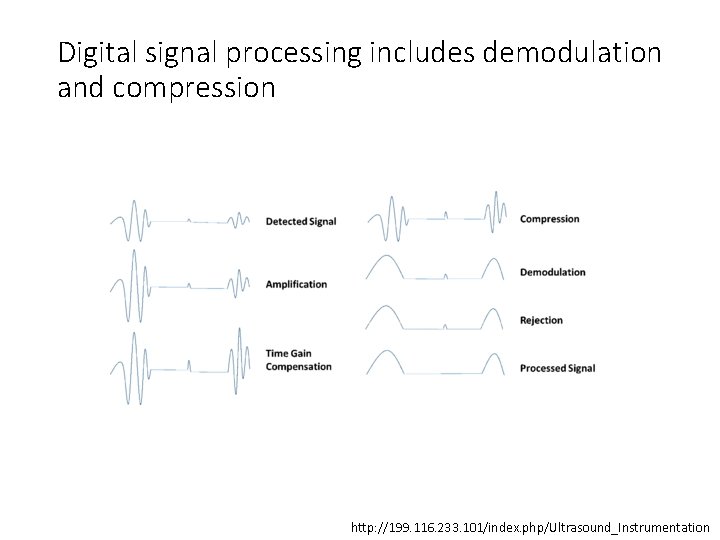
Digital signal processing includes demodulation and compression http: //199. 116. 233. 101/index. php/Ultrasound_Instrumentation
Summary (1) • Impedance mismatch causes acoustic reflections • Ultrasound can undergo reflection, refraction, absorption and scattering in tissue • Depends on the angle of incidence, size of the object relative to the ultrasound wavelength, acoustic impedance • Resolution must be traded against penetration depth because • High frequency ultrasound provides better spatial resolution • but high frequency ultrasound is strongly attenuated in tissue
Summary (2) • The pulse echo approach is used to form a brightness (B) mode ultrasound image • Transducers are composed of: • A piezoelectric element to generate and detect acoustic waves • Matching elements to maximise coupling of acoustic waves to the piezoelectric element • Backing material for damping to create a short pulse length and improve axial resolution • The finite transducer size results in a far field divergence of the beam and addition of side lobe imperfections • Focusing can partially compensate for this • Transducers are commonly combined into arrays for imaging
Next up: ultrasound imaging modalities!
- Slides: 73