
FRCR 2020 Nuclear Medicine Lectures Dr Helen Gill

- Slides: 51
FRCR 2020 Nuclear Medicine Lectures Dr Helen Gill Clinical Scientist Nuclear Medicine Department Castle Hill Hospital Hull University Teaching Hospitals NHS Trust email: helen. gill@hey. nhs. uk
FRCR Lectures 2020 ▪ Lecture I - Nuclear Medicine and Gamma Cameras ▪ Lecture II - Imaging and Optimisation ▪ Lecture III - SPECT Imaging ▪ Lecture IV - PET Imaging ▪ Lecture V - QA/QC, Measurement, Radiation Protection ▪ Lecture VI - Artefacts, Molecular Imaging, Questions
Bibliography ▪ Physics for Medical Imaging ▪ P. Allisy-Roberts, J. Williams – Farr’s Physics for Medical Imaging ▪ Radiological Physics ▪ P. Dendy, B. Heaton – Physics for Radiologists ▪ Medical Imaging ▪ J. Bushberg et al – The Essential Physics of Medical Imaging ▪ S. Webb – The Physics of Medical Imaging ▪ Nuclear Medicine ▪ S. Cherry – Physics in Nuclear Medicine ▪ P. Sharp et al – Practical Nuclear Medicine
FRCR Lecture I Nuclear Medicine and Gamma Cameras Dr Helen Gill Clinical Scientist Nuclear Medicine Department Castle Hill Hospital Hull University Teaching Hospitals NHS Trust email: helen. gill@hey. nhs. uk
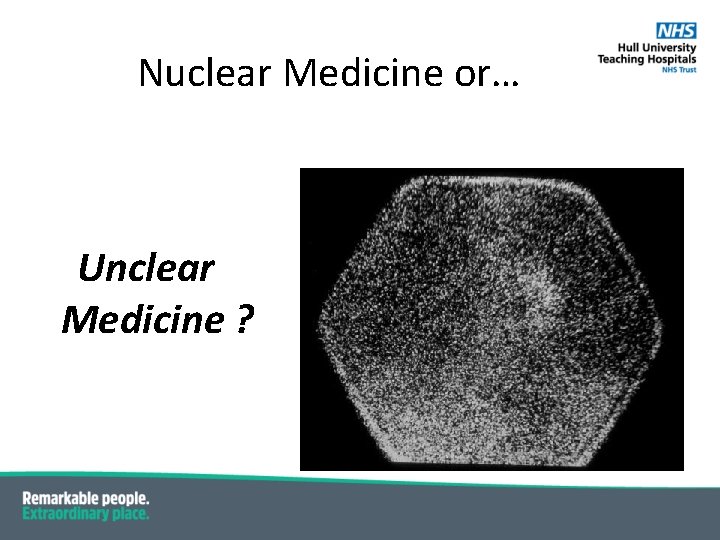
Nuclear Medicine or… Unclear Medicine ?
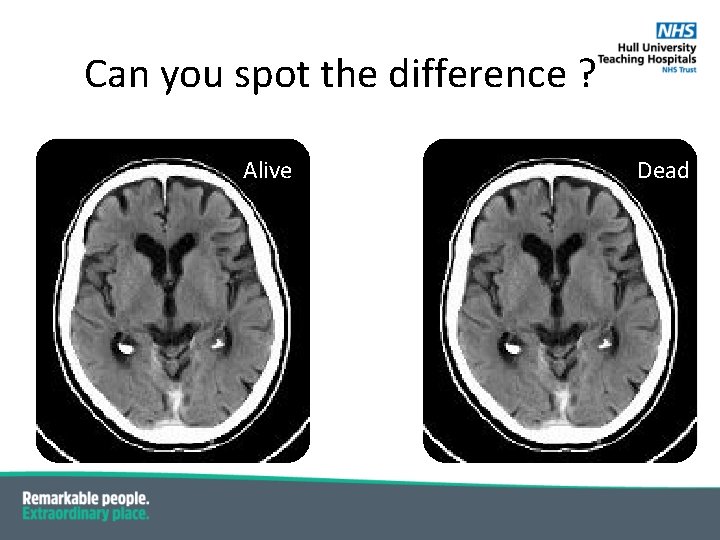
Can you spot the difference ? Alive Dead
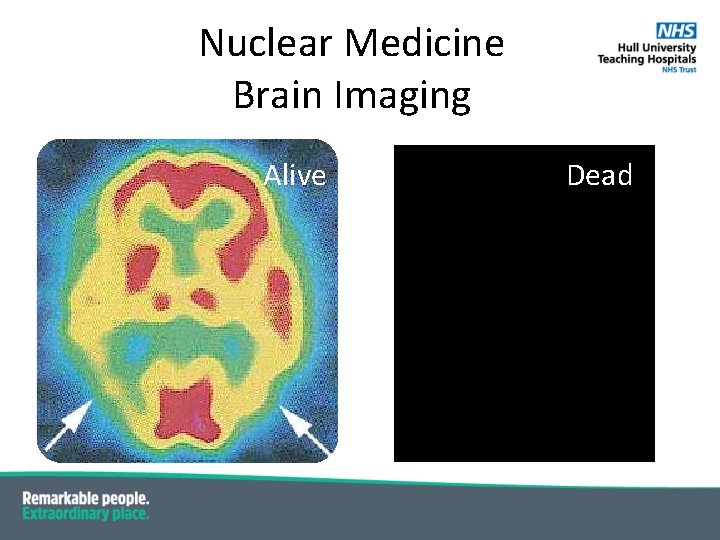
Nuclear Medicine Brain Imaging Alive Dead
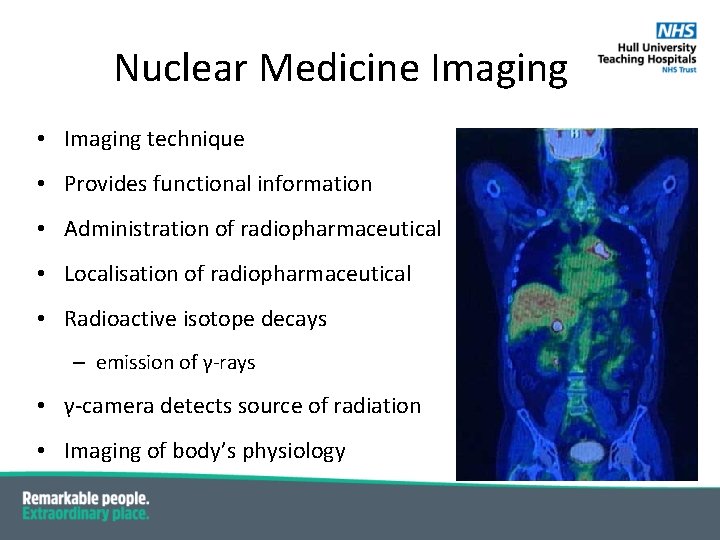
Nuclear Medicine Imaging • Imaging technique • Provides functional information • Administration of radiopharmaceutical • Localisation of radiopharmaceutical • Radioactive isotope decays – emission of γ-rays • γ-camera detects source of radiation • Imaging of body’s physiology
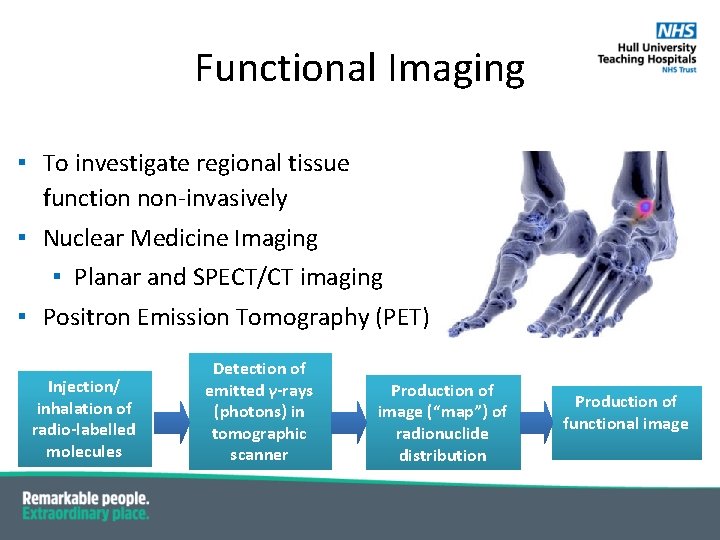
Functional Imaging ▪ To investigate regional tissue function non-invasively ▪ Nuclear Medicine Imaging ▪ Planar and SPECT/CT imaging ▪ Positron Emission Tomography (PET) Injection/ inhalation of radio-labelled molecules Detection of emitted γ-rays (photons) in tomographic scanner Production of image (“map”) of radionuclide distribution Production of functional image
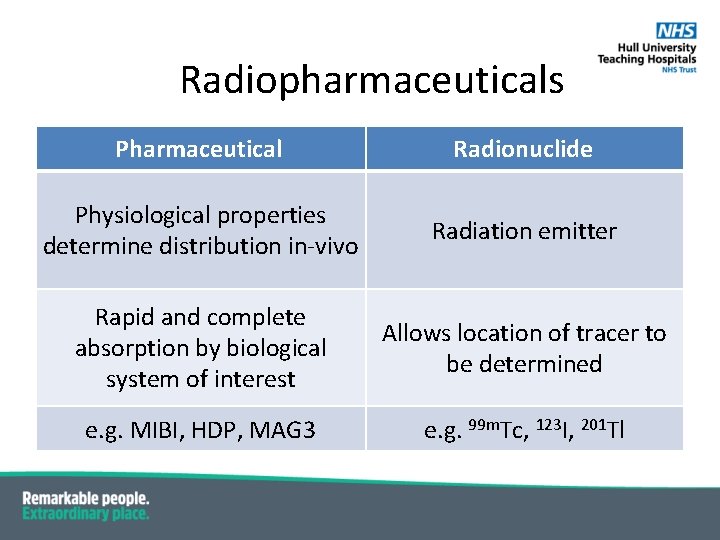
Radiopharmaceuticals Pharmaceutical Radionuclide Physiological properties determine distribution in-vivo Radiation emitter Rapid and complete absorption by biological system of interest Allows location of tracer to be determined e. g. MIBI, HDP, MAG 3 e. g. 99 m. Tc, 123 I, 201 Tl
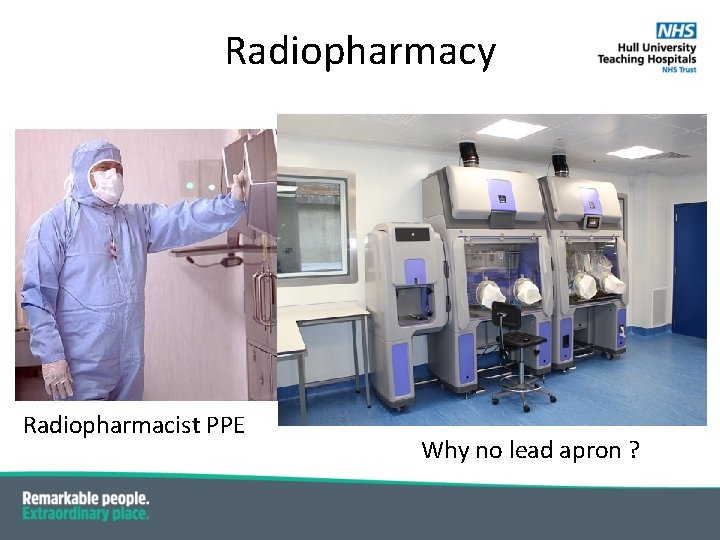
Radiopharmacy Radiopharmacist PPE Why no lead apron ?
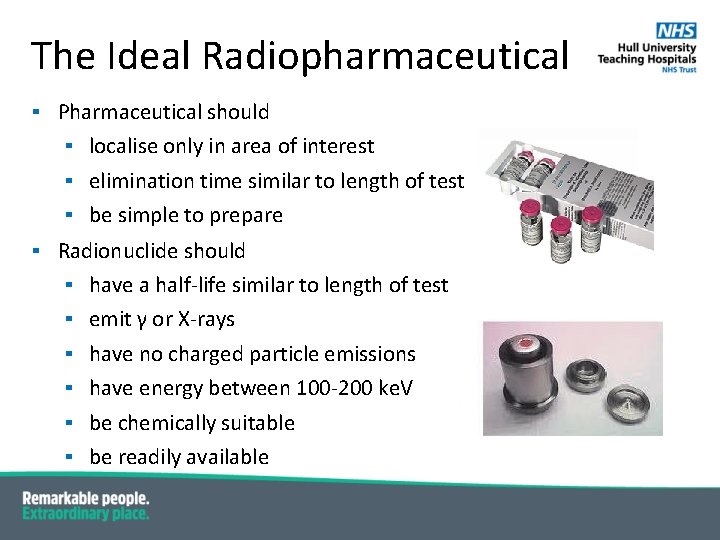
The Ideal Radiopharmaceutical ▪ Pharmaceutical should ▪ localise only in area of interest ▪ elimination time similar to length of test ▪ be simple to prepare ▪ Radionuclide should ▪ have a half-life similar to length of test ▪ emit γ or X-rays ▪ have no charged particle emissions ▪ have energy between 100 -200 ke. V ▪ be chemically suitable ▪ be readily available
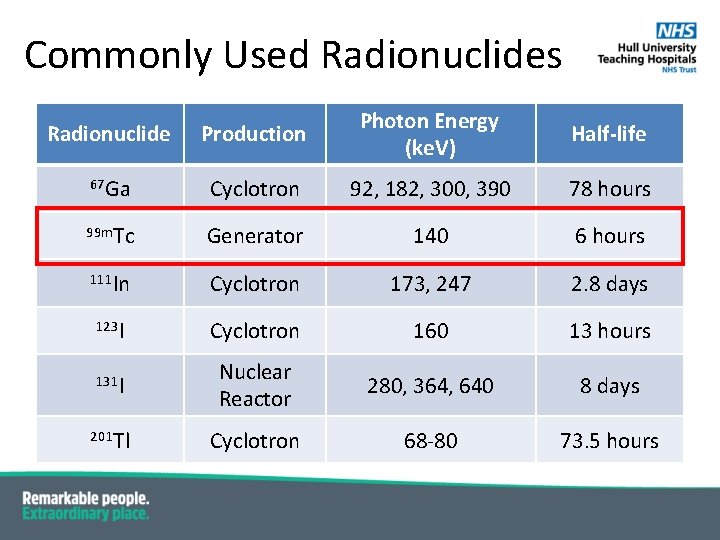
Commonly Used Radionuclides Radionuclide Production Photon Energy (ke. V) 67 Ga Cyclotron 92, 182, 300, 390 78 hours 99 m. Tc Generator 140 6 hours 111 In Cyclotron 173, 247 2. 8 days 123 I Cyclotron 160 13 hours 131 I Nuclear Reactor 280, 364, 640 8 days 201 Tl Cyclotron 68 -80 73. 5 hours Half-life
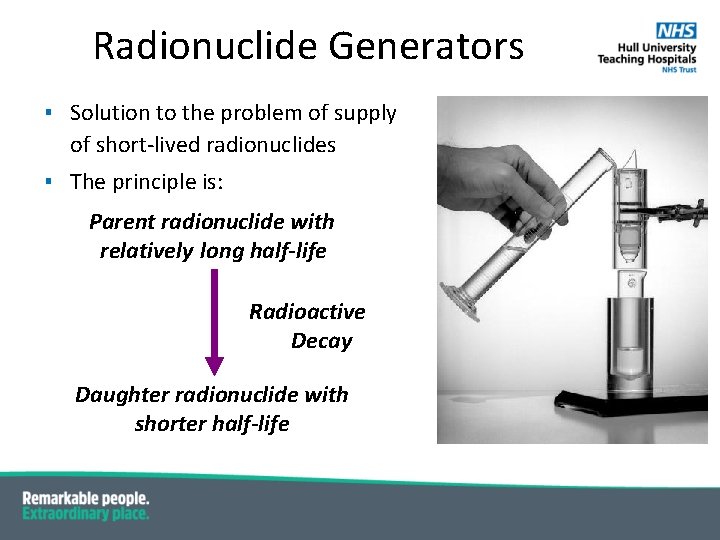
Radionuclide Generators ▪ Solution to the problem of supply of short-lived radionuclides ▪ The principle is: Parent radionuclide with relatively long half-life Radioactive Decay Daughter radionuclide with shorter half-life
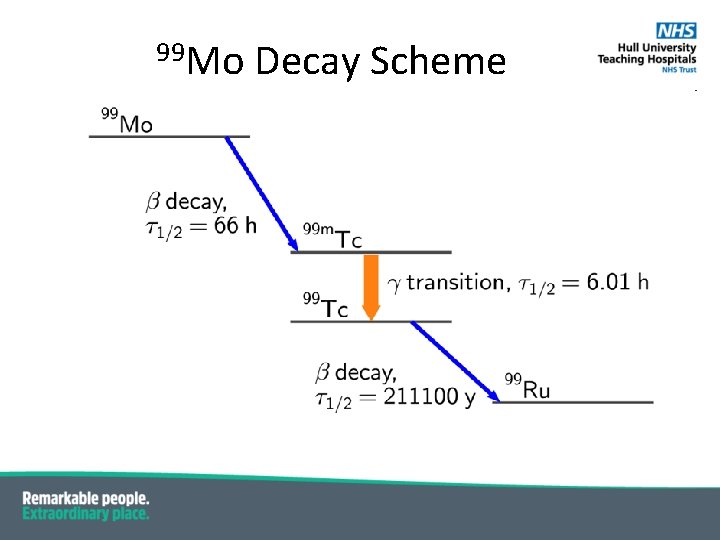
99 Mo Decay Scheme
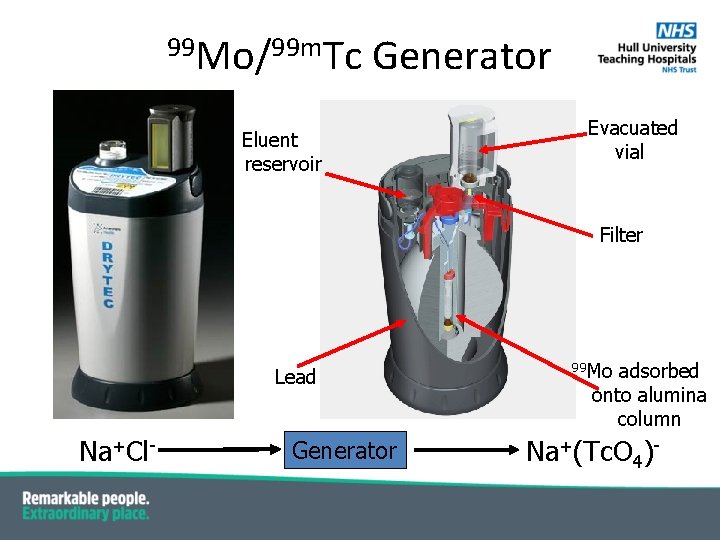
99 Mo/99 m. Tc Generator Eluent reservoir Evacuated vial Filter Lead Na+Cl- Generator 99 Mo adsorbed onto alumina column Na+(Tc. O 4)-
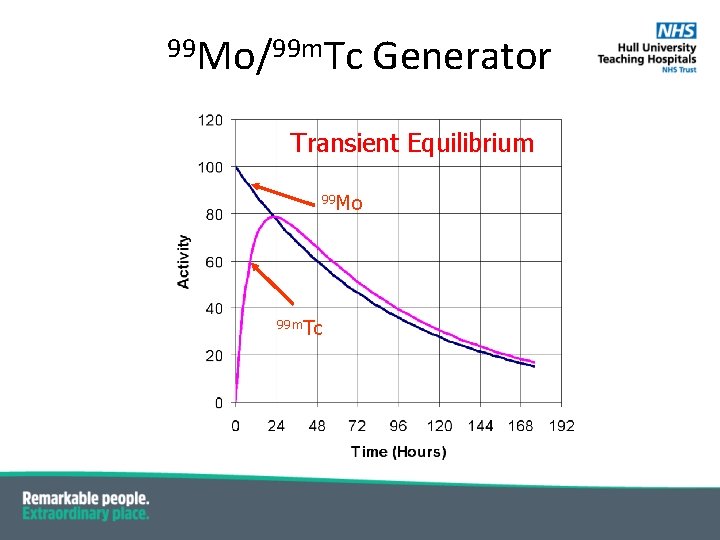
99 Mo/99 m. Tc Generator Transient Equilibrium 99 Mo 99 m. Tc
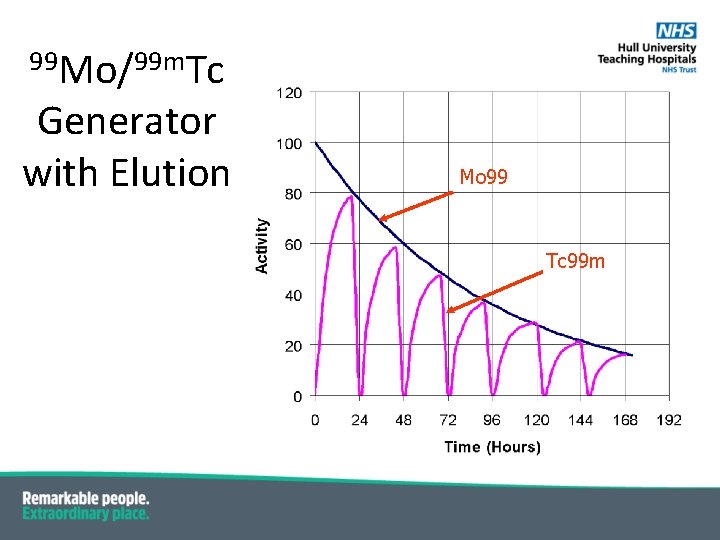
99 Mo/99 m. Tc Generator with Elution Mo 99 Tc 99 m
Radiolabelling with 99 m. Tc ▪ Cold (non-radioactive) kits (vials) ▪ pre-packed set of sterile ingredients designed for the preparation of a specific radiopharmaceutical ▪ Typical ingredients of the vials might be MDP (methylene diphosphonate) to be complexed to 99 m. Tc
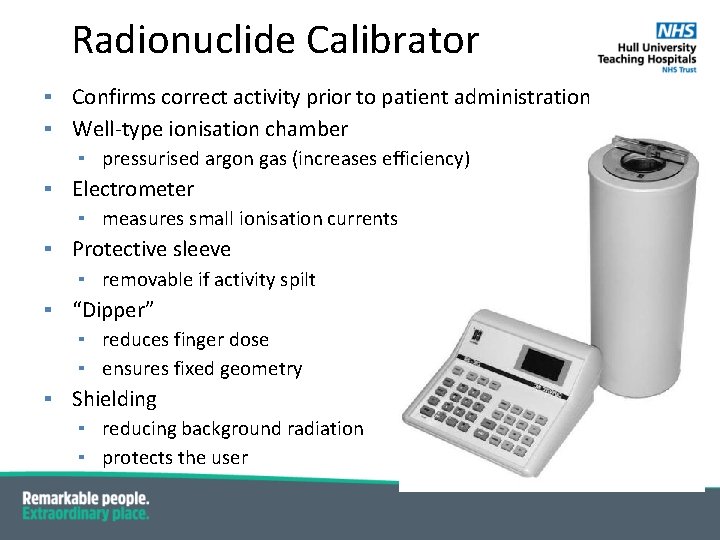
Radionuclide Calibrator ▪ Confirms correct activity prior to patient administration ▪ Well-type ionisation chamber ▪ pressurised argon gas (increases efficiency) ▪ Electrometer ▪ measures small ionisation currents ▪ Protective sleeve ▪ removable if activity spilt ▪ “Dipper” ▪ reduces finger dose ▪ ensures fixed geometry ▪ Shielding ▪ reducing background radiation ▪ protects the user
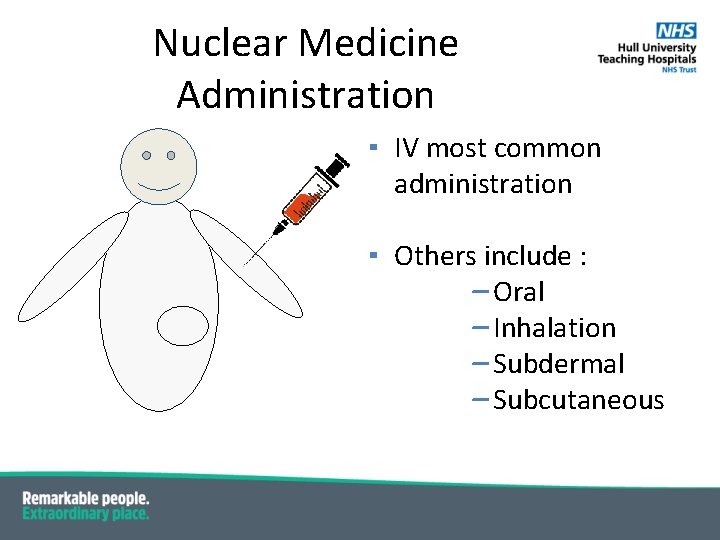
Nuclear Medicine Administration ▪ IV most common administration ▪ Others include : –Oral –Inhalation –Subdermal –Subcutaneous
Nuclear Medicine Localisation and Uptake Initially • Tracer circulates in the vasculature • No physiological uptake in the organ/area of interest
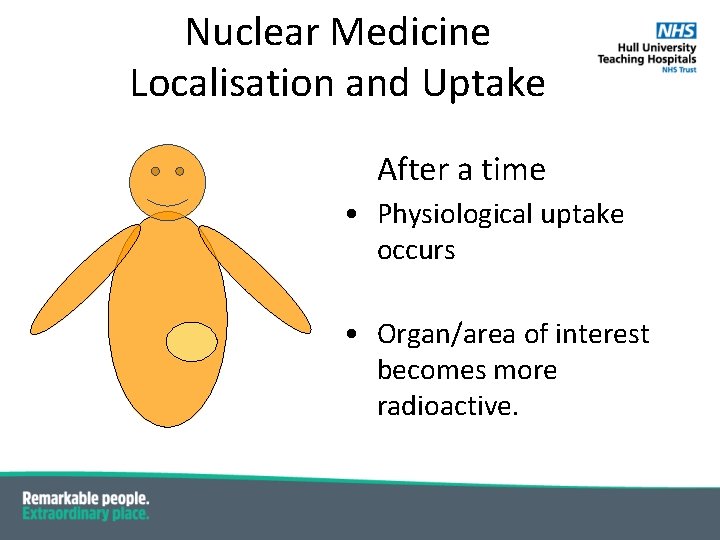
Nuclear Medicine Localisation and Uptake After a time • Physiological uptake occurs • Organ/area of interest becomes more radioactive.
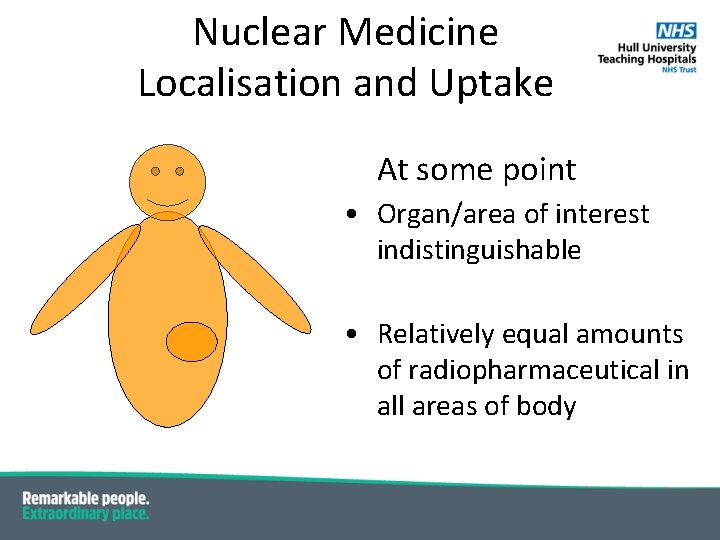
Nuclear Medicine Localisation and Uptake At some point • Organ/area of interest indistinguishable • Relatively equal amounts of radiopharmaceutical in all areas of body
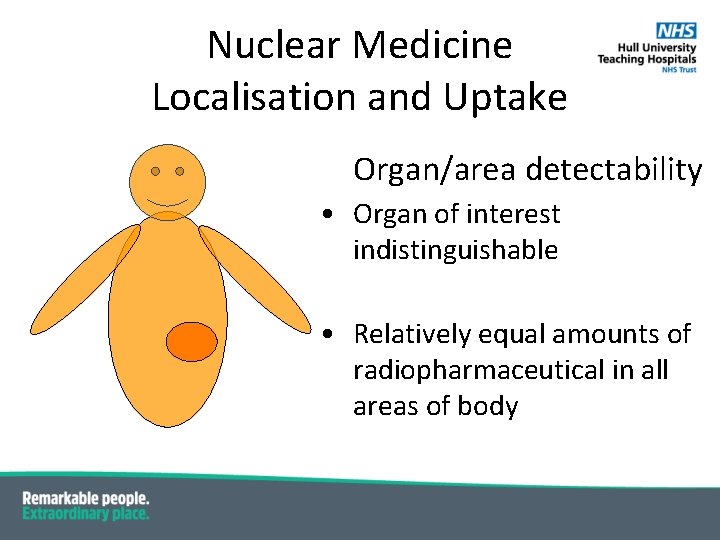
Nuclear Medicine Localisation and Uptake Organ/area detectability • Organ of interest indistinguishable • Relatively equal amounts of radiopharmaceutical in all areas of body
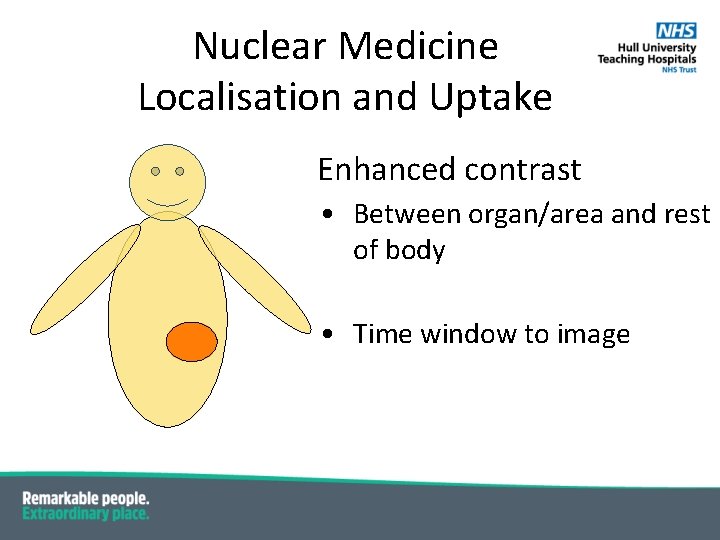
Nuclear Medicine Localisation and Uptake Enhanced contrast • Between organ/area and rest of body • Time window to image
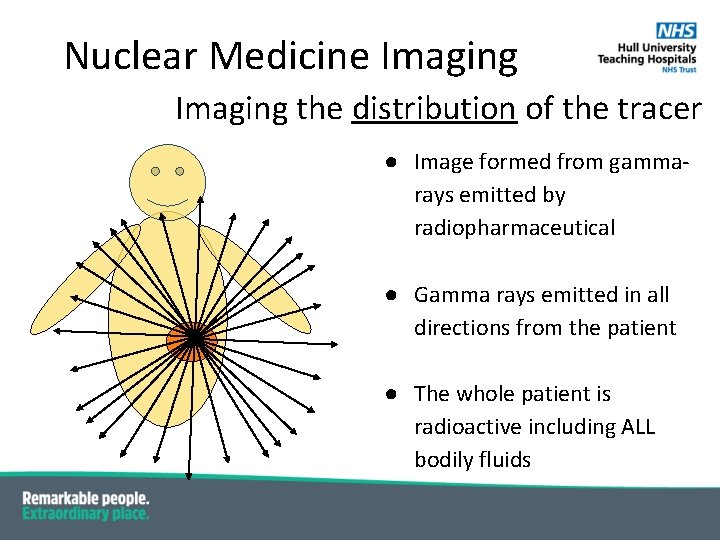
Nuclear Medicine Imaging the distribution of the tracer ● Image formed from gammarays emitted by radiopharmaceutical ● Gamma rays emitted in all directions from the patient ● The whole patient is radioactive including ALL bodily fluids
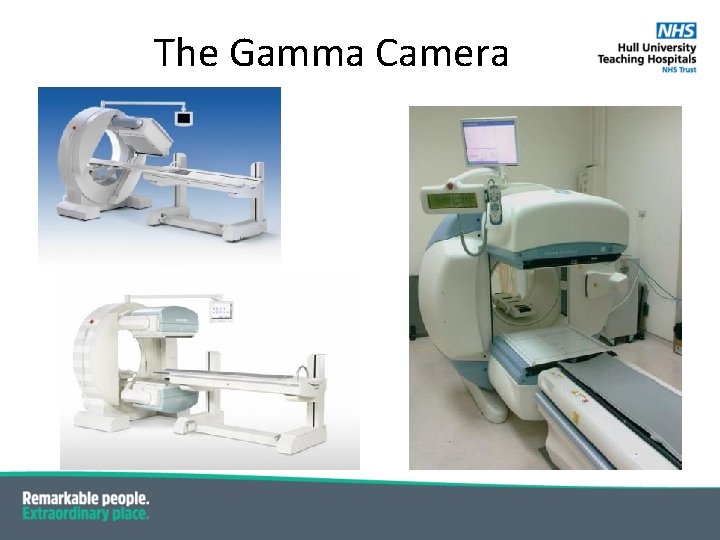
The Gamma Camera
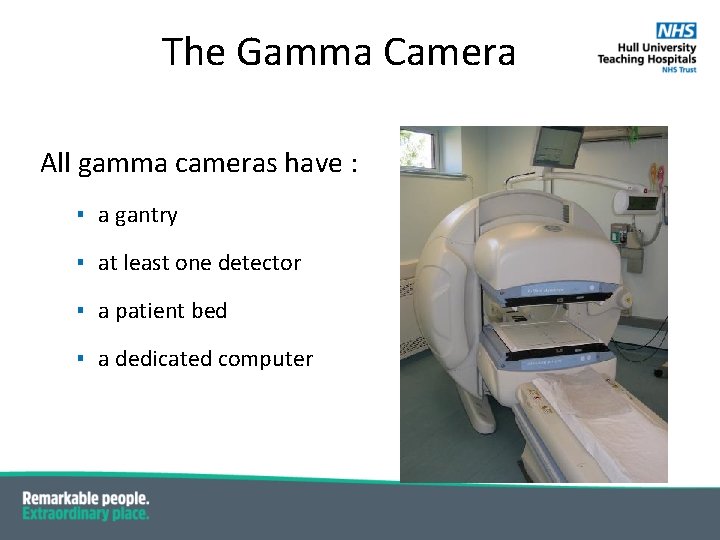
The Gamma Camera All gamma cameras have : ▪ a gantry ▪ at least one detector ▪ a patient bed ▪ a dedicated computer
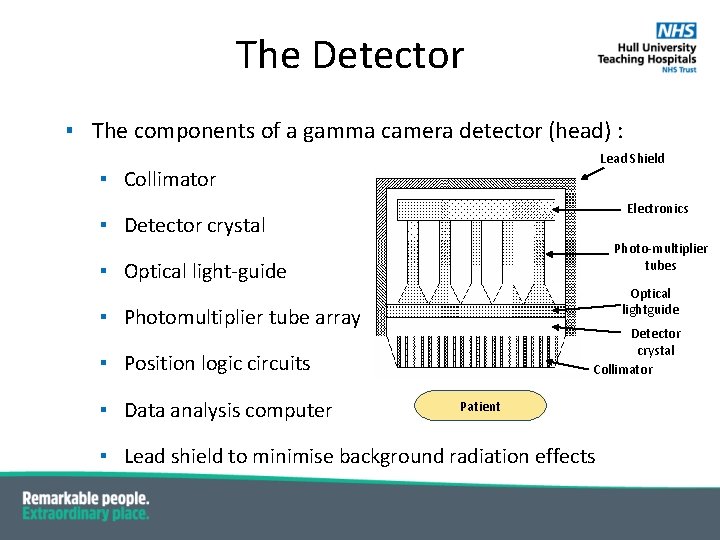
The Detector ▪ The components of a gamma camera detector (head) : Lead Shield ▪ Collimator Electronics ▪ Detector crystal Photo-multiplier tubes ▪ Optical light-guide Optical lightguide ▪ Photomultiplier tube array Detector crystal Collimator ▪ Position logic circuits ▪ Data analysis computer Patient ▪ Lead shield to minimise background radiation effects
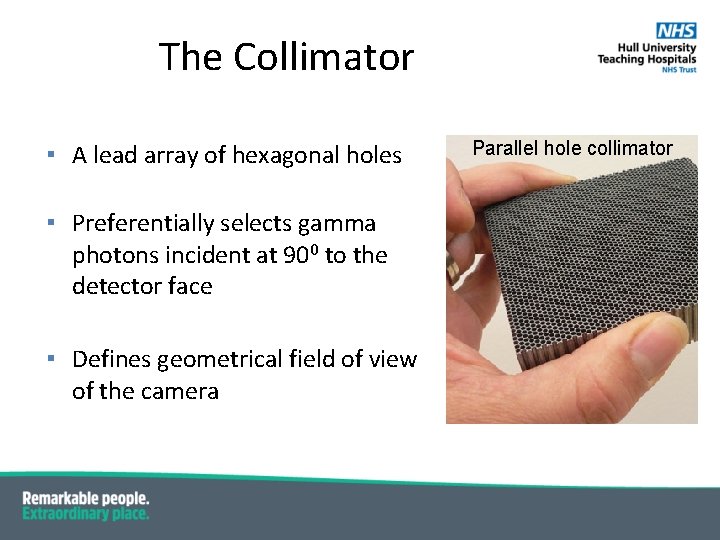
The Collimator ▪ A lead array of hexagonal holes ▪ Preferentially selects gamma photons incident at 900 to the detector face ▪ Defines geometrical field of view of the camera Parallel hole collimator
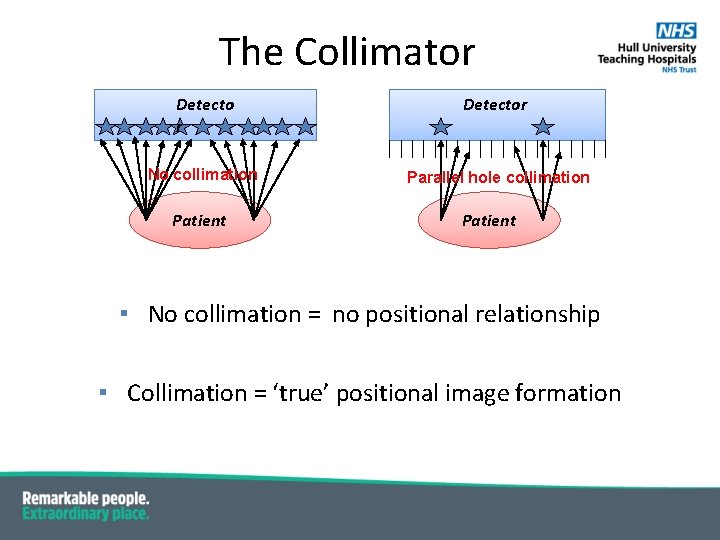
The Collimator Detector No collimation Parallel hole collimation Patient ▪ No collimation = no positional relationship ▪ Collimation = ‘true’ positional image formation
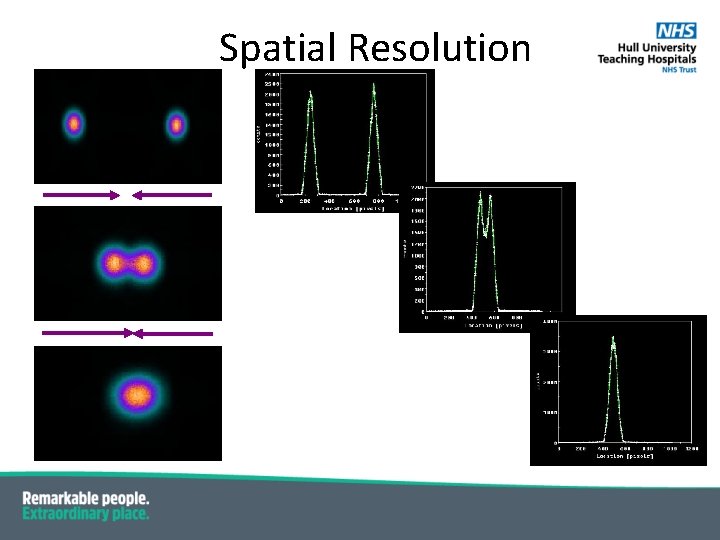
Collimator Parameters ▪ Sensitivity (cps/MBq) ▪ the proportion of the emitted photons which pass through the collimator and get detected ▪ Spatial resolution (mm) ▪ a measure of the sharpness of an image
Spatial Resolution
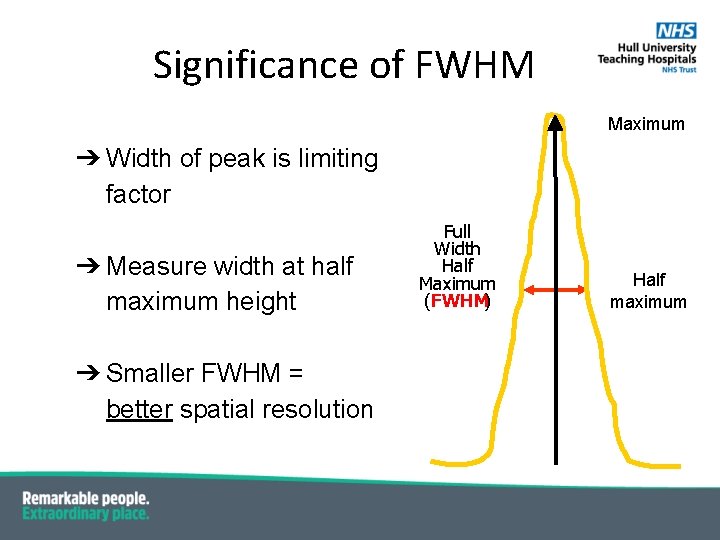
Significance of FWHM Maximum ➔ Width of peak is limiting factor ➔ Measure width at half maximum height ➔ Smaller FWHM = better spatial resolution Full Width Half Maximum (FWHM) Half maximum
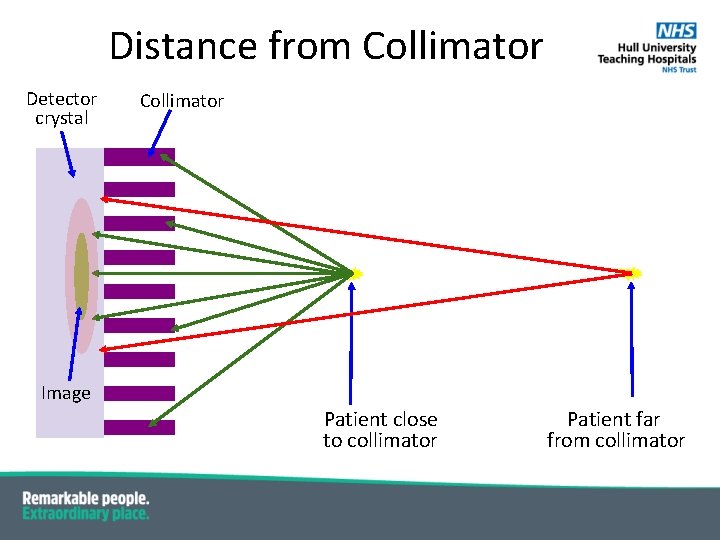
Distance from Collimator Detector crystal Collimator Image Patient close to collimator Patient far from collimator
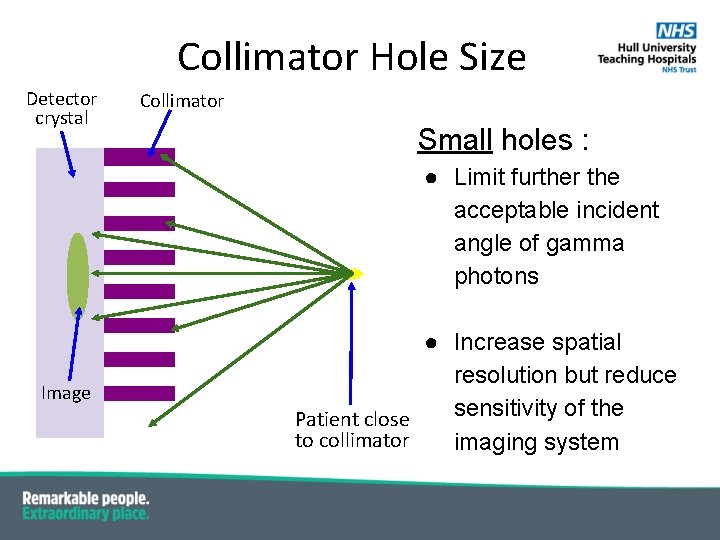
Collimator Hole Size Detector crystal Collimator Small holes : ● Limit further the acceptable incident angle of gamma photons Image ● Increase spatial resolution but reduce sensitivity of the Patient close to collimator imaging system
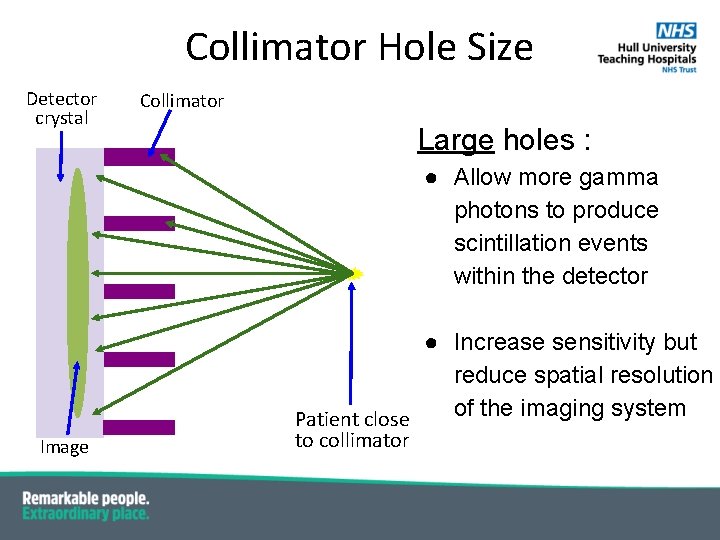
Collimator Hole Size Detector crystal Collimator Large holes : ● Allow more gamma photons to produce scintillation events within the detector ● Increase sensitivity but reduce spatial resolution of the imaging system Patient close Image to collimator
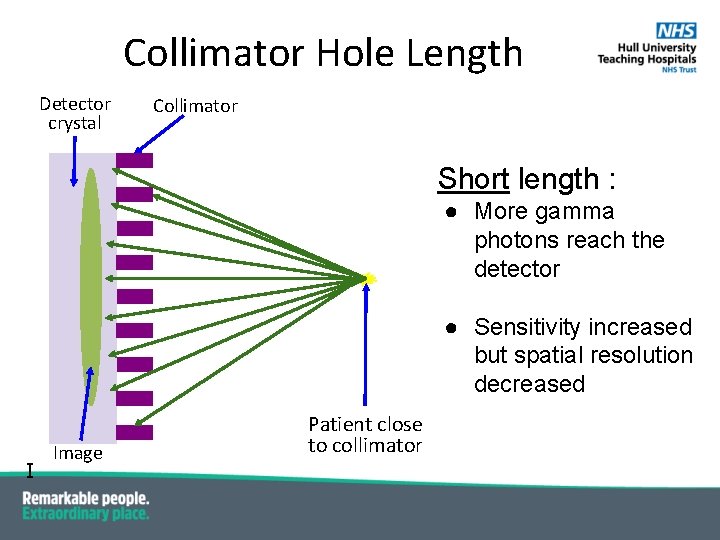
Collimator Hole Length Detector crystal Collimator Short length : ● More gamma photons reach the detector ● Sensitivity increased but spatial resolution decreased I Image Patient close to collimator
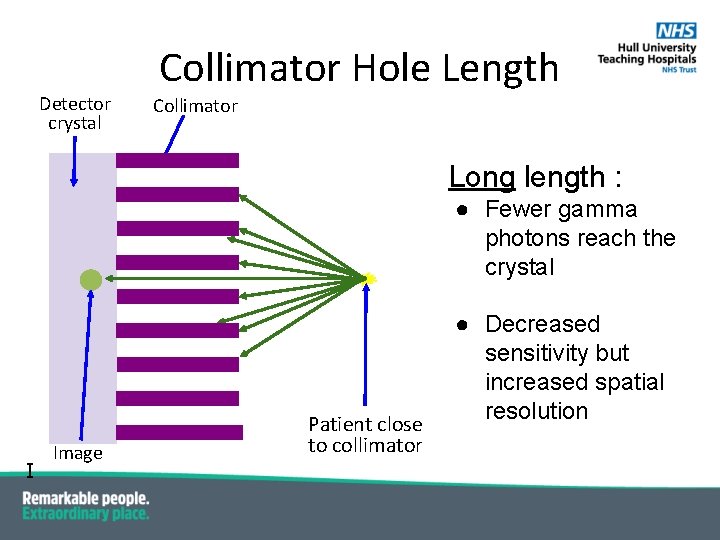
Detector crystal Collimator Hole Length Collimator Long length : ● Fewer gamma photons reach the crystal I Image Patient close to collimator ● Decreased sensitivity but increased spatial resolution
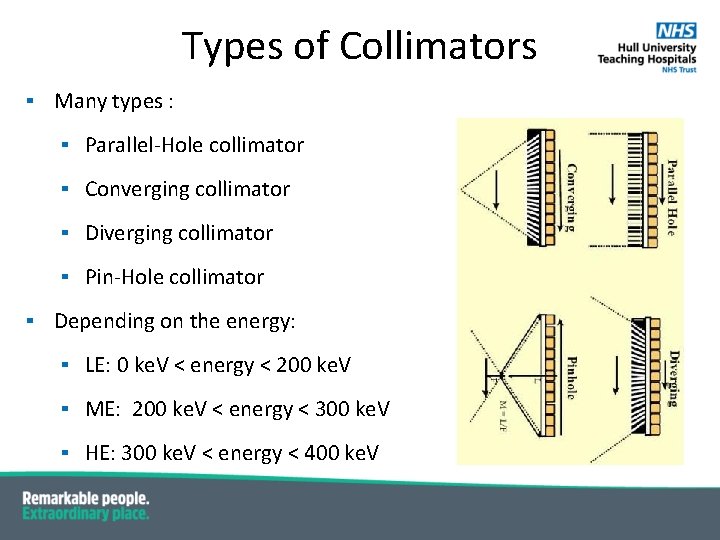
Types of Collimators ▪ Many types : ▪ Parallel-Hole collimator ▪ Converging collimator ▪ Diverging collimator ▪ Pin-Hole collimator ▪ Depending on the energy: ▪ LE: 0 ke. V < energy < 200 ke. V ▪ ME: 200 ke. V < energy < 300 ke. V ▪ HE: 300 ke. V < energy < 400 ke. V
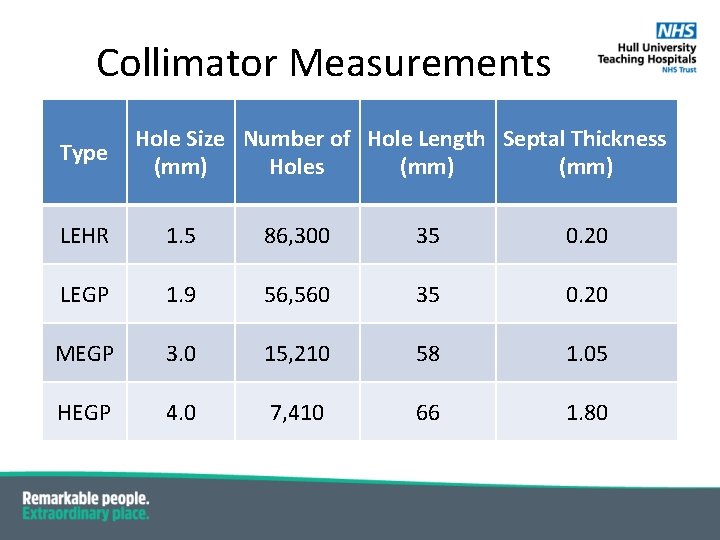
Collimator Measurements Type Hole Size Number of Hole Length Septal Thickness (mm) Holes (mm) LEHR 1. 5 86, 300 35 0. 20 LEGP 1. 9 56, 560 35 0. 20 MEGP 3. 0 15, 210 58 1. 05 HEGP 4. 0 7, 410 66 1. 80
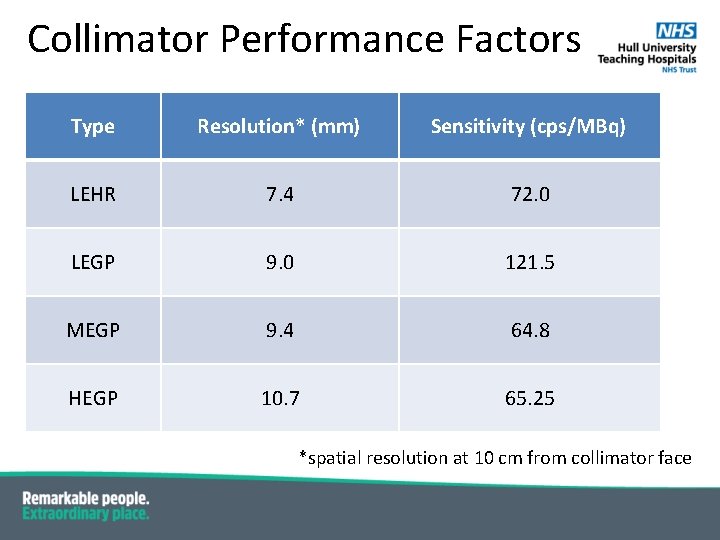
Collimator Performance Factors Type Resolution* (mm) Sensitivity (cps/MBq) LEHR 7. 4 72. 0 LEGP 9. 0 121. 5 MEGP 9. 4 64. 8 HEGP 10. 7 65. 25 *spatial resolution at 10 cm from collimator face
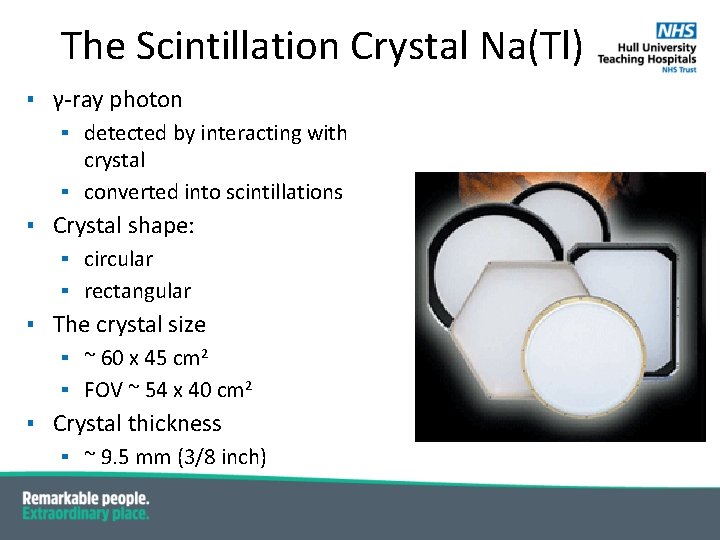
The Scintillation Crystal Na(Tl) ▪ γ-ray photon ▪ detected by interacting with crystal ▪ converted into scintillations ▪ Crystal shape: ▪ circular ▪ rectangular ▪ The crystal size ▪ ~ 60 x 45 cm 2 ▪ FOV ~ 54 x 40 cm 2 ▪ Crystal thickness ▪ ~ 9. 5 mm (3/8 inch)
Scintillation Crystal Properties ▪ Desirable properties : ▪ High stopping efficiency for γ-rays (~ 90%) ▪ Stopping without scatter ▪ Blue light emitted at 415 nm wavelength. ▪ Crystal is transparent to visible light ▪ The detector crystal is thin
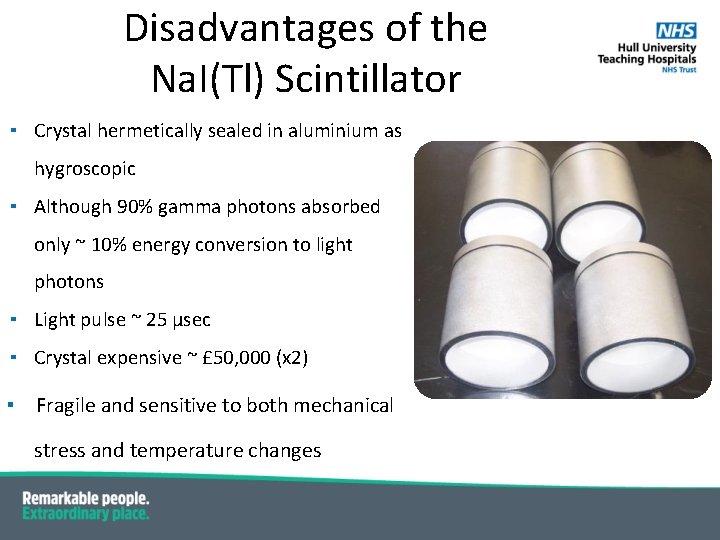
Disadvantages of the Na. I(Tl) Scintillator ▪ Crystal hermetically sealed in aluminium as hygroscopic ▪ Although 90% gamma photons absorbed only ~ 10% energy conversion to light photons ▪ Light pulse ~ 25 μsec ▪ Crystal expensive ~ £ 50, 000 (x 2) ▪ Fragile and sensitive to both mechanical stress and temperature changes
Lightguide and Optical Coupling ▪ Lightguide ▪ acts as optical coupler ▪ usually quartz doped plexiglass (transparent plastic) ▪ should be as thin as possible ▪ should match the refractive index of scintillation crystal ▪ Silicone grease between ▪ lightguide and the PMTs ▪ No air bubbles trapped in the grease ▪ photon reflections ▪ reduced light transmission
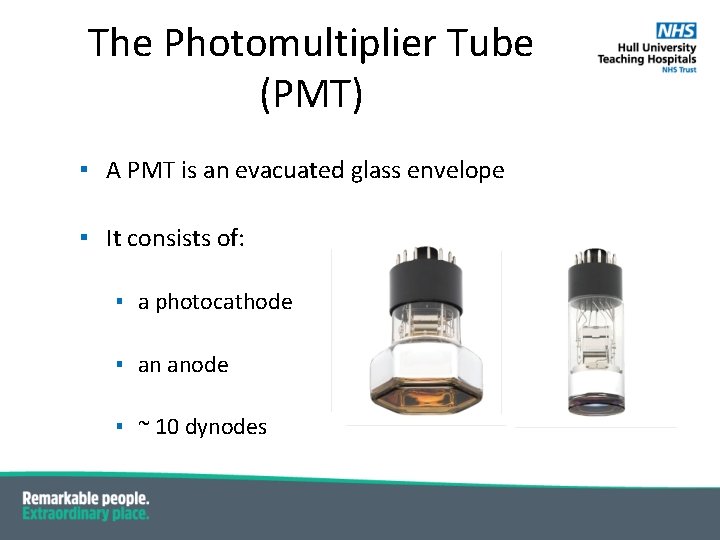
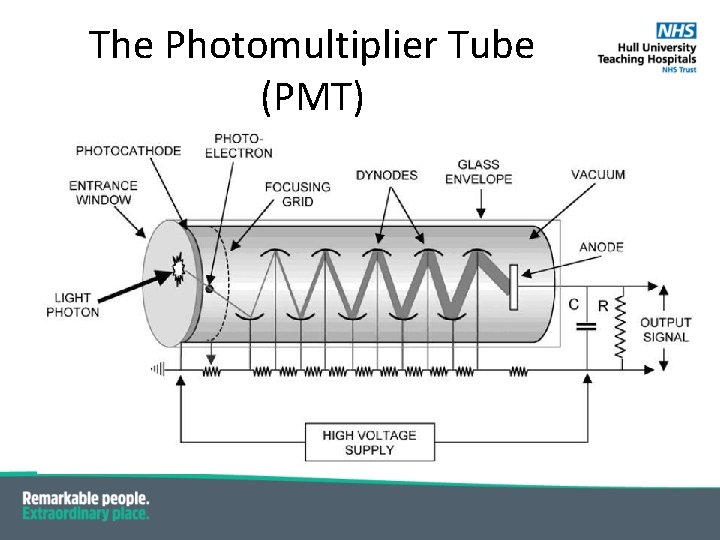
The Photomultiplier Tube (PMT) ▪ A PMT is an evacuated glass envelope ▪ It consists of: ▪ a photocathode ▪ an anode ▪ ~ 10 dynodes
The Photomultiplier Tube (PMT)
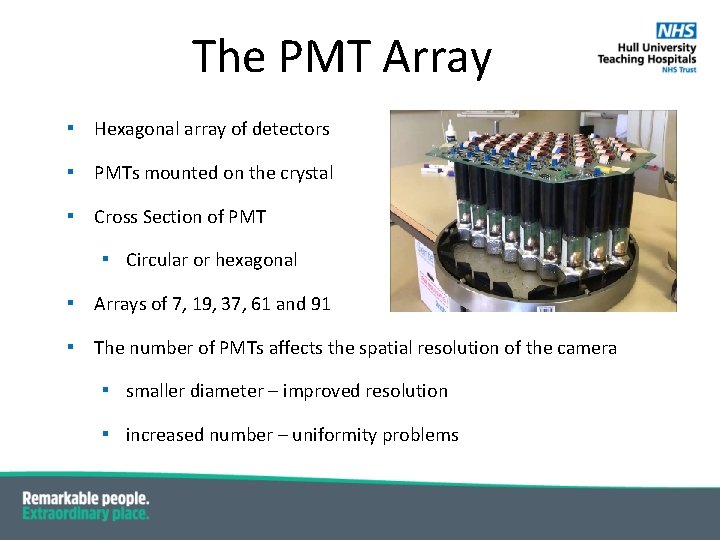
The PMT Array ▪ Hexagonal array of detectors ▪ PMTs mounted on the crystal ▪ Cross Section of PMT ▪ Circular or hexagonal ▪ Arrays of 7, 19, 37, 61 and 91 ▪ The number of PMTs affects the spatial resolution of the camera ▪ smaller diameter – improved resolution ▪ increased number – uniformity problems
Thank you for listening