
Fraunhofer Onboard Radiation Sensors FORS Stefan Metzger Stefan
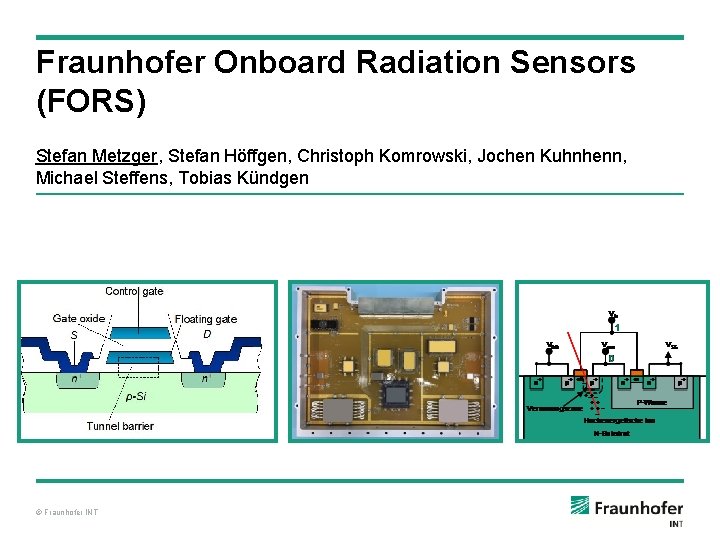
Fraunhofer Onboard Radiation Sensors (FORS) Stefan Metzger, Stefan Höffgen, Christoph Komrowski, Jochen Kuhnhenn, Michael Steffens, Tobias Kündgen © Fraunhofer INT
Outline n Fraunhofer Onboard Radiation Sensors n Implementation on Fraunhofer On-Board Processor on Heinrich-Hertz-Satellite n UV EPROM for Measuring Total Ionising Dose n SRAM for Detecting Solar Particle Events © Fraunhofer INT
Outline n Fraunhofer Onboard Radiation Sensors n Implementation on Fraunhofer On-Board Processor on Heinrich-Hertz-Satellite n UV EPROM for Measuring Total Ionising Dose n SRAM for Detecting Solar Particle Events © Fraunhofer INT
Onboard Radiation Sensors Goals n Characterize the radiation environment in terms of dose and particle flux. n Design and build radiation sensors that are n simple, n robust, n cheap and n easy to integrate. n Measure radiation where you really need it n locally on printed circuits boards, n inside electronic boxes and/or n in close proximity to radiation sensitive devices. n Support anomaly investigation. n Enable mitigation of radiation effects. © Fraunhofer INT
Onboard Radiation Sensors Approach n Do not install a separate radiation sensing systems. n Implement as few as possible additional devices that are n easy to operate, n consume low power and n do not put the whole system at risk. n Stay fully digital so that no complex data processing is needed. n Use already installed flight hardware, i. e. processor, interfaces, transceivers etc. for operation and communication, whenever possible. © Fraunhofer INT
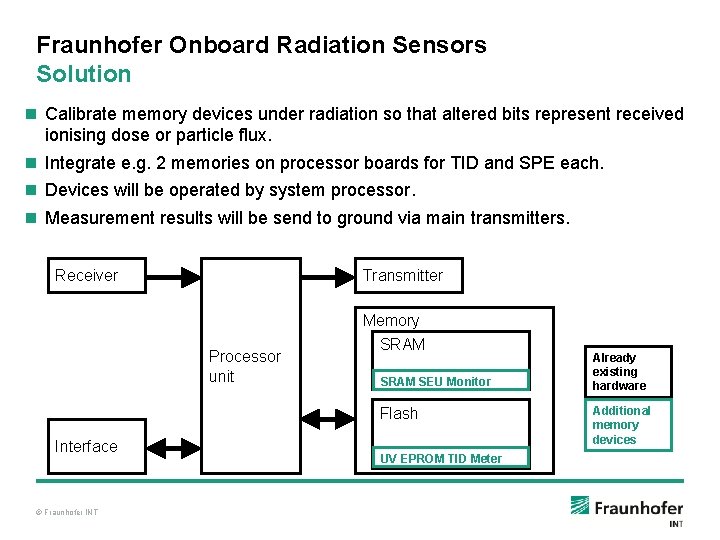
Fraunhofer Onboard Radiation Sensors Solution n Calibrate memory devices under radiation so that altered bits represent received ionising dose or particle flux. n Integrate e. g. 2 memories on processor boards for TID and SPE each. n Devices will be operated by system processor. n Measurement results will be send to ground via main transmitters. Receiver Transmitter Memory Processor unit SRAM SEU Monitor Flash Interface © Fraunhofer INT UV EPROM TID Meter Already existing hardware Additional memory devices
Outline n Fraunhofer Onboard Radiation Sensors n Implementation on Fraunhofer On-Board Processor on Heinrich-Hertz-Satellite n UV EPROM for Measuring Total Ionising Dose n SRAM for Detecting Solar Particle Events © Fraunhofer INT
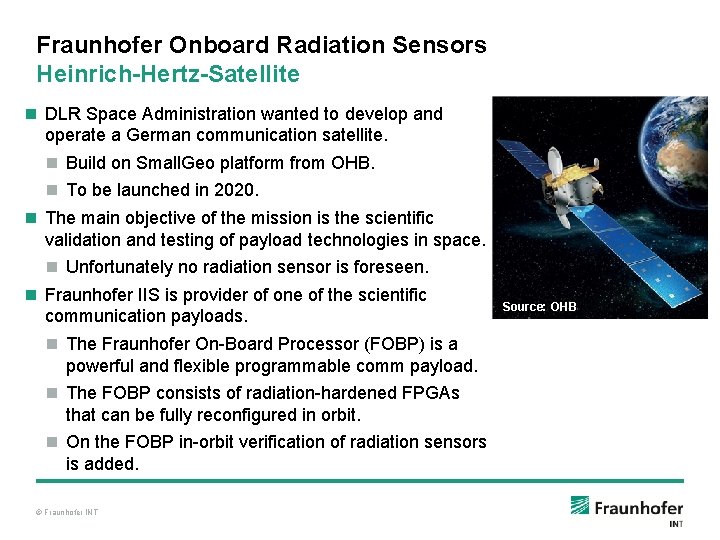
Fraunhofer Onboard Radiation Sensors Heinrich-Hertz-Satellite n DLR Space Administration wanted to develop and operate a German communication satellite. n Build on Small. Geo platform from OHB. n To be launched in 2020. n The main objective of the mission is the scientific validation and testing of payload technologies in space. n Unfortunately no radiation sensor is foreseen. n Fraunhofer IIS is provider of one of the scientific communication payloads. n The Fraunhofer On-Board Processor (FOBP) is a powerful and flexible programmable comm payload. n The FOBP consists of radiation-hardened FPGAs that can be fully reconfigured in orbit. n On the FOBP in-orbit verification of radiation sensors is added. © Fraunhofer INT Source: OHB
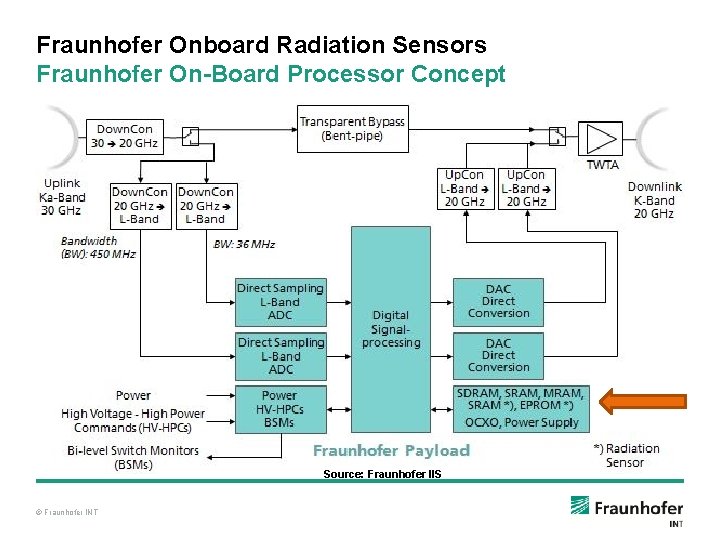
Fraunhofer Onboard Radiation Sensors Fraunhofer On-Board Processor Concept Source: Fraunhofer IIS © Fraunhofer INT
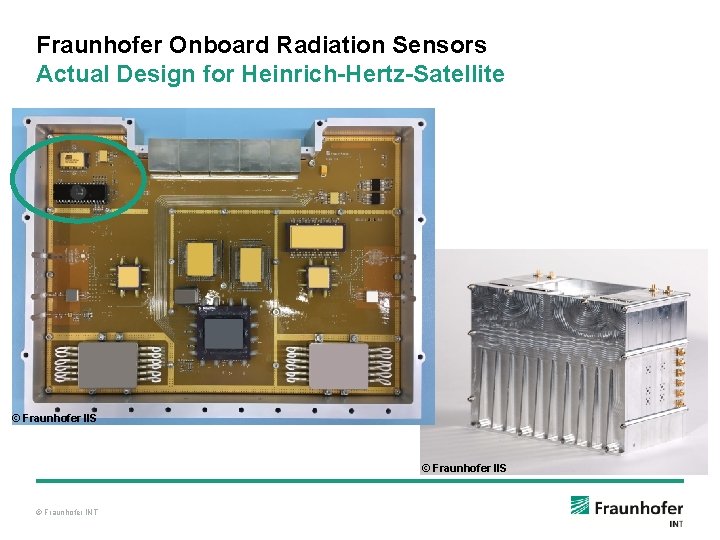
Fraunhofer Onboard Radiation Sensors Actual Design for Heinrich-Hertz-Satellite © Fraunhofer IIS © Fraunhofer INT
Outline n Fraunhofer Onboard Radiation Sensors n Implementation on Fraunhofer On-Board Processor on Heinrich-Hertz-Satellite n UV EPROM for Measuring Total Ionising Dose n SRAM for Detecting Solar Particle Events © Fraunhofer INT
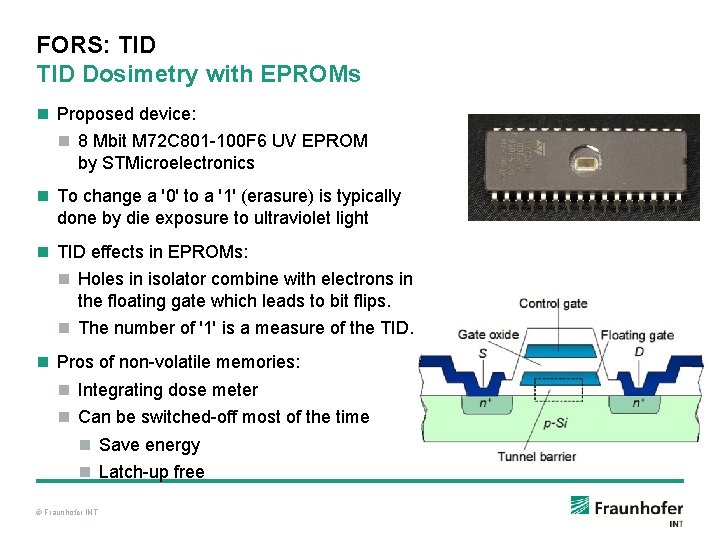
FORS: TID Dosimetry with EPROMs n Proposed device: n 8 Mbit M 72 C 801 -100 F 6 UV EPROM by STMicroelectronics n To change a '0' to a '1' (erasure) is typically done by die exposure to ultraviolet light n TID effects in EPROMs: n Holes in isolator combine with electrons in the floating gate which leads to bit flips. n The number of '1' is a measure of the TID. n Pros of non-volatile memories: n Integrating dose meter n Can be switched-off most of the time n Save energy n Latch-up free © Fraunhofer INT
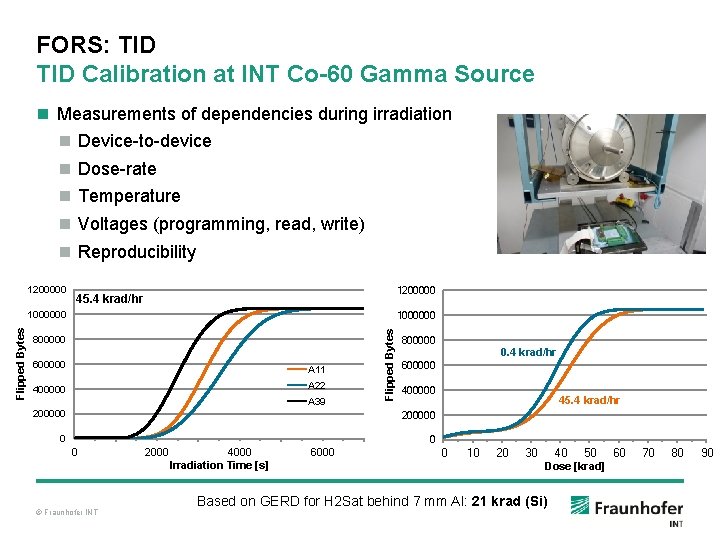
FORS: TID Calibration at INT Co-60 Gamma Source n Measurements of dependencies during irradiation n Device-to-device n Dose-rate n Temperature n Voltages (programming, read, write) n Reproducibility 1200000 45. 4 krad/hr 1000000 800000 600000 A 11 400000 A 22 A 39 200000 Flipped Bytes 1000000 800000 0. 4 krad/hr 600000 45. 4 krad/hr 200000 0 © Fraunhofer INT 2000 4000 Irradiation Time [s] 6000 0 10 20 30 40 50 60 Dose [krad] Based on GERD for H 2 Sat behind 7 mm Al: 21 krad (Si) 70 80 90
Outline n Fraunhofer Onboard Radiation Sensors n Implementation on Fraunhofer On-Board Processor on Heinrich-Hertz-Satellite n UV EPROM for Measuring Total Ionising Dose n SRAM for Detecting Solar Particle Events © Fraunhofer INT
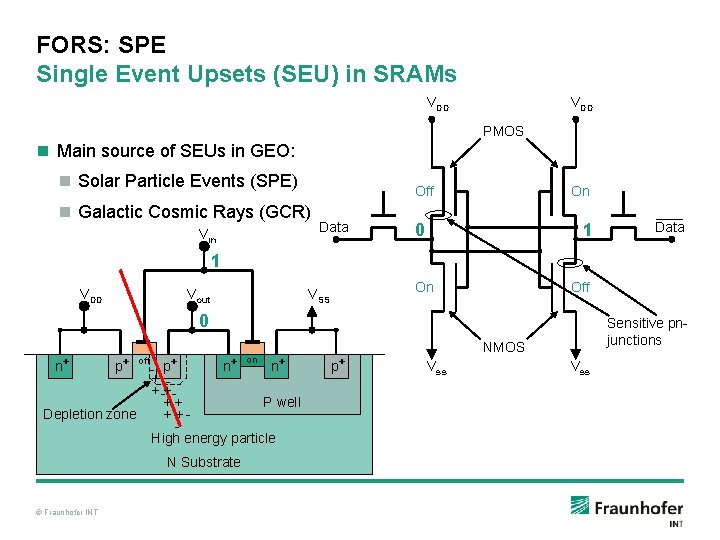
FORS: SPE Single Event Upsets (SEU) in SRAMs VDD PMOS n Main source of SEUs in GEO: n Solar Particle Events (SPE) Off n Galactic Cosmic Rays (GCR) Vin Data On 0 1 Data 1 Vout VDD On VSS Off 0 n+ p+ off p+ on n+ n+ + + -+ ++ P well Depletion zone + +High energy particle N Substrate © Fraunhofer INT p+ Sensitive pnjunctions NMOS Vss
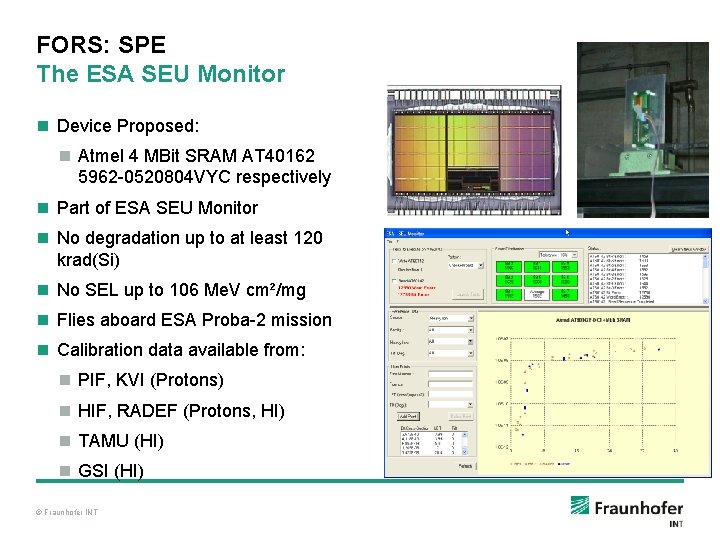
FORS: SPE The ESA SEU Monitor n Device Proposed: n Atmel 4 MBit SRAM AT 40162 5962 -0520804 VYC respectively n Part of ESA SEU Monitor n No degradation up to at least 120 krad(Si) n No SEL up to 106 Me. V cm²/mg n Flies aboard ESA Proba-2 mission n Calibration data available from: n PIF, KVI (Protons) n HIF, RADEF (Protons, HI) n TAMU (HI) n GSI (HI) © Fraunhofer INT
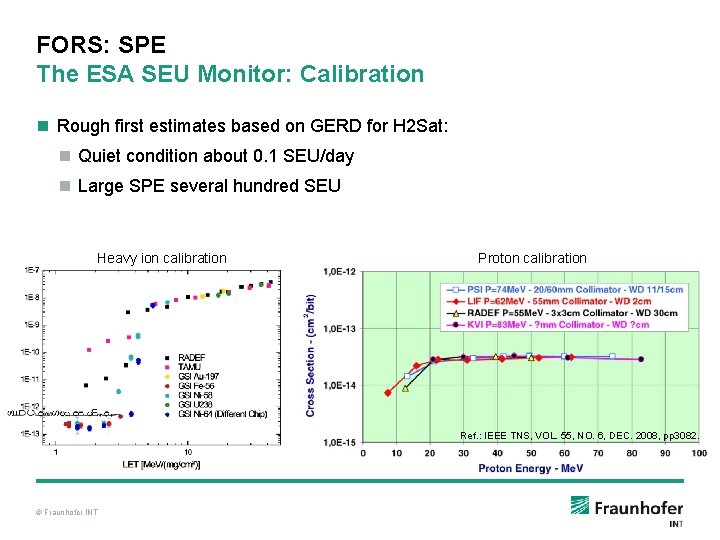
FORS: SPE The ESA SEU Monitor: Calibration n Rough first estimates based on GERD for H 2 Sat: n Quiet condition about 0. 1 SEU/day n Large SPE several hundred SEU Heavy ion calibration Proton calibration Ref. : IEEE TNS, VOL. 55, NO. 6, DEC. 2008, pp 3082. © Fraunhofer INT
Thank you for your attention! Dr. Stefan Metzger Deputy Director Head of Department NE +49 2251 18 -214 stefan. metzger@int. fraunhofer. de www. int. fraunhofer. de © Fraunhofer INT
- Slides: 18