
FRAUD PREVENTION GOOD PRACTICE GUIDE An introductory guide
- Slides: 18
FRAUD PREVENTION GOOD PRACTICE GUIDE An introductory guide to protecting your firm against fraud. A Publication of
Table of Contents Introduction 1. The Fraud Act and Key Offences 2. Internal versus External Fraud 3. The Fraud Triangle 4. Preventing Fraud Resources
INTRODUCTION Fraudsters are always looking for new ways to defraud individuals and companies. They may do so by impersonating your customers, fraudulently obtaining your goods and services, infiltrating your supply chain, or colluding with representatives. Although you may never have met them, you'll still be in their sights. To protect your company, you need to be aware of any vulnerabilities that you may be exposed to and strengthen your existing arrangements. This guide begins with the basics of Fraud Prevention and then acts as a platform to help you manage and identify the threat of fraud in your company. "Dishonest representation, failure to disclose information or abuse of position that is intended for making a gain for oneself or another, or causing a loss to another or exposing another to a risk of loss" Source: UK Fraud Act
1 CHAPTER ONE The Fraud Act & Key Offences
THE FRAUD ACT What are the key offences? Under the Fraud Act, there are three main offences: • • • Fraud by false representation: Where someone makes a dishonest representation (express or implied) with the intention of making a gain or causing a loss to another. Fraud by failing to disclose information: Where someone dishonestly fails to disclose information which they're under a legal duty to disclose, with the intention of making a gain for himself or inflicting a loss on another. Fraud by abuse of position: Where someone holding a position of responsibility (which requires him to safeguard the interests of another) dishonestly abuses the position, with the intention of making a gain for himself or inflicting a loss on another. Other offences include the possession of articles for use in fraud, making or supplying articles for use in fraud, participating in fraudulent business, and obtaining services dishonestly.
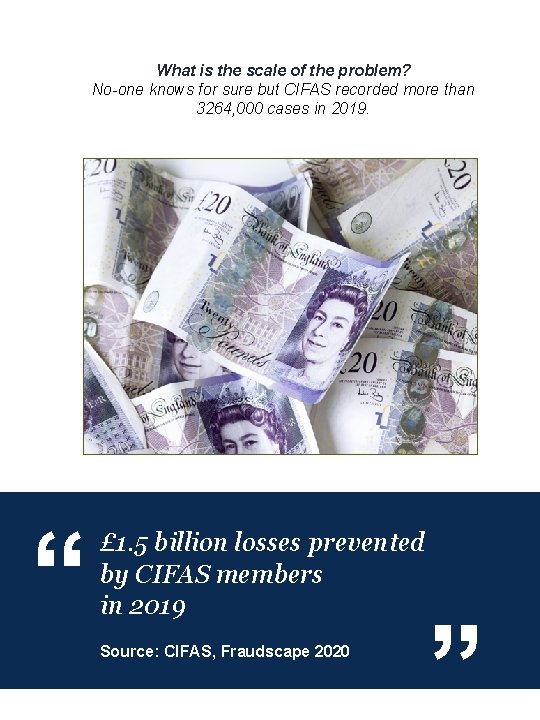
What is the scale of the problem? No-one knows for sure but CIFAS recorded more than 3264, 000 cases in 2019. Source: CIFAS, Fraudscape 2020 “ “ £ 1. 5 billion losses prevented by CIFAS members in 2019
2 CHAPTER TWO Internal versus External Fraud
WHO COMMITS FRAUD? The internal and external threat Fraud may be perpetrated by people who are internal or external to your firm: • • Internal threat: for instance, by disgruntled employees who may pilfer company assets, overstate expenses or overbill customers. Workers may also collude with suppliers to defraud the firm (misappropriation of funds). There may also be fraudulent reporting of company accounts by senior managers. External threat: for instance, by customers (obtaining goods or services without paying or misrepresenting their finances), by suppliers (submitting false or duplicate invoices), by representatives (not passing on all the money they receive to our firm). Fraud may also be committed by people who are unknown to us, via identity theft, CEO fraud, and so on.
3 CHAPTER THREE The Fraud Triangle
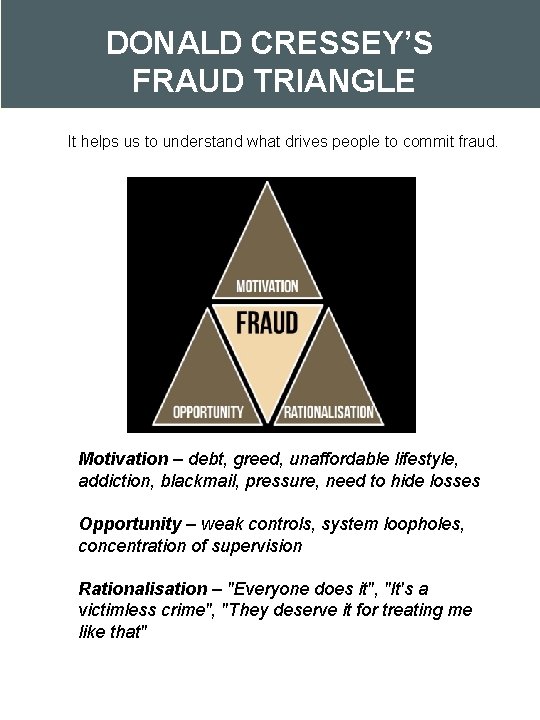
DONALD CRESSEY’S FRAUD TRIANGLE It helps us to understand what drives people to commit fraud. Motivation – debt, greed, unaffordable lifestyle, addiction, blackmail, pressure, need to hide losses Opportunity – weak controls, system loopholes, concentration of supervision Rationalisation – "Everyone does it", "It's a victimless crime", "They deserve it for treating me like that"
4 CHAPTER FOUR Preventing Fraud
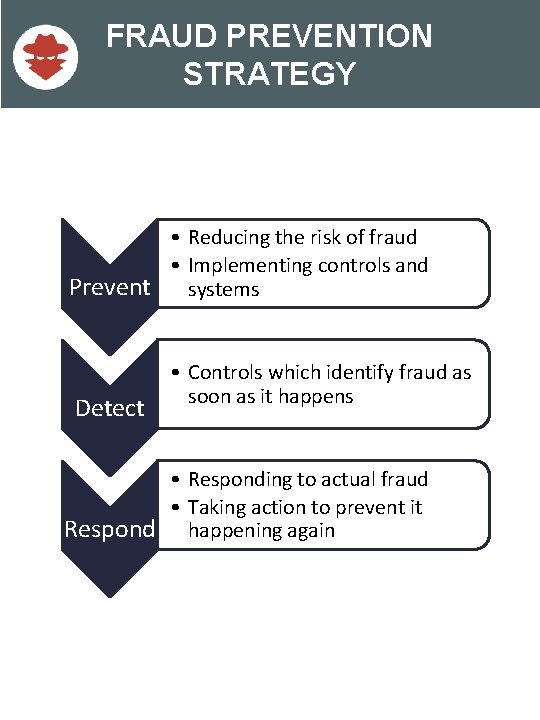
FRAUD PREVENTION STRATEGY • Reducing the risk of fraud • Implementing controls and Prevent systems Detect • Controls which identify fraud as soon as it happens • Responding to actual fraud • Taking action to prevent it Respond happening again
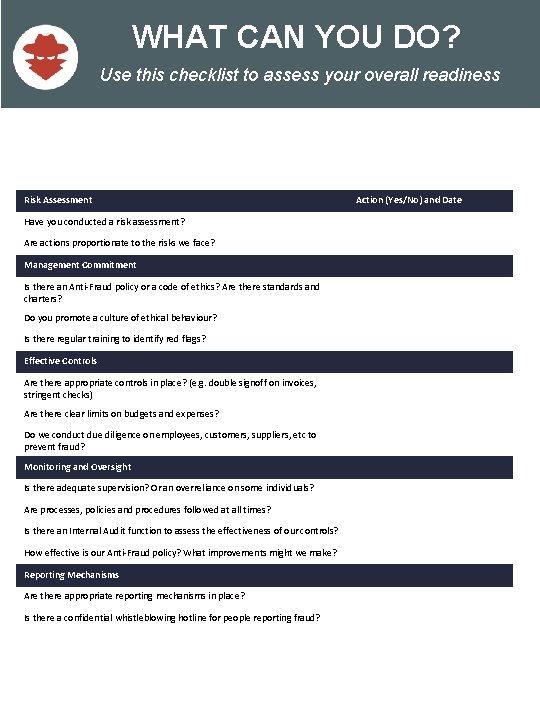
WHAT CAN YOU DO? Use this checklist to assess your overall readiness Risk Assessment Have you conducted a risk assessment? Are actions proportionate to the risks we face? Management Commitment Is there an Anti-Fraud policy or a code of ethics? Are there standards and charters? Do you promote a culture of ethical behaviour? Is there regular training to identify red flags? Effective Controls Are there appropriate controls in place? (e. g. double signoff on invoices, stringent checks) Are there clear limits on budgets and expenses? Do we conduct due diligence on employees, customers, suppliers, etc to prevent fraud? Monitoring and Oversight Is there adequate supervision? Or an overreliance on some individuals? Are processes, policies and procedures followed at all times? Is there an Internal Audit function to assess the effectiveness of our controls? How effective is our Anti-Fraud policy? What improvements might we make? Reporting Mechanisms Are there appropriate reporting mechanisms in place? Is there a confidential whistleblowing hotline for people reporting fraud? Action (Yes/No) and Date
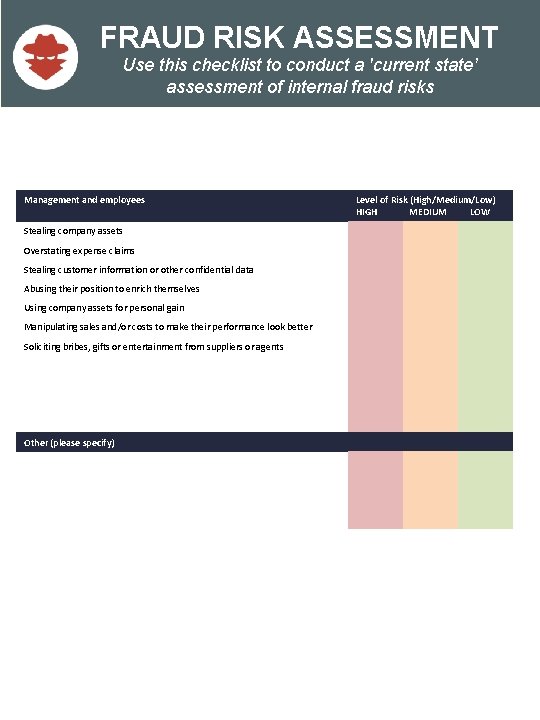
FRAUD RISK ASSESSMENT Use this checklist to conduct a 'current state’ assessment of internal fraud risks Management and employees Stealing company assets Overstating expense claims Stealing customer information or other confidential data Abusing their position to enrich themselves Using company assets for personal gain Manipulating sales and/or costs to make their performance look better Soliciting bribes, gifts or entertainment from suppliers or agents Other (please specify) Level of Risk (High/Medium/Low) HIGH MEDIUM LOW
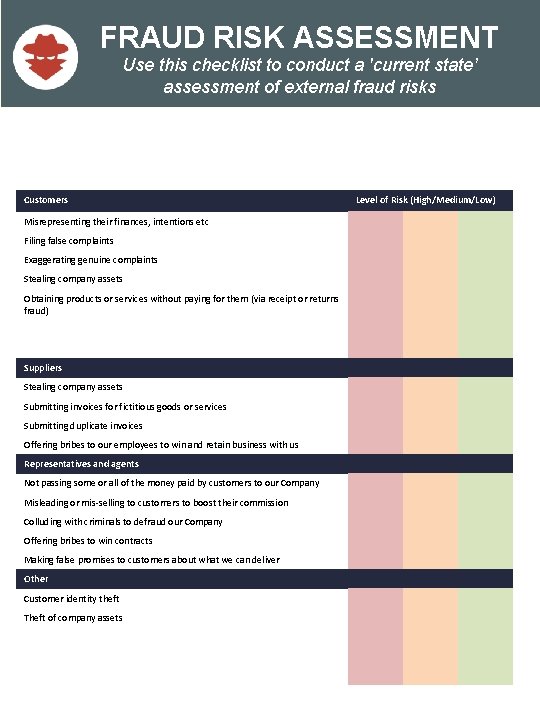
FRAUD RISK ASSESSMENT Use this checklist to conduct a 'current state’ assessment of external fraud risks Customers Misrepresenting their finances, intentions etc Filing false complaints Exaggerating genuine complaints Stealing company assets Obtaining products or services without paying for them (via receipt or returns fraud) Suppliers Stealing company assets Submitting invoices for fictitious goods or services Submitting duplicate invoices Offering bribes to our employees to win and retain business with us Representatives and agents Not passing some or all of the money paid by customers to our Company Misleading or mis-selling to customers to boost their commission Colluding with criminals to defraud our Company Offering bribes to win contracts Making false promises to customers about what we can deliver Other Customer identity theft Theft of company assets Level of Risk (High/Medium/Low)
5 CHAPTER FIVE Resources
FURTHER READING Fraud related websites: https: //www. cifas. org. uk/research_and_reports https: //www. financialfraudaction. org. uk/businesses https: //takefive-stopfraud. org. uk
Skillcast provides digital learning content, technology and services to help you train your staff, automate your compliance processes and generate management reports to help you keep track of it all. Our best-selling Compliance Essentials Library provides a complete and comprehensive off-theshelf compliance solution for UK businesses. It contains 30 in-depth e-learning courses and dozens of express micro-learning modules from AML, Bribery, GDPR and Equality to Health and Safety. Register for a free trial at https: //www. skillcast. com/free-trial Copyright © 2020 Skillcast. All Rights Reserved.