
Frank Cowell Microeconomics November 2006 Exercise 7 7
Frank Cowell: Microeconomics November 2006 Exercise 7. 7 MICROECONOMICS Principles and Analysis Frank Cowell
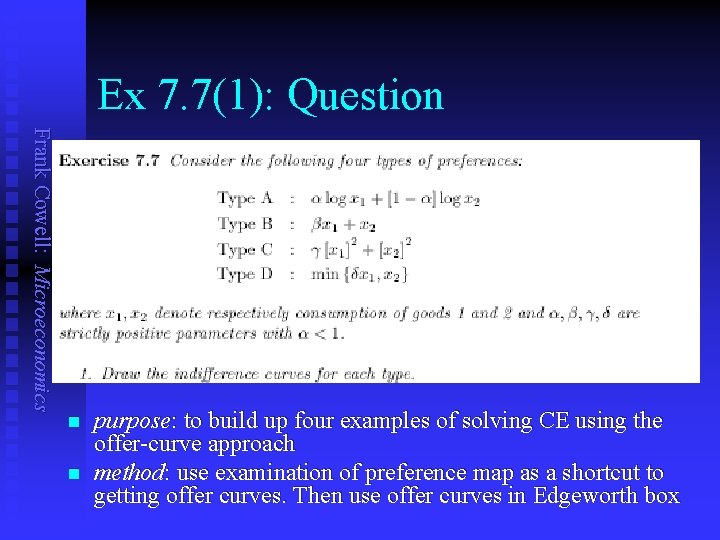
Ex 7. 7(1): Question Frank Cowell: Microeconomics n n purpose: to build up four examples of solving CE using the offer-curve approach method: use examination of preference map as a shortcut to getting offer curves. Then use offer curves in Edgeworth box
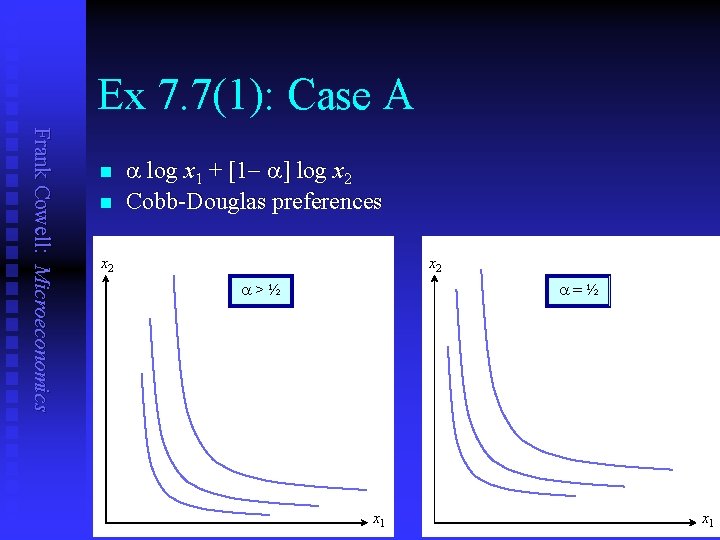
Ex 7. 7(1): Case A Frank Cowell: Microeconomics n n a log x 1 + [1 a] log x 2 Cobb-Douglas preferences x 2 a>½ a=½ x 1
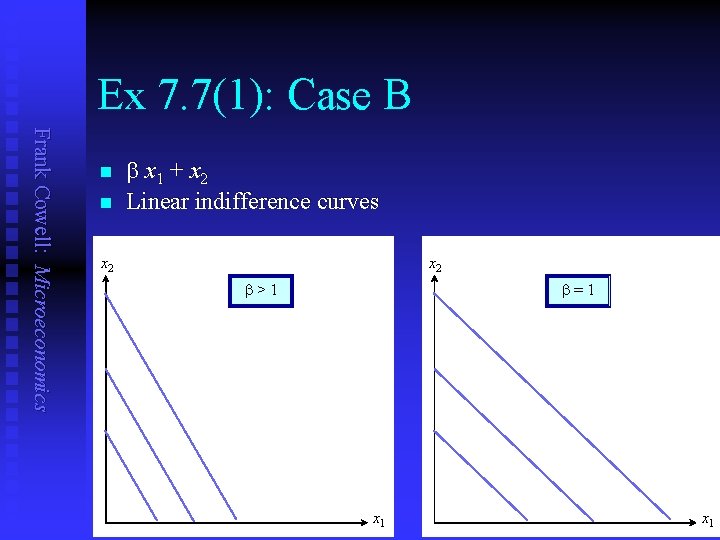
Ex 7. 7(1): Case B Frank Cowell: Microeconomics n n b x 1 + x 2 Linear indifference curves x 2 b>1 b=1 x 1
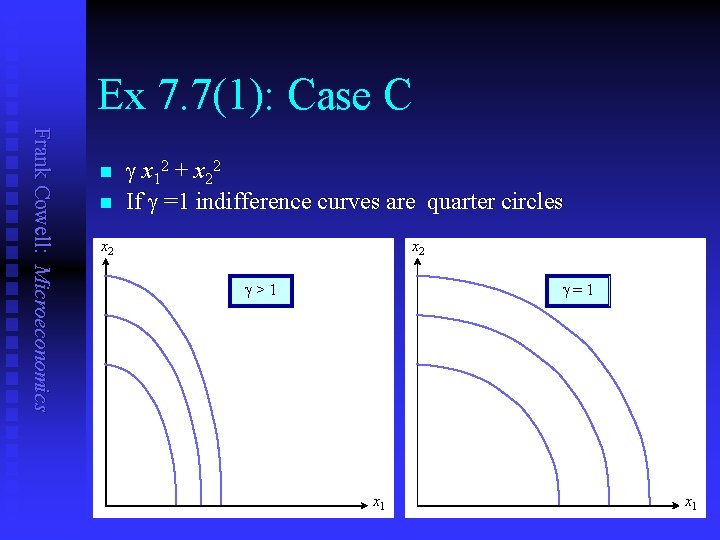
Ex 7. 7(1): Case C Frank Cowell: Microeconomics n n g x 12 + x 22 If g =1 indifference curves are quarter circles x 2 g>1 g=1 x 1
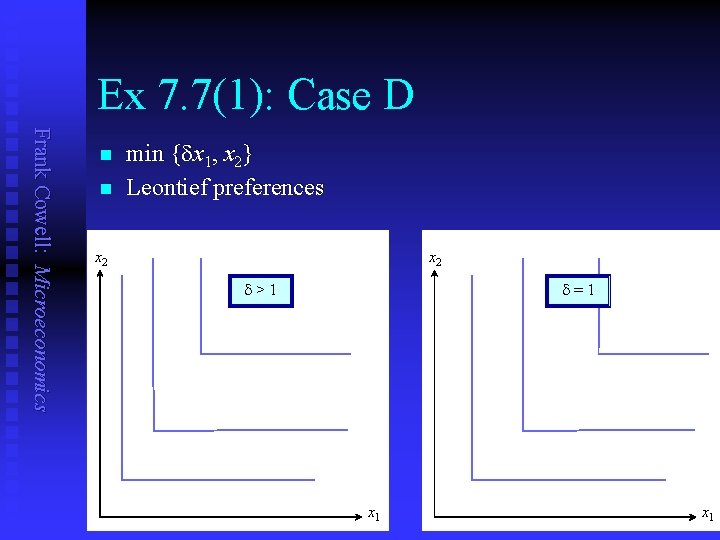
Ex 7. 7(1): Case D Frank Cowell: Microeconomics n n min {dx 1 , x 2 } Leontief preferences x 2 d>1 d=1 x 1
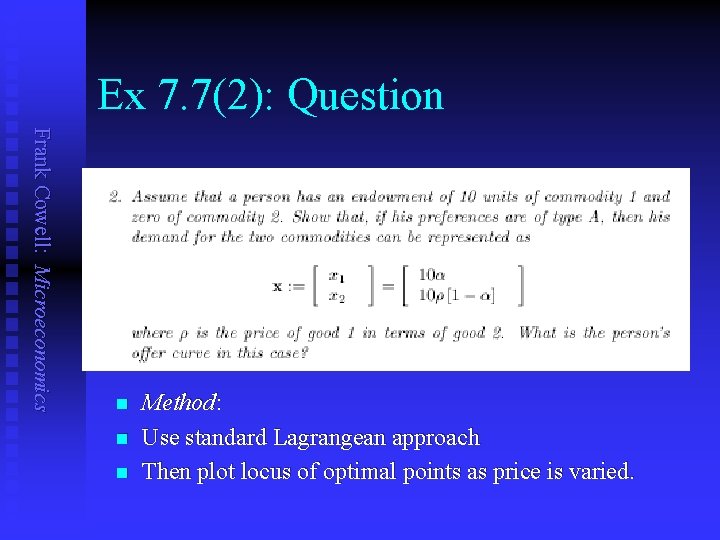
Ex 7. 7(2): Question Frank Cowell: Microeconomics n n n Method: Use standard Lagrangean approach Then plot locus of optimal points as price is varied.
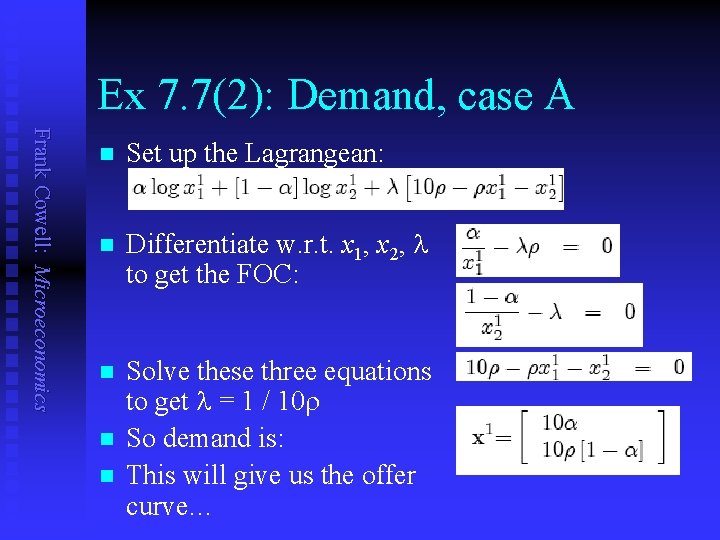
Ex 7. 7(2): Demand, case A Frank Cowell: Microeconomics n Set up the Lagrangean: n Differentiate w. r. t. x 1, x 2, l to get the FOC: n Solve these three equations to get l = 1 / 10 r So demand is: This will give us the offer curve… n n
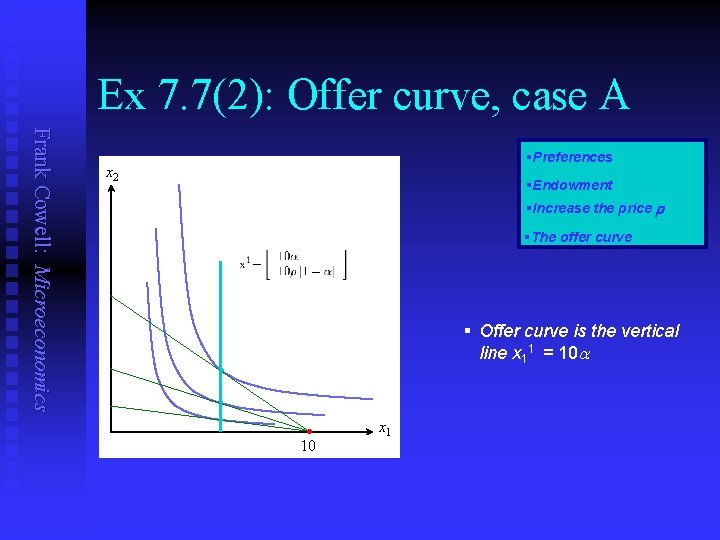
Ex 7. 7(2): Offer curve, case A Frank Cowell: Microeconomics §Preferences x 2 §Endowment §Increase the price r §The offer curve § Offer curve is the vertical line x 11 = 10 a • • 10 x 1
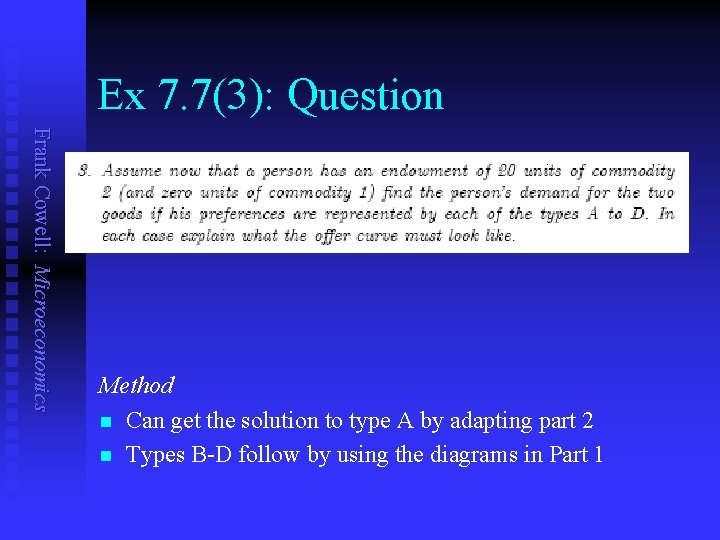
Ex 7. 7(3): Question Frank Cowell: Microeconomics Method n Can get the solution to type A by adapting part 2 n Types B-D follow by using the diagrams in Part 1
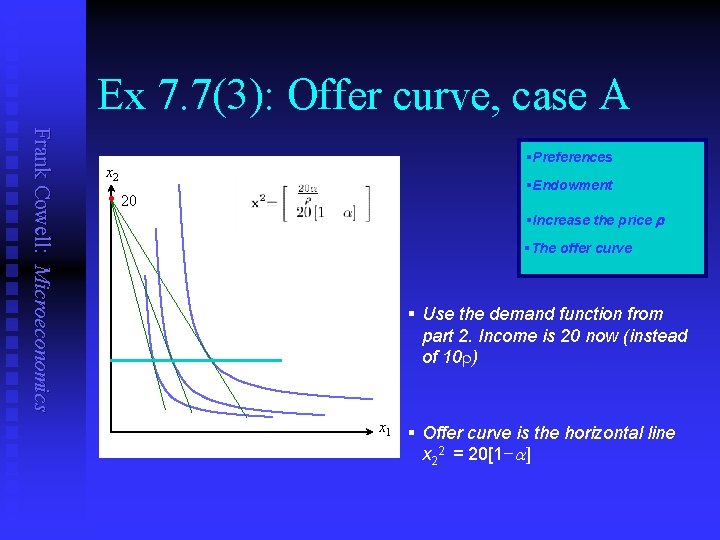
Ex 7. 7(3): Offer curve, case A Frank Cowell: Microeconomics §Preferences x 2 • §Endowment 20 §Increase the price r §The offer curve § Use the demand function from • • part 2. Income is 20 now (instead of 10 r) • x 1 § Offer curve is the horizontal line x 22 = 20[1−a]
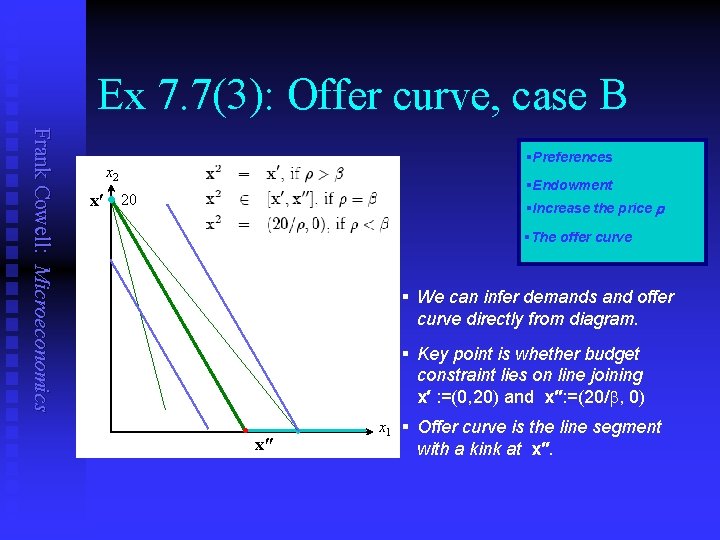
Ex 7. 7(3): Offer curve, case B Frank Cowell: Microeconomics §Preferences x 2 §Endowment x′ • 20 §Increase the price r §The offer curve § We can infer demands and offer curve directly from diagram. § Key point is whether budget constraint lies on line joining x′ : =(0, 20) and x″: =(20/b, 0) • x″ • x 1 § Offer curve is the line segment with a kink at x″.
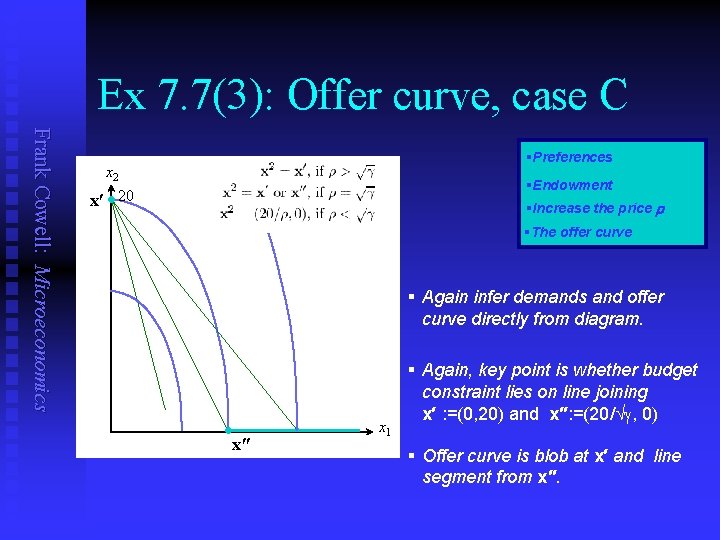
Ex 7. 7(3): Offer curve, case C Frank Cowell: Microeconomics §Preferences x 2 §Endowment x′ • 20 §Increase the price r §The offer curve § Again infer demands and offer curve directly from diagram. § Again, key point is whether budget • x″ • x 1 constraint lies on line joining x′ : =(0, 20) and x″: =(20/ g, 0) § Offer curve is blob at x′ and line segment from x″.
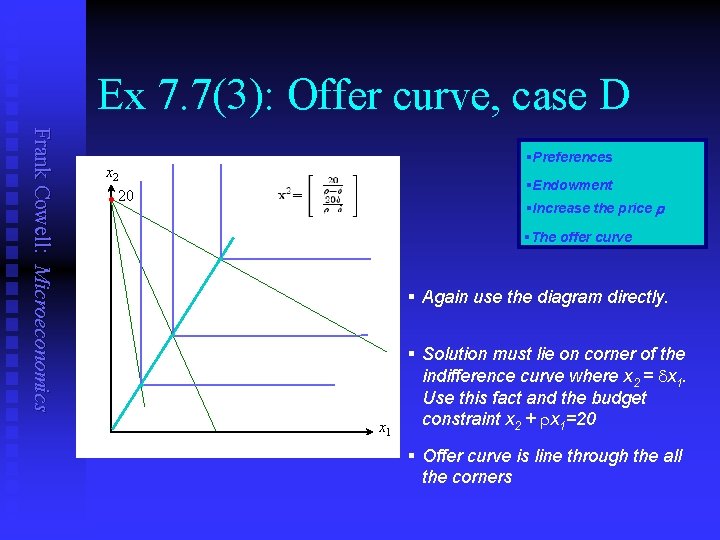
Ex 7. 7(3): Offer curve, case D Frank Cowell: Microeconomics §Preferences x 2 §Endowment • 20 §Increase the price r §The offer curve • § Again use the diagram directly. • § Solution must lie on corner of the • x 1 indifference curve where x 2 = dx 1. Use this fact and the budget constraint x 2 + rx 1=20 § Offer curve is line through the all the corners
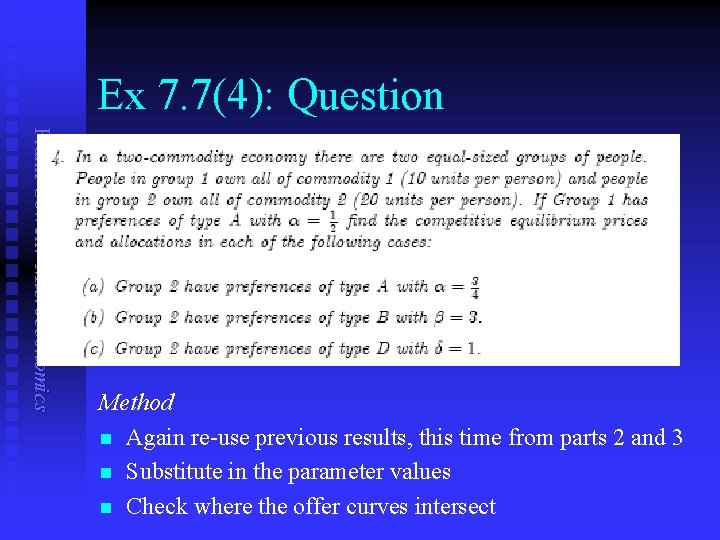
Ex 7. 7(4): Question Frank Cowell: Microeconomics Method n Again re-use previous results, this time from parts 2 and 3 n Substitute in the parameter values n Check where the offer curves intersect
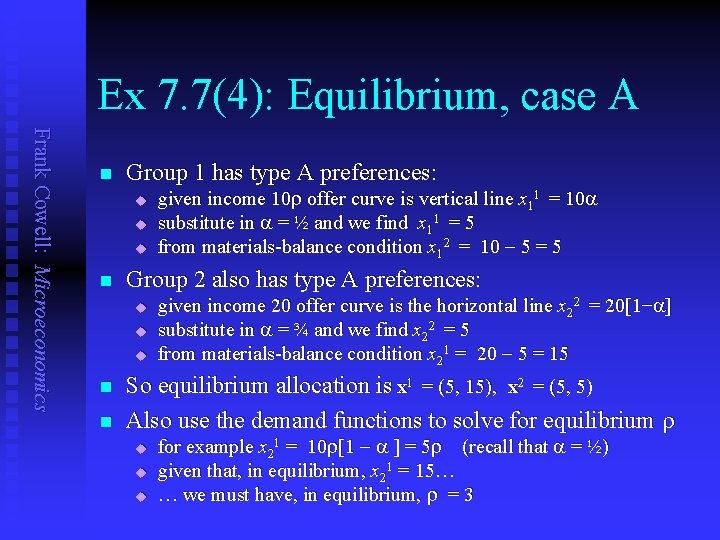
Ex 7. 7(4): Equilibrium, case A Frank Cowell: Microeconomics n Group 1 has type A preferences: u u u n Group 2 also has type A preferences: u u u n n given income 10 r offer curve is vertical line x 11 = 10 a substitute in a = ½ and we find x 11 = 5 from materials-balance condition x 12 = 10 5 = 5 given income 20 offer curve is the horizontal line x 22 = 20[1−a] substitute in a = ¾ and we find x 22 = 5 from materials-balance condition x 21 = 20 5 = 15 So equilibrium allocation is x 1 = (5, 15), x 2 = (5, 5) Also use the demand functions to solve for equilibrium r u u u for example x 21 = 10 r[1 a ] = 5 r (recall that a = ½) given that, in equilibrium, x 21 = 15… … we must have, in equilibrium, r = 3
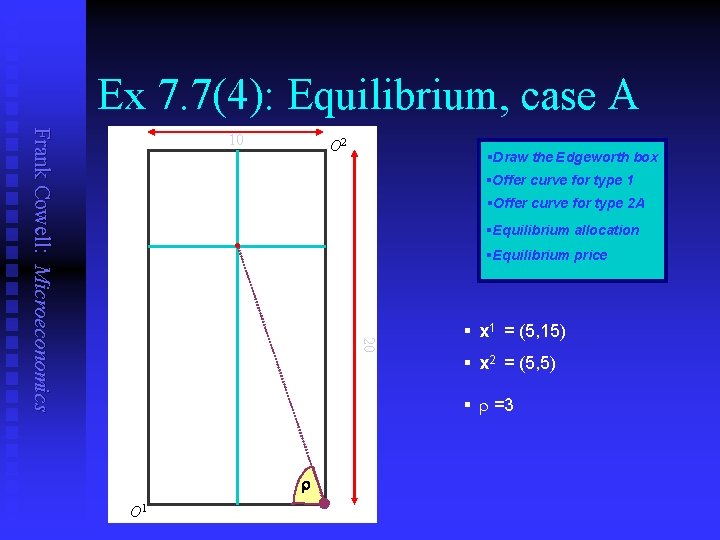
Ex 7. 7(4): Equilibrium, case A Frank Cowell: Microeconomics 10 O 2 §Draw the Edgeworth box §Offer curve for type 1 §Offer curve for type 2 A §Equilibrium allocation • §Equilibrium price 20 § x 1 = (5, 15) § x 2 = (5, 5) § r =3 r O 1
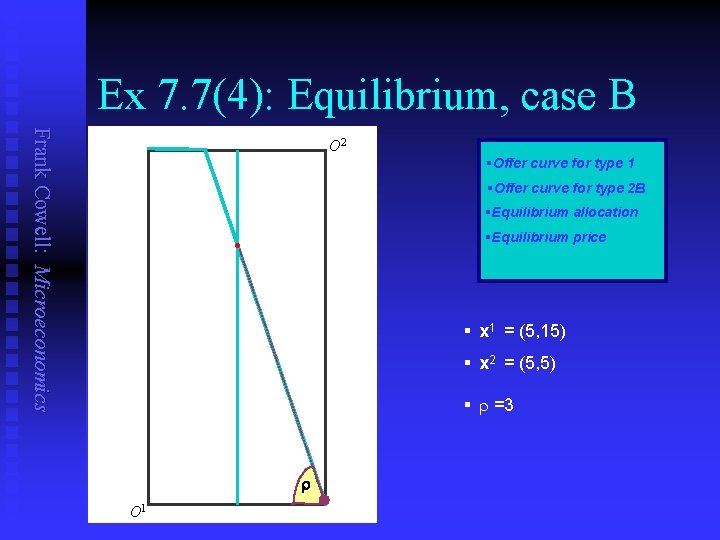
Ex 7. 7(4): Equilibrium, case B Frank Cowell: Microeconomics O 2 §Offer curve for type 1 §Offer curve for type 2 B §Equilibrium allocation §Equilibrium price • § x 1 = (5, 15) § x 2 = (5, 5) § r =3 r O 1
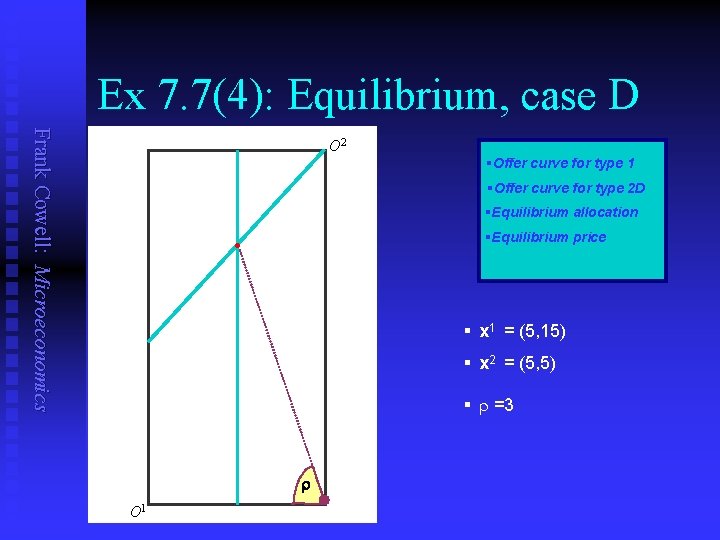
Ex 7. 7(4): Equilibrium, case D Frank Cowell: Microeconomics O 2 §Offer curve for type 1 §Offer curve for type 2 D §Equilibrium allocation §Equilibrium price • § x 1 = (5, 15) § x 2 = (5, 5) § r =3 r O 1
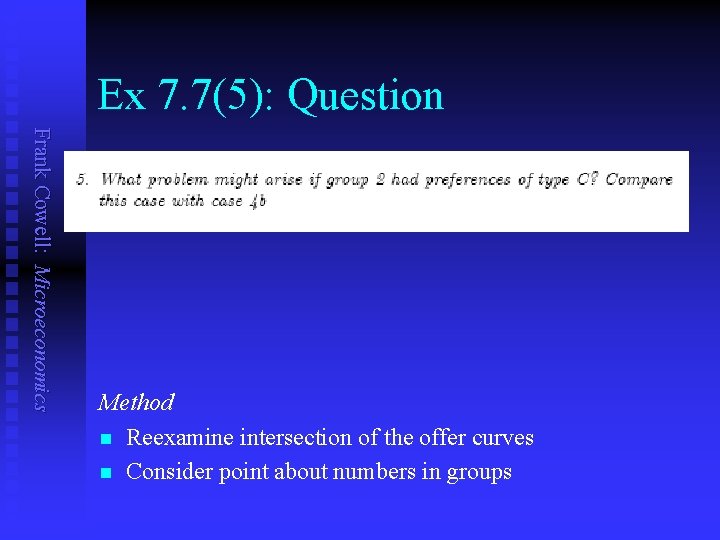
Ex 7. 7(5): Question Frank Cowell: Microeconomics Method n Reexamine intersection of the offer curves n Consider point about numbers in groups
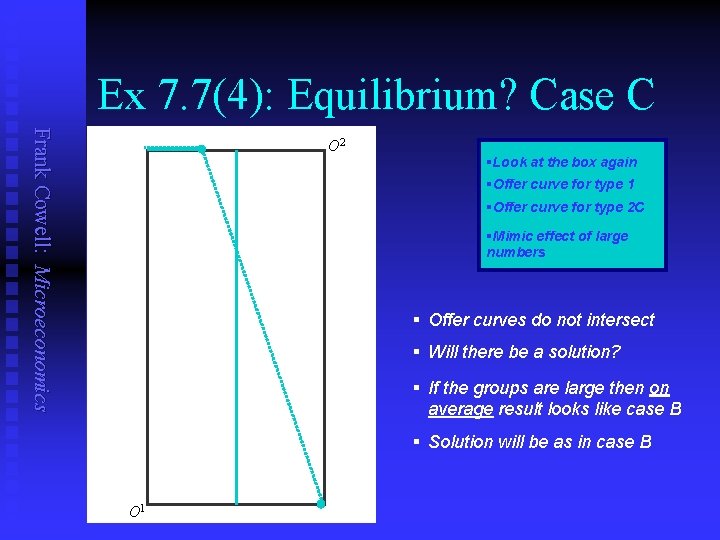
Ex 7. 7(4): Equilibrium? Case C Frank Cowell: Microeconomics O 2 §Look at the box again §Offer curve for type 1 §Offer curve for type 2 C §Mimic effect of large numbers § Offer curves do not intersect § Will there be a solution? § If the groups are large then on average result looks like case B § Solution will be as in case B O 1
Ex 7. 7: Points to remember Frank Cowell: Microeconomics n Use graphics to find the “shape” of the solution u n Reuse the solutions from one part in another u n for example we got the solution to type A in part 3 by adapting part 2 Be careful of discontinuous response functions u n for example types B, C, D in part 2 follow directly from thinking about the indifference curves wording of part 5 allows you to consider a “mixture” solution Don’t do more than is necessary u u part 5 just asked you to discuss the issue you don’t have to produce a numerical solution
- Slides: 22